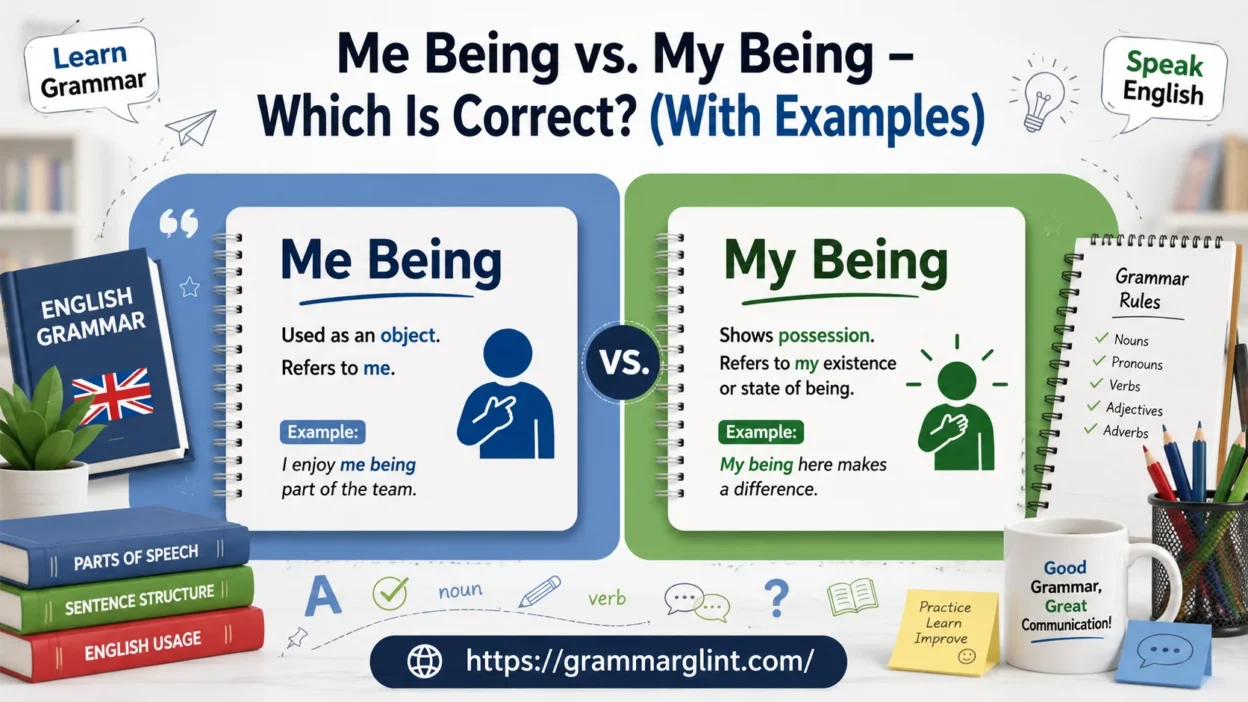
Many people have probably seen Me Being and My Being in English sentences and wondered what the difference is. These two forms may look similar, but they do not always serve the same purpose in grammar.
I have often noticed that learners think they mean the same thing, but each form has a different purpose and meaning. The choice depends on what you are describing and why it is used in the sentence.
My Being is usually correct when it shows something connected to your identity, characteristics, or features that are inherent to an individual. It focuses on something related to a person’s state, nature, or existence.
When Me Being appears, it is commonly about a temporary situation, a momentarily feeling, or an action involving the person. It often describes a condition happening at a specific time.
For example, “Can my car be repossessed without me being warned?” sounds natural to many ears, while others prefer “without my being warned” because my is possessive and being can work like a noun. The explanation can feel confusing because being may also act as a verb. The key is understanding the sentence structure and how the form expresses intent, even with an albeit small distinction between the two forms.
Quick Answer:
Both “me being” and “my being” can be grammatically correct. The right choice depends on the sentence structure.
Here’s a quick comparison:
| Phrase | Meaning | Common Use | Example |
| Me being | Refers to yourself as the person involved in an action or situation | After verbs or prepositions | “They talked about me being late.” |
| My being | Refers to your state, condition, or existence as a thing | As a subject or formal possessive phrase | “My being late caused a problem.” |
Think of it this way:
- Me being = “me” is the person involved.
- My being = “being” is treated like a thing or idea connected to you.
The difference is small but important.
Understanding “Being” in English Grammar
Before choosing between me being and my being, it helps to understand what “being” actually does.
The word being has several jobs in English. It can work as:
- A present participle
- A gerund
- Part of a continuous tense
Each use changes the meaning.
“Being” as a Present Participle
A present participle usually describes an ongoing action or temporary state.
Examples:
- “She is being polite.”
- “He is being difficult.”
- “I am being careful.”
In these examples, being describes behavior happening at that moment.
Compare:
“He is rude.”
This suggests a general personality trait.
“He is being rude.”
This suggests temporary behavior.
The word “being” adds the idea of a current situation.
“Being” as a Gerund
A gerund is when a verb acts like a noun.
For example:
- “Running is healthy.”
- “Reading improves vocabulary.”
- “Being honest builds trust.”
Here, being honest is not an action happening right now. It is an idea or concept.
That same idea appears in:
- “My being honest helped me.”
- “Your being patient made things easier.”
In these sentences, being works like a noun.
When to Use “Me Being”
The phrase “me being” is common in everyday English. It usually appears when you are talking about yourself as the person involved in something.
The word me is an object pronoun. It receives the action or follows a preposition.
“Me Being” After Prepositions
One of the most common uses of me being comes after prepositions.
Examples:
- “She apologized for me being upset.”
- “They laughed at me being nervous.”
- “Nobody cared about me being late.”
Words like:
- about
- for
- at
- without
- after
- before
often introduce phrases where me being sounds natural.
Example Breakdown:
“They complained about me being noisy.”
The sentence structure:
- They complained → main action
- about → preposition
- me being noisy → the thing they complained about
Here, “me” is not performing the main action. It is the object of the preposition.
Why “Me Being” Sounds Natural in Conversations
English speakers often prefer natural flow over strict formal structures in everyday speech.
That is why you commonly hear:
- “Sorry for me being late.”
- “Thanks for helping me.”
- “I hate me being ignored.”
These sentences sound conversational.
However, formal writing may prefer a different structure.
For example:
Casual:
“Sorry for me being late.”
More formal:
“Sorry for my being late.”
Even though both can work, they create slightly different tones.
Read More: “Will Not Be” or “Will Be Not”: Which Is Correct?
When to Use “My Being”
The phrase “my being” appears when “being” functions like a noun.
The word my is a possessive adjective. It shows that the “being” belongs to you.
Examples:
- “My being honest helped me.”
- “My being there changed everything.”
- “My being late created confusion.”
Here, the phrase is not simply describing you. It describes a condition, action, or state connected to you.
“My Being” as the Subject of a Sentence
The easiest way to identify my being is to check whether it starts the sentence.
Example:
“My being tired affected my performance.”
Ask:
What affected my performance?
Answer:
“My being tired.”
The phrase acts as the subject.
That is why my works better.
Another example:
“My being prepared helped me succeed.”
The preparation itself caused the result.
“My Being” vs. Simple Nouns
Sometimes “my being” sounds overly formal because English has simpler alternatives.
For example:
Formal:
“My being absent caused delays.”
Simpler:
“My absence caused delays.”
Formal:
“My being nervous affected my speech.”
Simpler:
“My nervousness affected my speech.”
A good writer knows when to use the longer structure and when to simplify.
Me Being vs. My Being: Side-by-Side Examples
| Sentence | Correct? | Explanation |
| “They talked about me being late.” | ✅ | “Me” follows a preposition |
| “My being late caused trouble.” | ✅ | The phrase is the subject |
| “She noticed me being quiet.” | ✅ | “Me” is the person observed |
| “My being quiet worried them.” | ✅ | Quietness is the cause |
| “They complained about my being late.” | ✅ | Formal possessive structure |
| “Me being late caused trouble.” | ⚠️ | Common in speech but less formal |
The Simple Subject vs. Object Test
When you feel confused, ask one question:
Is the phrase doing something, or is something happening to it?
If the phrase is doing the action:
Use my being.
Example:
“My being honest helped me.”
“My being honest” caused the result.
If the phrase is receiving attention or follows another word:
Use me being.
Example:
“They noticed me being honest.”
They noticed me.
Common Mistakes With Me Being and My Being
Small grammar choices can change how natural your sentence sounds.
Mistake: Using “Me Being” as a Formal Subject
Incorrect:
“Me being tired affected my work.”
Better:
“My being tired affected my work.”
Why?
Because the phrase is the subject.
Mistake: Using “My Being” Everywhere
Some people think “my being” always sounds more correct.
That is not true.
Example:
Formal but awkward:
“She laughed at my being silly.”
Natural:
“She laughed at me being silly.”
Both can make sense, but the second one sounds more like everyday English.
Mistake: Confusing Being With Been
These words look similar but work differently.
Being
Used for current actions or states:
- “I am being careful.”
Been
Used with perfect tenses:
- “I have been careful.”
Incorrect:
- “I have being careful.”
Correct:
- “I have been careful.”
Real-Life Examples
Grammar becomes easier when you see how people actually use these phrases in daily communication. The difference between “me being” and “my being” often depends on the situation and the level of formality.
Let’s look at practical examples.
Everyday Conversation Examples
In casual conversations, people often use “me being” because it sounds natural and relaxed.
Examples:
- “Sorry about me being so quiet today.”
- “They joked about me being nervous.”
- “Thanks for understanding me being late.”
- “I don’t like me being treated that way.”
These sentences focus on the person involved in the situation.
Now compare them with “my being”:
- “My being quiet made everyone concerned.”
- “My being late caused the meeting to start late.”
- “My being nervous affected my presentation.”
The second group focuses on the condition itself.
Workplace Examples
Professional communication often requires more precise grammar. The choice between these phrases can change the tone.
Example 1:
Casual:
“My manager noticed me being distracted.”
This means the manager noticed you in a distracted state.
Formal:
“My being distracted affected my performance.”
This means your distraction created an effect.
Example 2:
Casual:
“They were concerned about me being unavailable.”
Formal:
“My being unavailable created a problem.”
Both are correct. The difference comes from the sentence role.
Academic Writing Examples
In essays, reports, and formal writing, “my being” appears more often because writers usually describe causes and conditions.
Examples:
- “My being aware of the issue helped me respond quickly.”
- “My being involved in the project improved my communication skills.”
- “My being prepared allowed me to complete the task successfully.”
However, formal writing does not mean every sentence needs “my being.”
Sometimes a simpler noun works better:
Instead of:
“My being aware of the problem helped.”
Write:
“My awareness of the problem helped.”
Clear writing usually beats complicated writing.
Is “My Being” Too Formal?
The phrase “my being” can sound formal because people often use it in academic or professional contexts.
However, it is not outdated or incorrect.
It works well when you want to emphasize a condition or state.
Examples:
- “My being honest saved the relationship.”
- “My being there gave her confidence.”
- “My being prepared made the difference.”
Still, everyday English often chooses shorter options.
Compare:
| Formal Style | Natural Alternative |
| My being tired affected me | My tiredness affected me |
| My being late caused issues | My lateness caused issues |
| My being nervous was obvious | My nervousness was obvious |
The best choice depends on your audience.
Better Alternatives to Avoid Confusion
Sometimes the easiest solution is to rewrite the sentence.
A sentence can be grammatically correct but still feel heavy.
Instead of:
“My being unable to attend disappointed them.”
Try:
“My inability to attend disappointed them.”
Instead of:
“My being honest helped me.”
Try:
“My honesty helped me.”
Instead of:
“Me being upset was obvious.”
Try:
“It was obvious that I was upset.”
These alternatives often sound smoother.
How Native Speakers Think About “Me Being” and “My Being”
Native speakers usually do not stop and analyze grammar rules while speaking. They naturally choose what sounds right.
A useful pattern:
Me being often appears in conversations.
Examples:
- “They teased me for being nervous.”
- “She apologized for me being confused.”
- “He noticed me being quiet.”
My being appears more when the phrase acts like a concept.
Examples:
- “My being late caused problems.”
- “My being honest mattered.”
- “My being present helped.”
The difference is subtle, but the pattern becomes clear with practice.
Quick Memory Trick for Choosing Correctly
Use this simple test:
Ask: Can I replace it with “my action” or “my condition”?
If yes, choose my being.
Example:
“My being late caused trouble.”
Replace:
“My lateness caused trouble.”
It works.
So my being fits.
Now try:
“They complained about me being late.”
Replace:
“They complained about my lateness.”
It changes the structure.
The original sentence focuses on the person, so me being works naturally.
Me Being vs. My Being: Quick Reference Table
| Situation | Use | Example |
| After a preposition | Me being | “They talked about me being absent.” |
| A person is observed | Me being | “She saw me being careful.” |
| Phrase is the subject | My being | “My being careful prevented mistakes.” |
| Describing a cause | My being | “My being late caused confusion.” |
| Formal writing | Usually my being | “My being prepared helped.” |
| Casual speech | Usually me being | “Sorry for me being late.” |
FAQs
1. What is the difference between Me Being and My Being?
Me Being is often used for temporary actions or feelings, while My Being refers to identity, traits, or inherent qualities.
2. Which one is grammatically correct?
Both can be correct, depending on the sentence structure and meaning.
3. When should I use My Being?
Use My Being when talking about personal characteristics, features, or something connected to identity.
4. When should I use Me Being?
Use Me Being when describing a temporary situation, action, or momentary condition.
5. Why do people get confused between them?
Because both forms look similar and being can act as both a noun and a verb, creating confusion in usage.
6. Is “without me being warned” correct?
Yes, it is commonly used in spoken English and sounds natural in everyday communication.
7. Is “without my being warned” more formal?
Yes, it is considered more grammatically structured and formal due to the possessive form my.
8. Does My Being always refer to identity?
Mostly yes, it is used to describe deeper or inherent aspects of a person’s existence.
9. Can Me Being and My Being be interchangeable?
Not always. They depend on context, meaning, and how the sentence is formed.
10. What is the key to using them correctly?
Understanding the sentence structure, intent, and whether the phrase is temporary or identity-based.
Conclusion
Understanding Me Being vs. My Being depends on grammar context and meaning rather than a single fixed rule. Me Being usually focuses on temporary actions or situations, while My Being highlights identity, traits, and inherent qualities. Choosing the correct form requires attention to the sentence structure, intent, and whether you are describing a moment or a deeper personal state.

Shafiq Ur Rehman is an English language educator, editor, and grammar writer with over 10 years of teaching experience in English and Mathematics across various educational institutions. As an editor at Grammar Glint, he creates clear, accurate, and easy-to-understand content on English grammar, spelling, punctuation, word meanings, idioms, and common usage questions.
Drawing on years of classroom experience, Shafiq focuses on explaining grammar rules in simple language with practical examples that help students, teachers, writers, and English learners build confidence in their communication. His goal is to publish trustworthy, well-researched, and reader-friendly content that makes learning English easier for everyone.