Prepositions sometimes confuse writers and learners when choosing between Contact Us On or Contact Us At, because the usage can feel unclear in real communication. People often pause and think about what is right, what is wrong, and how they can properly find out the correct form in different writing situations, especially in emails, websites, and business contact sections.
In real English, both Contact Us On and Contact Us At are commonly used phrases, and they show how small changes in us, on, at can shift the feel of a sentence without changing its core meaning. This variation is very common in digital communication, where writers use different styles of contact medium expressions depending on tone, platform, and audience expectations.
Because of this flexibility, many people simply choose the form they are used to, rather than following strict grammatical rules, which explains why both Contact Us On and Contact Us At remain widely used across websites and professional communication. Over time, usage patterns and personal writing habits shape preference more than fixed rules, making both expressions equally common in real-world English.
“Contact Us At” Meaning and Correct Usage
The phrase “contact us at” points someone toward a specific place or destination where communication can happen.
Think of the word “at” as pointing to a fixed spot. It tells the reader exactly where to go or what address to use.
For example:
- Contact us at support@company.com.
- Contact us at our main office.
- Contact us at 555-123-4567.
In each example, the phrase introduces a specific contact destination.
Using “Contact Us At” With Email Addresses
One of the most common uses of “contact us at” is with email addresses.
Example:
Contact us at hello@example.com and our team will respond within 24 hours.
This works because an email address acts like a digital location. It gives the reader a specific place to send their message.
Common examples include:
- Contact us at sales@business.com.
- Contact our support team at help@website.com.
- Reach us at info@brand.com.
Using “on” with email usually sounds unnatural:
❌ Contact us on support@example.com.
✅ Contact us at support@example.com.
Using “Contact Us At” With Phone Numbers
Phone numbers can be slightly confusing because English speakers use different prepositions depending on their region.
In American English, “contact us at” is very common.
Examples:
- Contact us at (800) 555-1234.
- Call us at the number below.
- Contact our office at 555-987-6543.
This usage treats the phone number as a contact point.
However, British English often uses “contact us on” with phone numbers.
Example:
- Contact us on 020 7946 0000.
Both versions are understood, but your audience matters.
| Region | Common Phrase | Example |
| American English | Contact us at | Contact us at 555-1234 |
| British English | Contact us on | Contact us on 020 1234 5678 |
Using “Contact Us At” For Locations
The phrase also works when referring to a physical place.
Examples:
- Contact us at our New York office.
- Contact us at the customer service desk.
- Contact us at our headquarters.
Here, “at” works because it identifies a specific location.
You can think of it like saying:
- Meet me at the restaurant.
- Stop by at the office.
- Contact us at this address.
The idea stays the same: a specific point.
“Contact Us On” Meaning and Correct Usage
The phrase “contact us on” is often used when referring to a platform, application, or communication service.
The word “on” usually connects with something you use or access.
Examples:
- Contact us on Facebook.
- Contact us on WhatsApp.
- Contact us on LinkedIn.
Here, the phrase refers to the platform where communication takes place.
Using “Contact Us On” With Social Media
Social media platforms are the most common situation where “contact us on” feels natural.
Examples:
- Contact us on Instagram for updates.
- Contact our team on Facebook.
- Message us on LinkedIn.
Why does “on” work here?
Because social media platforms function like digital spaces. You don’t contact someone “inside” Facebook. You contact them on Facebook.
Similar examples include:
- Follow us on Twitter.
- Find us on YouTube.
- Connect with us on LinkedIn.
The same pattern appears across online communication.
Using “Contact Us On” With Messaging Apps
Messaging platforms also commonly use “on.”
Examples:
- Contact us on WhatsApp.
- Reach us on Telegram.
- Message our team on Messenger.
These apps act as communication channels. The platform carries the conversation.
A company contact page might look like this:
Customer Support
- Email: Contact us at support@example.com
- WhatsApp: Contact us on WhatsApp
- Facebook: Contact us on Facebook
This creates clear and consistent communication.
Read More: Generic vs. General: Difference Explained with Examples
Main Difference Explained
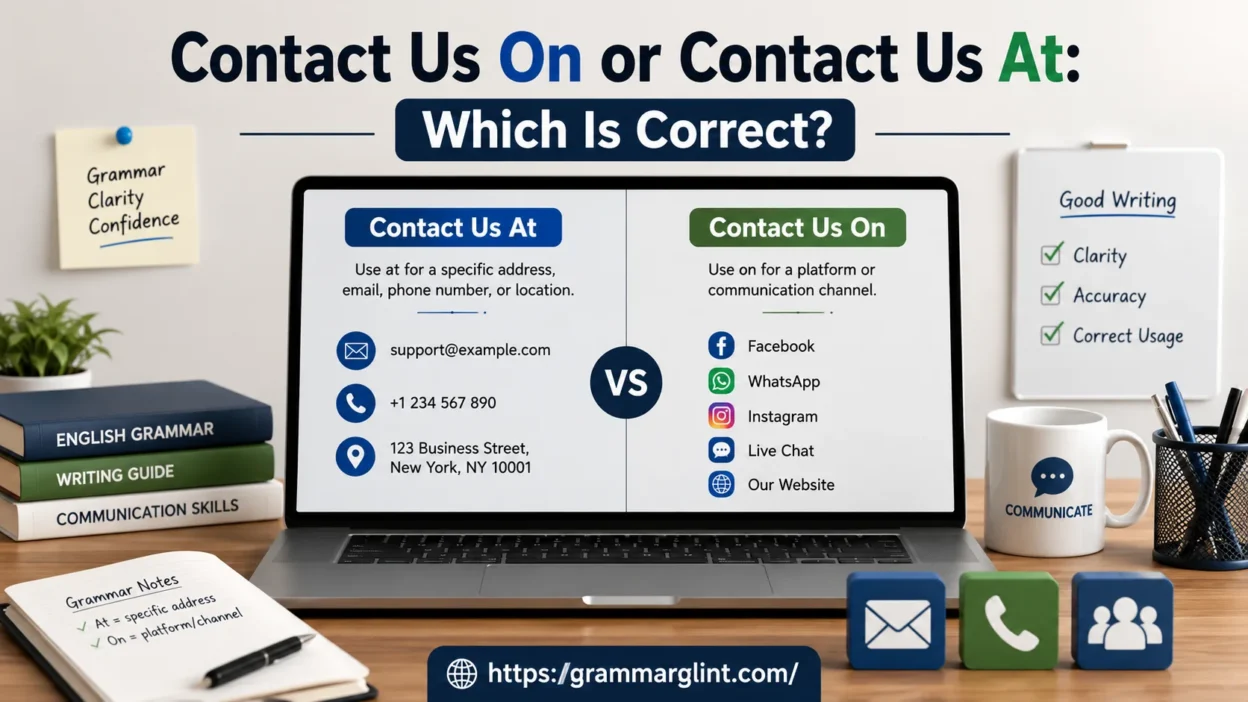
The easiest way to remember the difference is this:
At = a specific destination
On = a communication platform
Here is a quick comparison:
| Phrase | Used For | Example |
| Contact us at | Email address | Contact us at info@example.com |
| Contact us at | Phone number (US style) | Contact us at 555-555-5555 |
| Contact us at | Physical location | Contact us at our office |
| Contact us on | Social media | Contact us on Instagram |
| Contact us on | Messaging apps | Contact us on WhatsApp |
| Contact us on | Platforms | Contact us on LinkedIn |
The mistake happens because both words relate to communication. However, they focus on different parts of the process.
“Contact us at” focuses on where to reach someone.
“Contact us on” focuses on the tool or service used to communicate.
Why People Confuse
The confusion exists because modern communication has changed.
Years ago, contacting a company usually meant:
- Calling a phone number.
- Sending a letter.
- Visiting an office.
The language was simple.
You contacted someone at an address or at a phone number.
Today, communication happens everywhere:
- Social media.
- Chat apps.
- Websites.
- Online communities.
- Video platforms.
Now people say:
- Contact us on Instagram.
- Contact us on WhatsApp.
- Contact us on Discord.
The growth of digital platforms expanded how we use prepositions.
Language evolves with technology.
American English vs British English Differences
English changes depending on location. The phrase that sounds natural in one country may sound slightly unusual somewhere else.
This is especially true with phone numbers.
American English Preference
American English commonly uses:
- Contact us at this number.
- Reach us at 555-1234.
- Call us at our office line.
Examples:
For questions, contact us at (212) 555-1000.
This sounds normal to most American readers.
British English Preference
British English often uses:
- Contact us on this number.
- Call us on 020 1234 5678.
Example:
Contact our support team on the number provided below.
This sounds natural in the UK.
Neither version creates confusion. The important thing is consistency.
If you’re writing for an international audience, clearer alternatives include:
- Call us at the number below.
- Contact our team using the details below.
- Reach us through the following channels.
These avoid regional differences.
Common Mistakes
Even though these phrases seem simple, many writers mix them up. The mistakes usually happen because people focus on the word “contact” instead of the type of information that comes after it.
A small preposition change can make your writing sound more natural and professional.
Mistake: Using “Contact Us On” With Email Addresses
One of the most common errors is writing:
❌ Contact us on our email: support@example.com.
The better options are:
✅ Contact us at support@example.com.
or
✅ Contact us by email at support@example.com.
An email address works like a destination. Someone sends a message to a specific address, which is why “at” fits better.
Think of it like a mailbox. You don’t send a letter “on” a mailbox. You send it to a specific place.
The same idea applies digitally.
Mistake: Using “Contact Us At” With Social Media Platforms
Another common mistake appears on websites and advertisements.
Example:
❌ Contact us at Facebook.
This sounds unnatural because Facebook is not the destination. It is the platform where the conversation happens.
Better:
✅ Contact us on Facebook.
Other examples:
❌ Contact us at Instagram.
✅ Contact us on Instagram.
❌ Contact us at LinkedIn.
✅ Contact us on LinkedIn.
The platform carries the interaction, so “on” works naturally.
Mistake: Mixing Different Contact Channels
Some businesses write contact instructions like this:
Contact us on email and at Facebook.
This creates inconsistency.
A cleaner version:
Contact us by email or on Facebook.
or:
Contact us at our email address or message us on Facebook.
The goal is simple: make every communication option easy to understand.
How Businesses Should Use
A professional contact page should make communication effortless.
Visitors should not have to guess where to click or what method to use.
A good contact section separates different communication channels.
Example:
Customer Support
Email
Contact us at support@company.com.
Phone
Contact us at (555) 123-4567.
Social Media
Contact us on Facebook or Instagram.
This structure works because every phrase matches the information type.
Examples for Websites, Emails, and Marketing Materials
The correct phrase depends on where you use it.
Website Contact Page Example
A company website might say:
Have questions? Contact us at hello@business.com or reach us on Instagram for quick updates.
This sentence uses both phrases correctly.
Why?
- Email address → “at”
- Instagram → “on”
Email Signature Example
Incorrect:
Contact me on john@email.com.
Correct:
Contact me at john@email.com.
A professional email signature might look like:
John Smith
Customer Support Manager
Email: john@example.com
Phone: (555) 111-2222
LinkedIn: linkedin.com/company/example
Social Media Bio Example
For a social profile, “on” works well.
Example:
Need help? Contact us on WhatsApp or visit our website.
The platform is the communication method.
Better Alternatives
Sometimes repeating “contact us” makes writing feel robotic.
You can use different phrases depending on the situation.
Professional Alternatives
Instead of:
Contact us at…
Try:
- Reach us at…
- Get in touch at…
- Send your questions to…
- Connect with our team through…
Examples:
Reach us at support@example.com.
Get in touch through our customer service portal.
Casual Alternatives
For friendly communication:
- Message us on…
- Find us on…
- Chat with us on…
- Send us a note at…
Examples:
Message us on WhatsApp.
Find us on Facebook.
Why Choosing the Right Phrase Improves Writing
Grammar is not only about rules. It is also about clarity.
Readers process information quickly. If a phrase sounds unusual, they pause.
That small pause can affect trust.
Imagine two customer service messages:
Version One:
Contact us on our email address and at Facebook.
The reader understands it, but it feels awkward.
Version Two:
Contact us by email or on Facebook.
This feels smoother.
Good writing removes friction.
A strong contact message should feel like a clear road sign. It should point people in the right direction without making them stop and think.
Quick Rule to Remember: “At” vs “On”
A simple memory trick can help:
Use “At” When You Can Point to It
Examples:
- Email address
- Phone number
- Office
- Location
Think:
“Where exactly?”
Examples:
- Contact us at this address.
- Contact us at this number.
- Contact us at our office.
Use “On” When You Can Open It
Examples:
- Online platforms
Think:
“Which platform?”
Examples:
- Contact us on Instagram.
- Contact us on WhatsApp.
- Contact us on LinkedIn.
Final Comparison Table
| Contact Information | Best Phrase | Example |
| Email address | Contact us at | Contact us at hello@example.com |
| Office address | Contact us at | Contact us at our New York office |
| US phone number | Contact us at | Contact us at 555-123-4567 |
| UK phone number | Contact us on | Contact us on 020 1234 5678 |
| Contact us on | Contact us on Facebook | |
| Contact us on | Contact us on Instagram | |
| Contact us on | Contact us on WhatsApp |
FAQs
1. Is “Contact Us On” correct in English?
Yes, “Contact Us On” is correct and used in real English, especially in informal and digital communication contexts.
2. Is “Contact Us At” also correct?
Yes, “Contact Us At” is also correct and widely used in formal and professional writing.
3. What is the main difference between “on” and “at” here?
There is a slight style difference, but both are mostly interchangeable in modern usage.
4. Which one is more commonly used?
Both are common, but “Contact Us At” is often preferred in formal contexts like websites and business pages.
5. Can I use both in the same website?
Yes, but it is better to stay consistent and use one style throughout for clarity.
6. Does meaning change between the two?
No, there is little to no difference in meaning between the two expressions.
7. Is one grammatically wrong?
No, neither is grammatically wrong; both are accepted in English usage.
8. Which is better for email contact?
“Contact Us At” is usually preferred for email addresses and direct contact details.
9. Why do people use both forms?
Because usage depends on personal preference and context, not strict grammar rules.
10. Should I worry about choosing the wrong one?
Not really, as both are widely understood and function similarly in communication.
Conclusion
Choosing between Contact Us On and Contact Us At becomes much easier once you understand what each preposition points to. On usually refers to a platform or communication channel, such as social media or messaging apps, while at introduces a specific contact point like an email address, phone number, or office location. Although both expressions are common, they are not always interchangeable.
When you match the preposition to the correct context, your writing sounds more natural, professional, and grammatically accurate. Whether you’re creating a business website, writing customer support content, or sending a formal message, using the right form helps readers understand your meaning immediately. If you remember the simple distinction between platform and specific destination, you’ll choose the correct expression with confidence every time.

Aria Jane is a senior language writer and grammar specialist at Grammar Glint. She focuses on English grammar, spelling variations, vocabulary, and writing clarity. Through detailed research and practical examples, Aria helps readers understand language rules and avoid common mistakes. Her articles are designed to make English learning accessible for students, professionals, and everyday writers seeking reliable language guidance.