Have you ever wondered whether you should write means of, means for, or means to? These three expressions look very similar, which is why many English learners assume they are completely interchangeable. While all three are grammatically correct in many situations, each one places the emphasis on a slightly different relationship between a method, a purpose, and a goal.
As an English teacher, I have noticed that students often memorize these phrases without understanding why different prepositions are used. As a result, they may choose one expression simply because it sounds familiar rather than because it best fits the sentence.
Learning the role of each preposition makes it much easier to write naturally and confidently.
In this guide, you’ll learn the differences between means of, means for, and means to, when each expression is most appropriate, common mistakes to avoid, and practical examples that will help you choose the right phrase in academic, professional, and everyday English.
Quick Answer
All three expressions means of, means for, and means to are grammatically correct, but they are not always the best choice in the same sentence. The right preposition depends on what you want to emphasize: the method being used, the purpose it serves, or the result you hope to achieve.
Understanding this subtle difference will help your writing sound more precise, natural, and professional.
What Does “Means” Mean in English?
Before comparing means of vs means for vs means to, it helps to understand the word means itself.
The word means has several meanings depending on the context.
Most commonly, it means:
- A method or way to do something
- Resources or ability to achieve something
For example:
- “A bicycle is a means of transportation.”
- “She has the means to buy a new laptop.”
In the first sentence, means refers to a method. A bicycle helps someone travel.
In the second sentence, means refers to resources. The person has enough money or ability to purchase the laptop.
The meaning changes based on the words around it. That is why the small words after means matter so much.
Why Do “Of,” “For,” and “To” Change the Meaning?
Prepositions often look small, but they create important relationships between words.
Think of them as directional signs:
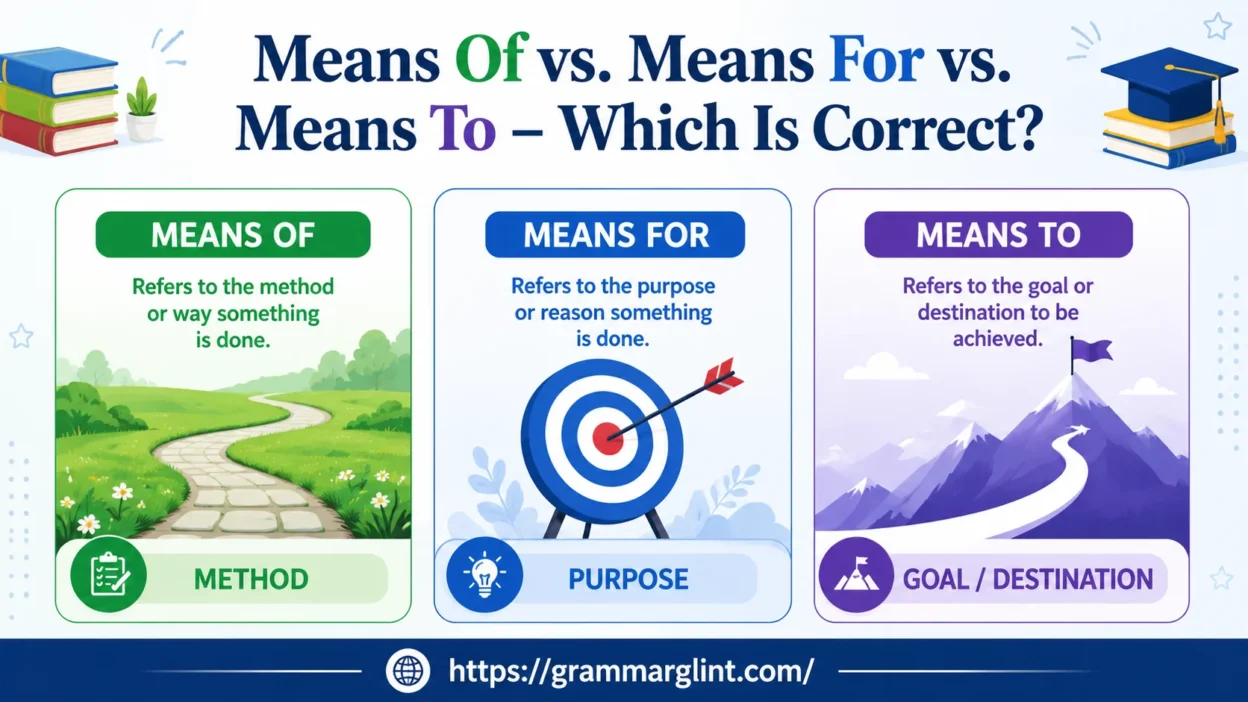
- Of points toward the method or source.
- For points toward the purpose.
- To points toward the destination or goal.
Compare these:
| Phrase | Main Question It Answers | Meaning |
| Means of | How? | The method used |
| Means for | Why? What purpose? | The intended use |
| Means to | What goal? What action? | The way to achieve something |
A simple example:
- A phone is a means of communication.
- A phone is a means for staying connected.
- A phone is a means to contact someone.
All three sentences are correct, but each one focuses on something different.
“Means Of” Meaning, Uses, and Examples
The phrase means of is the most common expression among the three.
It describes a method, system, tool, or process used to achieve something.
The focus is on the way something happens.
Common Structure
Means of + noun
or
Means of + verb ending in -ing
Examples:
- “The internet is a means of communication.”
- “Writing is a means of sharing ideas.”
- “Public transportation is a means of travel.”
In each example, the phrase explains the method.
The internet provides a method of communication. Writing provides a method of sharing thoughts. Transportation provides a method of moving from one place to another.
When Should You Use “Means Of”?
Use means of when you talk about:
- A tool
- A system
- A process
- A technique
- A method
Examples in Daily Life
Technology
Smartphones have become a means of communication.
This means smartphones are a method people use to communicate.
Education
Reading is a means of gaining knowledge.
Reading is the process through which people learn.
Business
Advertising is a means of attracting customers.
Advertising is the method businesses use to reach buyers.
Common Expressions With “Means Of”
English speakers often use means of in fixed phrases.
Some common examples include:
| Expression | Meaning | Example |
| Means of communication | Method of sharing information | Email is a means of communication |
| Means of transport | Method of traveling | Cars are a means of transport |
| Means of payment | Method used to pay | Credit cards are a means of payment |
| Means of production | Resources used to create goods | Factories are means of production |
| Means of control | Method used to manage something | Rules are a means of control |
These expressions appear frequently in academic, business, and everyday writing.
Common Mistakes With “Means Of”
A frequent mistake happens when people put a verb after means of incorrectly.
Incorrect:
This is a means of solve the problem.
The structure is wrong because of needs a noun or an -ing form.
Correct:
This is a means of solving the problem.
Another example:
❌ “Exercise is a means of become healthier.”
✅ “Exercise is a means of becoming healthier.”
A quick trick:
If you use means of, think:
means of + thing/activity
Not:
means of + base verb
Means For – Meaning, Uses, and Examples
The phrase means for focuses on purpose.
Instead of asking:
“How does something work?”
it asks:
“What is something used for?”
The phrase explains the intended function.
Common Structure
Means for + noun
or
Means for + verb ending in -ing
Examples:
- “This device is a means for improving safety.”
- “Education is a means for personal growth.”
- “The meeting became a means for solving conflicts.”
The focus is the purpose behind the action.
When Should You Use “Means For”?
Use means for when discussing:
- Intended use
- Purpose
- Function
- A reason something exists
For example:
A calculator is a means for making calculations easier.
The sentence focuses on the purpose of the calculator.
Means Of vs Means For: The Difference
These two phrases are close, which causes confusion.
The easiest way to separate them is this:
Means of = the method
Means for = the purpose
Look at this comparison:
| Sentence | Meaning |
| A computer is a means of communication. | A computer is the method used to communicate. |
| A computer is a means for communication. | A computer serves the purpose of communication. |
The difference is subtle, but it changes the focus.
Another example:
Means Of
A hammer is a means of building.
The hammer is a tool used in the process.
Means For
A hammer is a means for construction.
The hammer exists for the purpose of construction.
Means To – Meaning, Uses, and Examples
The phrase means to usually connects a method with a goal.
It explains how someone achieves a result.
The phrase often appears before a verb.
Common Structure:
Means to + verb
Examples:
- “Education is a means to create opportunities.”
- “Practice is a means to improve skills.”
- “Planning is a means to avoid mistakes.”
The phrase answers:
What does this help you achieve?
Examples of “Means To” in Context
Career
Training is a means to develop professional skills.
Training helps someone reach the goal of improving their abilities.
Health
Exercise is a means to maintain fitness.
Exercise helps achieve better health.
Business
Marketing is a means to increase sales.
Marketing helps a company reach a specific result.
“The Means To” – Another Important Use
There is another common pattern:
The means to + noun/verb
This means having the ability, resources, or opportunity to do something.
Examples:
- “They found the means to complete the project.”
- “She has the means to support her family.”
- “The company lacks the means to expand.”
Here, means does not simply mean a method. It refers to resources.
For example:
“She has the means to travel.”
This could mean she has enough money, time, or resources to travel.
A Simple Comparison: Means Of vs Means For vs Means To
The fastest way to understand these phrases is to compare them side by side.
| Phrase | Main Idea | Structure | Example |
| Means of | Method or process | Means of + noun/verb-ing | “Books are a means of learning.” |
| Means for | Purpose or intended use | Means for + noun/verb-ing | “Books are a means for education.” |
| Means to | Way to reach a goal | Means to + verb | “Books are a means to gain knowledge.” |
Although these sentences look similar, each one highlights a different relationship.
Think about a road trip:
- The road is the means of reaching a destination.
- The road exists as a means for transportation.
- The road is a means to arrive somewhere.
The road stays the same, but the focus changes.
Real-Life Examples of Means Of vs Means For vs Means To
Grammar becomes easier when you see real situations.
Technology Examples
Technology gives us many examples because tools usually have both a function and a purpose.
Means Of
The internet is a means of communication.
The internet acts as a method for sending and receiving information.
Means For
The internet is a means for connecting people worldwide.
This focuses on the purpose of the internet.
Means To
The internet is a means to access information quickly.
This explains the result people achieve.
Education Examples
Education also shows the difference clearly.
Means Of
Reading is a means of improving vocabulary.
Reading is the process used to build language skills.
Means For
Reading is a means for personal development.
The sentence focuses on the purpose of reading.
Means To
Reading is a means to become a better writer.
The goal is becoming a better writer.
Business Examples
Businesses often use these phrases when explaining strategies.
Means Of
Advertising is a means of promoting products.
Advertising is the method.
Means For
Advertising is a means for attracting new customers.
The focus is the purpose.
Means To
Advertising is a means to increase revenue.
The goal is higher income.
Means Of vs Means For vs Means To in Formal Writing
These expressions appear often in professional and academic writing.
Choosing the correct phrase helps your writing sound polished.
In Essays
Students often write sentences like:
Education is a means of success.
This sentence is understandable, but it may not express the exact idea.
Better options:
Education is a means to achieve success.
or
Education is a means of achieving success.
Both explain that education helps someone reach a goal.
In Research Writing
Researchers often discuss methods and goals.
Examples:
- “Data analysis is a means of identifying patterns.”
- “Technology serves as a means for improving research efficiency.”
- “This approach is a means to solve the problem.”
Each phrase serves a different purpose.
In Business Reports
Companies use precise language to explain strategies.
Example:
Automation is a means of increasing efficiency.
This describes the process.
Automation is a means to reduce operational costs.
This describes the goal.
Automation is a means for improving workplace productivity.
This describes the purpose.
A Quick Trick to Choose the Correct Phrase
When you are unsure, ask yourself a question.
Ask: “How is it done?”
Use:
Means of
Example:
“How do people communicate?”
Answer:
Email is a means of communication.
Ask: “Why is it used?”
Use:
Means for
Example:
“Why do people use email?”
Answer:
Email is a means for sharing information.
Ask: “What does it help achieve?”
Use:
Means to
Example:
“What goal does email help achieve?”
Answer:
Email is a means to stay connected.
Common Errors and How to Fix Them
Many mistakes happen because writers focus on the word means and ignore the preposition.
The small word controls the meaning.
Error: Using “Means To” Before a Noun
Incorrect:
A phone is a means to communication.
Why is it wrong?
Because to usually introduces an action.
Correct:
A phone is a means of communication.
or:
A phone is a means to communicate.
Error: Using “Means Of” With a Base Verb
Incorrect:
This method is a means of solve problems.
Correct:
This method is a means of solving problems.
Remember:
Of + noun or -ing form
Error: Mixing Purpose and Method
Incorrect:
Exercise is a means of getting healthy.
This sentence is not completely wrong, but it emphasizes the method.
If you want to highlight the goal:
Exercise is a means to get healthy.
If you want to highlight the process:
Exercise is a means of improving health.
Read More: Is It “Doctor’s Appointment” or “Doctors Appointment”?
Which One Is Most Common?
In everyday English, means of appears very frequently.
You will often see:
- means of communication
- means of transportation
- means of payment
- means of expression
Means to also appears often, especially when discussing goals.
Examples:
- a means to improve
- a means to achieve
- a means to solve
Means for is correct but usually appears less often. Writers often choose it when they want to emphasize purpose.
Mini Case Study: Using All Three Correctly
Imagine a company introducing a new online training platform.
A writer could say:
The platform is a means of employee development.
This means the platform is the method used for development.
The writer could also say:
The platform is a means for improving workplace skills.
This focuses on the purpose.
Finally:
The platform is a means to increase employee performance.
This focuses on the final result.
All three sentences work because each phrase has a different role.
My Experience as an English Language Specialist
As an English language specialist, I have noticed that many students believe means of, means for, and means to all mean exactly the same thing, so they choose whichever phrase sounds familiar. In my experience, this confusion usually begins in the early stages of learning English, where students are encouraged to memorize common expressions instead of understanding why a particular preposition is used.
Once I explain that each preposition shifts the focus slightly toward a method, a purpose, or a goal. They quickly become more confident and start selecting the most natural expression based on context rather than guesswork. That understanding not only improves their grammar but also makes their speaking and writing more accurate and fluent.
FAQs
1. What is “means of” used for?
means of is used to show the method or instrument through which something is done or achieved in a sentence.
2. Is “means for” grammatically correct?
Yes, means for is grammatically correct and works similarly to show purpose or method.
3. Can I use “means to” in writing?
Yes, means to is also correct and is often used in the same way as other forms.
4. Is there any difference between means of, means for, and means to?
The difference is very small; they are mostly interchangeable with no strict rule preferring one.
5. Why do these phrases confuse learners?
They confuse learners because prepositions (of, for, to) create a slight difference in meaning.
6. What does “a means” mean in grammar?
a means refers to a method or tool used for achieving something.
7. Are these phrases used in formal English?
Yes, all three phrases are used in both formal and informal English.
8. What is the role of prepositions in these phrases?
Prepositions show method, purpose, and instrument in communication.
9. Can one phrase be considered better than others?
No, none is preferred, and all forms are generally acceptable.
10. How can I choose the correct form?
You can choose based on sentence flow, as all forms carry the same core meaning.
Conclusion
The phrases means of, means for, and means to are all grammatically valid and widely used in English. Since a means refers to a method of achieving something, all three forms remain acceptable and mostly interchangeable. The choice mainly depends on context, sentence structure, and natural language usage, rather than strict rules.

Aria Jane is a senior language writer and grammar specialist at Grammar Glint. She focuses on English grammar, spelling variations, vocabulary, and writing clarity. Through detailed research and practical examples, Aria helps readers understand language rules and avoid common mistakes. Her articles are designed to make English learning accessible for students, professionals, and everyday writers seeking reliable language guidance.