Have you ever stopped while writing and wondered whether you should say the team that won, the team who won, or the team which won? This is one of the most common grammar questions English learners face because the word team has a dual identity.
It is a collective noun that refers to one group, yet it is made up of many individual people. As a result, choosing the correct relative pronoun often feels confusing.
As an English teacher, I have noticed that many students understand the meaning of team but struggle to decide which relative pronoun sounds natural. They often ask whether they should use who, that, or which, especially in essays, workplace writing, sports articles, and everyday conversations.
In reality, all three can appear in English, but the best choice depends on whether you are emphasizing the team as a single unit or the people within it.
In this guide, you’ll learn the difference between team that, team who, and team which, discover when each form is grammatically appropriate, explore real-life examples, avoid common mistakes, and pick up simple memory tricks that will help you make the right choice with confidence in any writing situation.
Quick Answer
There is no single “correct” choice between team who, team that, and team which. The best option depends on how you want readers to view the team as individual people, as a single unit, or as the subject of additional information.
In modern English, team that is the safest and most widely accepted choice, while team who emphasizes the people within the team and team which is mainly used in formal or descriptive contexts. Choosing the right pronoun improves clarity, tone, and the overall natural flow of your writing.
What Are Relative Pronouns and Why Do They Matter?
A relative pronoun connects one part of a sentence to another. It introduces extra information about a person, object, animal, place, or idea.
Think of relative pronouns as bridges. They connect two thoughts and help your writing flow smoothly.
Without relative pronouns, sentences can feel repetitive.
For example:
Without a relative pronoun:
I met a woman. The woman runs the company.
The sentence works, but it sounds basic and repetitive.
With a relative pronoun:
I met a woman who runs the company.
The sentence becomes cleaner and more natural.
Relative pronouns help you:
- Avoid repeating the same noun.
- Add useful details.
- Create smoother sentences.
- Make writing sound more professional.
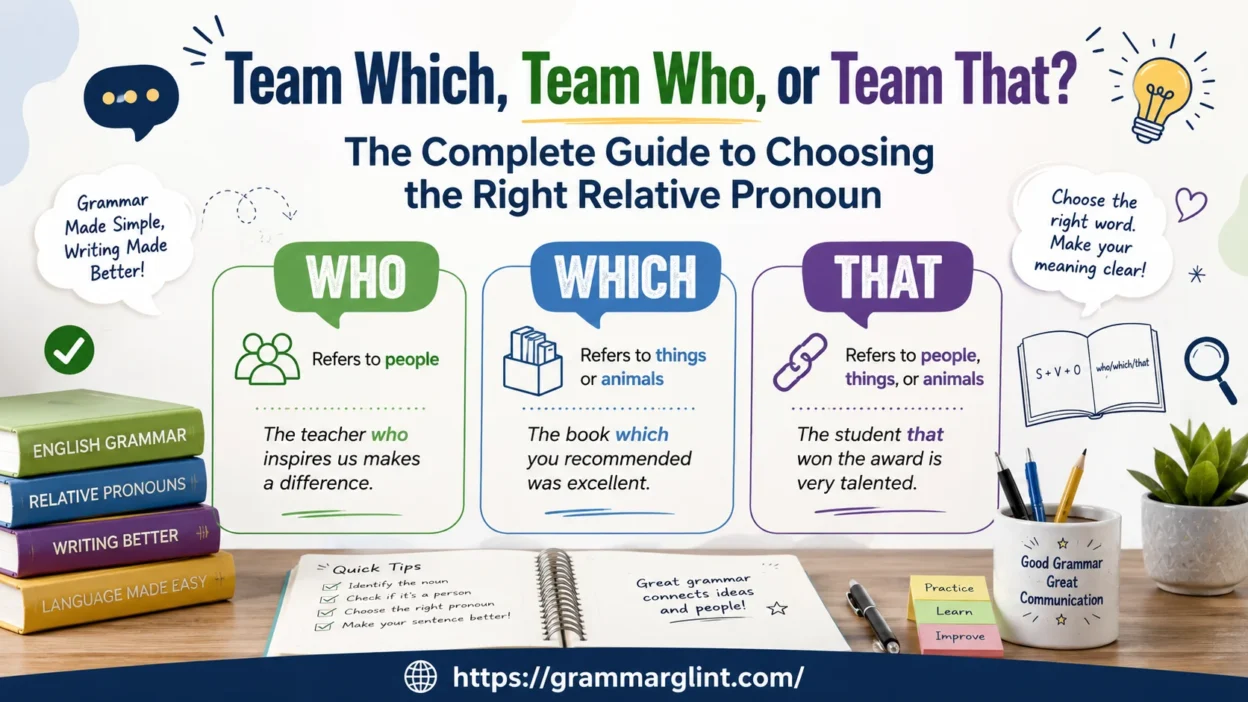
The most common relative pronouns include:
| Relative Pronoun | Main Use | Example |
| Who | People | The student who won the award smiled |
| Which | Things, animals, ideas | The phone which I bought is new |
| That | People, things, animals | The movie that we watched was great |
The challenge begins because who, which, and that can sometimes overlap.
Team Who: When Should You Use “Who”?
Who Meaning and Usage in English Grammar
The word who refers to people.
It usually describes a person or group of people. When you talk about humans, who is often the safest and most natural choice.
Examples:
- The doctor who treated me was kind.
- The friend who called you left a message.
- The employee who completed the project received praise.
In each sentence, who points to a person.
A simple memory trick:
Who = Human
If the noun has a face, name, personality, or identity, “who” usually fits.
Who as the Subject of a Sentence
A subject performs an action.
Example:
The athlete who won the race trained every day.
Who connects “athlete” with the action “won.”
The athlete performed the action.
More examples:
- The writer who created this story became famous.
- The manager who approved the plan explained the details.
- The chef who prepared the meal received compliments.
Who as the Object of a Sentence
Who can also refer to the person receiving an action.
Example:
The person who I met yesterday was friendly.
Here, “I met the person.”
Many grammar experts traditionally recommend whom in this situation:
The person whom I met yesterday was friendly.
However, in modern everyday English, many speakers use who instead. It sounds more natural in conversations.
Team Which: When Should You Use “Which”?
Which Meaning and Usage in English Grammar
The word which usually refers to things, animals, and ideas.
Examples:
- The computer which I use for work is fast.
- The movie which we watched was entertaining.
- The dog which lives next door is very friendly.
A simple memory trick:
Which = What thing?
If you are talking about an object, concept, or non-human subject, “which” often works well.
Which for Nonessential Information
One of the most important uses of which is adding extra information.
This information is called a nonrestrictive clause.
A nonrestrictive clause gives additional details. The sentence still makes sense without it.
Example:
My car, which I bought last year, still runs smoothly.
The main point:
My car still runs smoothly.
The extra detail:
I bought it last year.
The commas show that the information is optional.
More examples:
- My laptop, which is three years old, still works well.
- The restaurant, which opened in 2020, became popular quickly.
Team That: The Most Flexible Relative Pronoun
That Meaning and Usage
The word that is incredibly useful because it can refer to people, things, and animals.
Examples:
- The person that helped me was polite.
- The book that I read was interesting.
- The phone that I bought works perfectly.
This flexibility makes “that” common in everyday English.
However, “that” has a special strength.
It usually introduces essential information.
That for Restrictive Clauses
A restrictive clause gives information that identifies the noun.
Without it, the meaning becomes unclear.
Example:
The phone that I bought yesterday is expensive.
Which phone?
The clause answers that question.
The phrase “that I bought yesterday” identifies the exact phone.
More examples:
- The movie that won the award became popular.
- The student that answered correctly received a prize.
- The tool that saves time is valuable.
Which vs That: The Biggest Grammar Debate
The biggest argument in this grammar discussion usually involves:
Which vs That
Many writers wonder:
“Should I write the book that I bought or the book which I bought?”
The answer depends on meaning.
Use That for Essential Details
Example:
The house that has a blue door belongs to Sarah.
The phrase identifies the house.
Without it:
The house belongs to Sarah.
The meaning changes.
Use Which for Extra Details
Example:
The house, which has a blue door, belongs to Sarah.
The listener already knows which house you mean.
The blue door is just additional information.
Quick Comparison Table
| Sentence | Meaning |
| The phone that I purchased is expensive | Identifies the phone |
| The phone, which I purchased yesterday, is expensive | Adds extra information |
A helpful shortcut:
- That = necessary information
- Which = additional information
Can You Use “That” for People?
This question causes plenty of debate.
Many traditional grammar lessons say:
- Who → people
- That → things
But modern English often uses that for people.
Both examples can sound natural:
The woman who helped me was kind.
The woman that helped me was kind.
The first sentence feels slightly more formal or personal.
The second feels more conversational.
For professional writing, who remains the preferred choice when referring to people.
The Easy Decision Guide: Which, Who, or That?
When you feel stuck, follow these steps.
Step One: Identify the noun
Ask:
“What am I describing?”
Person?
Use:
Who
Example:
The teacher who explained the lesson was excellent.
Thing or idea?
Use:
Which or That
Example:
The method that works best is simple.
Step Two: Decide if the information matters
Ask:
“Do I need this information to know exactly what I mean?”
Yes:
Use:
That
Example:
The book that changed my life is on the shelf.
No:
Use:
Which
Example:
My book, which is on the shelf, is old.
Common Mistakes With Who, Which, and That
Mistake: Using Which for People
Incorrect:
The person which called me was angry.
Correct:
The person who called me was angry.
Why?
Because “person” refers to a human.
Mistake: Using Who for Objects
Incorrect:
The phone who I bought stopped working.
Correct:
The phone that I bought stopped working.
A phone is a thing, not a person.
Mistake: Adding Extra Pronouns
Incorrect:
The movie that I watched it was great.
Correct:
The movie that I watched was great.
The word “that” already connects the ideas.
Adding “it” creates repetition.
Read More: Is It “Doctor’s Appointment” or “Doctors Appointment”?
More Common Mistakes With Who, Which, and That
Mistake: Adding Commas Before “That”
A common error happens when writers place commas around that.
Incorrect:
The car, that I bought yesterday, is expensive.
Correct:
The car that I bought yesterday is expensive.
Why?
“That” usually introduces information that identifies the noun. Since the information matters, commas usually do not belong there.
Mistake: Believing “Which” Is Always Wrong
Some people learn a strict rule:
Never use “which.”
That advice is outdated.
“Which” is completely correct when it introduces extra information.
Example:
My phone, which I bought last year, still works perfectly.
The sentence sounds natural and professional.
The key is understanding the purpose of the clause.
Real-Life Examples: Choosing the Right Relative Pronoun
Grammar becomes easier when you see it in everyday situations.
Workplace Examples
Imagine you are writing a report at work.
You might write:
The employee who completed the task received recognition.
You are describing a person.
Now compare:
The software that improved our workflow saved hours.
You are describing a tool.
Another example:
The system, which launched in January, reduced errors.
The launch date adds extra information.
School and Learning Examples
Students often use relative pronouns in essays.
Examples:
The teacher who explained the topic made the lesson easier.
The teacher is a person.
The strategy that helped me study was creating notes.
The strategy is a thing.
The textbook, which contains many examples, helped me understand grammar.
The textbook information is additional.
Everyday Conversation Examples
People use these words constantly without thinking.
Examples:
- The restaurant that we visited was crowded.
- The friend who came over brought snacks.
- The movie, which was three hours long, felt surprisingly fast.
Natural speech often chooses simpler structures.
That is why “that” appears so frequently in conversations.
Who, Which, or That: A Simple Comparison Chart
| Word | Refers To | Common Use | Example |
| Who | People | Describing humans | The doctor who helped me was kind |
| Which | Things, animals, ideas | Extra details | The car, which is new, runs well |
| That | People, things, animals | Essential information | The book that I read was interesting |
This table gives you the quick answer.
However, context always matters.
The Grammar Psychology Behind These Words
Why do these tiny words create so much confusion?
Because English is not a simple collection of rules. It developed through centuries of change.
Words like who, which, and that evolved from older forms of English and gradually became more flexible.
Modern speakers often choose based on:
- clarity
- sound
- formality
- personal style
A sentence can be grammatically acceptable but still feel awkward.
For example:
The person that helped me was nice.
This works.
But:
The person who helped me was nice.
Often feels warmer and more natural.
Small choices affect the tone of your writing.
A Practical Trick: Replace the Noun
When you are unsure, replace the noun with a simpler word.
Ask:
“Would I say he/she or it?”
If you would say:
He or she → use who
Example:
The scientist who discovered the formula.
You can replace scientist:
He discovered the formula.
So “who” works.
If you would say:
It → use which or that
Example:
The machine that produces energy.
Replace machine:
It produces energy.
So “that” works.
Formal Writing vs Casual Writing
The best choice can depend on where you write.
Academic or Professional Writing
Many writers prefer:
- Who for people
- Which for nonessential information
- That for essential information
Example:
The researcher who conducted the study presented the results.
Casual Conversations
People often use “that” more freely.
Example:
The guy that helped me was really nice.
This sounds normal in everyday speech.
Case Study: How One Word Changes Meaning
Look at these sentences:
Sentence One:
The employees who completed the training received certificates.
Meaning:
Only the employees who completed the training received certificates.
The information identifies the group.
Sentence Two:
The employees, who completed the training, received certificates.
Meaning:
All employees completed the training and received certificates.
The commas change everything.
This shows why punctuation and relative pronouns work together.
The Role of Commas With Which and Who
Commas are not decoration.
They change meaning.
Without commas:
My brother who lives in Texas is visiting.
This suggests you have multiple brothers. The phrase identifies which one.
With commas:
My brother, who lives in Texas, is visiting.
This suggests you have one brother. The Texas detail is extra.
The same idea applies to “which.”
Quick Memory Rules for Writers
Keep these simple rules nearby:
Rule One
People → Who
Example:
The person who called me.
Rule Two
Things → Which or That
Example:
The device that works best.
Rule Three
Necessary information → That
Example:
The movie that won the prize.
Rule Four
Extra information → Which
Example:
The movie, which was filmed abroad, became popular.
My Classroom Experience
As an English teacher, I have found that many students struggle with relative pronouns not because the topic is difficult, but because they were never taught the underlying rules in their earlier grades. Instead of understanding when to use who, which, or that, they often rely on memorization or guesswork. This approach may help them complete exercises, but it leaves them uncertain when writing independently.
Once I explain the logic behind each relative pronoun and show how the choice depends on the noun and the sentence’s meaning, students gain confidence and begin using these structures naturally instead of simply trying to remember them. Just One thing students always need to remember, try to use these pronouns in their everyday life to learn it by heart.
FAQs
1. What is the difference between Team Who, Team That, and Team Which?
All three are used with collective nouns, but they differ slightly in tone and style depending on context.
2. Is “team who” grammatically correct?
Yes, team who is correct when referring to people within a team in a more human or informal way.
3. Is “team that” more commonly used?
Yes, team that is the most commonly used and neutral form in both formal and informal writing.
4. When should I use “team which”?
Team which is usually used in more formal or descriptive writing, especially in British English.
5. Why do learners get confused with these forms?
Because a team is one thing many people dual identity, which makes grammar choice unclear.
6. Do native speakers follow strict rules for this?
Not always. Native speakers not always correct same situations, and usage depends on style and tone.
7. Which form sounds most natural in everyday English?
Most often, team that sounds the most natural and safe in everyday communication.
8. Can the meaning change with different choices?
Yes, the pronoun choose reader imagines group tone clarity credibility, which slightly affects meaning.
9. Is this topic important for exams and professional writing?
Yes, especially in English writing school work emails essays reports professional communication writing tone uncertainty tricky situations.
10. What is the easiest way to remember the rule?
Focus on real-life usage natural English easy tricks remember usage, and choose based on context rather than overthinking.
Conclusion
Choosing between team who, team that, and team which can be confusing because team is a collective noun that represents both a single unit and a group of individuals. Although all three forms are grammatically correct in certain contexts, the best choice depends on the meaning you want to convey, the tone of your writing, and whether you are emphasizing the team as one entity or the people within it.
The easiest way to make the right choice is to understand the role of each relative pronoun, practice with real-life examples, and pay attention to context rather than memorizing rigid rules. With these simple guidelines, you can write more naturally and confidently in essays, emails, reports, workplace documents, and everyday English conversations.

Shafiq Ur Rehman is an English language educator, editor, and grammar writer with over 10 years of teaching experience in English and Mathematics across various educational institutions. As an editor at Grammar Glint, he creates clear, accurate, and easy-to-understand content on English grammar, spelling, punctuation, word meanings, idioms, and common usage questions.
Drawing on years of classroom experience, Shafiq focuses on explaining grammar rules in simple language with practical examples that help students, teachers, writers, and English learners build confidence in their communication. His goal is to publish trustworthy, well-researched, and reader-friendly content that makes learning English easier for everyone.