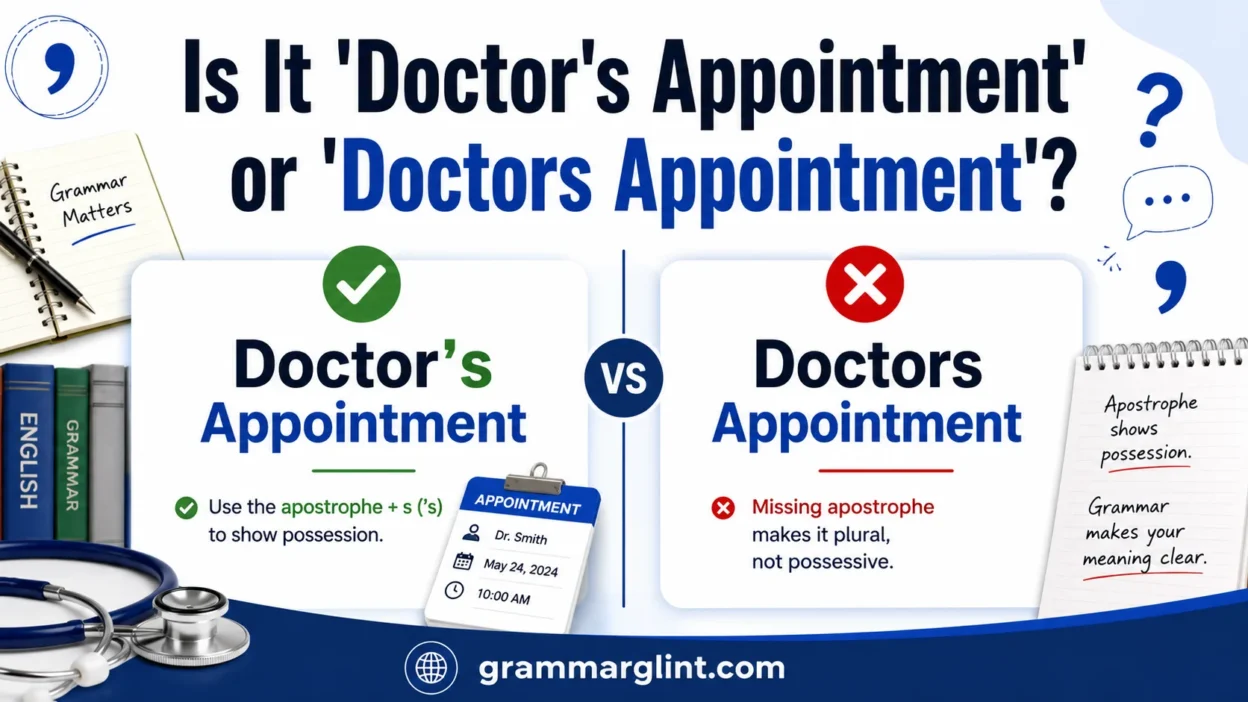
Understanding doctor’s appointment as a noun phrase with a possessive form helps explain why this phrase is common. The word doctor suggests ownership, but it often shows a genitive relationship describing the type of appointment. A patient may say “I have a doctor appointment,” where doctor modifies the word appointment and tells the kind of visit.
In a medical context, this language usage is common because the phrase explains a scheduled appointment or medical visit with a healthcare professional. The phrase Is It “Doctor’s Appointment” or “Doctors Appointment”? The Correct Grammar Explained explores this exact grammar choice.
The question of whose appointment it is can be confusing. If we think this way, a doctor’s appointment could be something the doctor possesses with a girlfriend, psychiatrist, dentist, or any other person. However, daily usage shows that this preferred phrasing is used by English speakers. The simple answer is convention because the majority of people choose this expression, even though doctor appointment is acceptable and has nothing wrong with it.
The grammar choice reflects an English language pattern where the possessive marker ’s is frequently used to show possession, like cat’s bowl, instead of other forms such as bowl of the cat. This common function in English grammar is not all about ownership because the marker can show other meanings including plural use in examples like p’s and q’s and pattern of x’s.
The structure and syntax depend on context, wording, and natural phrasing. From my experience of teaching English, many learners first focus on the rule, but real language usage develops through common usage, preference, and exposure. The explanation may seem complicated, but understanding this linguistic choice improves communication and makes English sound more natural.
Key Takeaway
✅ Doctor’s appointment = Correct
❌ Doctors appointment = Incorrect
⚠ Doctors’ appointment = Only correct when referring to multiple doctors
For almost all everyday situations, use a doctor’s appointment.
Quick Answer
If you’re looking for the short answer, here it is:
| Phrase | Correct? | Meaning |
| Doctor’s appointment | ✅ Yes | An appointment with a doctor |
| Doctors appointment | ❌ No | Missing apostrophe |
| Doctors’ appointment | ⚠ Sometimes | Appointment belonging to multiple doctors |
For everyday writing, professional communication, school assignments, and workplace messages, doctor’s appointment is the form you should use.
Example
Correct:
I have a doctor’s appointment tomorrow morning.
Incorrect:
I have a doctors appointment tomorrow morning.
The apostrophe isn’t optional. It serves an important grammatical purpose.
Understanding the Grammar Rule Behind “Doctor’s Appointment”
Grammar often feels complicated until you understand the underlying pattern.
The phrase doctor’s appointment uses a possessive noun.
What Is a Possessive Noun?
A possessive noun shows ownership, association, or connection.
Most singular nouns become possessive by adding:
‘s
Examples include:
| Singular Noun | Possessive Form |
| Doctor | Doctor’s |
| Teacher | Teacher’s |
| Lawyer | Lawyer’s |
| Dentist | Dentist’s |
| Manager | Manager’s |
In English, possession doesn’t always mean ownership.
Sometimes it simply shows a relationship between two things.
For example:
- doctor’s office
- doctor’s note
- doctor’s recommendation
- doctor’s appointment
The doctor doesn’t literally own the appointment. Instead, the appointment is associated with the doctor.
That’s why English grammar uses the possessive form.
Read More: Wriggle Room vs. Wiggle Room: What’s the Difference?
Why “Doctor’s” Needs an Apostrophe
Think about the phrase logically.
When someone says:
I have a doctor’s appointment.
They mean:
I have an appointment with a doctor.
The apostrophe helps indicate that connection.
Without the apostrophe, the phrase loses its grammatical structure.
Consider these examples:
| Correct | Incorrect |
| doctor’s office | doctors office |
| teacher’s desk | teachers desk |
| lawyer’s advice | lawyers advice |
| dentist’s appointment | dentists appointment |
The apostrophe clarifies meaning immediately.
Although readers may still understand the sentence without it, formal English considers the omission an error.
Possession vs. Description: Why the Difference Matters
English sometimes allows nouns to function as adjectives.
Examples include:
- school bus
- coffee mug
- chicken soup
- office chair
Because of these constructions, some people assume “doctor appointment” should work the same way.
The situation is more nuanced.
Historically, doctor’s appointment has been the preferred expression because it reflects a possessive relationship. Modern English occasionally uses noun modifiers instead of possessives, especially in business and technical writing.
However, traditional grammar still favors doctor’s appointment in most contexts.
Quick Comparison
| Phrase | Common Usage |
| Doctor’s appointment | Traditional and widely accepted |
| Doctor appointment | Seen in forms and healthcare software |
| Doctors appointment | Usually incorrect |
Understanding this distinction helps you choose the right form for different situations.
What Does “Doctor’s Appointment” Actually Mean?
At its core, a doctor’s appointment refers to a scheduled meeting between a patient and a physician.
The phrase covers a wide range of healthcare interactions.
Common Types of Doctor’s Appointments
Routine Checkups
Preventive visits help monitor overall health and identify issues before they become serious.
Annual Physical Exams
These comprehensive evaluations assess general wellness and establish health benchmarks.
Follow-Up Visits
Doctors often schedule follow-up appointments to review treatment progress.
Specialist Consultations
Patients may meet specialists such as:
- Cardiologists
- Neurologists
- Dermatologists
- Orthopedic surgeons
- Endocrinologists
Telehealth Appointments
Modern healthcare increasingly includes virtual consultations through video conferencing platforms.
Even though technology has changed how appointments occur, the phrase doctor’s appointment remains the standard expression.
How the Phrase Evolved Over Time
Language constantly evolves.
Many expressions that originated centuries ago still survive today because they remain practical and familiar.
The possessive construction in doctor’s appointment follows a long-standing English pattern.
Historically, people commonly referred to:
- doctor’s office
- doctor’s orders
- doctor’s advice
- doctor’s note
As healthcare systems expanded, the phrase naturally extended to scheduled medical visits.
Over time, it became deeply embedded in everyday English.
That’s one reason why alternatives such as doctors appointment often feel incorrect to native speakers.
The possessive form simply sounds natural because generations of speakers have used it consistently.
Is “Doctors’ Appointment” Ever Correct?
Yes.
However, most people rarely need this version.
Understanding the Plural Possessive
When multiple doctors possess or share something, English uses a plural possessive.
Example:
The doctors’ appointment schedule was revised.
In this sentence:
- Multiple doctors exist.
- The schedule belongs to those doctors.
Therefore:
Doctors’ is correct.
More Examples
- The doctors’ lounge was renovated.
- The doctors’ conference room was relocated.
- The doctors’ meeting lasted three hours.
Notice that these examples involve ownership by several doctors.
Now compare:
I have a doctor’s appointment.
Only one doctor participates in the appointment.
Therefore, the singular possessive remains correct.
Why So Many People Write “Doctors Appointment”
The mistake appears everywhere.
You can find it in emails, social media posts, school notes, and workplace communications.
Several factors contribute to the confusion.
Missing Apostrophes Are Common
Punctuation mistakes occur frequently because apostrophes are small and easy to overlook.
Many writers type quickly and focus on content rather than punctuation.
Informal Digital Communication
Texting habits have changed writing patterns.
Many people skip punctuation entirely when sending messages such as:
Can’t come. Doctors appointment today.
The reader understands the meaning. However, the grammar remains incorrect.
Auto-Correct Limitations
Spell-checkers don’t always catch missing apostrophes.
Because “doctors” is a valid word, software may not flag the error.
Apostrophe Anxiety
Ironically, many writers avoid apostrophes because they fear placing them incorrectly.
As a result, they omit them altogether.
Doctor Appointment vs. Doctor’s Appointment
This comparison creates even more confusion.
You may encounter both versions online.
Doctor’s Appointment
Traditional grammar favors this form.
Examples:
- doctor’s appointment
- doctor’s note
- doctor’s office
These constructions have existed for generations.
Doctor Appointment
This form treats “doctor” as a noun modifier.
Businesses increasingly use noun modifiers because they sound concise.
Examples include:
- customer service department
- employee handbook
- insurance policy
Healthcare organizations sometimes use:
- doctor appointment request
- doctor appointment reminder
- doctor appointment portal
Which Should You Use?
The answer depends on context.
| Context | Recommended Form |
| Academic writing | Doctor’s appointment |
| Professional emails | Doctor’s appointment |
| Workplace communication | Doctor’s appointment |
| School assignments | Doctor’s appointment |
| Healthcare software labels | Doctor appointment or doctor’s appointment |
For most readers, doctor’s appointment remains the safest and most natural choice.
Real-World Examples of Correct Usage
Let’s look at common situations.
At Work
Employees frequently notify managers about medical visits.
Examples:
I need to leave early for a doctor’s appointment.
My doctor’s appointment is scheduled for Friday afternoon.
I will return after my doctor’s appointment.
These sentences sound professional and grammatically correct.
At School
Students and parents often communicate absences.
Examples:
Sarah missed class because of a doctor’s appointment.
Please excuse Michael’s absence due to a doctor’s appointment.
We scheduled a doctor’s appointment during school hours.
In Professional Emails
Email communication benefits from correct punctuation.
Example:
Hello,
I will be unavailable from 2:00 PM to 4:00 PM due to a doctor’s appointment.
Thank you for your understanding.
This wording feels polished and credible.
Common Possessive Phrases Similar to “Doctor’s Appointment”
Learning related expressions helps reinforce the rule.
Healthcare Examples
| Phrase | Meaning |
| Doctor’s note | Written medical documentation |
| Doctor’s office | Medical practice location |
| Doctor’s recommendation | Professional medical advice |
| Nurse’s station | Central nursing workspace |
| Patient’s record | Medical history file |
Education Examples
- teacher’s guide
- student’s project
- principal’s office
- professor’s lecture
Business Examples
- manager’s decision
- client’s feedback
- employee’s handbook
- company’s policy
The pattern remains consistent.
When one person possesses or is associated with something, English typically uses ‘s.
Common Mistakes to Avoid
Even experienced writers occasionally make apostrophe errors.
Here are the most frequent mistakes.
Mistake: Omitting the Apostrophe
Incorrect:
doctors appointment
Correct:
doctor’s appointment
Mistake: Using the Wrong Apostrophe Placement
Incorrect:
doctors’ appointment
Correct:
doctor’s appointment
Unless multiple doctors possess something, the apostrophe belongs before the s.
Mistake: Mixing Singular and Plural Forms
Incorrect:
The doctor’s are available.
Correct:
The doctors are available.
Remember:
- Doctor’s = possessive
- Doctors = plural
They are not interchangeable.
A Simple Trick to Remember the Correct Form
Whenever you’re unsure, expand the phrase.
Ask yourself:
Can I replace it with “appointment with a doctor”?
If the answer is yes, use:
doctor’s appointment
Example
Original:
I have a doctor’s appointment tomorrow.
Expanded:
I have an appointment with a doctor tomorrow.
The meaning stays exactly the same.
This quick test works almost every time.
Mini Case Study: Workplace Communication
Imagine two employees sending absence requests.
Employee A
I have a doctors appointment tomorrow.
Employee B
I have a doctor’s appointment tomorrow.
Both messages communicate the same information.
However, Employee B demonstrates stronger writing skills and attention to detail.
In professional environments, small grammar choices influence how readers perceive competence and credibility.
While nobody gets promoted because of an apostrophe, polished communication leaves a positive impression.
What Major Style Guides Recommend
Most respected grammar authorities and style guides support possessive constructions like doctor’s appointment.
The reasoning remains simple:
- The appointment is associated with a doctor.
- English typically expresses that relationship through possession.
- Readers instantly recognize the meaning.
As a result, educational institutions, publishers, businesses, and professional organizations overwhelmingly favor the possessive version.
Grammar Cheat Sheet
Use “Doctor’s Appointment” When:
✅ Referring to an appointment with one doctor
✅ Writing professionally
✅ Completing school assignments
✅ Sending workplace emails
✅ Following standard English grammar
Use “Doctors’ Appointment” When:
✅ Referring to something belonging to multiple doctors
✅ Discussing schedules or resources shared by doctors
Avoid “Doctors Appointment” When:
❌ The apostrophe has been accidentally omitted
❌ Writing formal or professional content
❌ Submitting academic work
Frequently Asked Questions (FAQs)
1. Is “doctor’s appointment” grammatically correct?
Yes, doctor’s appointment is grammatically correct in standard English. The ’s works as a possessive or genitive form that connects the doctor with the type of appointment being discussed.
2. Is “doctor appointment” wrong?
No, doctor appointment is also used and understood by many speakers. It works as a noun modifier where doctor describes the kind of appointment, but doctor’s appointment is usually more common.
3. Why do people say “doctor’s appointment” more often?
The phrase became popular through common English usage and convention. Over time, native speakers adopted doctor’s appointment as the more natural expression.
4. What is the difference between “doctor’s appointment” and “doctor appointment”?
The difference is mainly grammatical structure. In doctor’s appointment, the word doctor uses a genitive form, while in doctor appointment, the word doctor acts like an adjective describing the appointment.
5. Does the “doctor” own the appointment?
Not always. Although the ’s can show ownership, in this phrase it often shows a relationship or connection rather than actual possession.
6. Can I say “dentist’s appointment” too?
Yes, dentist appointments follow the same pattern. It means an appointment related to visiting a dentist.
7. What does the possessive “’s” do in English?
The ’s has several functions. It can show possession, relationships, descriptions, and even appear in some plural expressions like p’s and q’s.
8. Which phrase should English learners use?
English learners should generally use doctor’s appointment because it is the most widely accepted and natural phrase in everyday communication.
9. Is “doctor’s appointment” always about a medical visit?
Usually, yes. In normal conversation, people understand it as a healthcare visit with a doctor. The context makes the meaning clear.
10. How can I remember the correct phrase?
Think of common everyday expressions. When talking about visiting a healthcare professional, doctor’s appointment is the phrase most speakers naturally choose.
Conclusion
The debate between doctor’s appointment and doctors appointment shows how English grammar can involve both rules and real-world usage. While both forms communicate the idea, doctor’s appointment is the more common and natural choice for most English speakers. The ’s does not always mean strict ownership; it can also show a connection or relationship between words. Understanding these small grammar patterns helps learners speak and write English more confidently and naturally.
Remember this simple rule:
If you mean an appointment with a doctor, write a doctor’s appointment.
One small apostrophe makes all the difference.

Aria Jane is a senior language writer and grammar specialist at Grammar Glint. She focuses on English grammar, spelling variations, vocabulary, and writing clarity. Through detailed research and practical examples, Aria helps readers understand language rules and avoid common mistakes. Her articles are designed to make English learning accessible for students, professionals, and everyday writers seeking reliable language guidance.