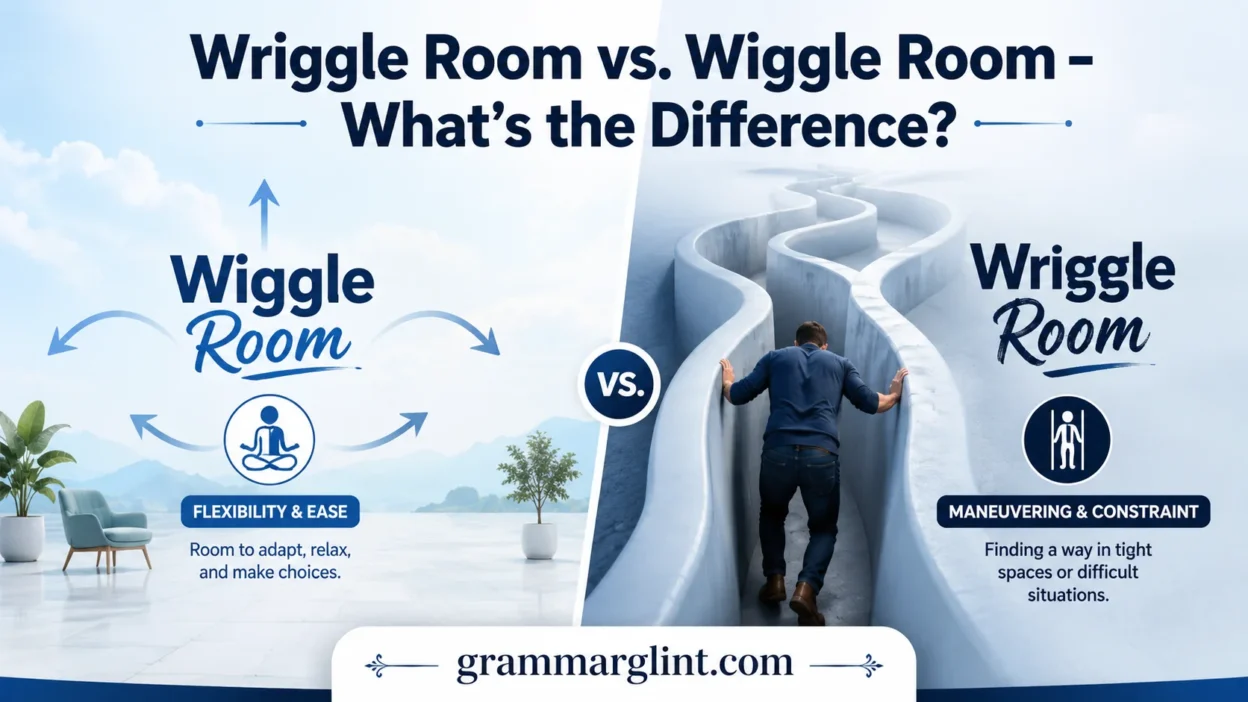
Wriggle Room vs. Wiggle Room What’s the Difference? shows confusion in wriggle and wiggle word choice, usage, meaning in English language.
Often notice how people recognize similar words and struggle with meaning in English words, especially when word choice and usage affect language understanding.
The comparison between wriggle and wiggle highlights a clear difference in physical movement and body motion, where each term depends on context, intent, and action. Wriggle suggests twisting, turning motion, effort, and struggle, often linked to escape, like a worm, caterpillar movement, or moving out of a tight spot or confined space with irregular movement and slow movement.
Meanwhile, wiggle feels more playful, showing back-and-forth movement such as dog tail movement or person toes, with shake, jiggle, and flexibility in a less constrained context. This language difference helps explain everyday usage, grammar, and correct word choice in both wriggle room and wiggle room situations.
What Does “Wiggle Room” Mean?
Wiggle room means flexibility, freedom, or extra space that allows changes. It usually refers to a situation where strict limits exist but you still have some ability to adjust.
The phrase originally connects to the physical idea of being able to wiggle — move slightly from side to side.
Imagine trying to fit into a tight parking spot. If there’s a little extra space, you can move your car back and forth until it fits perfectly. That little bit of space is your “wiggle room.”
Over time, English speakers started using the phrase in a figurative way.
Instead of physical movement, it described flexibility in:
- Rules
- Deadlines
- Budgets
- Agreements
- Expectations
- Plans
For example:
“The manager gave us some wiggle room on the deadline.”
This does not mean the deadline physically moves. It means the team has some flexibility.
Another example:
“There isn’t much wiggle room in the budget.”
This means the budget is tight and there isn’t much space for unexpected expenses.
Common Situations Where People Use “Wiggle Room”
| Situation | Example Sentence | Meaning |
| Work deadlines | “We have a little wiggle room before the project is due.” | Extra time is available |
| Negotiations | “The seller left some wiggle room on the price.” | The price can change |
| Rules | “The policy has no wiggle room.” | The rule is strict |
| Planning | “Add a few hours of wiggle room.” | Leave extra time |
The phrase works because it paints a simple picture. Everyone understands the feeling of needing just a little more space.
What Does “Wriggle Room” Mean?
Wriggle room is a less common expression that people sometimes use as an alternative to “wiggle room.”
The word wriggle means to twist, squirm, or make small movements to escape or move through a tight space.
A worm wriggling through soil is a classic example. A person trying to squeeze through a crowded area might also wriggle their way forward.
Because of that meaning, “wriggle room” often suggests maneuvering around an obstacle.
For example:
“The lawyer searched for wriggle room in the contract.”
This suggests looking carefully for a possible way around a restriction.
Another example:
“The team found some wriggle room in the rules.”
Here, the meaning focuses less on general flexibility and more on finding an opening.
The Main Difference
The biggest difference comes down to tone and usage.
Both phrases can communicate flexibility, but they create different impressions.
| Phrase | Main Meaning | Commonness | Feeling |
| Wiggle room | Space or flexibility to adjust | Very common | Neutral and everyday |
| Wriggle room | A way to maneuver around limits | Less common | More strategic or playful |
Think of it this way:
- Wiggle room is about having extra space.
- Wriggle room is about finding a way through a tight situation.
A person planning a vacation might say:
“I need some wiggle room in my schedule.”
They want flexibility.
A person analyzing a complicated rule might say:
“There may be some wriggle room in the wording.”
They are searching for an opening.
Why Do People Confuse Wriggle and Wiggle?
The confusion happens because these words are close relatives in sound and meaning.
Both words describe small movements.
Wiggle
To wiggle means to move from side to side.
Examples:
- A child wiggles in a chair.
- A dog wiggles its tail.
- Someone wiggles a loose tooth.
The movement is usually light, playful, or casual.
Wriggle
To wriggle means to twist or squirm.
Examples:
- A fish wriggles on a hook.
- A person wriggles through a crowded doorway.
- A worm wriggles underground.
The movement feels more urgent or effort-based.
Because both words involve movement, speakers naturally connect them. English also changes through everyday conversations, so variations sometimes become popular even when one form dominates.
Is “Wriggle Room” Wrong?
This is where things get interesting.
The short answer: No, “wriggle room” is not completely wrong.
People do use it. It appears in writing and conversation. However, “wiggle room” is the established idiom and the version most readers expect.
If you are writing:
- A business email
- An article
- A report
- A school assignment
- Professional content
then “wiggle room” is usually the safer choice.
It sounds natural because readers recognize it immediately.
Using “wriggle room” may make some readers pause because they expect the more common phrase.
The History Behind “Wiggle Room”
The phrase became popular because it perfectly captured a human experience: needing flexibility.
Life rarely follows a perfect plan.
A project takes longer than expected. A meeting runs late. A budget changes. A rule needs interpretation.
People need room to adjust.
That is why “wiggle room” became such a useful expression.
It turns an abstract idea into something visual. You can almost picture yourself squeezing through a narrow space with just enough movement to succeed.
That kind of imagery makes idioms memorable.
Read More: Is It “Doctor’s Appointment” or “Doctors Appointment”?
Real-Life Examples of Wiggle Room
Business and Workplace
In professional settings, wiggle room often appears during discussions about deadlines, contracts, and expectations.
Example:
“The client gave us some wiggle room with the delivery date.”
Meaning:
The client allowed extra time.
Another example:
“The agreement doesn’t leave much wiggle room.”
Meaning:
The terms are strict.
Companies often build wiggle room into plans because unexpected problems happen. A schedule with zero flexibility can quickly fall apart.
Money and Budgeting
Financial planning often needs flexibility.
A person might say:
“I need some wiggle room in my monthly budget.”
That means they want extra space for surprise costs.
Maybe the car needs repairs. Maybe an emergency bill appears. Without flexibility, a small problem can become a big one.
Rules and Policies
Rules usually create boundaries, but some situations require judgment.
For example:
“The teacher allowed some wiggle room on the assignment.”
The assignment still matters but students have flexibility.
However:
“The policy leaves no wiggle room.”
means there are no exceptions.
Wriggle Room in Real Usage: How People Actually Use It
Even though “wiggle room” dominates modern English, you’ll still spot “wriggle room” in writing, especially when someone wants to sound a bit more creative or precise about maneuvering through limits.
Let’s look at how it shows up in real contexts.
Legal and Contract Language
Lawyers and negotiators often deal with tight wording. Every phrase matters.
Example:
“The contract may offer wriggle room depending on interpretation.”
Here, the focus is not just flexibility. It’s about finding a possible opening in the language itself.
That subtle difference matters in legal settings. One word can shift responsibility, rights, or obligations.
Strategy and Problem Solving
In business strategy or political discussion, “wriggle room” sometimes appears when people talk about navigating restrictions.
Example:
“The company is looking for wriggle room in new regulations.”
This suggests active searching. Not passive flexibility.
Informal and Creative Writing
Writers sometimes use it for stylistic effect.
Example:
“He tried to wriggle his way out of the deal.”
That sense of movement and escape makes “wriggle room” feel more vivid in storytelling.
Why “Wiggle Room” Became the Standard Phrase
Language doesn’t stay still. It shifts based on usage, frequency, and clarity.
“Wiggle room” became dominant because it’s simpler and more intuitive.
Here’s why it won:
It feels natural in speech
People say “wiggle” more casually than “wriggle” in everyday conversation.
It sounds less technical
“Wriggle” feels slightly more physical or descriptive. “Wiggle” feels light and flexible.
It became widely used in media
Business news, interviews, and articles consistently use “wiggle room,” which reinforced it as the standard.
It reduces confusion
Writers prefer clarity. “Wiggle room” is instantly understood.
Wriggle Room vs Wiggle Room: Real Comparison in Context
Let’s break down how meaning shifts depending on usage.
Scenario 1: Negotiation
- “We still have wiggle room on the price.”
- “We still have wriggle room on the price.”
Both work, but:
- Wiggle room = general flexibility in price
- Wriggle room = finding a way to adjust within constraints
Scenario 2: Strict Rule System
- “There’s no wiggle room in the policy.”
- “There’s no wriggle room in the policy.”
Here, “wiggle room” sounds more natural. It clearly communicates strictness.
Scenario 3: Legal Context
- “The lawyer looked for wriggle room in the clause.”
This version feels stronger because it suggests digging into wording.
Quick Breakdown Table: When Each Phrase Feels Right
| Situation | Best Choice | Why |
| Business communication | Wiggle room | Clear and widely understood |
| Casual speech | Wiggle room | Natural flow |
| Legal interpretation | Wriggle room (sometimes) | Suggests maneuvering |
| Creative writing | Wriggle room | Adds imagery and motion |
| Formal writing | Wiggle room | Safer and standard |
Similar Expressions to “Wiggle Room”
English has plenty of ways to express flexibility. Each one carries a slightly different shade of meaning.
Breathing Room
Used when someone needs space to relax or recover.
“The new schedule gives us breathing room.”
Leeway
A formal word for freedom to act.
“The manager gave him leeway on decisions.”
Margin
Often used in numbers or planning.
“We built a margin for error.”
Room to Maneuver
Focuses on strategic flexibility.
“The team needs room to maneuver during negotiations.”
Flexibility
The most direct alternative.
“The system offers flexibility for users.”
Each of these expressions overlaps with “wiggle room,” but none carry exactly the same casual tone.
A Simple Way to Remember the Difference
Here’s an easy mental trick:
- If you can wiggle comfortably, you have wiggle room.
- If you are trying to squeeze or escape a tight situation, you are in wriggle room territory.
One feels open and relaxed. The other feels tight and strategic.
Frequently Asked Questions (FAQs)
1. What is the main difference between wriggle and wiggle?
Wriggle involves a twisting, turning movement often linked with effort or escape, while wiggle describes a light, playful back-and-forth motion.
2. Is wriggle always about escaping?
Most of the time, yes. Wriggle is commonly used when someone or something is trying to free itself from a tight, restricted, or confined space.
3. What does wiggle usually describe?
Wiggle usually describes gentle movement, such as shaking, swaying, or moving back and forth in a playful, relaxed, or casual way.
4. Can both words be used for animals?
Yes. Both words can describe animal movements. For example, a worm may wriggle through the soil, while a dog may wiggle its tail when excited.
5. Is “wriggle room” a correct phrase?
Yes, wriggle room is a correct phrase. It refers to flexibility or space to make adjustments, although it is less common than wiggle room in everyday English.
6. What does “wiggle room” mean?
Wiggle room means having flexibility, freedom, or allowance in a situation, especially when dealing with rules, plans, deadlines, or decisions.
7. Why do people confuse wriggle and wiggle?
People often confuse these words because they sound similar and both relate to movement. However, they differ in meaning, intensity, and typical usage.
8. Is wriggle more physical than wiggle?
Yes. Wriggle usually suggests stronger physical effort or twisting movement, whereas wiggle implies a lighter, smoother, and more playful motion.
9. Can wiggle be used in serious contexts?
Rarely. Wiggle is most often used in informal, friendly, or playful situations, though the phrase wiggle room is common in business and professional settings.
10. Which word is more commonly used in daily English?
Wiggle and the phrase wiggle room are generally more common in everyday English than wriggle, especially in modern conversation and writing.
Conclusion
The difference between wriggle and wiggle comes down to intensity and intention. Wriggle carries a sense of struggle, effort, and escaping from restriction, while wiggle reflects ease, flexibility, and playful motion. Understanding this helps improve word choice, usage, and overall clarity in English communication, especially when using phrases like “wriggle room” or “wiggle room” in different contexts.
Emma Brooke is an editor and language researcher at Grammar Glint. Her work centers on grammar rules, punctuation, word usage, and style consistency. Emma is passionate about transforming complex language concepts into clear, reader-friendly explanations. She contributes in-depth articles that help readers communicate more effectively and confidently in both academic and professional settings.