Many English learners and native speakers have paused during writing and wondered about this common grammar issue. These expressions are often used interchangeably but do not always serve the same purpose. Understanding the difference between whether or whether or not helps you discover the appropriate use, avoid the wrong form, and create a sentence that sounds less awkward, repetitive, or less professional.
This guide explains how grammar rules, sentence structure, and language patterns build writing confidence, communication, clarity, and accuracy. The right trick is checking the context, situation, and outcome before choosing the correct phrase. The topic Whether or Whether or Not: When to Use Each shows how this choice improves writing.
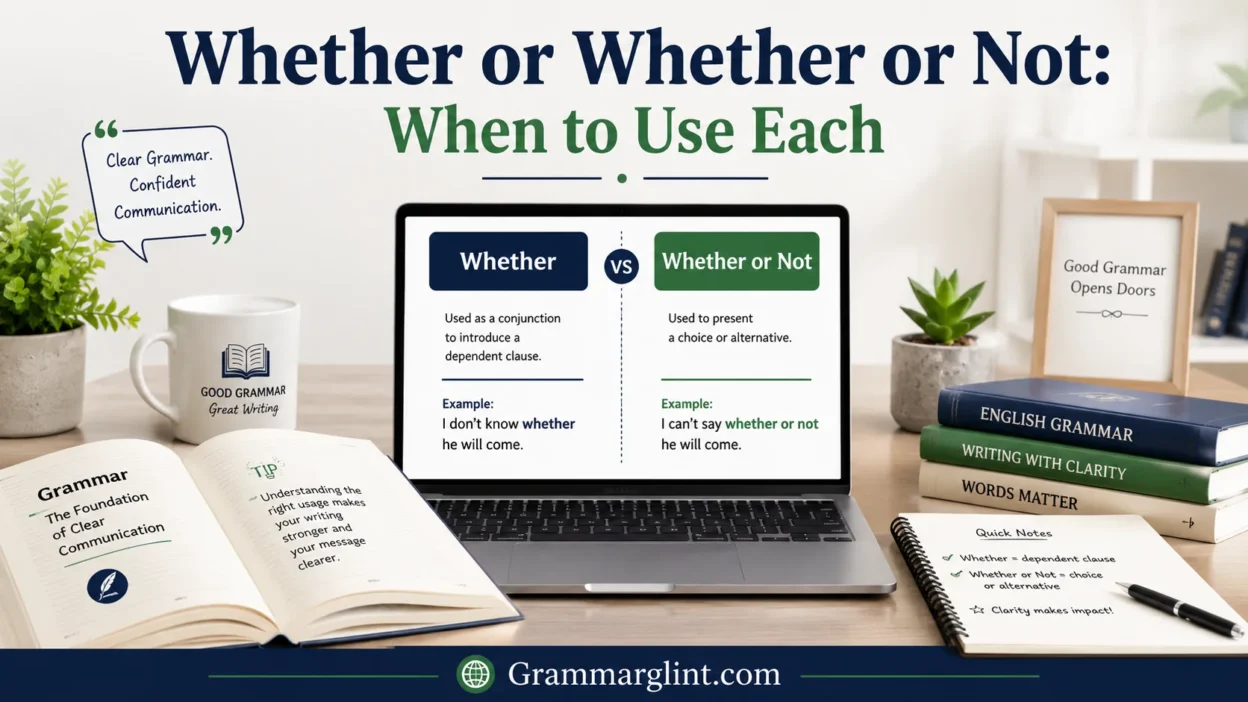
The rule is that whether or not it becomes essential when the response stays the same regardless of the possibility or condition. For example, children playing hide-and-seek use “ready or not,” which has a different meaning because both cases are possible.
When one possibility is stated, or not can be included as the second possibility, such as whether I go or not or whether or not I go. In other situations, whether can be used by itself and or not becomes unnecessary or can be omitted. These examples and practical tips help readers figure out when each one works, improve writing skills, and choose the correct usage.
What Does “Whether” Mean?
The word “whether” introduces two or more possible situations. It tells the reader that a decision, question, or uncertainty exists.
Think of “whether” as a signpost pointing toward different paths.
For example:
“I’m deciding whether I should buy a new phone.”
The person has two possible outcomes:
- Buy the phone
- Do not buy the phone
The sentence focuses on the decision itself.
Another example:
“She wondered whether the train had already left.”
The speaker does not know the answer. They are considering the possibility.
Common meanings of “whether”
“Whether” often expresses:
- A choice between options
- Doubt or uncertainty
- A question that needs an answer
- A decision-making process
Examples:
| Sentence | Meaning |
| “I don’t know whether he is home.” | Uncertainty |
| “They discussed whether to move.” | Decision |
| “Tell me whether you agree.” | Request for information |
| “She asked whether the plan worked.” | Question |
The key idea is simple:
Use “whether” when you are exploring possibilities.
What Does “Whether or Not” Mean?
The phrase “whether or not” adds extra emphasis. It highlights that both possibilities exist or that the outcome does not change the final result.
For example:
“I’ll finish the project whether or not you help.”
This means:
- If you help, I’ll finish it.
- If you don’t help, I’ll still finish it.
The result stays the same.
The phrase often carries the meaning of “regardless.”
Examples of “whether or not”
“She will travel whether or not her friends come.”
Meaning:
Her decision does not depend on her friends.
“You need to complete the form whether or not you agree.”
Meaning:
Agreement does not change the requirement.
The important difference
Compare these:
“I wonder whether he will call.”
The speaker is waiting for information.
“I will leave whether or not he calls.”
The speaker has already made a decision.
The first sentence focuses on uncertainty. The second focuses on independence from the outcome.
The Main Difference
The easiest way to understand the difference is to look at the purpose behind each phrase.
| Phrase | Main Purpose | Example |
| Whether | Shows uncertainty or choice | “I’m deciding whether to go.” |
| Whether or not | Shows two possible outcomes or independence | “I’ll go whether or not you come.” |
A useful question to ask yourself:
Does the result change the action?
If yes, use whether.
Example:
“I’m deciding whether I should apply.”
The decision depends on the answer.
If no, use whether or not.
Example:
“I’ll apply whether or not I get accepted.”
The action will happen either way.
When to Use “Whether”
Use “Whether” When Discussing Choices
The most common use of “whether” appears when someone must choose.
Examples:
“I haven’t decided whether I should quit my job.”
“He’s choosing whether to buy the car.”
“We need to decide whether to continue.”
In these sentences, the speaker is weighing options.
A choice exists.
The person has not reached a final decision yet.
Use “Whether” Before “Or” to Show Alternatives
Sometimes “whether” appears with “or” because it introduces two options.
Examples:
“I don’t know whether to call or text.”
“She asked whether we wanted pizza or pasta.”
The structure looks like this:
Whether + option A + or + option B
This pattern works well when the alternatives are clear.
Use “Whether” After Certain Verbs
Many verbs naturally connect with “whether.”
Common examples include:
- know
- ask
- wonder
- decide
- consider
- determine
- discuss
- discover
Examples:
“I wonder whether he understands.”
“They discussed whether the project was possible.”
“We need to determine whether the information is accurate.”
These verbs usually involve thinking, questioning, or evaluating.
When to Use “Whether or Not”
Use “Whether or Not” When the Outcome Does Not Matter
This is the biggest difference between the two phrases.
When the final action stays the same, “whether or not” fits better.
Example:
“I’m going for a walk whether or not it rains.”
The rain changes the situation but not the decision.
Another example:
“She will complete the assignment whether or not she receives feedback.”
The feedback might help but it does not control the outcome.
Use “Whether or Not” for Strong Emphasis
Sometimes writers add “or not” because they want to make the sentence stronger.
Example:
“You must follow the rules whether or not you agree.”
This sounds firm.
The message is:
Your opinion does not change the requirement.
The phrase creates a sense of certainty.
Use “Whether or Not” When “Or Not” Appears Later
Sometimes “or not” comes at the end.
Example:
“I don’t know whether he will come or not.”
This is common in conversation.
It emphasizes the unknown possibility.
You could also say:
“I don’t know whether he will come.”
Both are correct.
The second version is shorter. The first gives extra attention to the possibility that he may not come.
Can You Remove “Or Not” From “Whether or Not”?
In many sentences, yes.
Removing “or not” often keeps the same meaning.
Example:
Original:
“I don’t know whether or not she is ready.”
Shorter:
“I don’t know whether she is ready.”
Both sentences express uncertainty.
However, the longer version adds emphasis.
It reminds the reader:
There are two possible answers.
She may be ready.
She may not be ready.
Common Mistakes
Mistake: Using “If” Instead of “Whether”
Many people use “if” and “whether” the same way in casual speech.
Example:
“I don’t know if he will come.”
This sounds natural.
However, “whether” works better in formal writing.
Better:
“I don’t know whether he will come.”
The difference becomes clearer when alternatives appear.
Example:
Better:
“I don’t know whether he will come or stay.”
Not:
“I don’t know if he will come or stay.”
Mistake: Adding “Or Not” Without Purpose
Sometimes “or not” makes a sentence longer without adding meaning.
Wordy:
“She is deciding whether or not she should attend the event.”
Cleaner:
“She is deciding whether she should attend the event.”
The shorter version feels smoother.
However, if you mean “regardless,” keep “whether or not.”
Example:
“She will attend whether or not her friends go.”
Removing “or not” changes the meaning.
Mistake: Using “Whether or Not” Incorrectly
A sentence should still make logical sense.
Incorrect:
“Whether or not he likes the movie, I asked him.”
This creates confusion.
Better:
“Whether or not he likes the movie, I’ll watch it again.”
The phrase needs to connect to an outcome.
Formal Writing
Grammar choices become even more important when you write emails, reports, academic papers, or business documents. In professional writing, small differences can affect clarity.
Both “whether” and “whether or not” are grammatically correct. The best choice depends on what you want your sentence to communicate.
In many formal situations, writers prefer “whether” because it keeps sentences concise.
Example:
“The research team examined whether the method improved performance.”
This sentence sounds precise and professional.
Adding “or not” would not improve the meaning:
“The research team examined whether or not the method improved performance.”
This version is still correct but slightly heavier.
However, “whether or not” works well when the writer wants to show that the result does not change the conclusion.
Example:
“The company will continue the project whether or not sales increase.”
The message is clear:
The company has already decided.
Business Writing
Business communication often requires clear decisions and expectations. The difference between these phrases can help avoid confusion.
Use “Whether” for Questions and Decisions
Examples:
“Please confirm whether the payment has been received.”
“We need to determine whether the contract meets the requirements.”
These sentences ask for information.
The outcome is still unknown.
Use “Whether or Not” for Firm Statements
Examples:
“The deadline applies whether or not the client approves the changes.”
“Employees must complete the training whether or not they currently use the software.”
These sentences create certainty.
They show that a condition does not change the requirement.
Real Examples Compared Side by Side
The easiest way to master this grammar rule is to compare similar sentences.
| Sentence With Whether | Sentence With Whether or Not | Difference |
| “I don’t know whether she called.” | “I’ll respond whether or not she called.” | Unknown vs regardless |
| “He’s deciding whether to leave.” | “He’ll leave whether or not they agree.” | Choice vs independence |
| “We need to know whether it works.” | “We’ll use it whether or not it works.” | Information vs decision |
| “She asked whether you were coming.” | “She came whether or not you came.” | Question vs outcome |
The pattern becomes easier when you focus on the intention behind the sentence.
Simple Trick to Choose Between These Two
Choosing the correct phrase does not need to be complicated.
Use this quick method.
Ask: “Am I making a decision or showing uncertainty?”
If yes:
Use whether.
Examples:
- “I’m deciding whether to move.”
- “I don’t know whether he agrees.”
- “She asked whether the store was open.”
Ask: “Does the result change what happens next?”
If no:
Use whether or not.
Examples:
- “I’ll finish the task whether or not you help.”
- “He will attend whether or not he receives an invitation.”
A simple memory trick:
Whether = Which option?
Whether or not = Either way.
Read More: Wriggle Room vs. Wiggle Room: What’s the Difference?
Real-Life Examples of Whether vs Whether or Not
Example: Planning a Trip
Imagine someone says:
“I’m deciding whether to visit New York.”
The person is considering the trip.
They have not decided.
But:
“I’ll visit New York whether or not my friends come.”
The decision is final.
The friends’ choice does not affect the plan.
Example: Work Situation
A manager says:
“We need to know whether the report is complete.”
The manager wants information.
The report status matters.
But:
“The deadline remains tomorrow whether or not the report is complete.”
The deadline does not change.
Example: Everyday Conversation
“I wonder whether the restaurant is open.”
The speaker is uncertain.
“I’m going there whether or not it’s busy.”
The speaker has already decided
Both phrases work in formal and informal writing.
However, “whether” often sounds cleaner because it uses fewer words.
For example:
Professional:
“The study investigated whether the treatment worked.”
Emphasis:
“The study continued whether or not the treatment worked.”
Quick Reference Guide
| Situation | Use |
| Showing uncertainty | Whether |
| Making a choice | Whether |
| Asking about two options | Whether |
| Saying “regardless” | Whether or not |
| Showing the result does not matter | Whether or not |
| Adding emphasis | Whether or not |
FAQs
1. What does Whether or Whether or Not: When to Use Each mean in grammar?
It explains how to choose between whether and whether or not depending on meaning and sentence context.
2. Are whether and whether or not the same?
No, they are similar but not identical. They sometimes overlap, but each has different usage rules.
3. When should I use whether?
Use whether when you are showing uncertainty or presenting alternatives or choices.
4. When should I use whether or not?
Use whether or not when the result stays the same regardless of the condition or outcome.
5. Can I always remove “or not”?
No. In some sentences, removing or not changes the meaning or makes the sentence incomplete.
6. Is whether or not more formal?
Not necessarily, but it is often used for clarity when emphasizing that both outcomes are included.
7. Can both forms be used interchangeably?
Sometimes yes, but not always. The meaning of the sentence decides which one is correct.
8. What is a simple example of whether?
“I don’t know whether I will go.” This shows uncertainty about one action.
9. What is a simple example of whether or not?
“I will go whether or not it rains.” This shows the action happens in both situations.
10. How can I improve usage of these phrases?
By learning grammar rules, understanding sentence meaning, and practicing real examples regularly.
Conclusion
Understanding Whether or Whether or Not: When to Use Each helps improve clarity in writing and speaking. The choice between whether and whether or not depends on whether the sentence expresses uncertainty or fixed outcomes. When used correctly, both forms improve communication and make writing sound more natural, precise, and professional.

Emma Brooke is an editor and language researcher at Grammar Glint. Her work centers on grammar rules, punctuation, word usage, and style consistency. Emma is passionate about transforming complex language concepts into clear, reader-friendly explanations. She contributes in-depth articles that help readers communicate more effectively and confidently in both academic and professional settings.