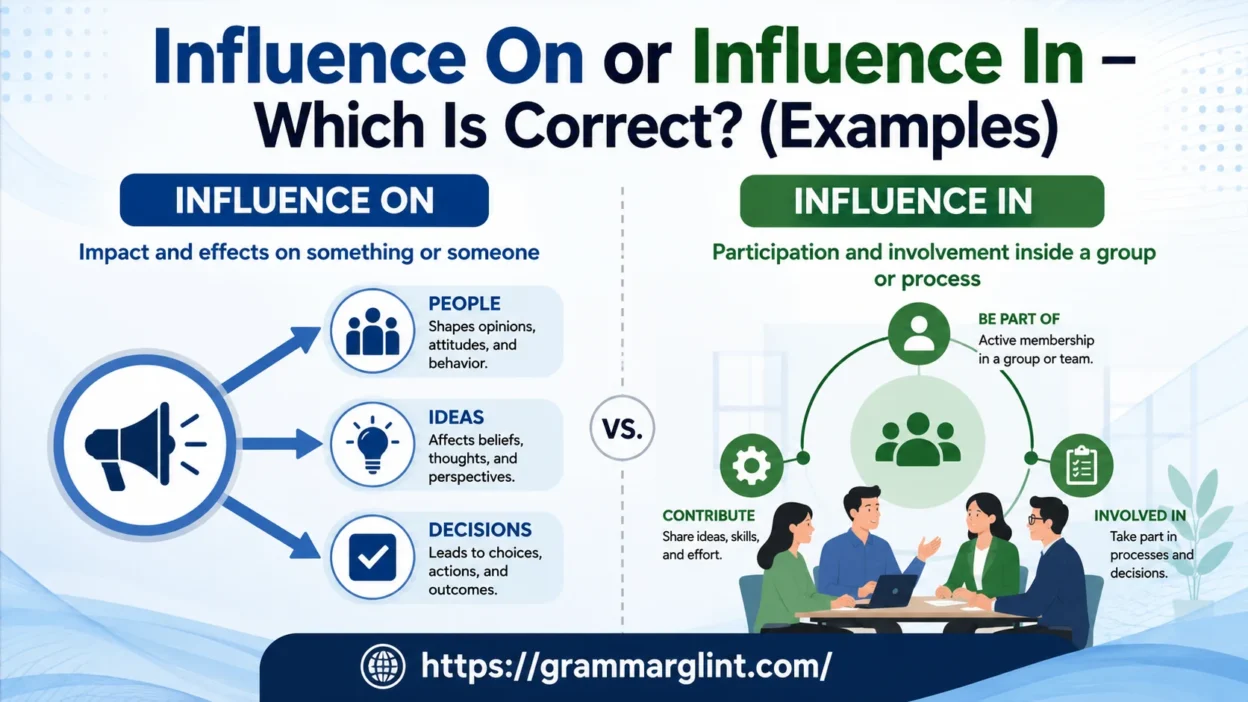
Influence on usually refers to the impact on a person or thing, while influence in shows the presence or role of something within a specific situation. The grammar becomes easier when we study example sentences and understand sentence structure.
A mother having an influential role in shaping a person they are today shows the effect over time. Both forms are used and depend on the context of the sentence, helping build understanding, clarification, and comparison.
Quick Answer
| Sentence | Correct Phrase | Reason |
| “Parents affect children’s behavior.” | Influence on | Children receive the effect |
| “She helped create the plan.” | Influence in | She participated |
| “The leader controls the group.” | Influence over | Shows authority |
| “The movie changed his opinion.” | Influenced by | Shows source |
What Does Influence Mean?
The word influence describes the power to affect someone or something. It can change thoughts, actions, decisions, behavior, results, or situations.
In simple words, influence means having an effect or playing a role in something.
Think of influence like a ripple in water. A single action can spread outward and affect many things around it.
For example:
- A teacher’s advice can influence a student’s career choice.
- A new technology can influence how people communicate.
- A leader can influence decisions within an organization.
The meaning stays similar, but the preposition after influence tells readers how that effect happens.
Influence as a Noun (Parts of Speech)
When influence works as a noun, it often appears with prepositions like:
- influence on
- influence in
- influence over
- influence by
Each one creates a slightly different meaning.
Examples:
Influence on:
“Parents have a major influence on their children.”
This means parents affect their children’s behavior or choices.
Influence in:
“She had a strong influence in the development of the project.”
This means she played a role in creating or improving the project.
Influence over:
“The manager has influence over the team.”
This means the manager has power or control.
Influenced by:
“The artist was influenced by nature.”
This means nature affected the artist’s work.
Influence as a Verb
The verb influence means to affect something directly.
Examples:
- “Social media influences buying habits.”
- “His experiences influenced his decisions.”
- “Books influence the way people think.”
When using influence as a verb, you usually don’t need a preposition.
Incorrect:
“The movie influenced on his opinion.”
Correct:
“The movie influenced his opinion.”
“Influence On” Meaning and Correct Usage
When Should You Use “Influence On”?
The phrase “influence on” is used when something has an effect on another person, object, idea, or outcome.
It focuses on the receiver of the effect.
The basic structure is:
Influence + on + affected thing
Examples:
- “Exercise has a positive influence on health.”
- “Climate has an influence on farming.”
- “Music has a powerful influence on emotions.”
In each sentence, something changes because of another factor.
Common Uses of Influence On
Influence On People
People often influence other people’s thoughts and actions.
Examples:
- “Friends have a strong influence on teenagers.”
- “Parents have a lasting influence on children.”
- “Teachers have an important influence on students.”
A person’s environment can shape their personality, habits, and decisions.
For example, a student who receives encouragement from teachers may develop more confidence. The teacher’s support creates an influence on the student’s attitude.
Influence On Behavior
Many things affect human behavior.
Examples:
- “Advertising has a major influence on consumer behavior.”
- “Culture has an influence on social habits.”
- “Technology has an influence on communication styles.”
Modern life shows this clearly. People’s daily choices often depend on the information, trends, and systems around them.
Influence On Results and Outcomes
The phrase also works when something changes an outcome.
Examples:
- “Weather has an influence on crop production.”
- “Experience has an influence on job performance.”
- “Education has an influence on career opportunities.”
Here, the focus is not on participation. It is about the final result.
Influence In: Meaning and Correct Usage
When Should You Use “Influence In”?
The phrase “influence in” focuses on involvement, participation, or a role within a specific activity, area, or process.
It answers the question:
“Where or in what area does this influence happen?”
The structure is:
Influence + in + activity/field/process
Examples:
- “She had influence in the decision-making process.”
- “He gained influence in politics.”
- “Experts have influence in scientific discussions.”
The person or thing is not simply causing an effect. It has a position or role within something.
Common Uses of Influence In
Influence In a Process
When someone helps shape a process, use in.
Examples:
- “The manager had influence in hiring decisions.”
- “Employees have influence in company policies.”
- “Researchers have influence in developing new methods.”
The focus is on participation.
A person may not control everything, but they contribute to what happens.
Influence In a Field or Area
You can also use in to describe influence within a particular field.
Examples:
- “She has influence in the fashion industry.”
- “He became a respected voice in technology.”
- “The organization has influence in global education.”
This shows a position or presence inside an area.

Main Difference Between “Influence on” and “Influence in”
The easiest way to understand the difference is to ask one question:
Is something being affected, or is someone involved?
| Phrase | Meaning | Focus |
| Influence on | Creates an effect | The thing affected |
| Influence in | Plays a role | The activity or area |
| Influence over | Has power | Control or authority |
| Influenced by | Receives an effect | The source of influence |

Influence On vs Influence In Examples
Example 1: Education
Influence on:
“Technology has a strong influence on education.”
Meaning:
Technology changes education.
Influence in:
“Technology has a growing influence in education research.”
Meaning:
Technology plays a role in the research field.
Example 2: Business
Influence on:
“Customers have an influence on product design.”
Meaning:
Customers affect the final design.
Influence in:
“Customers have influence in product development.”
Meaning:
Customers participate in the development process.
Example 3: Politics
Influence on:
“The media has an influence on public opinion.”
Meaning:
The media affects what people think.
Influence in:
“The media has influence in political discussions.”
Meaning:
The media plays a role in political conversations.
Common Mistakes
Many grammar mistakes happen because writers focus on the word influence and ignore the meaning of the sentence. The preposition should match the relationship between the two ideas.
A quick way to avoid mistakes is to ask:
“Am I describing an effect, or am I describing involvement?”
If something changes another thing, use influence on.
If someone participates or has a role, use influence in.
Read More: Wriggle Room vs. Wiggle Room: What’s the Difference?
Mistake 1: Using Influence In When Talking About Effects
Incorrect:
“Exercise has a positive influence in health.”
This sounds unnatural because exercise affects health. It does not participate in health.
Correct:
“Exercise has a positive influence on health.”
The word on connects the cause with the thing receiving the effect.
More examples:
Incorrect:
- “Books have an influence in people’s thinking.”
Correct:
- “Books have an influence on people’s thinking.”
Incorrect:
- “Technology has an influence in communication.”
Correct:
- “Technology has an influence on communication.”
Mistake 2: Using Influence On When Talking About Participation
Sometimes writers use influence on for a situation where someone has a role.
Example:
“She had influence on creating the new policy.”
This sentence is understandable, but influence in sounds more natural because it focuses on involvement in the creation process.
Better:
“She had influence in creating the new policy.”
Other examples:
- “Experts had influence in designing the system.”
- “Employees had influence in changing workplace rules.”
Mistake 3: Confusing Influence With Similar Words
Several words have similar meanings, but their prepositions differ.
| Word | Common Preposition | Example |
| Influence | on/in/over | “Influence on decisions” |
| Impact | on | “Impact on society” |
| Effect | on | “Effect on health” |
| Role | in | “Role in development” |
| Contribution | to | “Contribution to science” |
For example:
Correct:
“The internet has an impact on communication.”
Not:
“The internet has an impact in communication.”
The phrase impact on is the standard structure.
Which One Should You Use?
Choosing between these two phrases becomes easier when you look at the purpose of the sentence.
Use “Influence On” When Something Affects Something Else
Ask:
“What is being changed?”
Examples:
- “Stress has an influence on sleep quality.”
- “Food choices have an influence on health.”
- “Social media has an influence on relationships.”
In these examples, the second part receives the effect.
Stress → affects → sleep
Food choices → affect → health
Social media → affects → relationships
Use “Influence In” When Something Plays a Role
Ask:
“Where is someone involved?”
Examples:
- “She has influence in the organization.”
- “They had influence in the negotiations.”
- “Scientists have influence in medical research.”
The focus is not the result. The focus is the person’s position or participation.
A Simple Memory Trick
Think of on as a target.
Something lands on a target.
In the same way:
Influence on = effect landing on something
Example:
“Advertising has influence on customers.”
Advertising affects customers.
Think of in as being inside a space.
Something exists in an area.
In the same way:
Influence in = involvement inside a process or field
Example:
“She has influence in the industry.”
She is active within that area.

Influence With Other Common Prepositions
The word influence works with several prepositions. Each one creates a different meaning.
Influence Over: Power or Control
Influence over means having authority, control, or power.
Examples:
- “Parents often have influence over young children.”
- “The manager has influence over company decisions.”
- “The government has influence over regulations.”
The focus is power.
A person with influence over something can guide or affect what happens.
Influenced By: Being Affected
Influenced by means something affected a person, idea, or action.
Examples:
- “Her writing was influenced by personal experiences.”
- “The design was influenced by nature.”
- “His decisions were influenced by his values.”
This structure usually appears in passive voice.
The thing after by is the source of influence.
Influence Of: Source of Impact
The phrase influence of identifies where the influence comes from.
Examples:
- “The influence of technology is everywhere.”
- “The influence of culture shapes identity.”
- “The influence of history can still be seen today.”
Compare:
Influence of technology
= technology is the source
Influence on education
= education receives the effect
Real-Life Examples of Influence Usage
Everyday Life
Influence appears in almost every part of daily life.
Examples:
- “Friends have an influence on your choices.”
- “Family has an influence on personality.”
- “Habits have an influence on lifestyle.”
People often underestimate small influences. A simple conversation, a book, or a daily routine can slowly shape future decisions.
Workplace Examples
Professional environments depend heavily on influence.
Examples:
- “Managers influence employee motivation.”
- “Leaders have influence in workplace culture.”
- “Experience has an influence on performance.”
A skilled leader does not only give orders. They influence attitudes, teamwork, and productivity.
Education Examples
Education is one of the areas where influence appears frequently.
Examples:
- “Teachers have a strong influence on students.”
- “Technology has an influence on learning methods.”
- “Researchers have influence in educational development.”
A classroom is not just a place where information is shared. It is also a place where ideas and behaviors develop.
Business Examples
Companies study influence because it affects customer decisions.
Examples:
- “Reviews have an influence on buying decisions.”
- “Marketing has an influence on brand awareness.”
- “Executives have influence in business strategy.”
Businesses often analyze customer behavior to understand what influences choices.
My Personal Classroom Experience
As an English teacher, I have noticed that many students focus on learning vocabulary but pay little attention to prepositions. They don’t know the rules behind it. They often write phrases like influence in people or influence on the project without considering whether the preposition matches the intended meaning.
In my experience, this confusion happens because students memorize words instead of learning how they are naturally used in context. Once I explain that influence on usually expresses an effect and influence in refers to involvement or authority within a field, they begin choosing the correct expression with much greater confidence.
FAQs
1. What is the difference between influence on and influence in?
Influence on refers to the effect or impact something has on a person, object, or situation. Influence in refers to someone’s role, authority, or involvement within a particular field, organization, or environment.
2. Are influence on and influence in both grammatically correct?
Yes. Both expressions are grammatically correct, but they have different meanings. Influence on describes an effect or impact, while influence in refers to authority, participation, or involvement within a specific area.
3. When should I use influence on?
Use influence on when talking about how one person, event, or thing affects another.
Example: Parents have a strong influence on their children’s behavior.
4. When should I use influence in?
Use influence in when referring to someone’s authority, importance, or involvement within a particular field, organization, or activity.
Example: She has considerable influence in the technology sector.
5. Can influence on and influence in be used in the same sentence?
Yes. Both phrases can appear in the same sentence if they express different meanings.
Example: Her influence in the company increased her influence on major business decisions.
Conclusion
Understanding influence on and influence in depends on clear awareness of context, meaning, and preposition choice. While both are correct in English grammar, their usage changes the effect, role, and relationship being described. Practicing real example sentences and focusing on sentence structure helps improve clarity in English usage and strengthens overall communication skills.

Shafiq Ur Rehman is an English language educator, editor, and grammar writer with over 10 years of teaching experience in English and Mathematics across various educational institutions. As an editor at Grammar Glint, he creates clear, accurate, and easy-to-understand content on English grammar, spelling, punctuation, word meanings, idioms, and common usage questions.
Drawing on years of classroom experience, Shafiq focuses on explaining grammar rules in simple language with practical examples that help students, teachers, writers, and English learners build confidence in their communication. His goal is to publish trustworthy, well-researched, and reader-friendly content that makes learning English easier for everyone.