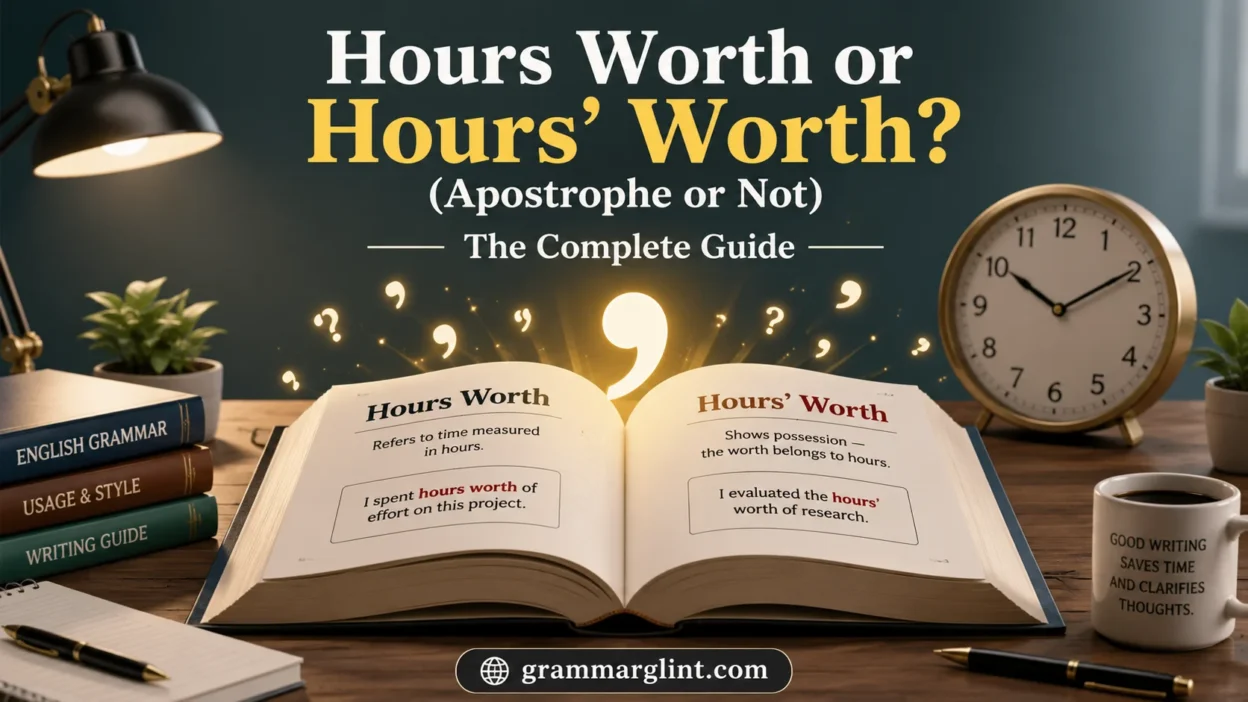
If you’re trying to understand Hours Worth or Hours’ Worth? (Apostrophe or Not), this guide makes the concept simple and easy to follow, even if you are just starting to learn grammar rules. It focuses on how apostrophes are used in possessive forms, helping you clearly understand why hours’ worth is considered correct in standard English. Many learners get confused between “hours worth” and “hours’ worth,” especially when writing sentences in real-life situations.
The keyword Hours Worth or Hours’ Worth? (Apostrophe or Not) is important here because it reflects a common grammar doubt people search for. The correct expression hours’ worth follows the plural possessive form, where multiple hours show ownership of worth, making the meaning precise and grammatically accurate.
In simple grammar terms, the apostrophe is necessary because it connects time with value. Without it, “hours worth” sounds incomplete and does not clearly show possession. This is why understanding possessive forms is important for writing correctly.
When you look at real examples, hours’ worth is used to show that something belongs to a period of time. This makes sentences clearer and more natural in formal English writing.
Once you understand this rule, you will easily avoid incorrect usage and improve your confidence in grammar, especially when dealing with time-based expressions like hours’ worth.
Quick Answer First
Let’s cut straight to it.
- “Hours’ worth” → correct for multiple hours
- “Hour’s worth” → correct for one hour
- “Hours worth” → incorrect in formal writing
Simple rule:
If the noun shows possession, you need an apostrophe.
And since “hours” is plural, the apostrophe comes after the “s.”
What Does “Hours Worth or Hours’ Worth?” Actually Mean?
Before grammar rules, you need meaning. Otherwise, the punctuation feels random.
The word “worth” here doesn’t mean money only. It means value, amount, or quantity equivalent to something.
So when you say:
- “two hours’ worth of work”
You mean:
The amount of work that equals two hours of effort.
It behaves like a measuring phrase, not just grammar decoration.
Think of it like filling a container. The container is time. The content is effort, sleep, food, or anything measurable.
Examples:
- “a dollar’s worth of candy”
- “a week’s worth of groceries”
- “three hours’ worth of studying”
Notice a pattern? The apostrophe always shows possession of quantity.
The Grammar Rule Behind “Hours Worth or Hours’ Worth”
Now let’s make the rule crystal clear.
Apostrophes have two main jobs in English:
- Show possession
- Show missing letters (like don’t, it’s)
We care about possession here.
The core rule:
- Singular noun → add ’s
- Plural noun ending in “s” → add only ’
So:
- hour → hour’s worth
- hours → hours’ worth
This rule isn’t random. It comes from Old English possessive structure, where ownership was marked differently depending on number.
Here’s the key idea:
The apostrophe shows that “worth” belongs to the time being measured.
So “hours’ worth” literally means:
worth belonging to hours
Hours Worth vs Hour’s Worth vs Hours’ Worth (Full Breakdown)
This is where most confusion happens. Let’s separate everything cleanly.
Hour’s Worth (Singular Form Explained)
Use this when talking about one single hour.
Examples:
- “I only slept an hour’s worth last night.”
- “He gave me an hour’s worth of attention.”
This form treats “hour” like it owns something.
Think of it like this:
One hour is holding a bucket of value.
So you attach ’s.
Common real-life usage:
- fitness routines
- tutoring sessions
- hourly wages
Example:
“That was only an hour’s worth of training, but it felt intense.”
Short. Clear. Correct.
Hours’ Worth (Plural Form Explained)
Now we move to multiple hours.
This is the most common version in writing.
Examples:
- “We studied for three hours’ worth of material.”
- “That meeting felt like five hours’ worth of stress.”
- “She packed a week’s worth of outfits in two hours’ worth of time.”
Here’s what’s happening:
- “hours” is already plural
- you show possession with just the apostrophe
So it becomes:
hours’
Think of it like this:
Multiple hours own the “worth.”
That’s why the apostrophe comes after the s.
Hours Worth (Why It’s Usually Wrong)
This version shows up a lot in casual typing.
But grammatically, it misses something important.
Without the apostrophe:
- there’s no possession
- the structure becomes incomplete
It reads like two random words sitting next to each other.
Examples:
- ❌ “hours worth of sleep”
- ❌ “hours worth of effort”
In formal writing, this is considered incorrect.
However, you’ll still see it in:
- social media captions
- text messages
- informal notes
Why? Because people type fast and skip punctuation.
But in professional writing, editors flag it immediately.
Read More: Is It “Doctor’s Appointment” or “Doctors Appointment”?
Why the Apostrophe Goes After “s” in Hours’ Worth
This confuses even native speakers.
Here’s the logic.
When a plural noun already ends in “s,” English avoids doubling the letter sound.
So instead of:
- hourss’ worth ❌ (clunky and wrong)
We use:
- hours’ worth ✔
This keeps writing clean and readable.
Compare:
- Students’ books ✔
- Student’s books ✔ (different meaning)
- Students books ❌
Same rule applies everywhere.
The apostrophe placement is not style. It’s structure.
Real-World Examples of Hours’ Worth in Action
Let’s make it practical so it sticks.
Everyday situations:
- “That documentary felt like two hours’ worth of emotional damage.”
- “I squeezed three hours’ worth of chores into one afternoon.”
- “She completed a full day’s worth of work before lunch.”
Academic context:
- “The assignment required five hours’ worth of research.”
- “Students completed four hours’ worth of lab work.”
Work environment:
- “We logged eight hours’ worth of overtime this week.”
- “The project demanded weeks’ worth of planning.”
These examples show flexibility. The phrase adapts to almost any situation involving time.
Common Mistakes People Make with Hours Worth or Hours’ Worth
Even confident writers slip up here. Let’s break down the usual errors.
Mistake: Dropping the apostrophe
- “hours worth of sleep”
Fix:
- “hours’ worth of sleep”
Mistake: Over-adding apostrophes
- “hours’s worth”
This is incorrect because plural nouns don’t take “’s” again.
Mistake: Confusing singular and plural meaning
- “hour’s worth” → one hour
- “hours’ worth” → multiple hours
Mixing them changes meaning completely.
Mistake: Overthinking punctuation mid-writing
People often pause too long and lose flow. The fix is simple: remember the rule, not the grammar theory.
Easy Memory Trick for Hours Worth or Hours’ Worth
Here’s a quick trick you can actually use under pressure.
Ask yourself:
“How many hours are we talking about?”
Then apply:
- One hour → hour’s worth
- More than one → hours’ worth
That’s it.
No overthinking needed.
Think of it like math:
- singular = simple ownership
- plural = shared ownership
Style Guide Insight: What Editors Prefer
Professional editors don’t treat this as optional.
Most style guides agree:
- AP Style → prefers clear possessive forms
- Chicago Manual of Style → supports standard possessive rules
They all agree on one thing:
clarity beats casual writing habits
So “hours’ worth” is the safe, accepted form in publishing, journalism, and academic writing.
Comparison Table: Hours Worth vs Hours’ Worth vs Hour’s Worth
| Phrase | Correct? | Meaning | Usage Example |
| hour’s worth | Yes | value of one hour | “an hour’s worth of practice” |
| hours’ worth | Yes | value of multiple hours | “three hours’ worth of reading” |
| hours worth | No (formal) | missing possessive structure | incorrect in essays or reports |
Case Study: How Small Grammar Choices Affect Writing Quality
Let’s look at a real-world writing scenario.
Scenario:
A student submits two essays.
Essay A uses:
- hours worth
- informal punctuation
- inconsistent grammar
Essay B uses:
- hours’ worth
- consistent apostrophes
- clean structure
Result:
Teachers typically rate Essay B higher in:
- clarity
- professionalism
- readability
Even if content is identical, grammar affects perception.
That’s the power of small punctuation marks.
Why This Tiny Apostrophe Actually Matters
It might feel minor. But here’s the bigger picture.
Correct grammar:
- builds trust
- improves readability
- signals attention to detail
And in writing, details compound fast.
Think of grammar like seasoning in food. One mistake doesn’t ruin everything, but balance matters.
FAQs
1. What is the correct form: hours worth or hours’ worth?
The correct form is hours’ worth, because it uses the plural possessive form.
2. Why do we use an apostrophe in hours’ worth?
We use an apostrophe to show that multiple hours own the worth.
3. Is “hours worth” ever correct?
No, “hours worth” is generally considered incorrect in standard English grammar.
4. What does hours’ worth mean?
It means the amount or value that belongs to a certain number of hours.
5. What grammar rule is used in hours’ worth?
It uses the rule of possessive forms, specifically plural possession.
6. Why is possessive form important here?
It helps show a clear relationship between hours and worth in the phrase.
7. Can I write it without an apostrophe?
You can write it informally, but grammatically it is not correct in standard usage.
8. Is hours’ worth used in formal writing?
Yes, hours’ worth is commonly used in formal and academic writing.
9. What mistake do learners often make?
They often forget the apostrophe and write “hours worth,” which is incorrect.
10. How can I remember the correct form?
Remember that hours is plural and needs an apostrophe to show possession.
Conclusion
Understanding Hours Worth or Hours’ Worth? (Apostrophe or Not) becomes simple once you focus on the rule of possessive forms. The correct expression hours’ worth clearly shows that multiple hours own a certain worth, making it grammatically accurate and widely accepted in English writing. By practicing this structure in real sentences, you can avoid common mistakes and improve your grammar clarity in both formal and everyday communication.
Mia Brooke is a content strategist and English language writer at Grammar Glint. She specializes in spelling comparisons, word meanings, idioms, and usage guides. Mia combines careful research with straightforward explanations to help readers navigate the nuances of modern English. Her goal is to provide accurate, trustworthy content that supports learners at every stage of their language journey.