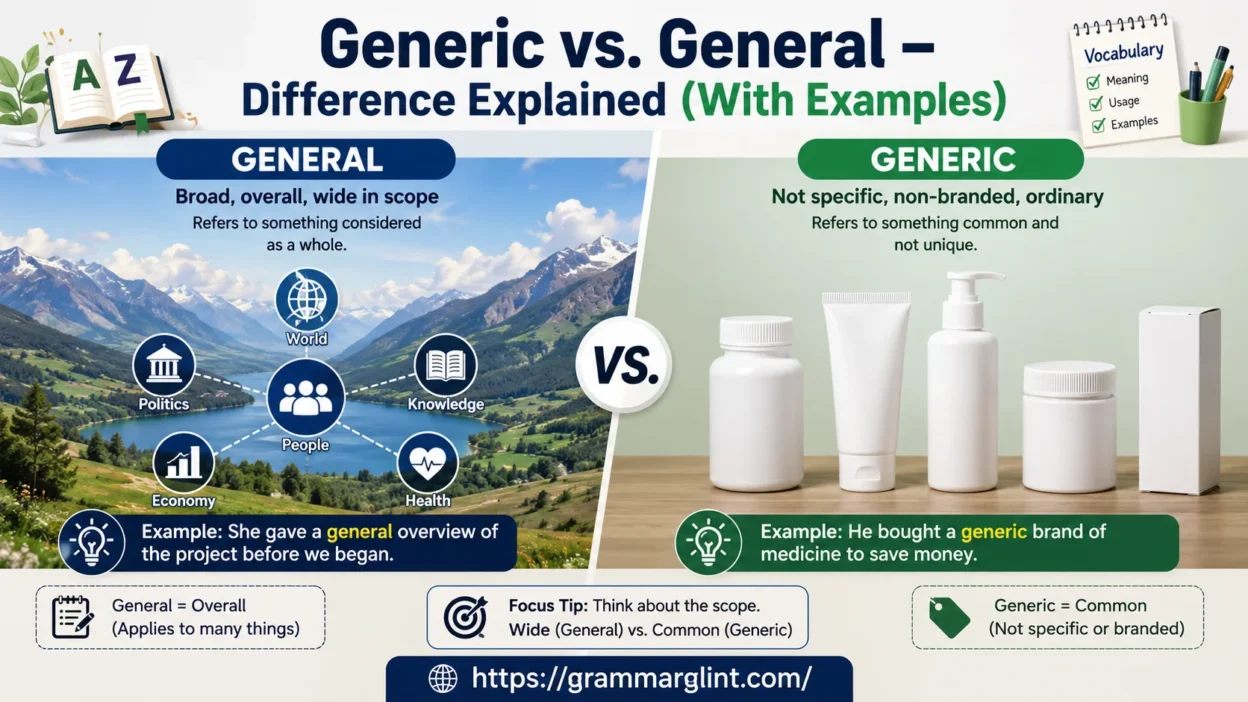
In this article, we’ll explore differences between Generic and General, two words that are often used interchangeably, but they are not the same in various contexts. Let’s define each: General refers to something broad, wide, nonspecific, applicable in most contexts.
While Generic is similar but carries connotation of plainness, unremarkability, and lack of distinctive feature. In daily life, people sometimes make mistakes due to confusion, leading us to apply these words in the wrong way.
Even though their meanings are different and may cause misunderstanding, the overlap in usage often creates uncertainty for learners and writers alike.
From experience, I notice a General thing is more all-purpose, like a high-ranking officer in military forces who commands an entire branch, or a store that sells a variety of items rather than specializing in a particular product.
On the other hand, Generic often feels like something vanilla, plain, or typical, something that is not special and does not stand out in proper contexts. So when we determine which word to use, we must see whether the thing is broad and applicable, or just common and unremarkable, since both can look similar but carry slightly different meanings.
Quick Difference
Before exploring the details, here is a quick comparison:
| Word | Meaning | Focus | Example |
| General | Broad or widespread | Range and coverage | “She gave a general overview of the topic.” |
| Generic | Common, non-specific, or lacking uniqueness | Identity and originality | “The product looks generic.” |
A useful way to remember:
General asks: “How wide is it?”
Generic asks: “How unique is it?”
What Does General Mean?
The word general describes something that covers a wide area, many people, or many situations.
When something is general, it does not focus on one narrow detail. Instead, it looks at the bigger picture.
Think of a map.
A world map gives you a general view of countries and continents. However, it does not show every street, building, or road. It provides a broad understanding.
That is how the word general works.
Definition of General
General means:
- Relating to many people or things
- Not limited to one specific case
- Broad in scope
- Common or widespread
The word can describe ideas, information, rules, opinions, and situations.
Examples of General in Everyday Language
General Information
When someone says:
“I need general information about investing.”
They want a broad introduction.
They are not asking about one specific stock, company, or strategy. They want the basics.
General information usually includes:
- Basic concepts
- Common facts
- A wide overview
- Important starting points
General Knowledge
General knowledge refers to information about many different subjects.
Someone with general knowledge may know a little about:
- History
- Science
- Geography
- Culture
- Current events
They may not be an expert in one area, but they understand many topics.
General Rules
A general rule applies to most situations.
Example:
“A general rule is to save money before making large purchases.”
This does not mean the rule works in every single situation. It means it is commonly useful.
General Opinion
A general opinion is a common view shared by many people.
Example:
“The general opinion was that the movie was entertaining.”
This means many people had a similar reaction.
It does not mean every person agreed.
Key Characteristics of General
Something is usually general when it has these qualities:
- Covers many examples
- Applies broadly
- Gives an overview
- Avoids narrow details
- Focuses on the bigger picture
A general idea is like looking at a forest.
You see the entire landscape. You do not examine every individual tree.
What Does Generic Mean?
The word generic has a different focus.
Instead of talking about how wide something is, it talks about whether something has a distinct identity.
Something generic feels common, standard, or replaceable.
Imagine walking through a store and seeing two products:
One has a unique design, recognizable branding, and special features.
The other has plain packaging with no memorable qualities.
The second product may feel generic.
Definition of Generic
Generic means:
- Not specific
- Not unique
- Without a recognizable identity
- Common or standard
However, generic does not always mean bad.
Sometimes it simply means something is not connected to a brand or special category.
Examples of Generic in Everyday Language
Generic Product
A generic product is usually a basic version without a strong brand identity.
Example:
A store sells two types of pain relievers.
One is a famous brand.
The other contains the same active ingredient but uses a different label.
The second product may be called generic medicine.
Generic does not automatically mean lower quality. It often means it does not carry the original brand name.
Generic Answer
A generic answer is usually too broad or predictable.
Example:
Question:
“How can I improve my writing?”
Generic answer:
“Practice more and read books.”
This advice is not wrong. However, it lacks detail.
A stronger answer might include:
- Reading different writing styles
- Editing your own work
- Studying sentence structure
- Practicing specific techniques
The second answer feels more useful because it is specific.
Generic Design
A generic design looks familiar but does not stand out.
For example:
A website template with common layouts and no unique features might feel generic.
A custom-designed website with a memorable style feels more original.
Key Characteristics of Generic
Something is often generic when it:
- Lacks originality
- Could belong to many people or companies
- Has few unique traits
- Feels standard or predictable
A generic thing is like a plain white shirt.
It works.
It is useful.
But it may not show much personality.
Read More: Clothes vs Clothing: Difference Explained With Clear Examples
The Main Difference Explained
The easiest way to understand the difference is to look at what each word describes.
General describes the size of an idea.
Generic describes the identity of an idea.
Here is another comparison:
| Question | Correct Word |
| “Does this cover many things?” | General |
| “Does this stand out?” | Generic |
| “Is this broad?” | General |
| “Is this ordinary or replaceable?” | Generic |
Examples
Understanding examples makes the difference much easier.
Example: Advice
General advice:
“Exercise regularly to stay healthy.”
This advice applies to many people.
It is broad.
Generic advice:
“Just be healthier.”
This sounds vague.
It does not provide useful direction.
The first sentence is general because it covers a broad topic. The second feels generic because it lacks meaningful detail.
Example: Writing
General writing:
A general article explains a topic broadly.
Example:
“A beginner’s guide to photography.”
It covers many areas:
- Cameras
- Lighting
- Composition
- Editing
Generic writing:
Generic writing feels like it could appear anywhere.
Example:
“Photography is an amazing hobby that everyone should try.”
The sentence is not wrong.
It simply does not offer a fresh perspective.
Example: Products
General product information:
This means information about a product category.
Example:
“General information about laptops.”
It might include:
- Common features
- Types of laptops
- Buying considerations
Generic product:
This describes a product without a strong identity.
Example:
A laptop case with no unique design or recognizable brand.
Generic vs. General in Different Fields
The meaning becomes even clearer when we look at different industries.
In Business
Businesses often use both terms.
A general market trend refers to a broad pattern.
Example:
“Online shopping is a general market trend.”
This means many customers are moving toward online purchases.
A generic product refers to something without a unique selling point.
Example:
A company selling a basic product with no special features may compete mainly through price.
In Medicine
Medicine provides one of the clearest examples.
General health information
This includes broad health knowledge:
- Eating habits
- Exercise
- Sleep
- Basic wellness
Generic medicine
This refers to medication that uses the same active ingredient as a branded version.
The key difference is branding, not necessarily effectiveness.
In Communication
Strong communication often depends on choosing the right word.
A person giving a general explanation helps someone understand the basics.
A person giving a generic explanation may leave the listener wanting more.
Good communication usually starts general and becomes more specific.
For example:
Step 1:
“Plants need sunlight.”
General idea.
Step 2:
“Plants use sunlight during photosynthesis to create energy.”
Specific explanation.
Common Mistakes When Using Generic and General
Even though generic and general seem similar, they are not interchangeable in every situation. Many mistakes happen because people focus only on the idea of “not specific” and ignore the deeper meaning.
Understanding these mistakes helps you choose the right word naturally.
Mistake: Using Generic When You Mean General
A very common mistake is using generic when you simply mean something broad.
Incorrect:
“I need a generic explanation of this topic.”
This sentence suggests you want an explanation that feels ordinary, vague, or lacking originality.
Better:
“I need a general explanation of this topic.”
This means you want an overview.
A general explanation introduces the topic without going into every detail.
Compare:
General explanation:
“A car engine converts fuel into energy that helps the vehicle move.”
This explains the basic idea.
Generic explanation:
“Cars are machines that help people travel.”
This sounds too broad and does not provide useful information.
The first sentence is general. The second feels generic.
Mistake: Thinking Generic Always Means Bad
The word generic sometimes carries a negative feeling, especially when talking about creativity or quality.
However, it is not always negative.
For example:
A generic medicine is not automatically worse than a branded medicine.
It usually means the product does not use the brand name. It may contain the same active ingredient.
Similarly:
A generic file format can simply mean a common format that works across many systems.
The meaning depends on the context.
| Context | Meaning of Generic |
| Medicine | Non-brand version |
| Writing | Lacking originality |
| Products | Standard or non-branded |
| Technology | Common or widely compatible |
Mistake: Confusing General With Simple
Another misunderstanding is believing that something general is always simple.
That is not true.
A general topic can still be complex.
For example:
A general discussion about climate change may cover:
- Causes
- Effects
- Solutions
- Scientific research
- Social impact
It gives a broad view, but the subject itself remains complicated.
General does not mean shallow.
It means wide.
Mistake: Using General When You Mean Unique
Sometimes people use general when describing something ordinary.
Incorrect:
“This logo looks general.”
The word sounds unusual here.
If the logo lacks originality, the better word is:
“This logo looks generic.”
Why?
Because the problem is not the size of the idea.
The problem is the lack of uniqueness.
How to Remember the Difference Between Generic and General
A simple memory trick makes the difference easier.
Think About a Forest
Imagine standing in front of a forest.
A general view shows the entire forest.
You see:
- The number of trees
- The landscape
- The overall environment
A generic tree would mean a tree that does not stand out.
Maybe it looks like every other tree.
The difference:
General = the whole picture.
Generic = no special identity.
Quick Reference Chart
| Sentence | Correct Word | Explanation |
| “Give me a ___ overview.” | General | You want broad information |
| “This answer feels ___.” | Generic | It lacks detail or originality |
| “These are ___ instructions.” | General | They apply widely |
| “This product looks ___.” | Generic | It has no unique identity |
| “She has ___ knowledge.” | General | She knows many areas |
| “The design feels ___.” | Generic | It does not stand out |
Side-by-Side Examples
Seeing both words together makes the difference clearer.
| Situation | General | Generic |
| Explanation | Broad overview | Vague explanation |
| Product | Product category information | Basic non-branded item |
| Writing | Covers many points | Lacks originality |
| Advice | Useful for many people | Too predictable |
| Design | Covers common styles | No unique features |
Why This Difference Matters in Writing
Writers often struggle with these words because both appear when discussing ideas and information.
However, word choice affects how readers understand your message.
A writer who says:
“This article provides general information.”
is saying:
The article gives a broad introduction.
A writer who says:
“This article provides generic information.”
is saying:
The article feels basic and does not add much value.
That is a major difference.
How to Make Writing Less Generic
Strong writing often begins with a general idea and then adds specific details.
For example:
Generic:
“Technology has changed our lives.”
This statement is true but common.
More specific:
“Smartphones have changed how people communicate, work, shop, and access information every day.”
The second sentence feels stronger because it gives the reader something concrete.
Ways to Avoid Generic Writing
- Add examples
- Include specific facts
- Explain causes and effects
- Use real situations
- Share unique observations
- Avoid empty phrases
Instead of:
“Exercise is important.”
Try:
“Regular exercise supports heart health, improves mood, and helps maintain strength as people age.”
Specific details transform ordinary writing into valuable content.
Generic vs. General in Everyday Conversations
In normal conversations, people use both words naturally.
Examples:
Person A:
“Can you give me a general idea?”
Meaning:
“Give me the basic picture.”
Person B:
“That sounds like a generic response.”
Meaning:
“That response sounds common and not thoughtful.”
The emotional difference matters.
A general answer can be helpful.
A generic answer can feel disappointing.
A Simple Formula to Choose the Right Word
When you are unsure, ask one question:
Are you talking about scope or uniqueness?
If you mean scope, use:
General
Examples:
- General information
- General discussion
- General advice
- General knowledge
If you mean uniqueness, use:
Generic
Examples:
- Generic product
- Generic response
- Generic design
- Generic solution
FAQs
1. What is the main difference between Generic and General?
General means broad and widely applicable, while Generic means plain, typical, and not distinctive.
2. Can Generic and General be used interchangeably?
No, they are sometimes confused, but their meanings are different in real usage.
3. Is General always more formal than Generic?
Not always, but General is more about scope, while Generic is about simplicity or lack of uniqueness.
4. What does Generic usually describe?
It describes something common, unremarkable, or without special features.
5. What does General usually describe?
It describes something wide, broad, and applicable in many situations.
6. Why do people confuse Generic and General?
Because both words sound similar and sometimes overlap in everyday contexts.
7. Can you give a simple example of General?
A General store that sells many types of items instead of one specific product.
8. Can you give a simple example of Generic?
A generic product that looks plain and does not have a special brand identity.
9. Which word is closer to “all-purpose”?
General is closer to “all-purpose” because it covers a wide range of uses.
10. Does Generic always mean bad quality?
No, it just means non-specialized or plain, not necessarily low quality.
Conclusion
After using both words in everyday conversations and while writing articles, I’ve realized that the difference is easier than it first appears. General is the right choice when talking about something broad or widely applicable, while generic describes something ordinary, non-branded, or lacking unique characteristics. I used to mix them up myself, especially when explaining ideas, but paying attention to whether I was describing scope or uniqueness made the choice much clearer.
A simple way to remember it is this: if you’re giving the big picture, use general; if you’re describing something plain or standard, use generic. Once you understand this distinction, your writing becomes more accurate, natural, and easier for readers to understand.

Aria Jane is a senior language writer and grammar specialist at Grammar Glint. She focuses on English grammar, spelling variations, vocabulary, and writing clarity. Through detailed research and practical examples, Aria helps readers understand language rules and avoid common mistakes. Her articles are designed to make English learning accessible for students, professionals, and everyday writers seeking reliable language guidance.