The English language has many prepositions that often create confusion for learners because their use changes depending on the context. Words like on and in may seem simple, but they can create different meanings when placed in sentences. The question Impact On or Impact In – Which Is Correct? explains how these phrases work and why choosing the right expression matters in everyday communication. Understanding these small differences helps improve writing, speaking, and overall language accuracy.
From my experience with linguistic learning, I have noticed that prepositions become easier when we focus on their connection with the main idea. The phrases impact on and impact in are both used correctly, but they work in different situations. The phrase impact on is generally used when discussing the effect that one thing creates on another thing. It highlights a direct relationship where one subject changes or affects another subject in a clear way.
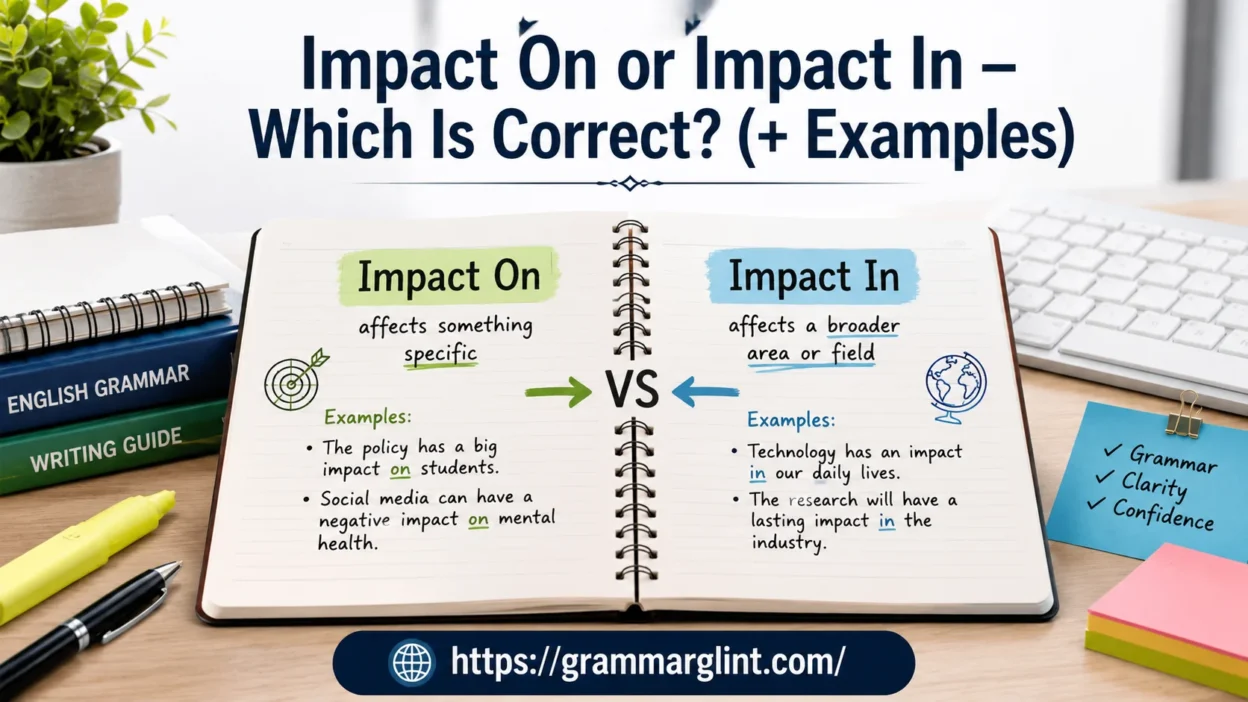
The phrase impact in focuses more on the area, field, or situation where an effect exists. It helps describe the influence or significance within a particular area, scope, or environment. The article tackles the difference between these expressions by explaining their meaning, grammar, and usage. Although both expressions are grammatically correct, their application depends on the sentence structure and the idea a speaker wants to communicate.
A strong understanding of these expressions improves vocabulary choice and makes communication clearer. When learners compare these terms, they can recognize how each phrase fits into different situations. The right use of impact on and impact in depends on the relationship between the action, result, and context. This comparison helps build confidence and makes English usage more natural in professional, academic, and daily conversations.
Quick Answer
Should you use “impact on” or “impact in”?
“Impact on” is the standard and most common choice when you mean that something affects another thing. “Impact in” is used only when referring to the area, field, or environment where the effect happens. In most everyday, academic, and business writing, “impact on” is the correct and more natural expression.
What Does Impact Mean in English?
Before comparing impact on vs impact in, it helps to understand the word impact itself.
The word impact means a strong effect, influence, or change caused by something. It can describe positive, negative, or neutral results.
For example:
- A new invention can have an impact on society.
- A natural disaster can have an impact on communities.
- A teacher can have an impact on a student’s future.
The word “impact” often suggests that the effect is noticeable or important.
You usually use “impact” when something creates a meaningful change rather than a tiny difference.
Examples of impact:
| Situation | Example Sentence |
| Technology | “Artificial intelligence has changed the impact on modern workplaces.” |
| Health | “Exercise has a positive impact on mental well-being.” |
| Environment | “Pollution has a harmful impact on wildlife.” |
| Education | “Teachers have a lasting impact on students.” |
| Business | “Customer reviews have an impact on buying decisions.” |
In English grammar, the preposition after “impact” helps explain the relationship between the cause and the result.
That is where on, in, and of become important.
When Should You Use Impact On?
The phrase “impact on” is the standard expression used when you want to show that something affects something else.
The structure is:
Subject + impact + on + affected thing
Examples:
- Technology has an impact on education.
- The economy has an impact on businesses.
- Sleep has an impact on your health.
The thing after “on” receives the effect.
Think of “impact on” as an arrow:
Cause → Effect Receiver
Technology → Education
Weather → Agriculture
Decisions → People
The arrow points toward the thing affected.
Examples of Impact On in Daily English
Impact On People
People often use “impact on” when discussing emotions, health, behavior, or life changes.
Examples:
- “Stress can have a serious impact on your health.”
- “A positive environment has an impact on personal growth.”
- “Family support can have a powerful impact on children.”
Here, health, growth, and children receive the effect.
Impact On Business and Economy
Companies frequently use this phrase when discussing trends, decisions, and market changes.
Examples:
- “Inflation has a major impact on product prices.”
- “Technology has transformed its impact on business operations.”
- “Consumer behavior has an impact on marketing strategies.”
Businesses use this structure because they usually focus on what changes after an event occurs.
Impact On Education
Education provides many examples because learning is constantly affected by new ideas and tools.
Examples:
- “Online learning has a significant impact on education.”
- “Teachers have a strong impact on student performance.”
- “Technology has changed the impact on classroom learning.”
The students, teachers, and systems receive the influence.
Why “Impact On” Sounds More Natural
English speakers commonly use impact on because it clearly connects an action with its result.
Compare these:
Natural:
“Climate change has an impact on agriculture.”
The meaning is immediate. Agriculture changes because of climate change.
Less natural:
“Climate change has an impact in agriculture.”
This sounds like climate change exists inside agriculture rather than affecting it.
The phrase is not always impossible, but it usually creates a different meaning.
Read More: Be Accepted To or Be Accepted Into: Which Is Correct?
Impact In: When Is It Correct?
Is Impact In Wrong?
No. “Impact in” is not always wrong.
However, it is less common than “impact on.”
You use impact in when you are talking about the area, field, environment, or situation where an effect appears.
The focus changes.
Instead of asking:
“What receives the effect?”
you ask:
“Where does this effect happen?”
Examples:
- “The impact in healthcare has been remarkable.”
- “The impact in rural communities is different.”
- “The impact in modern workplaces continues to grow.”
Here, the phrase points toward a specific context.
Understanding Impact In With Simple Examples
Imagine a new technology enters hospitals.
You could say:
Impact on:
“Artificial intelligence has an impact on doctors.”
Doctors experience the effect.
Impact in:
“Artificial intelligence has an impact in healthcare.”
Healthcare is the field where the change occurs.
Both can work, but they answer different questions.
Impact On vs Impact In: The Main Difference
The easiest way to separate these phrases is to look at their purpose.
| Phrase | Main Purpose | Example |
| Impact on | Shows what receives the effect | “The storm had an impact on homes.” |
| Impact in | Shows the area where the effect exists | “The impact in coastal areas was severe.” |
| Impact of | Shows the source causing the effect | “The impact of the storm was severe.” |
A useful shortcut:
Impact on = target
Impact in = location/context
Impact of = cause
Impact On vs Impact In vs Impact Of
Many writers also confuse impact of with the other two phrases.
Each one has a different job.
Impact Of
Use impact of when you explain the source of the effect.
Examples:
- “The impact of technology is everywhere.”
- “The impact of climate change is increasing.”
- “The impact of social media continues to grow.”
The question it answers:
What caused the effect?
Impact On
Use impact on when you explain the receiver.
Example:
- “The impact of technology on education is enormous.”
Breaking it down:
Cause:
Technology
Effect receiver:
Education
Impact In
Use impact in when you describe the environment or field.
Example:
- “The impact in education has changed teaching methods.”
Meaning:
The effect exists within education.
Quick Comparison Example
Sentence:
“The impact of AI on healthcare is significant.”
Breakdown:
- Impact of AI → AI creates the effect.
- Impact on healthcare → Healthcare receives the effect.
Another example:
“The impact in healthcare is significant.”
Meaning:
The discussion focuses on the healthcare field itself.
Common Mistakes With “Impact On” and “Impact In”
Even though both phrases can appear in English, many writers use them incorrectly because they focus only on the word “impact” and ignore the role of the preposition.
The small word after “impact” changes the relationship between ideas.
Let’s look at the most common mistakes.
Mistake: Using “Impact In” When You Mean “Impact On”
A frequent mistake happens when writers describe something that receives an effect.
Incorrect:
“Technology has a major impact in education.”
The sentence sounds like technology exists inside education rather than affecting it.
Better:
“Technology has a major impact on education.”
Education receives the change caused by technology.
More examples:
❌ “Exercise has an impact in your health.”
✅ “Exercise has an impact on your health.”
❌ “The decision had an impact in employees.”
✅ “The decision had an impact on employees.”
The people affected take on.
Mistake: Assuming “Impact On” Is Always About Physical Contact
Some learners think “on” only describes physical things.
That is not true.
English uses “on” for many abstract relationships.
Examples:
- “The impact on society was enormous.”
- “The impact on confidence was unexpected.”
- “The impact on future generations will be significant.”
Society, confidence, and generations are not physical objects, but they receive an effect.
Mistake: Adding Extra Prepositions
Sometimes writers combine phrases unnecessarily.
Incorrect:
“The impact on in the economy was noticeable.”
Correct:
“The impact on the economy was noticeable.”
Choose the preposition that matches your meaning.
One strong preposition is better than several confusing ones.
Mistake: Confusing Impact In With Impact Within
The words in and within often create similar ideas.
For example:
- “The impact in the workplace”
- “The impact within the workplace”
Both can work because they describe a setting.
However, within often emphasizes something happening inside a system.
Examples:
- “The impact within the organization changed company culture.”
- “The impact in the organization was noticeable.”
The difference is subtle.
Real-World Examples of “Impact On”
The best way to understand grammar is to see how people actually use it.
Technology
Technology changes how people work, communicate, and learn.
Examples:
- “Artificial intelligence has a major impact on the future of work.”
- “Smartphones have had a huge impact on communication.”
- “Automation has an impact on employment patterns.”
The technology causes change. Work, communication, and employment receive the effect.
Environment
Environmental topics frequently use “impact on.”
Examples:
- “Climate change has an impact on global temperatures.”
- “Deforestation has a negative impact on wildlife.”
- “Plastic waste has a harmful impact on oceans.”
The environment receives the consequences.
Business
Companies often analyze impact because decisions create measurable results.
Examples:
- “Customer feedback has an impact on brand reputation.”
- “Interest rates have an impact on business growth.”
- “Marketing strategies have an impact on consumer behavior.”
A business asks:
What changed because of this decision?
That answer usually follows impact on.
Education
Learning systems constantly experience new influences.
Examples:
- “Technology has an impact on classroom learning.”
- “Parents have an impact on children’s academic success.”
- “School policies have an impact on student experiences.”
The effect moves toward students, schools, or learning.
Real-World Examples of “Impact In”
Although less common, “impact in” has legitimate uses.
The key is context.
Impact In Specific Fields
When you discuss a field or industry, “in” can work.
Examples:
- “The impact in healthcare has been revolutionary.”
- “The impact in artificial intelligence research is growing.”
- “The impact in renewable energy continues to expand.”
Here, the focus is the field itself.
Impact In Specific Locations
“In” works when the place matters.
Examples:
- “The impact in rural areas was stronger.”
- “The impact in developing countries varies.”
- “The impact in coastal regions was severe.”
The sentence focuses on where the effect appears.
Impact In Specific Situations
You can also use “impact in” for situations.
Examples:
- “The impact in emergency situations can be unpredictable.”
- “The impact in crisis management is widely studied.”
- “The impact in professional settings depends on many factors.”
The phrase describes the environment.
A Simple Trick to Choose Between Impact On and Impact In
When you are unsure, ask one question:
Are you talking about the receiver or the environment?
If you mean the receiver:
Use:
Impact on
Examples:
- Impact on students
- Impact on business
- Impact on health
- Impact on society
If you mean the environment:
Use:
Impact in
Examples:
- Impact in healthcare
- Impact in schools
- Impact in rural areas
- Impact in modern workplaces
This simple test solves most cases.
Sentence Transformation Examples
Sometimes seeing a sentence change makes the difference clearer.
Example One
Original:
“The impact in technology has changed communication.”
Better:
“The impact of technology on communication has changed society.”
Why?
Technology causes the effect.
Communication receives it.
Example Two
Original:
“The impact on healthcare is growing.”
Correct.
Meaning:
Something is affecting healthcare.
Example Three
Original:
“The impact in healthcare is growing.”
Also possible.
Meaning:
The effect within healthcare as a field is increasing.
Impact On or Impact In: Which One Should You Use?
For most writing, choose:
Impact On
It is the safer and more natural option.
Use it when writing:
- Articles
- Essays
- Reports
- Emails
- Academic work
- Business content
Examples:
- “The impact on customers was positive.”
- “The impact on the economy was significant.”
- “The impact on education is clear.”
Use impact in when your sentence focuses on:
- A field
- A location
- A specific environment
Examples:
- “The impact in medicine is undeniable.”
- “The impact in urban areas is different.”
- “The impact in modern workplaces continues.”
My Personal Experience
After teaching English for more than 15 years, I have found that many students initially use “impact in” when they actually mean “impact on.” During classroom discussions and writing exercises, I encourage students to ask themselves one simple question: What is being affected? This approach helps them quickly recognize that “impact on” is appropriate when something receives the effect, while “impact in” is reserved for discussing influence within a specific field or context. Over the years, this practical method has greatly improved my students’ grammar accuracy and confidence in writing.
FAQs
1. What does “impact on” mean?
It means the effect that one thing has on another in a direct way.
2. When should I use “impact on”?
You should use it when showing how one action or situation affects another object or person.
3. What does “impact in” mean?
It refers to influence or significance within a specific area, field, or context.
4. Is “impact in” commonly used in English?
It is less common than “impact on” but still correct in certain contextual uses.
5. Are both “impact on” and “impact in” grammatically correct?
Yes, both are grammatically correct but used in different contexts.
6. What is the main difference between them?
“Impact on” shows direct effect, while “impact in” shows influence within a scope or area.
7. Can I replace “impact on” with “impact in”?
No, they are not interchangeable because their meanings differ based on usage.
8. Why do learners get confused between them?
Because both use similar prepositions and appear in similar sentence structures.
9. Does sentence structure affect their usage?
Yes, sentence structure and meaning decide which phrase is correct.
10. How can I improve usage of these phrases?
By understanding context, meaning, and practicing real-life sentence examples.
Conclusion
Understanding impact on and impact in is important for clear and correct English usage. While both are grammatically correct, their meaning changes based on context. Impact on is used for direct effects between two things, whereas impact in focuses on influence within a specific area or field. Learning these differences helps improve grammar, communication, and vocabulary choice in everyday English.

Shafiq Ur Rehman is an English language educator, editor, and grammar writer with over 10 years of teaching experience in English and Mathematics across various educational institutions. As an editor at Grammar Glint, he creates clear, accurate, and easy-to-understand content on English grammar, spelling, punctuation, word meanings, idioms, and common usage questions.
Drawing on years of classroom experience, Shafiq focuses on explaining grammar rules in simple language with practical examples that help students, teachers, writers, and English learners build confidence in their communication. His goal is to publish trustworthy, well-researched, and reader-friendly content that makes learning English easier for everyone.