Clothes vs Clothing shows how people assume same meaning, but usage and grammar reveal clear differences in everyday English language today now and in real communication practice.
In English, many people still have the assumption that clothes and clothing mean the same thing, but the article gives the answer by explaining both concepts more clearly in a simple and practical way that learners often need. These words may seem like synonyms, but in reality, they refer to ideas that are not always exact, not always common, and often depend on everyday use, context, and speaking style in real life situations where language is actually applied.
The term clothing generally refers to a larger collective idea of garments, accessories, and items worn on the body, while Cloth relates to material, and clothes are seen as individual wearable things used in daily life.
A plural item contrasts with a singular item, and countable / non-countable usage shows how pieces, a lot, or little fabric and outfits are understood in natural communication and learning contexts. This explanation is typically used to describe everyday wear, where broader types are grouped under one word, and it is regarded more formal when compared in general, broad, and specific contexts, especially in written English and academic or structured explanation style.
In daily life, usage often depends on situation, tone, and how naturally speakers want to express ideas, because however, both ideas are closely related and still interchangeable in casual speech at times.
Teaching experience shows that people often mix understanding, but learning the distinction helps avoid confusion and improves clarity in writing and speaking. The idea is that language is structured, where one thing is collective and broad, while the other is specific and individual, helping us make sense in speech and communication, not just through words, but also through details, patterns, and real examples of how we refer to what we wear in different real-world contexts.
Quick Answer Before We Go Deep
Let’s make this simple right away.
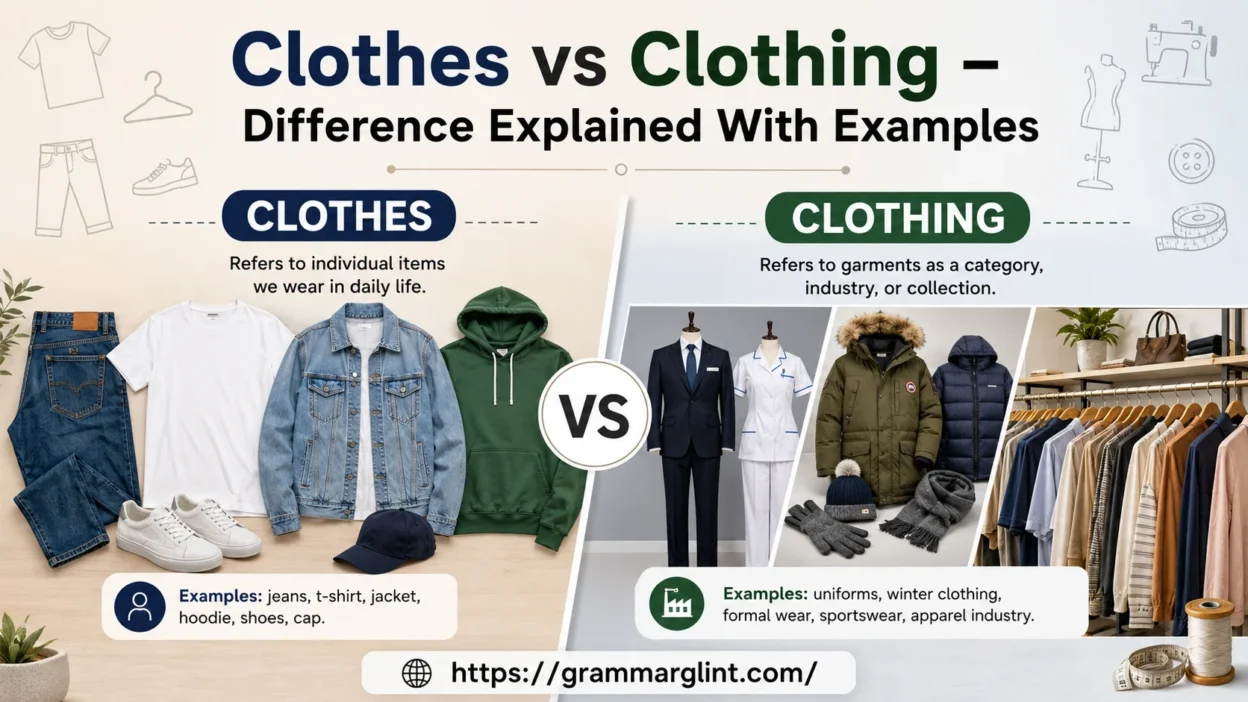
- Clothes = the actual items you wear (shirts, pants, jackets, dresses)
- Clothing = the general category or system of garments
Think of it like this:
- Clothes = individual objects in your wardrobe
- Clothing = the entire concept of dressing the human body
Example:
- “I washed my clothes.” (specific items)
- “Winter clothing is essential in cold weather.” (general category)
That’s the core difference in clothes vs clothing. Now let’s go deeper so you never confuse them again.
What “Clothes” Really Means in Everyday English
When people say “clothes,” they talk about what you physically wear every day.
Shirts, jeans, socks, hoodies, uniforms—all of these fall under clothes.
Clothes = Physical Items You Can Point To
You can touch them. You can fold them. You can spill coffee on them and regret it instantly.
That’s clothes.
How “Clothes” Behaves in Grammar
Here’s where learners often get stuck:
- “Clothes” is always plural
- There is no standard singular form in modern usage
- You don’t say “a clothe” when talking about garments
Instead, English treats “clothes” as a collective plural noun.
Real-Life Examples of Clothes
- “My clothes are still wet after the rain.”
- “He packed light clothes for the trip.”
- “She bought new clothes for Eid.”
Notice something? All of these feel casual and personal.
When People Naturally Use “Clothes”
You’ll hear “clothes” in situations like:
- Packing a suitcase
- Doing laundry
- Talking about outfits
- Shopping casually
- Describing someone’s appearance
It feels human. It feels direct. It feels normal in conversation.
A Simple Analogy
Think of clothes like items in your fridge.
You don’t say “food system is in the fridge.” You say “food is in the fridge.”
Same idea here. Clothes = what you physically use and see.
What “Clothing” Really Means (And Why It Sounds Different)
Now let’s talk about clothing, the word that often confuses people in formal writing.
Clothing does NOT refer to individual items in the same direct way.
Instead, it refers to the broader idea or category of what people wear.
Clothing = A System, Category, or Industry Concept
Clothing describes:
- Types of garments as a group
- Fashion categories
- Industry-level discussion
- Functional wear systems (protective, sports, uniforms)
Clothing in Grammar
Here’s the key rule:
- Clothing is an uncountable noun
- You don’t say “a clothing” or “two clothings”
- You treat it like “water” or “information”
Real-Life Examples of Clothing
- “Winter clothing helps protect against cold temperatures.”
- “The company produces safety clothing for workers.”
- “Clothing trends change every season.”
These sound more formal and structured.
Where You See “Clothing” Most Often
You’ll notice “clothing” in:
- Business writing
- Fashion industry reports
- Academic essays
- Product categories in stores
- Safety manuals
- Marketing language
A Simple Analogy
If “clothes” are individual trees, then “clothing” is the forest.
You’re not looking at one item. You’re looking at the whole system.
Clothes vs Clothing – Side-by-Side Comparison Table
Let’s make this crystal clear.
| Feature | Clothes | Clothing |
| Meaning | Individual wearable items | General category of garments |
| Grammar | Always plural | Uncountable noun |
| Tone | Casual and conversational | Formal and technical |
| Context | Daily life situations | Industry, business, academic use |
| Example | “I need clean clothes” | “Protective clothing is required” |
| Focus | Specific items | Entire system |
This table alone solves most confusion in clothes vs clothing usage.
When to Use “Clothes” Without Thinking Twice
You should naturally use clothes when you talk about real-life, personal situations.
Use Clothes When Talking About:
- Your daily outfit
- Laundry and washing
- Packing for travel
- Shopping for yourself
- Describing appearance
Examples You’ll Hear in Real Life
- “I don’t have enough clothes for the party.”
- “These clothes don’t fit anymore.”
- “Put on warmer clothes before you go out.”
Why It Works in Conversation
“Clothes” feels human. It feels like something you’d say without thinking.
It carries emotional and personal weight.
When to Use “Clothing” Like a Professional
Now shift your mindset.
Use clothing when you zoom out and talk about systems, industries, or categories.
Use Clothing When Talking About:
- Fashion industries
- Business reports
- Safety requirements
- Clothing lines or brands
- Technical or academic topics
Examples That Sound Professional
- “Sustainable clothing is growing in demand worldwide.”
- “The military requires standardized clothing systems.”
- “The clothing industry employs millions globally.”
Why Professionals Prefer “Clothing”
It sounds structured and neutral. It avoids emotional tone and focuses on classification.
That’s why reports and businesses rarely say “clothes industry.”
They say clothing industry instead.
Common Mistakes People Make With Clothes vs Clothing
Even fluent speakers mess this up sometimes.
Here are the biggest mistakes.
Mistake: Using “Clothing” in Casual Speech
❌ “I need new clothing for school.”
✔ “I need new clothes for school.”
The first one sounds overly formal for everyday talk.
Mistake: Saying “A Clothing”
❌ “A clothing is on sale.”
✔ “An item of clothing is on sale.”
✔ “Clothing is on sale.”
Mistake: Mixing Both Without Purpose
❌ “I bought clothes clothing yesterday.”
That sounds broken because both words overlap without structure.
Mistake: Overusing “Clothes” in Formal Writing
❌ “The clothes industry is huge.”
✔ “The clothing industry is huge.”
Real-World Usage: Clothes vs Clothing in Action
Let’s compare how these words behave in real contexts.
Casual Situation
“I spilled juice on my clothes during breakfast.”
Simple. Direct. Personal.
Formal Situation
“The company designs clothing for outdoor workers.”
Structured. Professional. Broad.
Marketing Example
- Clothes: “Shop trendy clothes for summer!”
- Clothing: “Explore sustainable clothing collections.”
Same idea. Different tone.
Grammar Insight: Why “Clothing” Works Differently
English treats these words in two different grammatical ways.
Clothes
- Always plural
- Refers to countable items collectively
- Works like “scissors” or “pants”
Clothing
- Uncountable noun
- Represents a mass category
- Works like “furniture” or “equipment”
Simple Rule to Remember
If you can count it, think “clothes.”
If you describe it as a whole system, think “clothing.”
Clothing Industry vs Clothes Industry (Why One Sounds Wrong)
This is a classic confusion point.
Correct Term
✔ Clothing industry
Why It Works
Because industries deal with systems, not individual items.
The industry covers:
- Design
- Manufacturing
- Retail
- Marketing
- Supply chains
So “clothing” fits perfectly.
Read More: South vs. Southern: What’s the Difference?
Case Study: How Brands Use Clothes vs Clothing
Let’s look at how real-world branding uses both terms.
Fast Fashion Retailer Example
A global retailer promotes:
- “Affordable clothes for everyday wear” (consumer-facing language)
But in reports, they write:
- “Expansion of global clothing supply chains” (business language)
Sports Brand Example
- Marketing: “High-performance training clothes”
- Technical report: “Athletic clothing designed for heat regulation”
Key Insight
Brands switch language based on audience.
- Emotional and casual → clothes
- Strategic and technical → clothing
Cultural Difference in Usage
Language changes depending on region and context.
In Everyday Speech
People say “clothes” almost everywhere in casual talk.
In Formal English Writing
Writers prefer “clothing” in academic or professional settings.
In Fashion Media
Both appear, but:
- “Clothing” dominates industry reporting
- “Clothes” dominates lifestyle content
Quick Memory Trick to Lock It In
Here’s an easy way to never forget:
- If you’re talking about what you wear today → clothes
- If you’re talking about the idea or system of dressing → clothing
Or even simpler:
- Clothes = items
- Clothing = category
My Personal Experience:
After teaching English for many years, I’ve noticed that many students use clothes and clothing as if they mean exactly the same thing. One day, a student wrote, “I bought new clothing for the wedding.” Although the sentence was grammatically correct, it sounded too formal for a casual conversation. I explained that native speakers would normally say, “I bought new clothes for the wedding.” Since then, I’ve used real-life shopping and travel examples in my classes, and my students have become much more confident in choosing the right word naturally.
FAQs
1. Are clothes and clothing the same thing?
No, they are related but not exactly the same. Clothes are individual items you wear, while clothing is a general term for garments as a whole.
2. Is clothing more formal than clothes?
Yes, clothing is considered more formal and is often used in written or general descriptions.
3. Can we use clothes for formal writing?
You can, but clothing is preferred in formal or academic writing because it sounds more general.
4. Is clothing countable or uncountable?
Clothing is uncountable, while clothes is plural and used as a countable concept.
5. What is the singular form of clothes?
We usually say “an item of clothing” or “an article of clothing” instead of a singular “clothe.”
6. Does clothing include accessories?
Yes, clothing can include garments and sometimes accessories depending on context.
7. What does clothes refer to exactly?
Clothes refer to wearable items like shirts, pants, jackets, and dresses.
8. Why do people get confused between clothes and clothing?
Because both words are closely related and often used in similar contexts in everyday English.
9. Is cloth the same as clothes?
No, cloth is material, while clothes are finished wearable items.
10. Which word is more commonly used in daily speech?
In daily speech, people often use clothes, while clothing appears more in formal contexts.
Conclusion
In simple terms, both clothes and clothing relate to what we wear, but they are used differently in English. Clothes usually describe specific wearable items in everyday speech, while clothing refers to a broader, more formal category of garments. Understanding this difference helps improve clarity in both speaking and writing, especially when choosing the right word for context.
Emma Brooke is an editor and language researcher at Grammar Glint. Her work centers on grammar rules, punctuation, word usage, and style consistency. Emma is passionate about transforming complex language concepts into clear, reader-friendly explanations. She contributes in-depth articles that help readers communicate more effectively and confidently in both academic and professional settings.