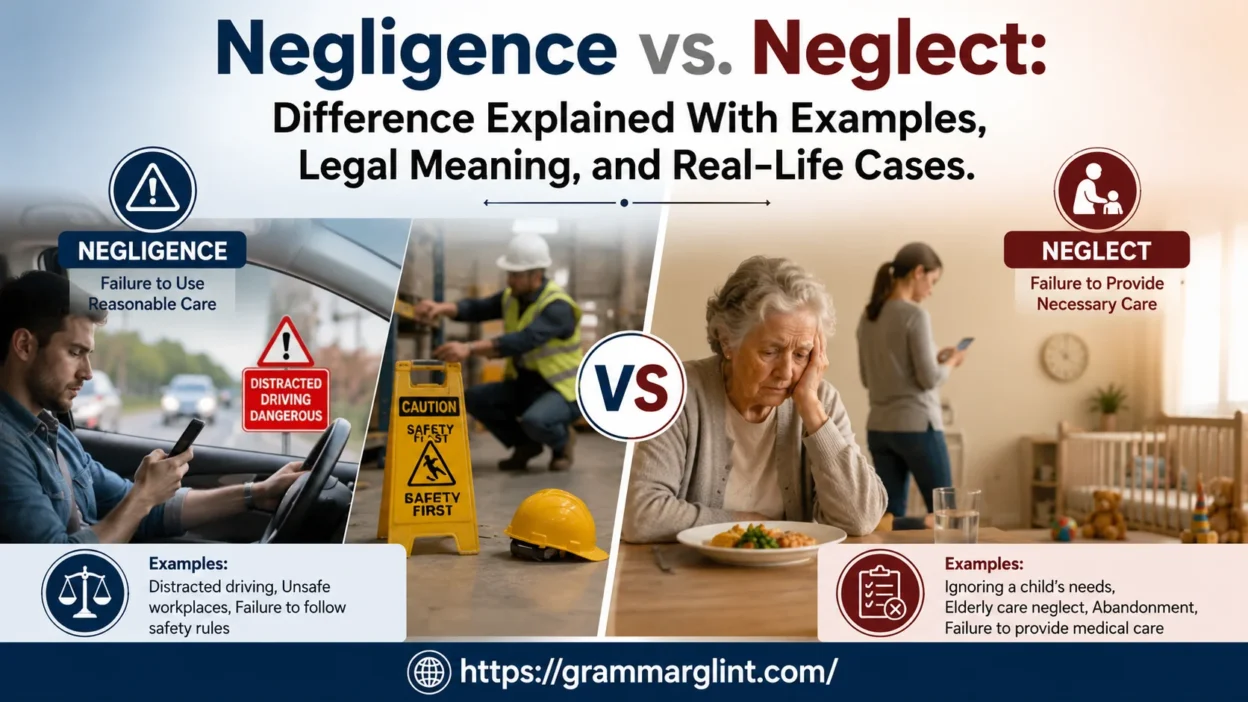
Negligence vs. Neglect the difference becomes clear when we study how both terms are used in legal scenarios and everyday English. Hearing these words can make us doubt whether they are synonyms or not. Moreover, they are used quite often in legal contexts, and knowing their exact meaning helps you understand language better. So, it is important to read carefully and never confuse these two terms.
The use of neglect and negligence is often interchangeable in colloquial English, but the difference between them appears when the meaning shifts in context. While both are usually used for people and things, in legal systems they become part of tort law, where negligence and neglect are not the same. A passive form of abuse is often linked with neglect, while negligence appears in more technical or legal meanings as a distinct term.
In practice, negligence refers to a lack of care and attention to duties, leading to harm or risk. It is not about doing something that should be done in professional contexts. For example, a doctor not following proper procedures may be judged under negligence in a legal or professional setting.
On the other hand, neglect means failing to care for someone or something, resulting in suffering or damage. It is more personal and involves ignoring the needs of others, such as a guardian providing care for a child. This shows that neglect is more specific to care-related situations.
Both involve a failure to act responsibly in different situations, but negligence is broader and can occur in various professional or legal contexts, whereas neglect is more focused on care and responsibility in personal situations.
What Is Negligence? Definition and Meaning
Negligence means failing to use reasonable care when you have a responsibility to do so.
A negligent person does not always intend to cause harm. Instead, their careless action or failure to act creates a risk that leads to damage, injury, or loss.
Think of negligence as a person who should have paid attention but didn’t.
For example, imagine a store owner knows a floor is wet but does not place a warning sign. A customer slips and gets injured. The owner may have acted negligently because they failed to take a reasonable safety step.
Negligence often involves a specific event or mistake.
Simple definition:
Negligence = careless action or inaction that causes harm.
Key Elements of Negligence
In legal and professional situations, negligence usually involves four important elements.
| Element | Meaning |
| Duty of care | A person or organization had a responsibility to act safely |
| Breach of duty | They failed to meet that responsibility |
| Cause | Their failure directly contributed to harm |
| Damages | Someone experienced injury, loss, or damage |
These elements help determine whether an action was truly negligent.
A simple mistake does not automatically equal negligence. Context matters.
For instance:
- Accidentally spilling coffee is a mistake.
- Leaving a dangerous spill unattended in a public area for hours may become negligence.
The difference comes from responsibility and reasonable expectations.
Real-Life Examples of Negligence
Negligence appears in many areas of life.
Driver Negligence
Driving requires attention and care. When someone ignores basic safety rules, they create danger.
Examples include:
- Texting while driving
- Driving under the influence
- Ignoring traffic signals
- Speeding in unsafe conditions
A driver who causes a crash because they looked at their phone for a few seconds may have acted negligently.
Medical Negligence
Healthcare professionals have a duty to provide proper care.
Medical negligence can happen when a healthcare provider fails to meet accepted standards.
Examples include:
- Giving the wrong medication
- Misreading test results
- Failing to diagnose a serious condition
- Making avoidable treatment mistakes
A medical error does not always mean negligence. Sometimes complications happen even when proper care is provided.
The key question is:
Did the healthcare provider act as a reasonable professional would under similar circumstances?
Workplace Negligence
Employers and employees both have responsibilities.
A company may act negligently if it ignores known safety risks.
Examples:
- Not repairing broken equipment
- Failing to provide safety training
- Ignoring repeated hazard reports
Consider this situation:
A factory worker reports a damaged machine guard. Management ignores the issue. Later, another employee gets injured.
The failure to address the known danger may be workplace negligence.
What Is Neglect? Definition and Meaning
Neglect means failing to give proper care, attention, or support that someone or something needs.
Unlike negligence, neglect often focuses on missing important needs.
It frequently involves repeated behavior rather than one isolated mistake.
For example:
- Forgetting to call someone back once is not usually neglect.
- Constantly ignoring someone’s emotional or physical needs may be neglect.
Simple definition:
Neglect = failure to provide necessary care or attention.
Types of Neglect Explained
Neglect can appear in different areas of life.
Child Neglect
Child neglect happens when a parent or caregiver fails to provide basic needs.
These needs may include:
- Food
- Shelter
- Supervision
- Education
- Medical care
- Emotional support
Example:
A parent forgets one school pickup because of an emergency. That may be a mistake.
However, consistently leaving a child without supervision or basic necessities may become neglect.
Elder Neglect
Older adults may depend on caregivers for daily support.
Elder neglect can involve failing to provide:
- Proper nutrition
- Medication assistance
- Hygiene support
- Safe living conditions
- Medical attention
For example:
An elderly person who depends on a caregiver but repeatedly does not receive necessary medication may experience neglect.
Workplace Neglect
Neglect can also happen professionally.
Examples include:
- Ignoring important maintenance tasks
- Failing to respond to safety concerns
- Repeatedly avoiding responsibilities
A worker who forgets one task may simply make a mistake.
A worker who repeatedly ignores essential duties may show neglect.
Self-Neglect
Neglect does not always involve another person.
Self-neglect happens when someone fails to care for their own basic needs.
Examples:
- Ignoring serious health concerns
- Refusing necessary personal care
- Failing to maintain a safe living environment
Self-neglect can develop for many reasons and often requires understanding the situation rather than quick judgment.
Negligence vs. Neglect: Main Differences
The easiest way to understand negligence vs. neglect is to compare them directly.
| Difference | Negligence | Neglect |
| Basic meaning | Lack of reasonable care | Lack of needed care or attention |
| Main focus | Careless behavior | Missing responsibilities or needs |
| Typical pattern | Often one event | Often repeated behavior |
| Intent | Usually accidental | Can be accidental or intentional |
| Common areas | Accidents, professional duties, safety | Caregiving, relationships, responsibilities |
A useful way to remember:
Negligence is about a careless act. Neglect is about a missing duty of care.
A Simple Analogy to Remember the Difference
Imagine someone owns a garden.
If they accidentally damage a plant while working, that may be negligence.
If they never water the garden for months and the plants die, that is closer to neglect.
One involves a careless action.
The other involves failing to provide ongoing care.
Read More: In Stock or On Stock: Which Is Correct? Complete Usage Guide
Negligence vs. Neglect in Legal Terms
The words negligence and neglect often appear in legal conversations, but the law treats them differently depending on the situation.
In many legal systems, negligence is a recognized basis for liability. A person, company, or professional may be responsible when their lack of reasonable care causes harm.
Neglect can also have legal consequences, especially when someone has a clear duty to care for another person.
However, the legal meaning depends on the circumstances.
A missed responsibility does not automatically become a legal issue. Courts usually examine the facts:
- Was there a duty to act?
- Did someone fail to meet that duty?
- Did harm occur?
- Was the harm connected to the failure?
These questions help separate ordinary mistakes from serious wrongdoing.
How Negligence Works in a Legal Case
A negligence claim usually focuses on whether someone acted reasonably.
The standard question is:
“What would a reasonable person have done in the same situation?”
For example:
A driver approaches a busy intersection. The light turns red, but the driver continues because they are distracted. A crash happens.
The issue is not simply that an accident occurred.
The issue is whether the driver failed to behave with reasonable care.
Common negligence cases include:
- Car accidents
- Medical mistakes
- Unsafe property conditions
- Workplace injuries
- Product-related injuries
How Neglect Is Viewed Legally
Neglect often appears in areas where one person depends on another.
Examples include:
- Child care
- Elder care
- Patient care
- Professional responsibilities
A caregiver has a responsibility to provide basic support. If they repeatedly fail to do so, the situation may become neglect.
For example:
A caregiver forgets one meal because of an emergency. That may be a mistake.
A caregiver repeatedly refuses to provide food, medication, or basic assistance may be neglect.
The pattern and impact matter.
Negligence vs. Neglect in Healthcare
Healthcare is one of the clearest areas where these terms are often confused.
Doctors, nurses, caregivers, and healthcare facilities all have responsibilities toward patients.
A failure in care can happen in different ways.
Medical Negligence Explained
Medical negligence occurs when a healthcare professional fails to provide the level of care expected from someone in their position.
Healthcare providers make decisions under pressure. Not every poor outcome means negligence.
A treatment can fail even when a medical professional follows proper procedures.
Medical negligence usually involves a preventable mistake.
Examples:
- A doctor prescribes the wrong medication dosage.
- A healthcare provider fails to check important medical information.
- A professional ignores a known risk.
The central question is whether the care met accepted professional standards.
Patient Neglect Explained
Patient neglect focuses more on failing to provide necessary attention or support.
Examples:
- Ignoring a patient’s requests for essential assistance
- Failing to provide basic hygiene care
- Leaving a patient without needed supervision
- Not responding to obvious medical needs
A hospital worker making one small mistake is not always neglect.
A repeated failure to provide basic care may become neglect.
Medical Negligence vs. Patient Neglect Table
| Medical Negligence | Patient Neglect |
| Usually involves a professional error | Usually involves missing basic care |
| Often connected to treatment decisions | Often connected to attention and support |
| May happen during diagnosis or treatment | Often happens during ongoing care |
| Focuses on standard of professional care | Focuses on unmet needs |
Negligence vs. Neglect Examples in Everyday Life
These words are easier to understand when you see them in normal situations.
Driving Example
Negligence:
Someone checks a phone while driving and causes a crash.
Why?
Because they failed to use reasonable caution.
Neglect:
Someone knows their brakes are dangerous but keeps driving for months without fixing them.
Why?
Because they ignored an ongoing responsibility.
Home Responsibility Example
Negligence:
A person leaves a candle burning and accidentally causes a small fire.
Neglect:
A homeowner ignores exposed wiring for years despite knowing it creates a danger.
The first situation involves careless behavior.
The second involves failing to address a continuing problem.
Relationship Example
Relationships also show the difference.
Negligence:
Someone forgets an important anniversary because they were overwhelmed.
Neglect:
Someone repeatedly ignores their partner’s needs, concerns, and attempts to communicate.
A single failure is different from a repeated pattern.
Can Negligence and Neglect Overlap?
Yes, they can sometimes overlap.
A situation may involve both negligence and neglect depending on the details.
Imagine a caregiver responsible for giving medication.
Scenario one:
The caregiver accidentally gives the wrong dose once because they misread the instructions.
This may be negligence.
Scenario two:
The caregiver regularly ignores medication schedules and does not care whether the person receives treatment.
This may be neglect.
The difference often comes down to:
- Frequency
- Responsibility
- Awareness
- Consequences
Common Misunderstandings About Negligence and Neglect
Many people use these words interchangeably. That creates confusion.
Let’s clear up some common myths.
“Negligence and neglect are exactly the same.”
They are related but not identical.
Both involve a failure of responsibility, but negligence usually focuses on careless actions while neglect focuses on missing care or attention.
“Neglect always means someone wanted to cause harm.”
Not necessarily.
Neglect can happen because someone is careless, overwhelmed, uninformed, or unable to handle responsibilities.
Intent matters in some situations, but the result and circumstances also matter.
“One mistake automatically means negligence.”
A mistake alone is not enough.
Everyone makes mistakes.
Negligence usually involves a failure to act with the level of care expected in a situation.
Quick Guide: Negligence vs. Neglect Cheat Sheet
| Question | Negligence | Neglect |
| What happened? | Someone acted carelessly | Someone failed to provide care |
| Is it usually one event? | Often yes | Often repeated |
| Main issue | Unsafe or unreasonable action | Missing important needs |
| Example | Distracted driving accident | Repeated failure to provide care |
A simple memory trick:
Negligence = “I did something careless.”
Neglect = “I failed to take care of something important.”
FAQs
1. What is the main difference between negligence and neglect?
Negligence is a failure to take proper care in duties, while neglect is failing to care for someone or something, often in personal situations.
2. Is negligence a legal term?
Yes, negligence is widely used in tort law and legal systems where lack of care leads to harm or risk.
3. Is neglect also used in law?
Yes, neglect can be used in legal and social contexts, especially when referring to care, responsibility, or abuse situations.
4. Can negligence and neglect be used interchangeably?
No, they are sometimes confused, but they have different meanings and applications.
5. Which one is more professional: negligence or neglect?
Negligence is more commonly used in professional and legal contexts.
6. What is an example of negligence?
A doctor not following proper medical procedures can be an example of negligence.
7. What is an example of neglect?
A guardian failing to provide basic care for a child is an example of neglect.
8. Is neglect always intentional?
Not always. Neglect can happen due to carelessness, but it often involves ignoring responsibilities.
9. Does negligence always involve harm?
Yes, negligence usually involves harm or risk caused by lack of proper care or attention.
10. Why do people confuse negligence and neglect?
People confuse them because both involve failure to act responsibly, but their usage differs in legal and personal contexts.
Conclusion
In simple terms, negligence is mainly related to duties, carelessness, and legal responsibility, while neglect is more connected to personal care and responsibility towards people or things. Both terms involve failure to act properly, but their context makes them different. Understanding this distinction helps avoid confusion in both everyday English and legal usage.

Shafiq Ur Rehman is an English language educator, editor, and grammar writer with over 10 years of teaching experience in English and Mathematics across various educational institutions. As an editor at Grammar Glint, he creates clear, accurate, and easy-to-understand content on English grammar, spelling, punctuation, word meanings, idioms, and common usage questions.
Drawing on years of classroom experience, Shafiq focuses on explaining grammar rules in simple language with practical examples that help students, teachers, writers, and English learners build confidence in their communication. His goal is to publish trustworthy, well-researched, and reader-friendly content that makes learning English easier for everyone.