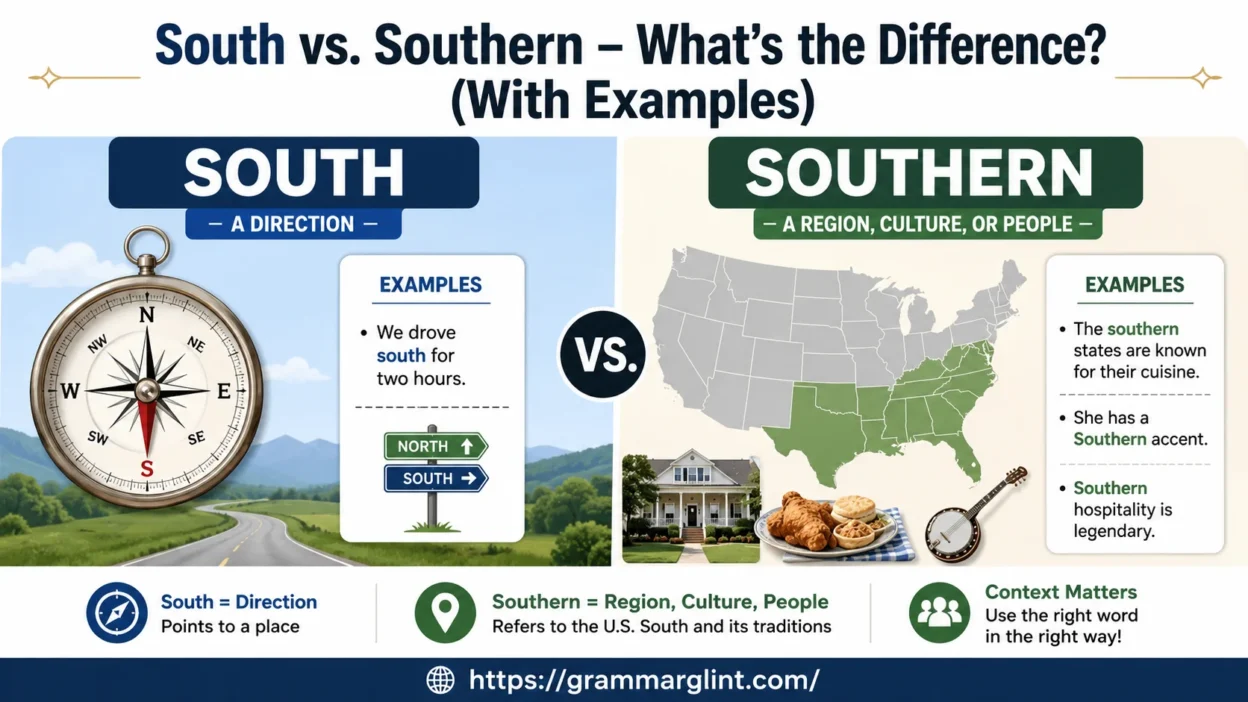
The main difference between “south” and “southern” is that “south” can function as both a noun and an adjective, while “southern” is used only as an adjective. Although both words relate to direction and geography, their grammatical roles and usage in sentences are not the same. This difference affects how we describe places, regions, and directions in English.
The word “south” is more flexible. As a noun, it refers to a direction or region, for example, “We traveled to the south.” As an adjective, it describes something located in that direction, such as “south wind” or “south gate.” Because of this dual usage, south is commonly used in both formal and everyday contexts when referring to direction or location.
On the other hand, “southern” is strictly an adjective. It is used to describe something that belongs to or is related to the south. For example, we say “southern region,” “southern culture,” or “southern states.” Unlike “south,” it cannot stand alone as a noun and always needs a noun after it to complete its meaning.
In simple terms, “south” points directly to a direction or place, while “southern” describes something connected to that direction or place. Understanding this distinction helps learners use both words correctly and avoid common grammatical mistakes.
Quick Difference Explained
Before exploring every use, look at the basic difference:
| Word | Main Function | Meaning | Example |
| South | Noun, adverb, adjective | A direction or region | “The city is south of here.” |
| Southern | Adjective | Connected to the south | “She enjoys southern cooking.” |
Think of it this way:
South tells you where something is. Southern tells you what something is like.
For example:
- “They traveled south.”
- They moved in a direction.
- “They visited a southern town.”
- The town has a connection to the south.
The difference looks small, but it changes the entire meaning.
What Does South Mean?
The word south has several uses in English. It can work as a noun, adjective, or adverb depending on the sentence.
Understanding these roles helps you avoid mistakes.
South as a Direction
The most common use of south is as a compass direction.
The four main directions are:
- North
- South
- East
- West
When someone moves toward the bottom of a map, they move south.
Examples:
- “The train is heading south.”
- “Drive south for five miles.”
- “The birds fly south during winter.”
In these examples, south describes movement or position.
A useful question to ask is:
“Where is something going?”
If the answer is a direction, use south.
Example:
Incorrect:
The birds flew southern for winter.
Correct:
The birds flew south for winter.
Why?
Because the birds are moving in a direction, not becoming connected to the south.
South as a Noun
Sometimes south acts like a thing or place.
Examples:
- “The south is warmer than the north.”
- “The wind came from the south.”
- “Many people moved to the South.”
Here, south refers to an area or direction.
The meaning changes slightly depending on capitalization.
Lowercase “south”
Usually means a direction:
“The house faces south.”
The house faces a direction.
Capitalized “South”
Often refers to a recognized region:
“The South has a distinct cultural identity.”
In American English, the South commonly refers to states and regions associated with the southern United States.
South as an Adjective
Although less common than southern, south can also describe nouns.
You see this often in official names and geographic terms.
Examples:
- South Korea
- South Africa
- South America
- South Pole
In these cases, South is part of a name.
It does not simply mean “located below something.”
For example:
South Africa is a country name.
But:
southern Africa refers to the southern part of the African continent.
Those two phrases are related but not identical.
What Does Southern Mean?
The word southern is mainly an adjective.
It describes something connected to the south.
It can describe:
- Location
- Culture
- Weather
- People
- Traditions
- Characteristics
Examples:
- southern cities
- southern weather
- southern music
- southern accent
- southern traditions
A quick test:
Ask:
“What kind of thing is it?”
If you need a describing word, southern is usually the right choice.
Southern Describes Connection, Not Direction
This is where many people make mistakes.
You usually do not use southern to describe movement.
Incorrect:
We drove southern.
Correct:
We drove south.
However, you can say:
We drove through a southern region.
Why?
Because “southern” describes the region.
South vs. Southern Grammar Comparison
The easiest way to understand these words is to compare their grammar roles.
| Question | Use | Example |
| Where? | South | “They moved south.” |
| Which direction? | South | “The road goes south.” |
| What kind? | Southern | “A southern tradition.” |
| Connected to what place? | Southern | “Southern culture.” |
Here is another comparison:
| Sentence | Meaning |
| “She lives in the South.” | She lives in a region. |
| “She lives in a southern city.” | The city is located in the south. |
| “He traveled south.” | He moved in a direction. |
| “He enjoys southern food.” | The food style comes from the south. |
Examples in Real Sentences
Location Examples
Correct:
Florida is in the South.
This means Florida belongs to a region.
Also correct:
Florida has a southern climate.
This describes the climate.
Incorrect:
Florida is a south state.
Most native speakers would avoid this phrase.
A better choice:
Florida is a southern state.
Culture Examples
Culture creates many examples of southern usage.
Correct:
- Southern hospitality
- Southern traditions
- Southern music
- Southern cooking
Why?
Because these things are connected to a region.
You are describing their style or origin.
However:
The South has influenced American culture.
Here, South refers to the region itself.
Weather Examples
Weather also follows this pattern.
Correct:
Southern states often experience warmer winters.
The states have a southern location.
Correct:
The wind is coming from the south.
The wind direction is south.
Incorrect:
The wind is coming from the southern.
A direction requires south.
South vs. Southern in Geography
Geography is where these words become especially interesting.
Some places use South as part of their official name. Others use southern to describe a section of a larger place.
Read More: “Influence On” or “Influence In” Which Is Correct?
South America vs. Southern America
Most people say:
✅ South America
This is the name of the continent.
“Southern America” is possible in some contexts but usually sounds less natural.
Example:
South America contains twelve independent countries.
South Africa vs. Southern Africa
This difference matters.
South Africa:
- A country
- Official name
Southern Africa:
- A region
- Includes multiple countries
Southern Africa can include places such as:
- South Africa
- Namibia
- Botswana
- Zimbabwe
The word changes because the meaning changes.
South Korea vs. Southern Korea
This is another important example.
South Korea:
- The official country name
Southern Korea:
- Usually means the southern part of the Korean Peninsula
The first is a political name. The second is a geographic description.
Common Mistakes With South and Southern
Small grammar mistakes can change the meaning of your sentence.
Here are the most common errors.
Mistake: Using South Before a Normal Noun
Wrong:
I like south food.
Correct:
I like southern food.
Food is not a direction. It is connected to a region.
Mistake: Using Southern for Movement
Wrong:
The birds traveled southern.
Correct:
The birds traveled south.
The birds moved in a direction.
Mistake: Confusing Region and Direction
Compare:
He moved south.
Meaning:
- He changed location toward the south.
He moved to the South.
Meaning:
- He moved to a specific region.
A small change creates a different idea.
A Simple Memory Trick for South vs. Southern
Here is an easy way to remember:
South = place or direction
Southern = description
Examples:
- Go south.
- Eat southern food.
- Travel south.
- Enjoy southern culture.
The word south points.
The word southern describes.
South, Southern, Southward, and Southerly
English has several related words that look similar.
They are not interchangeable.
| Word | Meaning | Example |
| South | Direction/region | Go south |
| Southern | Related to south | Southern style |
| Southward | Moving toward south | Traveling southward |
| Southerly | Coming from south | A southerly wind |
Southward
Southward means “toward the south.”
Examples:
- The river flows southward.
- They continued southward.
It sounds slightly more formal than “south.”
Southerly
Southerly usually describes wind.
Example:
A southerly wind brought warmer air.
It means the wind comes from the south.
South vs. Southern in Everyday English
These two words appear everywhere in daily conversations. You’ll hear them in travel discussions, weather reports, history lessons, and casual conversations.
The key is to notice whether someone talks about a direction or a connection.
For example:
“We’re heading south this weekend.”
This tells you the direction of travel.
Now compare:
“We’re visiting a southern town this weekend.”
This tells you about the character or location of the town.
The difference may seem tiny, but native speakers naturally use these patterns.
Common Expressions With South
English has many everyday phrases using south.
These expressions often refer to movement, location, or change.
Head South
Meaning: Move toward the south.
Examples:
- “The storm is heading south.”
- “We decided to head south after lunch.”
This phrase appears often in travel writing.
South of
Meaning: Located below or beyond a place.
Examples:
- “The hotel is south of the airport.”
- “The village sits south of the river.”
The phrase gives a clear location.
Go Down South
This informal phrase means traveling to southern areas.
Examples:
- “We’re going down south for vacation.”
In American English, people often use “down south” when talking about the southern United States.
It does not literally mean moving downward.
Things Went South
This expression has a completely different meaning.
It means something became worse.
Example:
“The meeting went south after the disagreement.”
The phrase has nothing to do with geography.
It shows how flexible English words can become through idioms.
Common Expressions With Southern
The word southern appears in many descriptive phrases.
It often connects an idea with a region.
Southern Hospitality
This phrase describes friendliness and welcoming behavior traditionally associated with the southern United States.
Example:
“Visitors often mention the southern hospitality they experience.”
Here, southern describes the style or cultural connection.
Southern Accent
A southern accent refers to speech patterns associated with southern regions.
Example:
“She has a southern accent.”
You would not say:
“She has a south accent.”
Because the accent is not a direction. It is a characteristic.
Southern Food
Southern food refers to cooking traditions connected with southern regions.
Examples often include:
- Fried chicken
- Biscuits
- Barbecue styles
- Cornbread
- Regional dishes
The important point is that southern describes the origin or style.
Case Study: Understanding South vs. Southern Through Travel
Imagine someone planning a road trip.
They say:
“We are driving south.”
This tells you their movement.
Maybe they are traveling from a northern city to a southern destination.
Later, they say:
“We want to try southern restaurants.”
Now the meaning changes.
They are talking about a type of food.
The word changed because the purpose changed.
| Sentence | Meaning |
| We drove south. | Direction of travel |
| We visited a southern town. | Town connected to the south |
| We explored the South. | A region |
This simple example shows how one small word difference affects meaning.
The South vs. Southern States
American English often uses both terms when discussing geography.
The South
“The South” refers to a cultural and geographic region.
Example:
“The South has a rich musical history.”
The phrase treats the region as a whole.
Southern States
“Southern states” describes states located in the south.
Example:
“Southern states often have different climates from northern states.”
Here, southern modifies states.
Comparison Table
| Phrase | Meaning |
| The South | A region |
| Southern states | States located in the south |
| South of the city | Direction |
| Southern culture | Culture connected to the south |
South vs. Southern in Writing
Writers often confuse these words because both appear before nouns.
The trick is to look at the noun.
Ask:
Am I naming a place or describing something?
Examples:
Place Name
South America
This is the official name.
Description
Southern American culture
This describes culture connected to America’s southern regions.
How Native Speakers Choose Between South and Southern
Native speakers usually make the choice naturally by thinking about meaning.
They do not focus on grammar rules first.
They think:
- Is this about direction?
- Is this about a region?
- Is this describing something?
Let’s test it.
Sentence:
“The restaurant serves ___ cuisine.”
Cuisine is a style of food.
Answer:
✅ Southern cuisine
Sentence:
“The road continues ___.”
Road direction.
Answer:
✅ South
Sentence:
“They live in the ___.”
A region.
Answer:
✅ South
Quiz Examples
Try choosing the correct word.
Example One
“The birds fly ___ every winter.”
Answer:
✅ South
Reason:
They are moving in a direction.
Example Two
“She enjoys ___ music.”
Answer:
✅ Southern
Reason:
The music style is connected to a region.
Example Three
“He lives in the ___.”
Answer:
✅ South
Reason:
A region is being named.
Example Four
“They visited a ___ village.”
Answer:
✅ Southern
Reason:
The village is located in or connected to the south.
Why This Difference Matters
Using the right word improves clarity.
Compare:
“I like south culture.”
A reader may understand the idea, but it sounds unnatural.
Better:
“I like southern culture.”
The second sentence clearly describes cultural connection.
Small word choices often separate fluent writing from awkward writing.
Quick Reference Guide
| Situation | Correct Word |
| Direction | South |
| Moving toward a place | South |
| Region name | South |
| Describing a characteristic | Southern |
| Food style | Southern |
| Accent | Southern |
| Weather type | Southern |
| Official country/region name | South |
FAQs
1. What is the main difference between south and southern?
South can be a noun or adjective, while southern is only an adjective.
2. Is “south” a noun or adjective?
It can be both a noun and an adjective depending on the sentence.
3. Is “southern” ever used as a noun?
No, southern is only used as an adjective.
4. Can we say “southern side”?
Yes, it is correct because southern describes the side.
5. Can we say “south side”?
Yes, it is also correct, but it directly refers to the direction or location.
6. Which is more formal: south or southern?
Both are correct, but southern is often used in descriptive contexts.
7. Does “south” always mean geography?
Mostly yes, it refers to direction or geographic location.
8. What does “southern region” mean?
It means the region located in the south of a country or area.
9. Can “southern” stand alone in a sentence?
No, it must be followed by a noun.
10. Why do people confuse south and southern?
Because both refer to direction, but their grammar usage is different.
Conclusion
The difference between south and southern is mainly grammatical. While south can work as both a noun and adjective, southern only works as an adjective. Knowing this distinction helps in forming correct and natural English sentences, especially when describing directions and regions.

Emma Brooke is an editor and language researcher at Grammar Glint. Her work centers on grammar rules, punctuation, word usage, and style consistency. Emma is passionate about transforming complex language concepts into clear, reader-friendly explanations. She contributes in-depth articles that help readers communicate more effectively and confidently in both academic and professional settings.