The English language can sometimes feel confusing when you are trying to understand why certain words change their role in a sentence. Many learners and native speakers may think they already have the answer, but it often slips away when they start using different and differently in real communication. These two words can give even seasoned speakers pause because they sound similar and may appear interchangeable at first glance, but their usage is actually different.
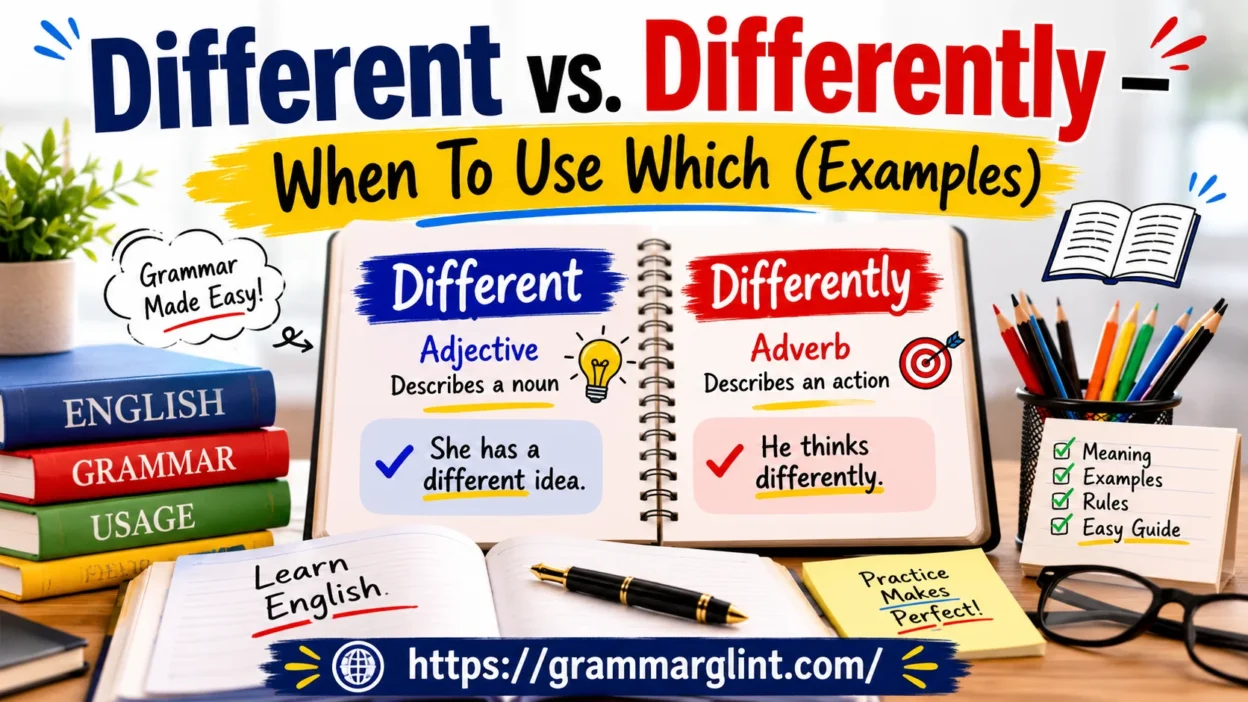
In Different vs. Differently When To Use Which, a simple comparison helps crack the code behind these commonly confused terms. The main difference is that different works as an adjective and describes nouns, people, or things. On the other hand, differently acts as an adverb that modifies verbs, adjectives, or other adverbs by explaining how an action is performed in a unique way. The -ly ending is an important clue because it can change the word function and overall meaning.
Remembering this approach and reviewing practical examples helps avoid common mistakes, awkward phrasing, and grammatically incorrect statements. With consistent learning, careful practice, and useful tips, your writing can become more natural, professional, and precise. Understanding these small differences makes your communication clearer and helps you use English with more confidence.
Understanding The Basic Rule
The easiest way to separate these two words is to look at the job they perform.
Different is an adjective.
Differently is an adverb.
Here is the simple breakdown:
| Word | Part of Speech | What It Describes | Example |
| Different | Adjective | A noun (person, place, thing, idea) | “A different solution” |
| Differently | Adverb | A verb (action) | “Solve it differently” |
Think of it like this:
- Different answers → the answers are not the same.
- Answer differently → the way someone answers is not the same.
The meaning changes depending on what you are describing.
Different: Meaning, Definition, and Correct Usage
The word different means “not the same” or “unlike something else.”
You use different when you want to describe a person, object, idea, situation, or quality.
It answers questions like:
- Which one?
- What kind?
- What type?
Examples:
- “I need a different example.”
- “They have different opinions.”
- “This restaurant has a different atmosphere.”
In each sentence, different gives information about a noun.
Different as an Adjective
Adjectives add details to nouns. They help readers understand which person, place, object, or idea you mean.
The common structure looks like this:
Different + noun
Examples:
- “She chose a different dress.”
- “We followed a different plan.”
- “They live in a different city.”
Here are more examples:
| Sentence | Noun Being Described |
| He bought a different phone. | Phone |
| The company created a different strategy. | Strategy |
| I found a different solution. | Solution |
| They have different experiences. | Experiences |
Notice how the word different always connects to a thing.
You are not describing the action. You are describing the object itself.
When To Use Different From, Different Than, and Different To
Many learners also wonder which preposition should follow different.
The most common options are:
- Different from
- Different than
- Different to
All three appear in English, but their usage varies.
Different From
Different from is widely accepted and works in almost all situations.
Examples:
- “Your answer is different from mine.”
- “This version is different from the original.”
- “Her opinion is different from everyone else’s.”
For formal writing, different from is usually the safest choice.
Different Than
Different than appears frequently in American English.
It often comes before a clause.
Example:
- “The result was different than I expected.”
Here, “than I expected” gives a complete idea.
Another example:
- “The experience was different than we imagined.”
Many modern American writers use this structure naturally.
Different To
Different to is common in British English.
Examples:
- “This method is different to the old one.”
- “His approach is different to hers.”
It is correct in many varieties of English, especially outside the United States.
Differently: Meaning, Definition, and Correct Usage
The word differently means “in another way” or “in a different manner.”
Unlike different, it does not describe a thing.
It describes how something happens.
Examples:
- “She thinks differently.”
- “They reacted differently.”
- “The machine works differently.”
In each example, differently explains the action.
Differently as an Adverb
Adverbs modify verbs. They tell readers how someone performs an action.
The common structure is:
Verb + differently
Examples:
- “He writes differently.”
- “She speaks differently.”
- “They behave differently.”
Look at the difference:
Different:
“She has a different writing style.”
The word “different” describes the noun style.
Differently:
“She writes differently.”
The word “differently” describes the verb writes.
The action changes, not the object.
Side by Side Examples
Seeing both words together makes the difference clearer.
| Different | Differently |
| A different idea | Think differently |
| A different method | Work differently |
| Different results | Perform differently |
| A different approach | Approach it differently |
| Different opinions | Express opinions differently |
A useful question can solve most confusion:
Am I describing a thing or an action?
If you describe a thing → choose different.
If you describe an action → choose differently.
The Quick Test
When you are unsure, try this method.
Step One: Find the Word Being Modified
Look at the nearby word.
If it is a noun, use different.
Example:
“She needs a ______ answer.”
Answer is a noun.
Correct:
“She needs a different answer.”
If it is a verb, use differently.
Example:
“She answered ______.”
Answered is a verb.
Correct:
“She answered differently.”
Step Two: Replace the Word Mentally
Try replacing the word.
If “not the same” works, use different.
Example:
“This is a different car.”
This means:
“This is a car that is not the same.”
Good.
If “in another way” works, use differently.
Example:
“He drives differently.”
This means:
“He drives in another way.”
Also good.
Common Mistakes
Even experienced writers sometimes mix up different and differently because the words look so similar. The mistake usually happens when people focus on the meaning instead of the grammar role.
The good news? Most errors follow a few common patterns.
Once you recognize these patterns, choosing the correct word becomes much easier.
Read More: Progress In vs. Progress On vs. Progress Of: A Clear Guide
Mistake: Using “Different” After an Action Verb
One of the most common mistakes is using different where an adverb is needed.
Incorrect:
“She thinks different.”
Correct:
“She thinks differently.”
Why?
The word thinks is an action. You need a word that explains how she thinks.
The sentence means:
- She does not think in the same way as others.
- Her thinking process is unique.
The same rule applies to many verbs.
Examples:
❌ “They communicate different.”
✅ “They communicate differently.”
❌ “He behaves different.”
✅ “He behaves differently.”
❌ “The system works different.”
✅ “The system works differently.”
Mistake: Using “Differently” Before a Noun
The opposite mistake happens when writers put differently before a thing.
Incorrect:
“They created a differently plan.”
Correct:
“They created a different plan.”
Why?
The word plan is a noun. It needs an adjective.
A plan can be different.
A plan cannot be differently.
More examples:
❌ “A differently approach”
✅ “A different approach”
❌ “A differently answer”
✅ “A different answer”
❌ “A differently method”
✅ “A different method”
In Everyday Conversation
These two words appear constantly in daily speech.
You might hear them when people talk about:
- habits
- opinions
- preferences
- experiences
- choices
- behavior
Examples:
“I see things differently now.”
This means your way of seeing or understanding something has changed.
“I have a different opinion.”
This means your opinion is not the same as someone else’s.
The difference is subtle but important.
Compare these:
“We have different ideas.”
The ideas are not the same.
“We think differently.”
The way we think is not the same.
One describes the ideas.
The other describes the thinking process.
In Professional Writing
Clear word choice matters in workplaces. A small grammar mistake can distract readers from your message.
Consider these examples.
Business Communication
Incorrect:
“Our team works different from competitors.”
Better:
“Our team works differently from competitors.”
The sentence talks about the way the team works.
Incorrect:
“We use a differently strategy.”
Better:
“We use a different strategy.”
The sentence describes the strategy.
Workplace Examples
| Situation | Correct Sentence |
| Comparing methods | “Our process is different from theirs.” |
| Comparing actions | “Our team operates differently.” |
| Comparing products | “This model has different features.” |
| Comparing behavior | “Customers respond differently.” |
Strong writing depends on these small details. They help your ideas land clearly.
In Academic Writing
Academic writing often requires precision. Researchers and students regularly compare ideas, theories, results, and methods.
Examples:
- “The two studies reached different conclusions.”
- “The researchers interpreted the data differently.”
- “The experiments used different techniques.”
- “The groups responded differently.”
Notice the pattern:
Different → thing being compared
Differently → action or process being compared
Academic Comparison Example
Imagine two scientists studying the same problem.
You could write:
“The scientists used different methods.”
This means the methods were not the same.
You could also write:
“The scientists approached the problem differently.”
This means their way of approaching the problem was not the same.
Both sentences work. They simply focus on different parts of the situation.
In Creative Writing
Writers often use these words to show character development, change, and perspective.
Examples:
“After the experience, she saw the world differently.”
The character’s perspective changed.
“The story had a different ending.”
The ending itself changed.
Good writers choose carefully because one word can shift the focus of a scene.
Compare:
“He felt different.”
This describes his state or identity.
“He felt differently.”
This describes a change in his feelings or reaction.
Related Words: Difference, Different, and Differently
These words belong to the same word family.
Understanding all three makes the pattern easier.
| Word | Type | Meaning | Example |
| Difference | Noun | A distinction | “There is a difference.” |
| Different | Adjective | Not the same | “A different choice.” |
| Differently | Adverb | In another way | “Choose differently.” |
Think of them as a family:
- Difference = the thing that separates two options.
- Different = describes something that is not the same.
- Differently = explains a different way of doing something.
Comparison Examples
Let’s compare similar sentences.
Example One
Different:
“The two phones have different designs.”
Meaning:
The designs are not the same.
Differently:
“The two phones work differently.”
Meaning:
The phones operate in different ways.
Example Two
Different:
“She chose a different path.”
Meaning:
The path itself changed.
Differently:
“She walked differently.”
Meaning:
Her manner of walking changed.
Example Three
Different:
“They have different opinions.”
Meaning:
Their opinions disagree.
Differently:
“They express opinions differently.”
Meaning:
Their communication style is different.
A Simple Memory Trick
Here is an easy way to remember:
Different = thing
Differently = action
Or:
Different answers.
Answer differently.
The noun comes after different.
The verb comes before differently.
This small pattern works in most everyday situations.
Practice Quiz
Test yourself.
Fill in the blanks:
- She solved the problem ______ than I did.
- They bought a ______ house.
- Everyone learns ______.
- This idea is ______ from the original.
- The machine operates ______ now.
- He has a ______ perspective.
Answers
- Differently
- Different
- Differently
- Different
- Differently
- Different
If you got these right, you understand the main rule.
My Personal Experience as an English Language Specialist
Over the years, one lesson has stood out more than almost any other: small grammar choices often make the biggest difference. Among the questions I receive from students, writers, and professionals, the difference between different and differently comes up surprisingly often. At first, many people assume the two words can be used interchangeably because they share the same root. However, once they begin writing or speaking in real-life situations, they realize that choosing the wrong one can make a sentence sound unnatural.
I also emphasize that grammar is not about memorizing countless rules. It is about understanding how words work together to create clear and accurate communication. Once learners recognize that different describes people, things, or ideas, while differently explains how an action is performed, they become much more confident in both writing and conversation.
One of the most rewarding moments as a teacher is seeing students begin to correct themselves naturally. Instead of saying, “She thinks different,” they pause and realize that thinks is a verb, so the sentence needs the adverb differently. Those small moments of understanding often have a lasting impact because they strengthen the learner’s overall grasp of English grammar.
From my experience, mastering distinctions like different and differently is about more than passing grammar tests. It builds precision, confidence, and clarity qualities that make every piece of writing and every conversation more effective. Small improvements in grammar often lead to significant improvements in communication, and that is what makes learning English both practical and rewarding.
FAQs
1. What is the main difference between different and differently?
The main difference is that different is an adjective used to describe a noun, while differently is an adverb used to describe an action or verb. Different explains what something is like, and differently explains how something happens.
2. Is different an adjective or an adverb?
Different is an adjective. It gives more information about a person, thing, or idea. For example, “This book is different” describes the book.
3. When should I use differently in a sentence?
You should use differently when you want to explain the way an action is done. It works as an adverb and usually connects with a verb, such as “She thinks differently.”
4. Why do people confuse different and differently?
People often confuse these words because they sound similar and have the same base word. The -ly ending changes the word type and helps show whether it is an adjective or adverb.
5. Can different describe actions?
No, different normally does not describe an action. It describes nouns, people, or things. For actions, differently is the better choice.
6. Is “He thinks different” correct English?
In standard English, “He thinks differently” is the grammatically correct form because thinks is a verb, and the sentence needs an adverb to explain how he thinks.
7. How can I remember the correct usage?
A simple rule is to check the context. If you are describing a thing or person, use different. If you are describing how something happens, use differently.
8. What is an example of using both words together?
A sentence like “They have a different plan and they work differently” uses both correctly. The first word describes the plan, while the second describes the action.
9. Does using the wrong word affect communication?
Yes, using the wrong form can make a sentence sound awkward or grammatically incorrect. Choosing the correct word makes your writing and communication more clear and natural.
10. How can learners improve their use of these words?
Learners can improve by reviewing examples, practicing sentence structures, and paying attention to whether they need an adjective or adverb in a sentence.
Conclusion
Understanding different vs. differently becomes easier when you focus on their roles in a sentence. Different works as an adjective to describe nouns, while differently works as an adverb to explain actions. The small -ly change creates a major difference in meaning and usage.
By learning the basic rules, checking the context, and practicing with real examples, English users can avoid mistakes and communicate more effectively. These small grammar choices help make sentences sound more natural, accurate, and professional.

Aria Jane is a senior language writer and grammar specialist at Grammar Glint. She focuses on English grammar, spelling variations, vocabulary, and writing clarity. Through detailed research and practical examples, Aria helps readers understand language rules and avoid common mistakes. Her articles are designed to make English learning accessible for students, professionals, and everyday writers seeking reliable language guidance.