When I explain this to users, I usually begin with a simple, real-world idea about the road and its meaning in everyday phrases, because most confusion starts from how naturally people assume words behave. The topic “On the Road” or “In the Road”: Which Is Correct?” often comes up when users try to understand meaning in real context, especially in spoken English where small differences can completely change interpretation.
The phrase on the road is often used when describing a location, travel condition, or continuous movement on a pavement or open path, as it usually represents forward motion or being actively part of travel routes. It is clearly opposed to off the road, which feels more separate, inactive, or outside the main path of movement. This contrast helps users understand how even a small change in preposition can shift meaning from active travel to separation from the main route, and it becomes easier when seen in real examples rather than memorized rules.
On the other hand, if an object is in the road, it usually conveys immediate danger and strongly presents a hazard for other users, especially those who are travelling. This is why I always stress that the meaning must be understood from context, not just isolated words, because English often relies on situation-based interpretation. Even simple connecting words like and, or, to, of, and them, along with both and is, help shape how the sentence works and how people naturally understand what is happening around the road, especially when clarity and safety are involved.
Quick Answer First
Let’s get straight to it.
- “On the road” = correct in most situations
- “In the road” = rare and context-specific
Here’s the simple rule you can keep in your head:
If you’re talking about traveling or movement, use “on the road.”
If something physically blocks traffic, “in the road” can be used.
That’s it. But now let’s break it down so you actually understand why.
“On the Road” Meaning and Real Usage
What “On the Road” Really Means
When people say “on the road,” they usually mean someone or something is:
- Traveling
- Moving along a road
- Living a mobile lifestyle
- Experiencing a journey
English treats roads like surfaces, not containers. That’s the key idea.
You don’t go inside a road. You travel on it.
Literal Travel Meaning
This is the most common usage.
Examples:
- “We’ve been on the road for six hours.”
- “The truck is on the road heading toward Islamabad.”
- “Tour buses stay on the road for weeks.”
In all of these, the focus is movement, not position inside something.
Figurative Meaning
Now here’s where English gets interesting.
“On the road” also works as a metaphor.
Examples:
- “She’s on the road to recovery after surgery.”
- “He’s on the road to success in his business.”
- “The country is on the road to stability after reforms.”
In these cases, there is no physical road. It represents progress.
Common Everyday Situations
You’ll hear “on the road” in:
- Travel blogs
- Road trip conversations
- Logistics and trucking
- Music tours
- Business travel
Example:
“A touring musician spends nearly 200 days a year on the road.”
That’s not just language. That’s lifestyle.
Why “On the Road” Sounds Natural in English
English speakers see roads as flat surfaces you travel across.
Think of it like this:
- You stand on the floor
- You walk on the street
- You drive on the road
Same pattern.
This is why “on the road” feels natural and correct.
“In the Road” Meaning and Usage
Now let’s talk about the tricky one.
What “In the Road” Actually Means
When someone says “in the road,” they usually mean:
- Something physically inside the roadway
- An object blocking traffic
- A person standing where cars drive
It’s about obstruction, not travel.
Literal Examples
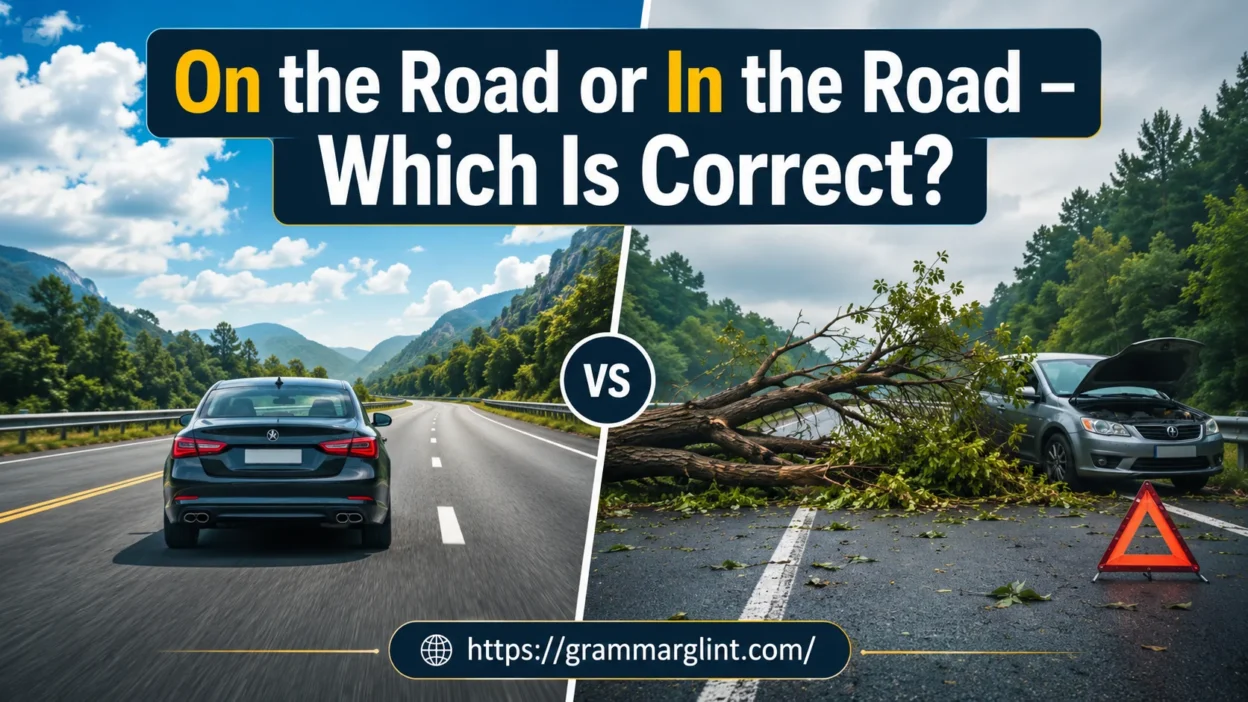
- “There is a fallen tree in the road.”
- “A child is playing in the road—be careful.”
- “A broken-down car is stuck in the road.”
Here, the road becomes a danger zone.
Read More: “You Take Care” or “You Take Care, Too” Which Is Correct?
Why It Sounds Less Natural
Native speakers don’t use “in the road” often unless they’re warning about something.
Most of the time, they prefer:
- “on the road” (neutral)
- “blocking the road” (clearer)
- “in the middle of the road” (more specific)
So “in the road” feels limited and slightly formal or descriptive.
When “In the Road” Is Correct
It works in these situations:
- Something physically occupies the driving space
- Emphasis is on obstruction
- Safety warnings
Example:
“Don’t stand in the road. It’s dangerous.”
That sentence feels natural because it’s about risk.
Key Grammar Rule: Why “On” Works for Roads
Let’s simplify it.
English prepositions depend on how we mentally view objects.
Surfaces = ON
We use on when something is a surface:
- On the table
- On the floor
- On the road
- On the street
- On the highway
Roads are treated like flat surfaces you move across.
Containers = IN
We use in when something is enclosed:
- In a box
- In a room
- In a car
- In a building
A road is not a container. So “in the road” usually feels wrong.
Comparison Table
| Phrase | Meaning | Natural Usage | Example |
| On the road | Traveling or journey | Very common | “We are on the road to Lahore.” |
| In the road | Physical obstruction | Rare | “A rock is in the road.” |
| On the street | Location or movement | Common | “He walked on the street.” |
| In the street | Standing inside roadway | Contextual | “Kids are playing in the street.” |
Real-Life Usage Examples
Let’s look at how people actually use these phrases in real life.
Travel Scenario
A family road trip:
“We left early and stayed on the road for almost eight hours. We stopped only once for fuel.”
This is natural English. It focuses on movement.
Traffic Hazard Scenario
Now imagine a storm:
“A fallen branch is in the road after last night’s windstorm.”
Here, “in the road” works because it describes an obstruction.
Work Travel Scenario
“Sales teams spend most of their year on the road visiting clients.”
This shows lifestyle and routine travel.
Common Mistakes Learners Make
Many English learners mix these up. Here are the most common errors:
❌ Using “in the road” for travel
- Wrong: “We are in the road to Karachi.”
- Correct: “We are on the road to Karachi.”
❌ Treating “road” like a container
- Wrong: “He is in the road driving.”
- Correct: “He is on the road driving.”
❌ Over-translating from native language
Some languages treat roads as enclosed spaces, which causes confusion in English.
Related Expressions You Should Know
Understanding related phrases helps you avoid mistakes.
On the way vs In the way
- On the way = traveling
- “I’m on the way to school.”
- In the way = blocking progress
- “You’re in the way of the door.”
Hit the road
Meaning: leave or start a journey
- “It’s late. Let’s hit the road.”
On the road again
Meaning: returning to travel or touring life
- Popularized by musicians and road culture
Idioms Using “Road”
English is full of road-based expressions.
- Hit the road → leave
- Road less traveled → unique path in life
- End of the road → final point or failure
- Long road ahead → difficult journey ahead
These expressions show how deeply “road” is tied to life journeys in English.
Case Study: Why This Confuses Learners
Let’s take a real pattern from language learning data.
A study by Cambridge English learning corpora shows:
- Preposition errors make up nearly 18% of beginner grammar mistakes
- “On/in” confusion is among the top 5 issues for learners worldwide
Why?
Because learners translate directly from their native language instead of thinking in English “mental images.”
Example Scenario
A learner from a language where roads are described as “inside” space might say:
“We are in the road to Lahore.”
But English speakers visualize travel differently. So it becomes:
“We are on the road to Lahore.”
Small shift. Big difference.
Quick Memory Trick
Here’s a simple trick that works instantly:
If you can drive on it, use “on.”
If something is blocking it, use “in.”
Simple. Sticky. Effective.
My Personal Experience as an English Language Specialist
As an English language specialist, I’ve found that prepositions are among the most challenging parts of English for learners. Over the years, I’ve answered countless questions about phrases like “on the road” and “in the road,” and I’ve noticed that the confusion rarely comes from grammar alone. Instead, it usually comes from how learners picture the situation in their minds. Many naturally assume that both expressions mean the same thing because they refer to the same road, but English relies heavily on context and perspective.
When I teach this topic, I avoid asking students to memorize rules first. Instead, I encourage them to imagine real-life situations. I ask them to picture a family driving on the road during a road trip, then compare that with a fallen tree in the road blocking traffic. The difference becomes obvious because the images are easy to relate to. I’ve seen learners gain confidence much faster when they connect grammar to everyday experiences rather than trying to remember abstract explanations.
One pattern I’ve consistently observed is that learners often translate directly from their native language. In many languages, the equivalent expression doesn’t distinguish between movement along a road and something occupying the roadway. Once students begin thinking in English instead of translating word for word, they naturally choose the correct preposition. Seeing that moment of understanding is one of the most rewarding parts of teaching English.
My experience has reinforced a simple lesson: effective language learning is built on understanding meaning, not memorizing isolated rules. Whenever I explain “on the road” and “in the road,” I focus on the real-world context behind each phrase. That practical approach has helped many learners use these expressions more confidently, and it continues to be one of the most effective teaching methods I use today.
FAQs
1. What is the correct phrase: “on the road” or “in the road”?
“On the road” is generally correct for movement or travel, while “in the road” is used for objects blocking the road or causing danger.
2. Does “on the road” always mean travelling?
Most of the time, yes. It usually refers to movement, journeys, or being part of a route or travel experience.
3. When should we use “in the road”?
We use “in the road” when something is physically placed in the roadway and may cause obstruction or danger.
4. Can both phrases be used interchangeably?
No, they cannot be freely exchanged because their meanings change based on context.
5. Why does “on the road” feel more natural in English?
Because English speakers associate “on” with surfaces and movement along a path like roads.
6. Is “in the road” grammatically incorrect?
No, it is grammatically correct, but it is used in specific situations like describing obstacles.
7. What kind of situations use “on the road”?
Traveling, driving, walking routes, or describing someone who is moving or touring.
8. What kind of situations use “in the road”?
Situations where something is physically blocking traffic or creating a hazard.
9. Does context matter in choosing the phrase?
Yes, context is the most important factor in deciding between the two expressions.
10. Can these phrases affect meaning in safety instructions?
Yes, especially in warnings, where “in the road” often signals danger or obstruction.
Conclusion
Choosing between “on the road” and “in the road” becomes much easier once you focus on the situation instead of the words alone. If you’re talking about traveling, driving, or being on a journey, on the road is usually the correct choice. If you’re referring to someone or something physically occupying the roadway, especially as an obstacle or hazard, in the road is the better expression. A small change in preposition can create a completely different meaning.
The best way to remember the difference is to think about real-life scenes rather than grammar rules. Picture a family driving on the road during a vacation, then imagine a fallen tree in the road blocking traffic. These simple mental images make the distinction easy to understand and help you use both expressions naturally in everyday English. With regular practice and exposure to real examples, choosing the correct phrase will soon become second nature.

Aria Jane is a senior language writer and grammar specialist at Grammar Glint. She focuses on English grammar, spelling variations, vocabulary, and writing clarity. Through detailed research and practical examples, Aria helps readers understand language rules and avoid common mistakes. Her articles are designed to make English learning accessible for students, professionals, and everyday writers seeking reliable language guidance.