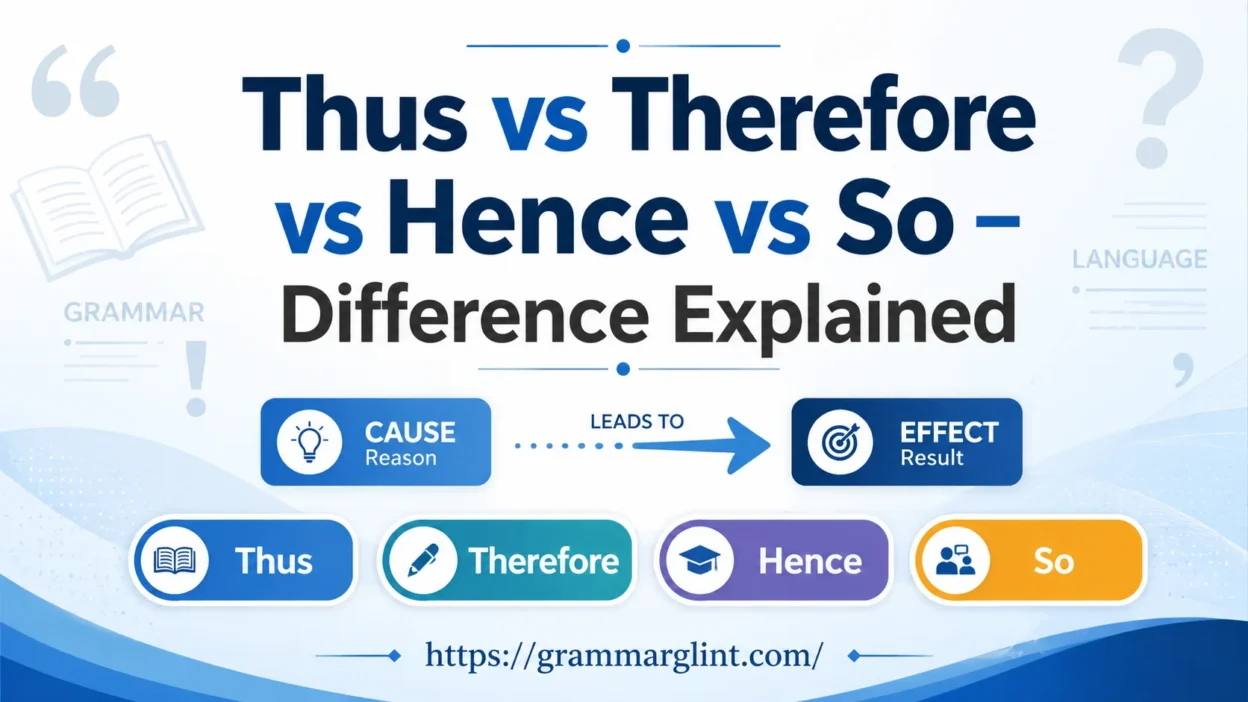
The Thus vs Therefore vs Hence vs So topic shows how English connectors create a link between ideas and results clearly. In different contexts, I often think about the ways we use these words in a statement where meaning matters. These small words may look simple, but they play an important role in making communication smoother and more logical. Thus appears in formal speech, while hence, so, and therefore are common choices with a similar function. When we take a closer look at an event or action, these connectors help explain the following consequence and make the relationship between ideas easier to understand.
I have noticed these differences in many daily examples. She was unable to find a solution for a job issue, and she decided to quit what she had because the situation became difficult. Then, we can imagine a train that was missed, so we have to decide whether we should take a taxi or hire one while going somewhere else. These examples show how simple connectors can express decisions and outcomes naturally. The result becomes easier to follow when the relationship between events is explained properly.
In other situations, they go to Japan where their interest grew from childhood memories connected with Zen Buddhism. Like a wheel of life, he faced injuries, and the rest of his time was spent dealing with severe pain that was sustained while sitting in a chair. Even mathematical proofs depend on how each idea must connect with another idea, because logical thinking helps flow from one result to another. This is why these words remain useful tools for creating clear explanations.
Why These Words Confuse Writers So Easily
Here’s the problem: English gives you multiple tools for the same job.
All four words thus, therefore, hence, and so connect a reason to a result. That overlap creates confusion. Writers assume they are fully interchangeable.
They’re not.
Think of them like different gears in a car:
- First gear (so) moves you in daily conversation
- Second gear (therefore) handles formal writing
- Third gear (thus) leans academic and logical
- Fourth gear (hence) feels strict and mathematical
Same direction. Different power.
Another reason they confuse people is tone inconsistency. You might start a sentence casually and suddenly insert a formal connector. That mismatch breaks flow.
For example:
“It was raining, therefore we stayed inside.”
It sounds slightly stiff. Now compare:
“It was raining, so we stayed inside.”
The second version feels natural because the tone matches the situation.
The Core Idea Behind
Before diving into differences, you need one simple truth:
All four words express cause → effect logic.
They answer this invisible question:
“What happened because of this?”
Example:
- Cause: It rained heavily
- Effect: The match was canceled
Now you can write it four ways:
- It rained heavily, so the match was canceled.
- It rained heavily; therefore, the match was canceled.
- It rained heavily; thus, the match was canceled.
- It rained heavily; hence, the match was canceled.
Same meaning. Different tone, structure, and audience fit.
Quick Comparison
| Word | Formality Level | Typical Use | Natural in Speech | Writing Style |
| So | Low (informal) | Everyday conversation | Very common | Casual writing |
| Therefore | Medium-high | Essays, reports | Rare | Professional |
| Thus | High (formal) | Academic logic | Very rare | Scholarly |
| Hence | Very high | Mathematical or strict logic | Almost never | Technical writing |
This table already tells you most of what you need. But the real skill comes from understanding why they behave differently.
Understanding “Thus” in Real Writing
Thus means “as a result of this reasoning.”
It belongs in structured arguments where logic matters more than emotion.
Where “thus” works best:
- Academic essays
- Scientific explanations
- Logical arguments
- Formal reports
Example:
“The sample size was too small; thus, the results cannot be generalized.”
Notice how it feels controlled and precise. It doesn’t sound conversational. It sounds like someone is building a case step by step.
What makes “thus” tricky:
It can feel outdated in modern writing. Many native speakers avoid it unless they want a formal tone.
Simple rule:
If you wouldn’t say it out loud in conversation, “thus” probably feels too stiff.
Understanding “Therefore” as the Standard Formal Connector
If one word wins the “safe choice” award, it’s therefore.
It means “for that reason.”
Where “therefore” fits best:
- Business writing
- Academic essays
- Formal emails
- Structured reasoning
Example:
“The system failed multiple tests; therefore, it requires redesign.”
This sounds polished but not overly complex. It’s clear. That’s why writers love it.
Placement flexibility:
- Start of sentence: “Therefore, we revised the plan.”
- After semicolon: “We revised the plan; therefore, results improved.”
Key advantage:
It signals professionalism without sounding outdated.
Read More: “You Take Care” or “You Take Care, Too” Which Is Correct?
Understanding “Hence” as the Strict Logical Connector
Hence is the most abstract of the four.
It means “for this reason” but carries a stronger sense of inevitability.
Where “hence” belongs:
- Mathematics
- Formal logic
- Philosophical arguments
- Technical writing
Example:
“All variables are constant; hence, the equation holds true.”
This feels almost like a proof. Not a conversation.
Why it feels different:
“Hence” doesn’t just show cause and effect. It shows necessity. The result feels unavoidable.
Real-world note:
Outside technical or academic writing, “hence” often feels unnatural.
Understanding “So” as the Natural Everyday Connector
Now we reach the most important one: so.
This is how real people talk.
It simply means “therefore” in casual speech.
Where “so” dominates:
- Daily conversation
- Informal writing
- Emails
- Messaging
Example:
“It was late, so I left.”
Short. Clean. Natural.
Why it works so well:
It matches spoken rhythm. People naturally think in short cause-effect patterns.
Common mistake:
Writers avoid “so” in formal writing even when it fits perfectly. That can make writing feel unnecessarily stiff.
Key Differences That Actually Matter in Real Use
Let’s move beyond definitions and focus on what changes your writing style.
Formality level changes everything
- So → relaxed, conversational
- Therefore → professional
- Thus → academic
- Hence → technical
If you mix these randomly, your tone breaks.
Strength of logic differs
Think of intensity:
- So → simple result
- Therefore → clear reasoning
- Thus → structured conclusion
- Hence → strict logical necessity
Example:
“He missed practice, hence he was benched.” (strong inevitability)
Sentence flow behaves differently
- “So” feels smooth and fast
- “Therefore” adds pause and weight
- “Thus” feels calculated
- “Hence” feels formal and final
Sentence Placement Rules You Should Actually Remember
Each word prefers certain positions:
Start of sentence:
- Therefore
- Hence
- So
Example:
“Therefore, we adjusted the strategy.”
Middle of sentence:
- So
- Thus
Example:
“The data was incomplete, thus the conclusion changed.”
End of sentence (rare but possible):
- Thus
- Hence
Example:
“The system is unstable, hence.”
Short. Sharp. Final.
Real-Life Usage Examples Side by Side
Let’s see how tone shifts using the same idea.
| Situation | Sentence |
| Casual | “It was raining, so we stayed home.” |
| Formal | “It was raining; therefore, we stayed home.” |
| Academic | “It was raining; thus, we stayed home.” |
| Logical proof | “It was raining; hence, we stayed home.” |
Same meaning. Different voice.
Case Study: Academic Writing
Imagine a student writing a research paper.
They write:
“The dataset was incomplete, so results are unreliable.”
This sounds too casual.
Improved version:
“The dataset was incomplete; therefore, the results are unreliable.”
Even better in strict academic tone:
“The dataset was incomplete; thus, the results are unreliable.”
Here, tone shifts matter more than vocabulary.
Case Study: Business Report
A manager writes:
“Sales dropped, hence we reduced production.”
This feels too formal and slightly rigid for a business memo.
Better version:
“Sales dropped, so we reduced production.”
Or in formal report:
“Sales dropped; therefore, we reduced production.”
Business writing usually prefers therefore or so depending on tone.
Case Study: Everyday Email
You write to a colleague:
“I was unwell, therefore I didn’t attend the meeting.”
It sounds overly stiff.
Better:
“I was unwell, so I didn’t attend the meeting.”
This matches natural communication.
Common Mistakes Writers Keep Making
Let’s fix the biggest issues quickly.
Mixing formal and informal words
Wrong:
“So therefore I left early.”
Correct:
“So I left early.” OR “Therefore, I left early.”
Overusing “hence” in casual writing
It makes sentences sound robotic.
Using “thus” like everyday speech
It doesn’t belong in conversation-style writing.
Forgetting punctuation
Correct:
“It rained; therefore, we stayed inside.”
Incorrect:
“It rained therefore we stayed inside.”
Simple Decision Guide (Use This Every Time)
Ask yourself:
- Am I speaking casually? → use so
- Am I writing professionally? → use therefore
- Am I writing academic logic? → use thus
- Am I writing strict technical reasoning? → use hence
This one habit removes 90% of confusion.
My Personal Experience as an English Language Specialist
As an English language specialist, I’ve worked with learners and writers who often assume that thus, therefore, hence, and so are completely interchangeable. Through years of analyzing English grammar, editing articles, and answering language questions, I’ve found that the real challenge isn’t understanding their meanings—it’s knowing which one fits the context naturally. I’ve seen how choosing the right connector can improve the clarity, tone, and professionalism of a sentence, while the wrong choice can make even well-written content sound awkward or overly formal.
In my experience, the best way to master these connectors is to observe how they’re used in authentic English rather than relying solely on grammar rules. I encourage learners to use so confidently in everyday communication, therefore in professional and academic writing, thus when presenting logical arguments, and hence in technical or specialized contexts. Over time, this practical approach helps writers develop a natural sense of style, making their English more fluent, precise, and effective.
FAQs
1. What is the main difference between thus, therefore, hence, and so?
Thus, therefore, hence, and so all show a connection between ideas, but their tone and usage differ. Thus, therefore, and hence are often used in formal writing, while so is more common in everyday speech.
2. Is thus the same as therefore?
They have a similar meaning because both can introduce a result or conclusion. However, thus often sounds more formal and is commonly used in academic, technical, or logical explanations.
3. When should I use therefore in a sentence?
Use therefore when you want to show that one idea is a direct result of another. It is common in essays, reports, and professional communication.
4. Is hence still used in modern English?
Yes, hence is still used, especially in formal contexts. It often appears in academic writing, scientific discussions, and expressions that explain a reason or result.
5. Why is so more common than therefore, thus, and hence?
So is used more frequently because it fits casual conversations and everyday situations. It is simple, natural, and widely understood.
6. Can I use thus and so interchangeably?
Not always. They can share similar meanings, but thus usually has a more formal tone, while so sounds more conversational.
7. Are therefore and consequently the same?
They are close in meaning because both introduce a result. However, consequently strongly emphasizes the outcome that follows from a previous event or action.
8. Where are thus and therefore commonly used?
They are commonly found in academic writing, business documents, mathematical explanations, research papers, and formal speech.
9. How do I choose the correct connector?
Look at the situation and tone. For casual conversations, so works well. For formal explanations, thus, therefore, or hence may be more suitable.
10. Do these words improve writing clarity?
Yes, using these connectors correctly helps readers understand the relationship between ideas, reasons, and results more easily.
Conclusion
Mastering the differences between thus, therefore, hence, and so can make your writing clearer, more natural, and more effective. Although all four connectors introduce a result or conclusion, each one suits a different level of formality. So works best in everyday conversations, therefore is the safest choice for professional and academic writing, thus fits logical or scholarly discussions, and hence is most appropriate for technical or mathematical contexts. Choosing the right connector helps your ideas flow smoothly and ensures your tone matches your audience.
Instead of treating these words as interchangeable, focus on the context in which you’re writing. A simple change from so to therefore or thus can make a sentence sound more polished, while using so keeps casual communication friendly and easy to read. With regular practice, you’ll know instinctively which connector fits each situation, making your English more precise, confident, and engaging.

Aria Jane is a senior language writer and grammar specialist at Grammar Glint. She focuses on English grammar, spelling variations, vocabulary, and writing clarity. Through detailed research and practical examples, Aria helps readers understand language rules and avoid common mistakes. Her articles are designed to make English learning accessible for students, professionals, and everyday writers seeking reliable language guidance.