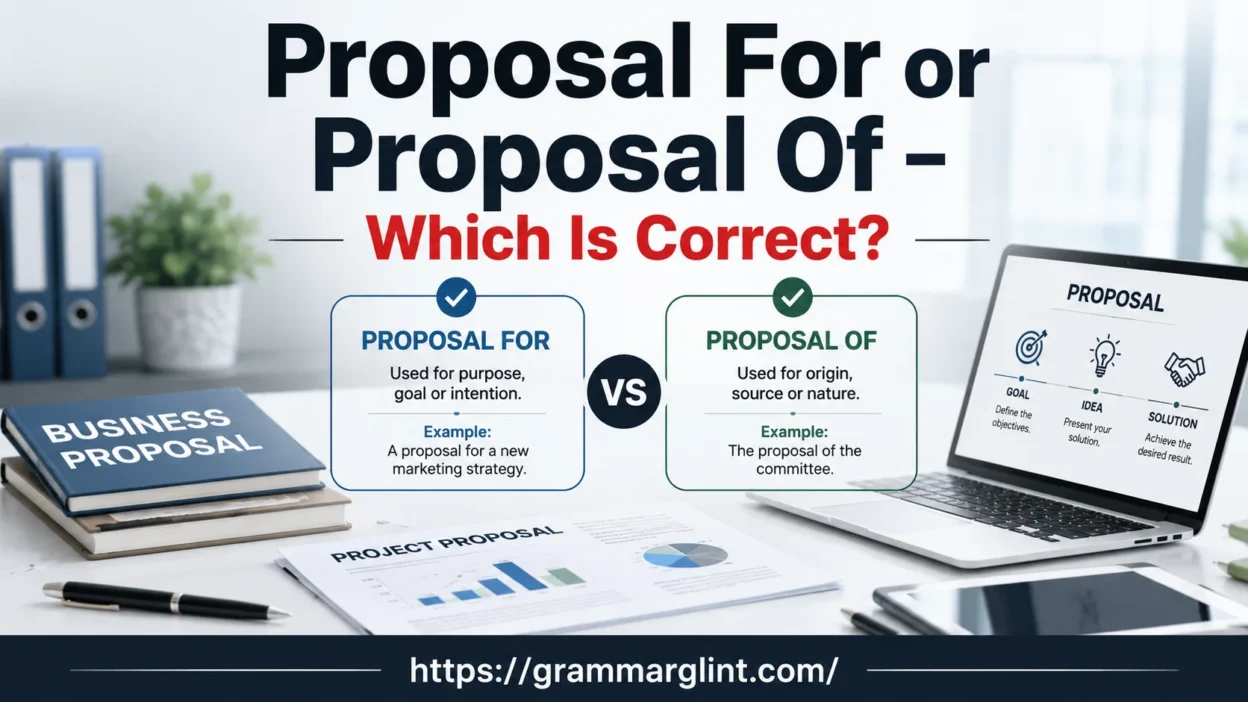
Proposal For or Proposal Of Which Is Correct? explains how the English language uses prepositions with the word proposal in different situations. In everyday writing, selecting the right word with proposal can sometimes feel like a labyrinth, where every corner creates a new challenge. Even seasoned explorers of language may face this puzzle because tiny words can completely change the direction and meaning of sentences. This is why many learners struggle with these small but powerful grammar choices.
This article discusses the use of for, of, and to with proposal, focusing on their meaning, usage, and structure. The common conundrum is whether proposal for or proposal of is the correct expression. From my experience, having a strong understanding of the context makes it easier to find the correct answer and reach a natural sentence. These phrases may appear similar, but their functions can change depending on what the writer wants to communicate.
When deciding the important difference, we need to see what the proposal is suggesting. A proposal for usually presents a plan or idea that is aimed at solving a problem or achieving a specific goal. On the other hand, proposal of is less common and often referring to the act of presenting or offering something. It can describe the source, nature, or details of an idea rather than the goal behind it.
The grammatically correct choice depends on the message a writer wants to deliver. A clear sentence communicates the intention of the suggestion and describes who, what, or whose proposal is being discussed. Understanding the characteristics of each phrase helps explain what the proposal consists of and allows writers to use these terms with more confidence.
Why It Confuses So Many Writers
English prepositions are sneaky. They don’t always follow strict logic, and that’s where most confusion starts.
Both “for” and “of” connect ideas, but they connect them differently.
- “For” shows purpose or intent
- “Of” shows origin, belonging, or composition
Now here’s the problem: a proposal can feel like both.
It’s something you create for a purpose, but it can also feel like something that belongs to a person or group.
That overlap creates uncertainty.
Add to that the influence of older English texts, legal documents, and non-native usage patterns, and you get a mix that looks like both forms are correct.
But in real-world modern English, clarity wins. And clarity strongly favors “proposal for.”
The Simple Rule
If you only remember one thing from this article, keep this:
Use “proposal for” when talking about purpose, goal, or intention.
Avoid “proposal of” unless you’re in formal or legacy-style writing.
Here’s a quick mental shortcut:
- If you can replace it with “aimed at”, use for
- If it sounds like ownership or origin, rethink it
- If you’re unsure, choose for
Simple rules stick. Complicated grammar explanations don’t.
What “Proposal” Really Means in Modern English
Before deciding between for and of, you need to understand the word itself.
A proposal is:
- A suggested plan
- A formal idea presented for approval
- A structured recommendation for action
You’ll see it in many environments:
- Business planning
- Academic research
- Government policy
- Relationships and personal commitments
For example:
- A startup sends a proposal to investors
- A student submits a research proposal to a supervisor
- A company drafts a proposal for a new system
Notice something important here?
Every example naturally leans toward purpose-driven action, not possession. That’s why “for” fits better.
Read More: Opportunities For vs Opportunities Of vs Opportunities To
Understanding “Proposal For” in Real Usage
When you use “proposal for,” you connect the idea of a proposal to its goal or target.
It tells the reader:
“This proposal exists for something.”
Common Real-World Uses
You’ll see this phrase everywhere in professional English:
- Proposal for funding
- Proposal for a business partnership
- Proposal for a marketing campaign
- Proposal for policy change
- Proposal for software development
Example Sentences That Sound Natural
- “We submitted a proposal for expanding our logistics network.”
- “She prepared a proposal for improving customer retention.”
- “The team presented a proposal for reducing operational costs.”
These sound smooth because they match how English speakers think:
action → purpose → outcome
Why “For” Works So Well
The word “for” naturally signals direction. It tells the reader where the proposal is aimed.
Think of it like throwing a ball. The “for” is the target you’re aiming at.
Without it, the sentence feels incomplete or awkward.
Breaking Down “Proposal Of” and Why It Sounds Different
Now let’s talk about “proposal of.”
This form is not completely wrong, but it feels heavier and less natural in modern English.
What It Usually Means
“Proposal of” tries to show:
- Origin
- Source
- Possession
- The idea belonging to someone or something
Example That You Might See in Formal Writing
- “The proposal of the committee was approved.”
This sounds more like legal or bureaucratic English.
Why It Feels Old-Fashioned
Modern English tends to prefer clarity and simplicity. “Proposal of” often creates a slightly abstract structure that feels distant.
Compare:
- ❌ The proposal of the team was accepted
- ✔ The team’s proposal was accepted
- ✔ The proposal for the project was accepted
The second and third options feel more natural because they are direct.
When “Of” Still Appears
You might still see “proposal of” in:
- Legal documents
- Formal meeting minutes
- Older academic writing
- Institutional reports
But even there, modern editing often replaces it with “for” or a possessive structure.
Key Difference
Let’s make this crystal clear.
| Phrase | Meaning Focus | Naturalness in Modern English | Example |
| Proposal for | Purpose or goal | Very common | Proposal for digital transformation |
| Proposal of | Origin or possession | Rare, formal | Proposal of the committee |
| Team’s proposal | Ownership | Very common | The team’s proposal was approved |
Here’s the key takeaway:
Modern English prefers clarity over abstract structure.
That’s why “for” dominates everyday usage.
Grammar Logic Behind the Choice
Let’s break this into simple language.
“For” = Purpose
You use it when something exists for a reason.
Examples:
- A tool for building
- A plan for improvement
- A proposal for change
“Of” = Relationship or Origin
You use it when something belongs to or comes from something else.
Examples:
- The roof of the house
- The voice of the speaker
- The decision of the board
Now here’s the key insight:
A proposal is not a physical object with ownership. It is an idea with a purpose. That makes “for” the natural match.
Common Mistakes People Make
Even experienced writers slip up sometimes. Here are the most common mistakes.
Using “of” in business writing
- ❌ Proposal of a new software system
- ✔ Proposal for a new software system
Overcomplicating formal emails
Writers often think “of” sounds more professional. It doesn’t. It sounds outdated.
Mixing both forms in one document
This creates inconsistency and weakens clarity.
Translating directly from other languages
Some languages structure ideas differently, which leads to unnatural “of” usage in English.
Real-Life Case Study: Why “For” Wins in Business Communication
Let’s look at a practical scenario.
A consulting firm prepared two versions of a project document:
- Version A used “proposal for”
- Version B used “proposal of”
Feedback from reviewers:
- Version A felt clearer and easier to read
- Version B felt formal but slightly confusing
- Decision-makers preferred Version A for faster understanding
Why this happened
Business communication values:
- Speed
- Clarity
- Direct meaning
“Proposal for” delivers all three without friction.
That’s why modern corporate writing almost always chooses it.
How Native Speakers Actually Decide Between Them
Here’s something most grammar guides don’t tell you.
Native speakers rarely think about rules.
Instead, they rely on instinct:
- Does it sound natural?
- Does it feel clear?
- Would I say this in conversation?
When they apply this instinct, they almost always choose “proposal for.”
Why?
Because spoken English strongly favors direct purpose-based structure.
Quick Decision Guide
Use this checklist whenever you write:
Ask yourself:
- Am I describing purpose or goal? → Use for
- Am I describing ownership or source? → Rarely use of
- Does it sound like something I would say out loud? → If yes, it’s probably for
If you still hesitate, default to:
Proposal for
It is safe, modern, and widely accepted.
Simple Examples That Lock It In
Let’s reinforce the difference with real comparisons.
Business Context
- ❌ Proposal of a digital transformation strategy
- ✔ Proposal for a digital transformation strategy
Academic Context
- ❌ Proposal of research design
- ✔ Proposal for research design
Government or Policy Context
- ❌ Proposal of new regulations
- ✔ Proposal for new regulations
Informal Context
- ❌ Proposal of marriage ideas (unnatural)
- ✔ Marriage proposal ideas (different structure entirely)
Why “Proposal For” Will Keep Dominating Modern English
Language evolves toward simplicity.
Over time, English removes:
- Unclear structures
- Redundant phrasing
- Heavy formal constructions
That’s exactly why “proposal for” keeps winning.
It is:
- Clear
- Direct
- Flexible
- Easy to understand
Meanwhile, “proposal of” slowly fades into niche or formal use.
My Personal Experience as an English Language Specialist
As an English language specialist, I’ve noticed that one of the most common mistakes learners make is choosing the wrong preposition after familiar nouns like proposal. Many students assume that proposal of sounds more formal, so they use it in business emails, academic papers, and professional reports. In reality, native English speakers almost always prefer proposal for when referring to a plan, recommendation, or suggested course of action. Once I explain that for points to the purpose or goal of the proposal, the confusion usually disappears.
Over the years, I’ve reviewed countless essays, research papers, and workplace documents, and this small grammar point appears again and again. I’ve found that the easiest way to remember the difference is to focus on what the proposal is trying to achieve rather than who created it. When learners begin thinking about meaning instead of memorizing rules, they naturally choose the correct expression. That’s why I always encourage my students to read authentic English, pay attention to real-world usage, and practice writing complete sentences. This approach builds confidence and helps them develop writing that sounds clear, natural, and professional.
FAQs
1. What is the difference between proposal for and proposal of?
Proposal for is generally used when talking about the purpose, target, or goal of a proposal. Proposal of is less common and often refers to the act, source, or nature of something being proposed.
2. Is proposal for grammatically correct?
Yes, proposal for is grammatically correct and is the more common choice in everyday and professional English. It usually introduces a plan, idea, or solution.
3. When should I use proposal of?
You can use proposal of when you want to describe the presentation or offering of something, or when focusing on what the proposal contains.
4. Is proposal of wrong in English?
No, proposal of is not wrong. It is grammatically acceptable but appears less frequently than proposal for in many contexts.
5. Why do people confuse proposal for and proposal of?
The confusion happens because both phrases use the same word proposal, and the small prepositions for and of can change the meaning and direction of a sentence.
6. Can I use proposal for in business writing?
Yes, proposal for is commonly used in business writing, especially when discussing plans, projects, strategies, or solutions.
7. What does proposal for a new marketing strategy mean?
A proposal for a new marketing strategy means a suggested plan or idea designed to create or improve a marketing approach.
8. How can I choose the correct phrase?
Look at the context and ask what you want to express. If the focus is the purpose or goal, use proposal for. If the focus is the act or content, proposal of may fit.
9. Are prepositions important in English grammar?
Yes, prepositions are important because they connect ideas and show relationships between words, helping sentences communicate clear meaning.
10. Which phrase should learners use most often?
Learners can usually choose proposal for because it is more natural and widely used in many situations.
Conclusion
Choosing between proposal for and proposal of becomes much easier once you understand the purpose of each expression. In most everyday situations, proposal for is the preferred choice because it introduces a plan, idea, or solution. Proposal of, on the other hand, is more formal and usually refers to the act of proposing or identifies what has been proposed. Paying attention to the context will help you select the most natural and grammatically correct option.
The best way to master these expressions is to read authentic English, notice how native speakers use them, and practice writing your own examples. Over time, you’ll recognize the patterns without having to think about them. With a solid understanding of proposal for, proposal of, and proposal to, you’ll communicate your ideas more clearly and write with greater confidence in both academic and everyday English.

Aria Jane is a senior language writer and grammar specialist at Grammar Glint. She focuses on English grammar, spelling variations, vocabulary, and writing clarity. Through detailed research and practical examples, Aria helps readers understand language rules and avoid common mistakes. Her articles are designed to make English learning accessible for students, professionals, and everyday writers seeking reliable language guidance.