Opportunities For vs Opportunities Of vs Opportunities To explains contexts of prepositions in meaning and use, especially in communication, grammar, and structure. This article discusses the need of understanding how a different word is used in a manner where prepositions like for, of, and to can change meaning.
It shows how language works in a connected system, where using the right form helps clarity. In this article, we see how and, which, and can link ideas, making it easier to understand patterns in real usage.
In real communication, it becomes difficult to choose the right form in contexts, especially when words look similar but carry different meanings. Learners often feel it is not easy to differentiate because the same word structure appears in multiple ways. However, understanding how each preposition is used helps reduce confusion. The role of the sentence depends on how meaning is shaped, and this is where clarity develops step by step.
Opportunities for is often referring to situations where something is intended or given to someone. It explains direction, showing whom the opportunity is meant for. This helps define purpose in a practical way. On the other hand, opportunities of refers to ownership, showing who owns or possesses the opportunity. It can also be used to describe situations or outcomes themselves, giving a more descriptive meaning. Both forms depend on context and how the idea is structured.
Finally, opportunities to is used when focusing on purpose or action. It connects the opportunity with what someone is expected to do or achieve. In practice, learners often find it difficult at first, but with repeated exposure, understanding improves. The structure becomes clearer when you see how sentences change meaning based on preposition choice. Over time, recognizing these patterns helps build stronger grammar understanding across different contexts.
Understanding in English
At the core, the word opportunity means a favorable chance to do something beneficial. The confusion starts when prepositions attach themselves to it.
Think of prepositions like direction arrows:
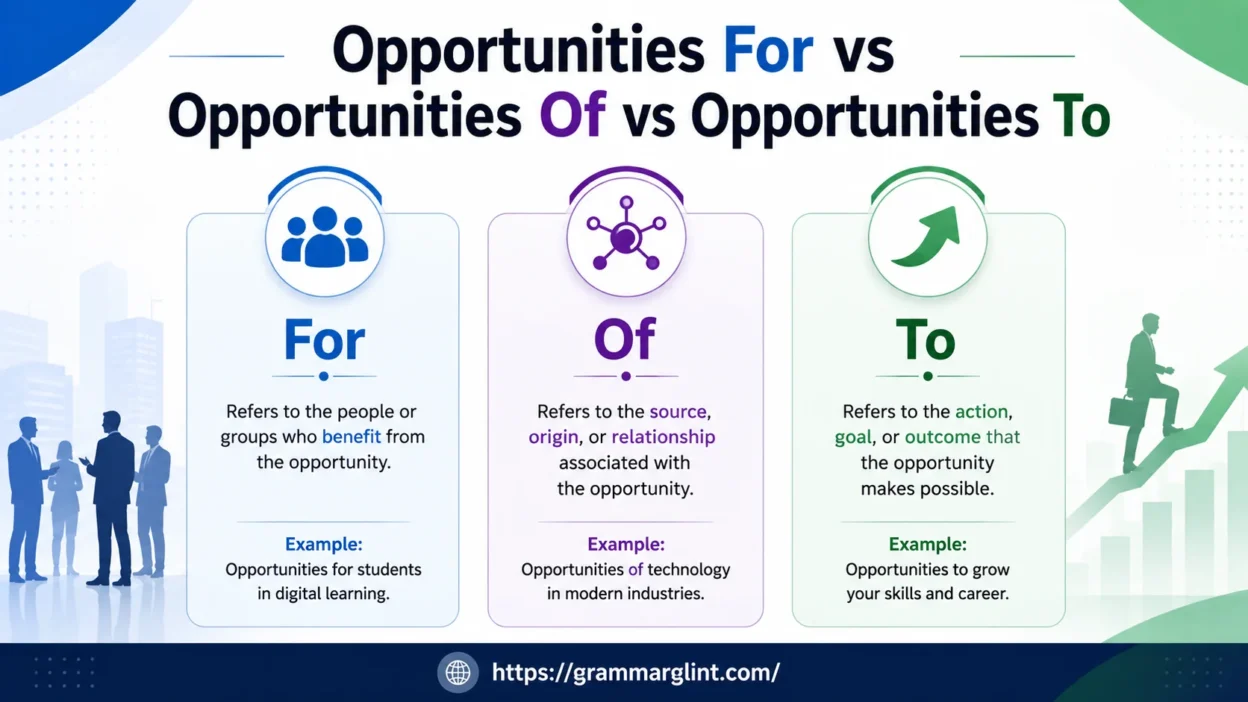
- For → benefit or audience
- Of → origin or concept
- To → action or outcome
Each one shifts the meaning slightly.
Here’s a quick example to feel the difference:
- Opportunities for students → who benefits
- Opportunities of education → what concept produces them
- Opportunities to learn → what action is possible
Same base word. Different direction. Different meaning.
Opportunities For: Meaning, Usage, and Real Contexts
What “Opportunities For” Actually Means
When you use opportunities for, you connect the opportunity to a group, person, or purpose that benefits from it.
It feels broad, inclusive, and audience-focused.
You’re basically answering this question:
“Who is this opportunity for?”
Where You Naturally Use “Opportunities For”
You’ll see this structure in:
- Education writing
- Business reports
- Job descriptions
- Public policy documents
- Marketing content
It highlights availability and benefit, not action.
Real Examples of “Opportunities For”
- Opportunities for students in digital learning platforms
- Opportunities for small businesses in global markets
- Opportunities for remote workers in tech industries
- Opportunities for investors in renewable energy
Notice something? None of these focus on action. They focus on who benefits.
What It Sounds Like in Real Life
“Opportunities for” feels:
- Broad
- Formal but natural
- Informative
- Audience-centered
It works best when you want to highlight potential access or advantage.
Quick Insight
If you remove “for” and the sentence still makes sense, you’re probably missing the audience angle.
For example:
- ❌ Opportunities growth in tech
- ✔ Opportunities for growth in tech
That “for” anchors the sentence to people or groups.
Opportunities Of: Meaning, Usage, and Why It Feels Tricky
What “Opportunities Of” Really Means
This phrase connects opportunity to a source, system, or abstract idea.
It answers:
“What kind of opportunity is this part of?”
However, here’s the catch: native speakers don’t use it as often in everyday speech.
It sounds more formal, academic, and conceptual.
Where You See “Opportunities Of”
You’ll mostly find it in:
- Academic papers
- Research writing
- Policy analysis
- Theoretical discussions
It describes opportunity as part of a bigger system.
Real Examples of “Opportunities Of”
- Opportunities of globalization in developing economies
- Opportunities of artificial intelligence in healthcare systems
- Opportunities of digital transformation in modern industries
- Opportunities of renewable energy adoption in cities
These sound deeper and more abstract. You’re not talking about people directly. You’re talking about systems and ideas.
What It Feels Like in Writing
“Opportunities of” feels:
- Academic
- Abstract
- Heavy
- Analytical
It’s not wrong. It’s just situational.
Read More: “You Take Care” or “You Take Care, Too” Which Is Correct?
Important Reality Check
In many cases, writers replace “of” with something more natural:
- Instead of: Opportunities of innovation
- Better: Opportunities for innovation
- Or: Opportunities to innovate
That small shift makes writing feel more human and less rigid.
Opportunities To: Meaning, Usage, and Action Focus
What “Opportunities To” Means
This is the most active and practical structure.
It connects opportunity directly to an action or outcome.
You’re answering:
“What can someone do?”
Where You Use “Opportunities To”
You’ll see this everywhere in modern English:
- Career development
- Education and training
- Marketing copy
- Self-improvement content
- Startup and tech communication
It focuses on movement and action.
Real Examples of “Opportunities To”
- Opportunities to learn new programming skills
- Opportunities to grow your online business
- Opportunities to collaborate with global teams
- Opportunities to improve communication skills
This version feels dynamic because it pushes action forward.
What It Sounds Like
“Opportunities to” feels:
- Active
- Modern
- Direct
- Practical
It’s the most commonly used structure in everyday writing.
Why It Works So Well
People respond better to action-oriented language.
Compare:
- Opportunities for career growth (general)
- Opportunities to grow your career (active and clear)
The second one feels like something you can actually do.
Opportunities For vs Of vs To: Side-by-Side Comparison
Let’s make this crystal clear.
| Phrase | Focus | Tone | Common Use | Example |
| Opportunities for | Audience or benefit | Neutral, general | Very common | Opportunities for students |
| Opportunities of | Concept or system | Formal, academic | Less common | Opportunities of AI |
| Opportunities to | Action or outcome | Active, direct | Most common | Opportunities to learn |
Simple Memory Trick
- For = Who benefits
- Of = What it belongs to
- To = What you can do
If you remember this, you’ll rarely make mistakes again.
How to Choose the Right Phrase Instantly
Here’s a quick decision flow you can use while writing.
Step 1: Are you talking about an action?
- Yes → Use to
- Example: opportunities to improve skills
Step 2: Are you talking about a group or audience?
- Yes → Use for
- Example: opportunities for graduates
Step 3: Are you describing a system or concept?
- Yes → Use of
- Example: opportunities of digital transformation
Fast Rule of Thumb
If your sentence sounds like a headline or motivational phrase, you probably want “to.”
If it sounds like a report, you probably want “for.”
If it sounds like a research paper, you might need “of.”
Real-World Applications of Opportunities For, Of, and To
Let’s see how these phrases behave in real writing environments.
Business Writing
Companies often mix all three, but each serves a different purpose.
- Opportunities for expansion into Asian markets
- Opportunities to increase customer engagement
- Opportunities of automation in logistics (formal tone)
Businesses prefer “to” when they want action and “for” when they talk about stakeholders.
Resume and Career Writing
Recruiters scan for clarity, not complexity.
Strong examples:
- Opportunities to develop leadership skills
- Opportunities for career advancement
- Opportunities to work in cross-functional teams
Avoid overusing “of” in resumes. It often feels too abstract.
Marketing and Advertising
Marketing thrives on action.
Best-performing structures:
- Opportunities to grow your business faster
- Opportunities to reach new customers
- Opportunities for your brand to stand out
Notice how “to” creates movement. That’s what converts readers into customers.
Academic Writing
Academia prefers precision and abstraction.
- Opportunities of climate policy reforms
- Opportunities for sustainable development
- Opportunities to study behavioral patterns
Here, “of” appears more often than in casual writing.
Common Mistakes Writers Make
Let’s fix the most frequent errors.
Mistake: Overusing “Of”
Many writers try to sound formal and default to “of.”
- ❌ Opportunities of success
- ✔ Opportunities for success
- ✔ Opportunities to succeed
Mistake: Mixing Structures in One Sentence
- ❌ Opportunities for students to of learning
- ✔ Opportunities for students to learn
Keep structure clean and consistent.
Mistake: Ignoring Action Focus
If your sentence feels passive, switch to “to.”
- ❌ Opportunities for growth
- ✔ Opportunities to grow
Natural Usage vs Formal Usage
Here’s something most grammar guides don’t tell you.
English doesn’t always follow strict logic. It follows natural rhythm.
- “Opportunities for” = feels safe and general
- “Opportunities to” = feels alive and active
- “Opportunities of” = feels intellectual and distant
Native speakers instinctively choose based on tone, not rules.
Case Studies: Real Writing Examples in Action
Case Study 1: Tech Startup Website
A startup changed their wording:
- Before: Opportunities for digital transformation
- After: Opportunities to transform digitally
Result: clearer messaging and better engagement.
Why? The second version focuses on action, not abstraction.
Case Study 2: University Program Description
Original:
- Opportunities of interdisciplinary research
Rewritten:
- Opportunities for interdisciplinary research
Outcome: improved readability for students.
Why? Students connect better with “for” because it feels accessible.
Case Study 3: Resume Optimization
Before:
- Seeking opportunities of professional growth
After:
- Seeking opportunities to grow professionally
Outcome: stronger impact and clearer intent.
Why? Recruiters prefer action-oriented language.
My Personal Experience as an English Language Specialist
As an English language specialist, I’ve worked with many learners who find prepositions more confusing than grammar rules themselves. One of the most common questions I receive is why we say opportunities for, opportunities to, or sometimes opportunities of, even though all three use the same noun. The confusion usually comes from translating directly from another language or assuming that every preposition can be used interchangeably.
Over the years, I’ve found that memorizing grammar rules alone rarely solves this problem. What truly helps is paying attention to how these phrases appear in real English. When learners read books, articles, job postings, and everyday conversations, they begin to notice that opportunities for usually points to the people or things that benefit, opportunities to introduces an action or goal, and opportunities of is much less common, appearing mainly in formal or academic contexts.
In my teaching experience, I encourage students to learn complete phrases instead of isolated words. Rather than memorizing the word opportunity, I recommend practicing expressions like opportunities for students, opportunities to improve, and opportunities for career growth. This approach helps learners develop a natural sense of English instead of relying on translation.
I’ve also seen that the more learners read authentic English and write regularly, the more confidently they choose the correct preposition without stopping to think about grammar rules. With consistent practice, these patterns become automatic, leading to clearer writing, more natural speech, and greater confidence in everyday communication.
FAQs
1. What does “Opportunities for” mean?
It means the opportunity is intended or given to someone.
2. When do we use “Opportunities of”?
We use it to show ownership or possession of opportunities.
3. What is the purpose of “Opportunities to”?
It is used to show the goal or action connected with the opportunity.
4. Are these three phrases interchangeable?
No, they change meaning depending on context and usage.
5. Why are prepositions important in these phrases?
Because prepositions decide the meaning and direction of the sentence.
6. Can “opportunities for” and “opportunities to” mean the same?
Not exactly, as “for” shows intention while “to” shows purpose.
7. Is “opportunities of” commonly used in modern English?
It is less common compared to “for” and “to,” but still valid.
8. What mistake do learners often make?
They confuse prepositions because the words look similar but differ in meaning.
9. How can I learn the difference easily?
By practicing examples and understanding context-based usage.
10. Do these phrases affect sentence structure?
Yes, they directly influence meaning and clarity of sentences.
Conclusion
Choosing between opportunities for, opportunities of, and opportunities to becomes much easier once you understand the relationship between the preposition and the meaning it creates. Opportunities for usually identifies who or what benefits from the opportunity, opportunities of is mainly used to express association, possession, or a characteristic in specific contexts, and opportunities to introduces the action or goal that the opportunity makes possible. Paying attention to these differences helps you write and speak with greater accuracy and confidence.
From my experience as an English language specialist, I have noticed that many learners struggle with these expressions because they focus on the noun opportunity instead of the complete phrase. The most effective way to master them is to read authentic examples, notice how native speakers use each pattern, and practice writing your own sentences. With regular exposure and consistent practice, choosing the correct preposition becomes natural, improving both your grammar and your overall communication skills.

Emma Brooke is an editor and language researcher at Grammar Glint. Her work centers on grammar rules, punctuation, word usage, and style consistency. Emma is passionate about transforming complex language concepts into clear, reader-friendly explanations. She contributes in-depth articles that help readers communicate more effectively and confidently in both academic and professional settings.