Situation vs Circumstance helps learners understand confused interchangeable words in English with clearer meaning and clarity. These words often appear similar in everyday communication, but they differ in context, time, and conditions, which shape how we describe events, problems, and scenarios in real-life usage and conversations.
In real usage, situation usually refers to a specific event or place, something more direct and clearly defined within a moment of time. It focuses on what is happening in a particular setting, making it easier to explain a clear problem or visible condition.
While circumstance reflects surrounding factors that influence meaning more broadly, including background conditions and external influences. This helps improve communication, interpretation, and avoids misusing language in writing or conversation, especially when dealing with complex ideas or unclear situations.
It also makes grammar rules, examples, and real-world uses easier to follow in both learning and teaching environments. We often use interchangeably words in everyday conversations, but careful word choice, comparison, and practice help build stronger understanding over time.
When we apply knowledge, notice clues, and explore differences, it becomes easier to handle nuances, improve sentences, and achieve clearer expression in real life communication.
Why People Keep Confusing
You hear both words everywhere.
- “It depends on the situation.”
- “It depends on the circumstances.”
They sound interchangeable. They even show up in similar contexts. But here’s the catch: they don’t describe the same layer of reality.
Think of it like this.
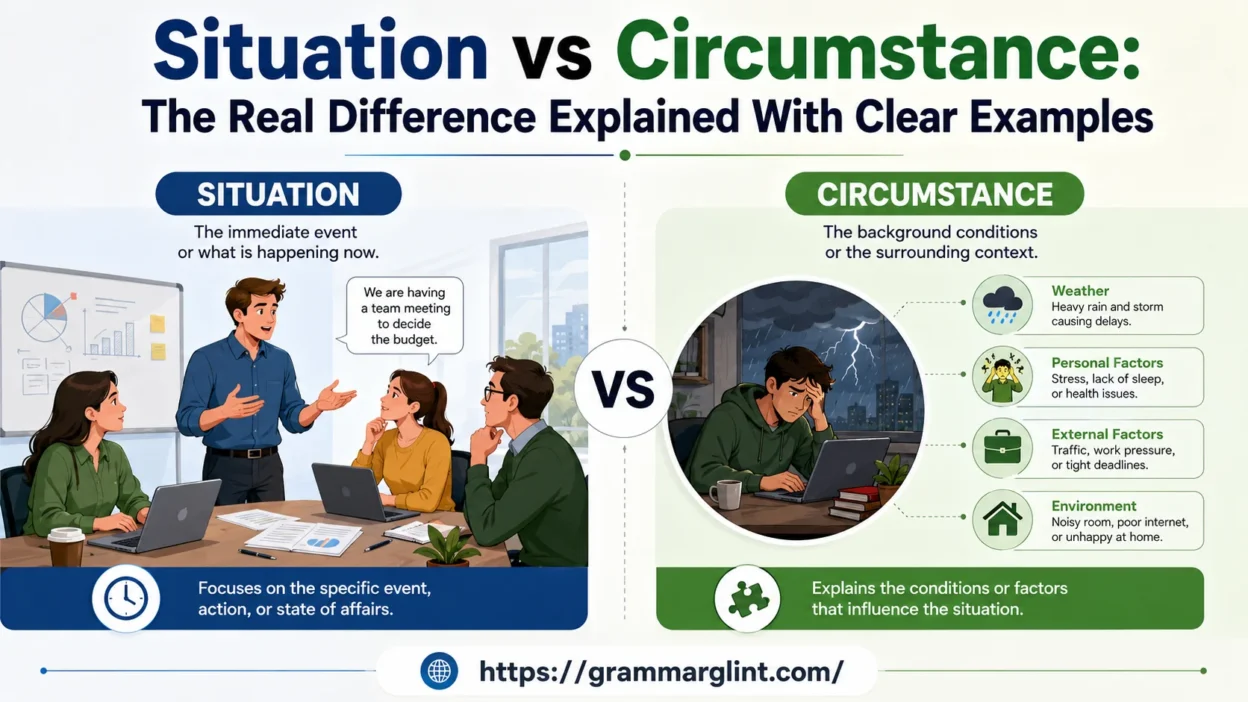
A situation is what you see happening right in front of you.
A circumstance is everything shaping why that thing is happening.
Most confusion happens because English often blurs the line between the two in casual speech. But when you write, explain, or analyze something, the difference matters a lot.
Simple Definitions
Let’s strip everything down.
What “Situation” Means
A situation is a specific event or condition happening at a given moment.
It is:
- Immediate
- Observable
- Narrow in focus
- Often temporary
Think of it as a snapshot.
Example:
- You walk into a room and see two people arguing. That is the situation.
What “Circumstance” Means
A circumstance refers to the background conditions that shape or influence an event.
It is:
- Broader
- Contextual
- Often long-term
- Sometimes invisible at first glance
Think of it as the full story behind the snapshot.
Example:
- Those two people arguing might be under financial stress, family pressure, or work tension. Those are the circumstances.
Difference Explained Clearly
Here’s the simplest mental model:
- Situation = what is happening
- Circumstance = why it is happening
But let’s go deeper.
A situation exists on the surface level. You can describe it without much background knowledge.
A circumstance sits underneath. It explains the conditions that shape the situation.
Key Comparison Table
| Feature | Situation | Circumstance |
| Meaning | Immediate event | Background conditions |
| Focus | What is happening | Why it is happening |
| Scope | Narrow | Broad |
| Time | Short-term | Often long-term |
| Visibility | Easy to see | Sometimes hidden |
| Role in communication | Describes event | Explains context |
| Example | A car crash | Wet road, speeding, fog |
This difference becomes extremely important in writing, decision-making, and communication.
Real-Life Examples
Let’s make this practical. Because theory alone doesn’t stick.
Workplace Example
Imagine an employee misses a deadline.
- Situation: The employee did not submit the report on time.
- Circumstances: The employee faced sudden illness and system failure at work.
Now ask yourself:
Would you judge the employee differently depending on which detail you know first?
Exactly. That’s the power of circumstance.
Driving Example
- Situation: A car accident happened on the highway.
- Circumstances: Heavy rain, low visibility, and reckless speeding contributed to it.
The situation tells you what happened.
The circumstances tell you why it happened.
School Example
- Situation: A student failed an exam.
- Circumstances: The student worked part-time, had limited study time, and faced personal stress.
Now the meaning changes completely. Same outcome. Different understanding.
Read more: Implementing vs Executing: Difference With Real Examples
How Context Changes Meaning
Language is powerful because it shapes perception.
Let’s compare two statements:
- “The situation was difficult.”
- “The circumstances were difficult.”
They sound similar, but they don’t feel the same.
What changes?
- “Situation” feels like you are describing a moment in time.
- “Circumstance” feels like you are explaining a deeper reason.
Here’s another comparison:
- “The situation got out of control.”
- “The circumstances made control difficult.”
The first statement focuses on the event itself.
The second shifts attention to external factors.
This is why politicians, lawyers, and leaders carefully choose between these words.
Common Mistakes
Most learners make predictable errors. Once you see them, you can avoid them easily.
Mistake: Using circumstance for a single event
Wrong:
- “The circumstance happened quickly.”
Why it’s wrong:
A circumstance is not an event. It’s context.
Correct:
- “The situation happened quickly.”
Mistake: Using situation for background conditions
Wrong:
- “His situation affected the decision-making environment.”
Better:
- “His circumstances affected the decision-making environment.”
Mistake: Treating both as identical in formal writing
In casual speech, people mix them. In formal writing, it weakens clarity.
Clear writing separates:
- Events (situation)
- Context (circumstance)
Mistake: Overusing them interchangeably
If you swap them randomly, your message loses precision. Readers may feel the logic is blurry.
Memory Tricks to Remember
You don’t need complicated grammar rules. You just need mental shortcuts.
Trick 1: Snapshot vs Story
- Situation = snapshot (one moment frozen in time)
- Circumstance = story (everything leading up to it)
Trick 2: Movie Analogy
- Situation = a single scene
- Circumstance = the entire movie plot
Trick 3: Photo Album Trick
- Situation = one photo
- Circumstance = the entire album
These analogies help because your brain remembers visuals better than definitions.
Grammar Usage in Sentences
Let’s see how both words behave in real sentences.
Situation Examples
- “The situation is under control now.”
- “We need to handle this situation carefully.”
- “The situation escalated faster than expected.”
Notice how each sentence focuses on what is happening.
Circumstance Examples
- “Under these circumstances, we had no choice.”
- “Her success depends on personal circumstances.”
- “The circumstances forced a change in strategy.”
Notice how each sentence explains conditions, not just events.
When to Use
This is where clarity becomes practical.
Use “Situation” when:
- You describe an event happening now
- You report a problem or incident
- You talk about immediate conditions
- You summarize a moment
Example:
- “This is a dangerous situation.”
Use “Circumstance” when:
- You explain reasons behind something
- You discuss influencing factors
- You provide context or background
- You justify or clarify outcomes
Example:
- “Given the circumstances, the decision makes sense.”
Side-by-Side Real World Scenarios
Let’s compare both words in deeper real-world contexts.
Emergency Scenario
- Situation: A fire broke out in a building.
- Circumstances: Faulty wiring and lack of maintenance caused the fire.
Insight:
The situation demands action. The circumstances demand investigation.
Business Decision Scenario
- Situation: A company laid off employees.
- Circumstances: Declining revenue, market competition, and rising costs.
Insight:
The situation describes the action. The circumstances explain necessity.
Personal Life Scenario
- Situation: Someone moved to a new city.
- Circumstances: Job relocation, family needs, and better opportunities.
Insight:
Situation = visible change. Circumstances = hidden reasons.
Case Study: How Misunderstanding These Words Affects Communication
Let’s look at a realistic communication breakdown.
A manager says:
- “The situation in the team is unstable.”
Team members assume:
- Immediate crisis
- Poor performance
- Urgent problem
But what if the manager actually meant:
- “The circumstances are changing due to restructuring.”
Now the meaning shifts:
- Not an emergency
- A transition phase
- A strategic change
Result of confusion:
- Panic increases
- Misinterpretation spreads
- Productivity drops
Lesson:
Choosing between situation vs circumstance can change emotional response.
Why Professionals Care About This Difference
You’ll notice this distinction often in:
- Law
- Business communication
- Journalism
- Psychology
- Conflict resolution
Why?
Because precision matters.
A lawyer won’t say “circumstances of the crime” casually. They choose words carefully to shape interpretation.
A journalist won’t report “the situation behind inflation” because that mixes layers of meaning.
My Personal Experience as an English Language Specialist
In my work as an English language specialist, I’ve often seen learners struggle with words like situation and circumstance because they appear interchangeable at first glance. When I explain them in real teaching or editing sessions, I usually start by focusing on context rather than definitions. Over time, I noticed that students understand faster when I link language to real-life events instead of abstract grammar rules. This shift alone reduces confusion and improves sentence clarity in both writing and speaking.
One pattern I’ve consistently observed is how learners overuse situation in every context because it feels simpler and more direct. During feedback on essays, emails, and professional writing, I often point out that circumstance is more suitable when background factors matter. Once students see this difference in real examples like workplace decisions, accidents, or academic performance the distinction becomes much more natural. It’s less about memorizing rules and more about recognizing layers of meaning.
From my experience, the biggest improvement happens when learners start thinking in terms of “what is happening” versus “what is influencing what is happening.” This mental shift strengthens not only their grammar accuracy but also their overall communication style. In professional writing especially, this awareness helps them sound more precise, structured, and confident without adding unnecessary complexity.
FAQs
1. What is the main difference between situation and circumstance?
The main difference is that a situation is a specific event or condition, while a circumstance includes surrounding factors that influence that event.
2. Are situation and circumstance synonyms?
They are partly similar, but not exact synonyms. They often overlap in meaning but are used differently depending on context.
3. When should I use the word situation?
Use situation when talking about a clear, specific event, problem, or condition happening at a particular time or place.
4. When should I use the word circumstance?
Use circumstance when referring to broader conditions or background factors that affect or influence something.
5. Why do people confuse these two words?
People confuse them because both relate to conditions, events, and contexts, which makes their meanings seem similar in everyday English.
6. Can situation and circumstance be used interchangeably?
Sometimes they can be used loosely, but in precise communication, they should not always be treated as interchangeable.
7. Does context matter when using these words?
Yes, context is very important because it decides whether you should use situation or circumstance.
8. Which word is more specific?
Situation is more specific because it refers to a particular event or condition.
9. Which word is more general?
Circumstance is more general because it includes surrounding and influencing factors.
10. How can I improve my usage of these words?
You can improve by practicing examples, studying real-life usage, and focusing on word choice in different contexts.
Conclusion
Understanding Situation vs Circumstance helps improve clarity, communication, and overall English vocabulary. While both words describe conditions and events, their usage depends on how specific or broad the meaning needs to be.
A situation focuses on a clear and direct event, while a circumstance explains the surrounding factors that shape it. By paying attention to context, learners can avoid confusion and use both words more accurately in everyday writing and speech.

Aria Jane is a senior language writer and grammar specialist at Grammar Glint. She focuses on English grammar, spelling variations, vocabulary, and writing clarity. Through detailed research and practical examples, Aria helps readers understand language rules and avoid common mistakes. Her articles are designed to make English learning accessible for students, professionals, and everyday writers seeking reliable language guidance.