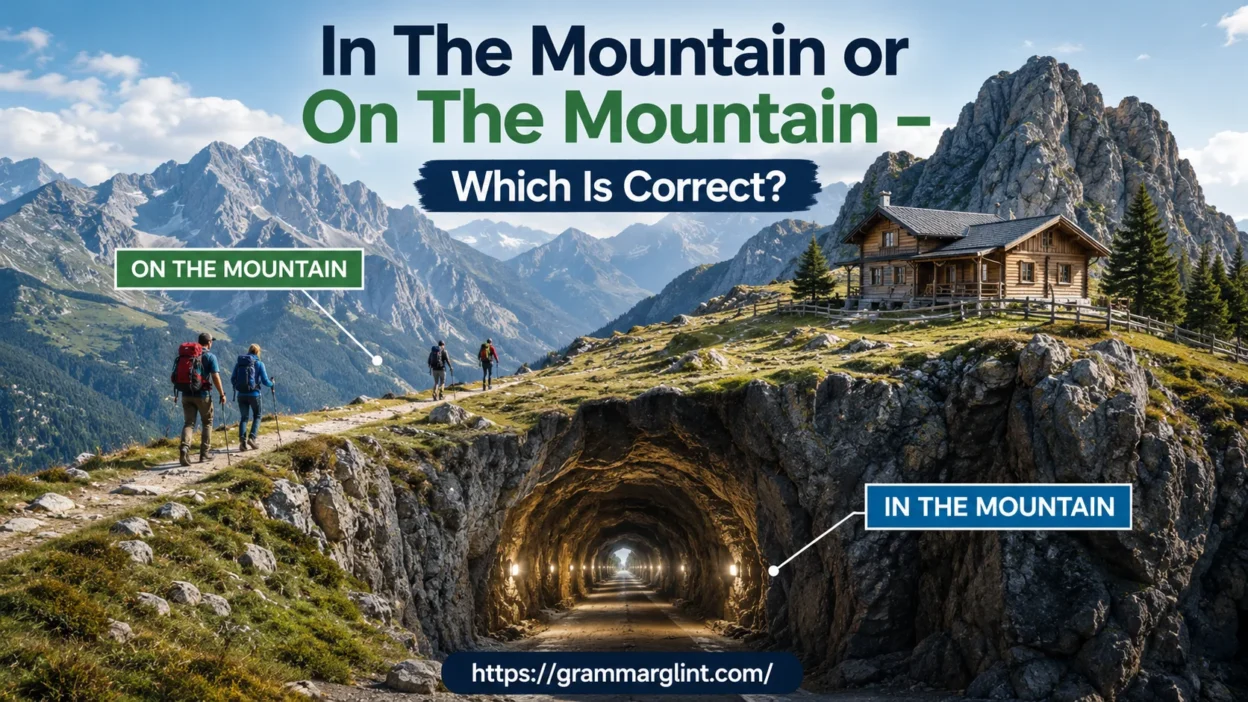
In The Mountain or On The Mountain Which Is Correct? explains confusing prepositions in English language for ESL learners in simple way now. This topic is often misunderstood because small changes in wording can completely change the meaning of a sentence, especially when describing natural locations like mountains, caves, and trails.
When location choosing between in the mountain or on the mountain, it depends on meaning and use. Use referring tunnel example work inside, such as caves or underground paths, but on the other hand people talk being on surface or top when they are active in nature like climbing or skiing. Both phrases are correct, but their use depends on structure, usage, refer, refers to interior or mountains and how something is literally located in real-world context.
It is not interchangeble, and for that reason however according further let’s look changes meaning sentence. In real usage, learners should focus on how the location is being described rather than memorizing fixed rules. Once this idea becomes clear, choosing between in the mountain and on the mountain feels natural and supports more accurate and confident English communication in both speaking and writing.
The Difference
The easiest way to understand these phrases is to imagine the mountain as a physical object.
A mountain has:
- An outside surface
- An inside space
- A surrounding region
Each part connects with a different preposition.
| Phrase | Meaning | Example |
| On the mountain | On the surface or slopes | The climbers are on the mountain |
| In the mountain | Inside the mountain | A cave is in the mountain |
| In the mountains | A mountain area or region | They live in the mountains |
The confusion happens because English speakers do not always think about mountains in the same way. Sometimes a mountain feels like a surface. Other times it feels like a huge container.
What Does “On The Mountain” Mean?
“On the mountain” is the phrase you will hear most often.
It describes something located on the outside part of a mountain.
Think about a person walking, climbing, skiing, or building something on the mountain. They are not inside the rock. They are on its surface.
Examples:
- “The hikers are on the mountain.”
- “There is a small cabin on the mountain.”
- “Snow covers the mountain.”
- “The climbers spent three days on the mountain.”
The mountain acts like a large surface.
Just like:
- on the table
- on the roof
- on the hill
- on the beach
A mountain has slopes and trails, so English speakers often use on.
Common Situations Where You Use
Hiking and Climbing
When people walk across mountain trails, they are usually on the mountain.
Examples:
- “We were on the mountain before sunrise.”
- “The rescue team found the climbers on the mountain.”
The hikers are outside and moving across the terrain.
Skiing and Snowboarding
Winter sports also use on the mountain.
Examples:
- “Thousands of people ski on the mountain every winter.”
- “The resort has several trails on the mountain.”
The skiers move across the slopes.
Buildings and Settlements
Homes and structures can also be on the mountain.
Examples:
- “A village sits on the mountain.”
- “The hotel is located on the mountain.”
This means the building is built on the mountain’s surface.
What Does “In The Mountain” Mean?
The phrase “in the mountain” is less common, but it is still correct.
It means something exists inside the mountain.
Imagine cutting a mountain open and looking inside. Anything located within the rock or underground space can be described as being in the mountain.
Examples:
- “The cave is in the mountain.”
- “A tunnel runs through the mountain.”
- “The miners worked in the mountain.”
Here, the mountain acts like a container.
Similar examples:
- in a box
- in a building
- in a cave
- in a tunnel
Real Examples
Caves
Natural caves are one of the clearest examples.
A cave is not on the mountain’s surface. It exists inside it.
Example:
“The explorers discovered ancient drawings in the mountain.”
The drawings are inside a cave or rock chamber.
Tunnels
Many roads and railways pass through mountains.
Examples:
- “The train travels through the mountain.”
- “The highway tunnel is inside the mountain.”
The tunnel cuts through the rock.
Mines
Mining operations often happen inside mountains.
Examples:
- “Workers extracted minerals from the mine in the mountain.”
- “The old mine was hidden in the mountain.”
“In The Mountains” vs “On The Mountain”
This is where many English learners get confused.
The phrase “in the mountains” does not mean inside a mountain.
Instead, it means a mountain region.
For example:
- “I live in the mountains.”
This means:
“I live in an area with many mountains.”
It does not mean your house is inside a mountain.
Compare These Examples
| Sentence | Meaning |
| I live in the mountains | I live in a mountainous area |
| I live on the mountain | My home is located on a mountain |
| I live in the mountain | My home is inside the mountain |
The difference is small but important.
Why Do We Say “In The Mountains”?
English uses in for large areas.
Examples:
- in a city
- in a country
- in a forest
- in the mountains
A mountain range is treated as a region.
For example:
- “They spent their vacation in the mountains.”
- “Many animals live in the mountains.”
The phrase focuses on the surrounding landscape.
Common Mistakes
Mistake: “We walked in the mountain”
Many learners say:
❌ “We walked in the mountain.”
This sounds like you were walking inside the rock.
Better options:
✅ “We walked on the mountain.”
or
✅ “We walked in the mountains.”
The correct choice depends on your meaning.
Mistake: Using “On The Mountains”
People sometimes say:
❌ “They are hiking on the mountains.”
Usually, English speakers say:
✅ “They are hiking in the mountains.”
Why?
Because hiking often happens across a whole mountain area, not only one mountain.
However:
✅ “They are hiking on the mountain.”
This works when talking about one specific mountain.
Read More: Progress In vs. Progress On vs. Progress Of: A Clear Guide
A Simple Way To Remember The Rule
Use this mental picture:
Surface = ON
If you can stand, walk, or build there:
Use on.
Examples:
- on the mountain
- on the hill
- on the slope
Inside = IN
If something is surrounded by rock:
Use in.
Examples:
- in the mountain
- in the cave
- in the tunnel
Region = IN THE MOUNTAINS
If you mean a larger mountain area:
Use:
- in the mountains
Other Useful Mountain Prepositions
English has several other mountain expressions.
Up the mountain
Means moving higher.
Examples:
- “They climbed up the mountain.”
- “The road goes up the mountain.”
Down the mountain
Means moving lower.
Examples:
- “The snow came down the mountain.”
- “They walked down the mountain.”
Through the mountain
Means passing from one side to another.
Examples:
- “The train goes through the mountain.”
- “A river flows through the mountain.”
At the mountain
Usually means a location near the mountain.
Examples:
- “Meet me at the mountain entrance.”
- “There is a parking area at the mountain.”
Quick Comparison Table
| Expression | Meaning | Example |
| On the mountain | Surface/location | The climber is on the mountain |
| In the mountain | Inside | A cave is in the mountain |
| In the mountains | Mountain region | They live in the mountains |
| Up the mountain | Moving higher | We walked up the mountain |
| Down the mountain | Moving lower | They came down the mountain |
| Through the mountain | Passing inside | The road goes through the mountain |
Real-Life Examples
Example One: A Mountain Cabin
Imagine a cabin built halfway up a peak.
Correct:
“The cabin is on the mountain.”
The cabin sits on the outside slope.
Example Two: An Underground Shelter
Imagine a shelter carved into rock.
Correct:
“The shelter is in the mountain.”
The shelter exists inside the rock.
Example Three: A Vacation Trip
Someone visits a mountain region.
Correct:
“We stayed in the mountains.”
This describes the entire area.
My Personal Experience as an English Language Specialist
After teaching English and reviewing thousands of learner sentences, I’ve noticed that “in the mountain” and “on the mountain” are among the most frequently misunderstood preposition pairs. Many ESL learners assume they have the same meaning because both refer to a mountain, but a single preposition completely changes the location being described. I’ve often seen students write sentences like “We walked in the mountain” when they actually meant they were hiking on its slopes. Once I explain that on refers to the mountain’s surface and in refers to its interior, the confusion usually disappears.
One teaching method that has consistently helped my students is asking them to picture a real mountain. If they can stand, hike, ski, or build something there, they should choose on the mountain. If the object is surrounded by rock, such as a cave, tunnel, or mine, in the mountain is the correct choice. I also remind learners that in the mountains refers to a mountain region rather than the inside of a mountain. This simple visualization has helped many students become more confident with English prepositions and use them naturally in both speaking and writing.
FAQs
1. What is the main difference between “in the mountain” and “on the mountain”?
In the mountain means inside it, while on the mountain means on the surface, top, or side.
2. Is “in the mountain” correct English?
Yes, it is correct when talking about something inside the mountain like a cave or mine.
3. Is “on the mountain” more common?
Yes, on the mountain is more commonly used because people usually hike or ski outside.
4. Can both phrases be used interchangeably?
No, they are not interchangeable because they describe different locations.
5. When should I use “in the mountain”?
Use it when referring to something located inside, such as tunnels, caves, or mines.
6. When should I use “on the mountain”?
Use it when someone is hiking, climbing, skiing, or standing on the surface.
7. Does plural form change meaning?
Yes, in the mountains often refers to a region, while on the mountains still refers to surfaces.
8. Why do learners get confused between these phrases?
Because prepositions in English are subtle and depend heavily on context.
9. Are both phrases grammatically correct?
Yes, both are correct but used in different situations.
10. How can I remember the difference easily?
Think: inside = in, surface/top = on.
Conclusion
Choosing between in the mountain and on the mountain becomes much easier once you understand the difference in meaning. In the mountain refers to something located inside the mountain, such as a cave, tunnel, or mine, while on the mountain describes something on its surface, including trails, slopes, or the summit. Since the two phrases describe different locations, they are not interchangeable, even though both are grammatically correct.
When you’re unsure which preposition to use, think about the physical location you’re describing. If it’s inside the mountain, use in. If it’s on the outside or at the top, use on. Remembering this simple rule will help you speak and write more naturally, avoid common ESL mistakes, and communicate with greater confidence in everyday English.

Aria Jane is a senior language writer and grammar specialist at Grammar Glint. She focuses on English grammar, spelling variations, vocabulary, and writing clarity. Through detailed research and practical examples, Aria helps readers understand language rules and avoid common mistakes. Her articles are designed to make English learning accessible for students, professionals, and everyday writers seeking reliable language guidance.