The topic Input or Inputs? Correct Plural Form often creates confusion because the word input can work in different types of nouns depending on the context and contexts where it appears. In my experience with English grammar and language usage, this small term frequently comes up in writing when people try to find the correct meaning and form. Many learners notice that a simple word can change its role depending on how it is used in a sentence structure. The word helps determine whether it is a countable noun or an uncountable noun, which affects its plural form and overall classification.
The plural form changes when the word becomes a countable noun with multiple entities or identifiable entities. In different contexts, you can use inputs when you are talking about several clear items, ideas, or sources. These multiple examples show how the quantity and identifiable details influence the choice between input and inputs. The distinction becomes easier when you look at whether the things being discussed can be separated and counted individually.
This article content aims to help readers understand the distinction through a simple approach that connects grammar, meaning, and practical communication. A good example shows how both words fit naturally into a sentence based on the situation.
The right choice between input and inputs improves clarity and makes communication more precise. By observing how the word functions in various situations, writers can select the correct term without confusion. The connection between language, structure, and usage makes this topic easier to understand and apply in real writing.
Explained Simply
Let’s get straight to the point.
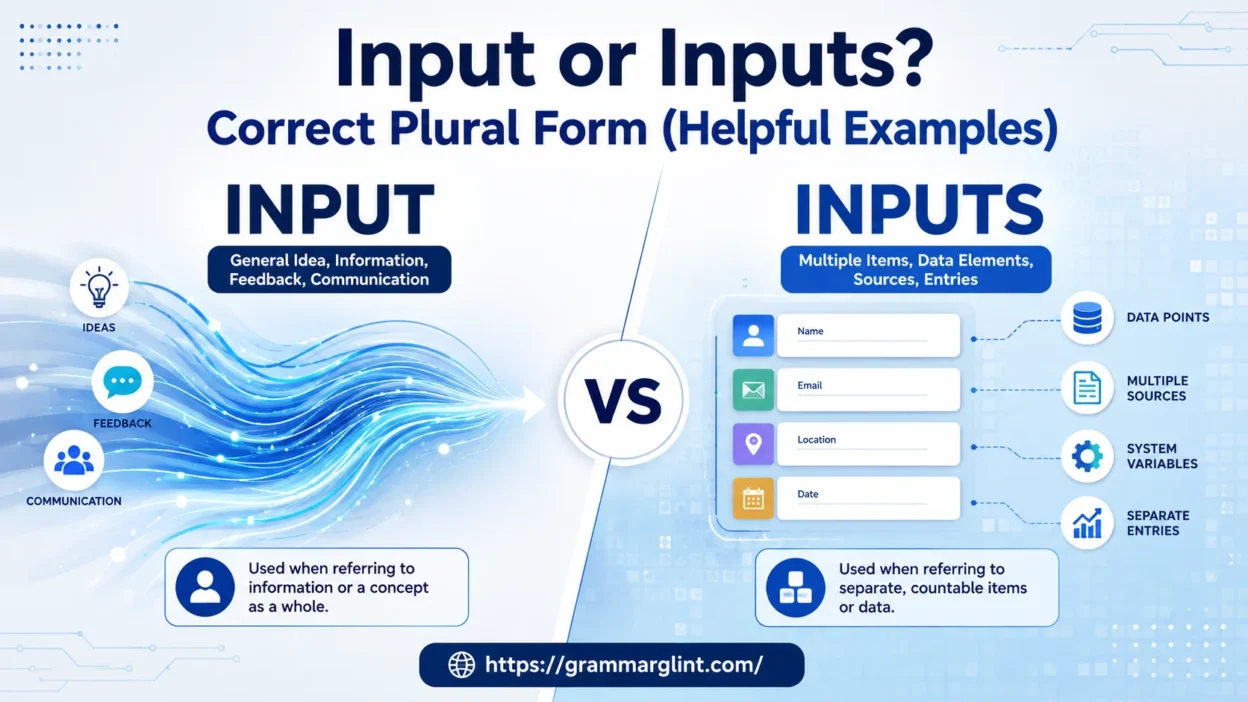
Both input and inputs are correct plural forms depending on meaning.
Here’s the simple rule you can rely on:
- Use input when referring to information, feedback, or a general concept
- Use inputs when referring to multiple distinct data elements or sources
That’s it. The confusion happens because English treats “input” as both a countable and uncountable noun depending on context.
Think of it like water:
- You don’t say “waters” when talking about water in general
- But you do say “waters” when talking about different bodies of water
Same logic applies here.
What “Input” Really Means in Everyday Language
Before deciding between input or inputs, you need to understand what “input” actually means.
In simple terms, input means anything you provide to a system, conversation, or process.
It can be:
- Information
- Feedback
- Data
- Suggestions
- Commands
Everyday examples of “input”
- “I need your input on this idea.”
- “The teacher welcomed student input during discussion.”
- “Your input helped improve the design.”
Notice something important here.
Even though multiple people may contribute, we still use input (singular). That’s because we treat it as one combined idea rather than separate pieces.
When “Input” Stays Singular (Even When It Feels Plural)
This is where most confusion happens.
In many cases, input behaves like an uncountable noun. That means you don’t count it as separate units.
You treat it as a general mass of information.
Use “input” when talking about:
- Opinions or feedback
- General data contribution
- Abstract information flow
- Collective ideas
Examples that sound natural:
- “We value customer input.”
- “Her input shaped the final decision.”
- “The system processes user input.”
Even if ten people contribute, you still say input.
Why? Because you’re referring to the concept, not individual pieces.
Simple analogy
Think of “input” like sand.
You don’t say:
“I collected sands.”
You say:
“I collected sand.”
Even though sand has grains, we treat it as one substance. Input works the same way when used generally.
When “Inputs” Is the Correct Choice
Now let’s flip the situation.
You use inputs when you are talking about separate, countable pieces of data or information.
This usually happens in technical, analytical, or structured environments.
Use “inputs” when:
- Listing multiple data points
- Referring to different sources
- Breaking information into categories
- Working with systems or models
Examples of “inputs” in real usage:
- “The model requires three inputs: age, income, and location.”
- “We analyzed inputs from five departments.”
- “Different sensor inputs control the system.”
Here, each item is clearly separate. That’s why the plural form makes sense.
Simple analogy
Think of inputs like ingredients in a recipe.
- Flour = input
- Eggs = input
- Sugar = input
Together:
“These are the inputs for the cake.”
Each item is distinct and countable.
In Technology (Where Things Get Real)
If there’s one place this grammar question shows up constantly, it’s technology.
Developers, engineers, and data analysts use these terms daily.
And here’s where precision matters.
In programming:
- Input often refers to a single user action or data stream
- Inputs refer to multiple parameters or variables
Example in coding context:
- “The function takes user input.”
- “The algorithm processes multiple inputs.”
In user interfaces:
- Input field = single entry box
- Inputs = multiple fields in a form
Real-world tech analogy
Imagine a login form:
- Username → input
- Password → input
Together:
“These are the inputs required for authentication.”
Why tech uses both forms so often
Technology separates data clearly. Systems don’t deal with vague ideas. They deal with structured units.
So developers naturally say:
- input (single entry)
- inputs (multiple entries)
This distinction helps avoid ambiguity in code and system design.
Read More: Any Problem or Any Problems : Which Is Correct?
Common Mistakes People Make
Even experienced writers slip up here. Let’s fix that.
Mistake: Using “inputs” for general feedback
❌ “We need your inputs on this idea.”
✔ Correct:
“We need your input on this idea.”
Why? Because feedback is treated as a collective concept.
Mistake: Using “input” when listing items
❌ “The system uses three input: speed, time, distance.”
✔ Correct:
“The system uses three inputs: speed, time, distance.”
Why? Because you are clearly counting items.
Mistake: Mixing both in one sentence
❌ “We gathered input from multiple inputs.”
✔ Better:
“We gathered input from multiple sources.”
OR
“We gathered inputs from multiple departments.”
Quick correction table
| Incorrect Sentence | Correct Version | Why It Works |
| We need many input | We need much input | Input is uncountable here |
| Add the inputs from users | Add user input | General feedback concept |
| The model needs input values | The model needs inputs | Countable variables |
A Simple Rule You Can Always Remember
Let’s make this painfully easy.
Ask yourself:
Can you count them individually?
- Yes → use inputs
- No → use input
That’s your decision filter.
Memory trick
Input = idea or flow
Inputs = pieces or items
It’s like thinking in terms of water vs bottles of water.
Real-Life Case Study: Marketing Team Confusion
Let’s look at a real-world style scenario.
A marketing team is preparing a product launch report.
They write:
“We collected inputs from customers, surveys, and focus groups.”
At first glance, it seems fine. But there’s a problem.
What went wrong?
They used inputs incorrectly because they were referring to general feedback.
Correct version:
“We collected input from customers, surveys, and focus groups.”
Now it flows naturally.
But here’s another scenario from the same project:
They later write:
“We analyzed three inputs: customer age, purchase history, and browsing behavior.”
This time, inputs is correct because they are clearly separate data points.
Lesson from the case
Context changes everything. Same word. Different meaning. Different grammar outcome.
Quick Comparison: In Real Use
| Context | Correct Form | Example |
| Feedback | Input | “We value your input.” |
| Data points | Inputs | “The model uses three inputs.” |
| General ideas | Input | “Her input helped us.” |
| Structured variables | Inputs | “Multiple inputs affect output.” |
| Conversations | Input | “Team input is important.” |
| Engineering systems | Inputs | “Sensor inputs vary.” |
My Personal Experience as an English Language Specialist
Over the years, I’ve noticed that input and inputs are among the words that confuse English learners more than they expect. On the surface, the difference seems simple, but in practice, many writers hesitate because they aren’t sure whether they’re referring to a general concept or to several individual items. I’ve seen this uncertainty in academic writing, business communication, technical documentation, and even among fluent English speakers.
In my experience as an English language specialist, the easiest way to solve this problem is to focus on the meaning instead of memorizing grammar rules. Whenever I edit articles or teach students, I encourage them to ask one question: “Am I talking about information as a whole, or am I talking about separate, countable pieces?” That single question usually leads to the correct choice.
I’ve also found that context is far more important than the dictionary definition alone. For example, in everyday conversations, people naturally say, “I’d appreciate your input,” because they’re asking for general advice or feedback. In contrast, professionals working in programming, engineering, or data analysis often write about inputs because they’re referring to multiple variables or data points that can be counted individually.
One piece of advice I always give my students is not to overthink the plural form. Native English speakers choose between input and inputs based on what they mean, not because they consciously remember a grammar rule. Once you begin thinking about the message rather than the word itself, the correct form becomes much easier to recognize.
From both teaching and editing experience, I’ve learned that mastering small distinctions like this can significantly improve the clarity and professionalism of your writing. Understanding when to use input and when to use inputs is a small detail, but it’s one that helps you communicate more naturally and confidently in English.
FAQs
1. Is Input a singular or plural word?
Input can be both singular and plural depending on the context. When it is used as an uncountable noun, it can remain unchanged, but when it refers to separate items, the plural form becomes inputs.
2. Is Inputs the correct plural form of Input?
Yes, inputs is a correct plural form when input refers to multiple countable items, sources, or identifiable entities that can be separated.
3. Can Input be used as a plural noun?
Yes, input can be used as a plural form when it works as an uncountable noun. In this case, the singular form and plural form are identical.
4. When should I use Input instead of Inputs?
Use input when discussing general information, advice, feedback, or a concept that does not represent separate countable objects.
5. When should I use Inputs instead of Input?
Use inputs when you are talking about multiple clear items, ideas, sources, or contributions that can be counted individually.
6. Are Input and Inputs always interchangeable?
No, Input and Inputs are not always interchangeable. The correct choice depends on the meaning, quantity, and how the word fits into the sentence structure.
7. Why is the word Input confusing for English learners?
The confusion happens because input has different uses in English grammar. It can act as both a countable noun and an uncountable noun depending on the situation.
8. What is an example of Input as an uncountable noun?
When input refers to general information, suggestions, or feedback as one overall idea, it works as an uncountable noun.
9. What is an example of Inputs as a countable noun?
Inputs can describe several separate and measurable things, such as different sources, ideas, or pieces of information used together.
10. How can I remember the difference between Input and Inputs?
Look at the context. If the things can be counted as separate units, use inputs. If they represent a general idea, use input.
Conclusion
Choosing between input and inputs is easier once you understand whether the word is being used as a countable or an uncountable noun. Use input when referring to information, advice, or contribution in a general sense, and use inputs when talking about multiple separate ideas, opinions, data sources, or other identifiable contributions. The correct choice always depends on the context rather than a fixed grammar rule.
When you’re unsure, ask yourself a simple question: Can the items be counted individually? If the answer is yes, inputs is usually the right option. If you’re referring to the concept as a whole, input is the better choice. With regular practice and exposure to real-world examples, you’ll be able to choose the correct form confidently and write with greater clarity and precision.

Aria Jane is a senior language writer and grammar specialist at Grammar Glint. She focuses on English grammar, spelling variations, vocabulary, and writing clarity. Through detailed research and practical examples, Aria helps readers understand language rules and avoid common mistakes. Her articles are designed to make English learning accessible for students, professionals, and everyday writers seeking reliable language guidance.