Many learners, beginners, students, ESL learners, developers, writers, and programmers see Postfix vs Suffix as a small word puzzle because both look like interchangeable terms, but their difference becomes clear with proper understanding. From my teaching experience and practice, I have noticed this common confusion during learning English and English grammar.
A Suffix is a linguistic element from affixes and suffixes that attach to the end of a word or verb to change meaning, tense, and grammatical function in a sentence. These elements shape words, strengthen language structure, and follow grammar rules.
In postfix notation, operators are placed after operands in expressions to help with organizing data, efficiency, and correct syntax. This system appears in calculators, technical tasks, and software tools, where symbols follow a specific way to complete tasks efficiently.
Knowing the distinction, comparison, and correct usage of both affixes helps people gain confidence, apply correctly, speak, and write in a more fluent, smoother, and natural English style. This article helps break down the simplest way to explore the real meaning, changes, and completely different concepts behind these two entirely different terms, improving communication, writing, professional tone, polished tone, and opening a whole world of logical control and better skills.
Difference Explained in Simple Terms
Before going deep, here’s the cleanest distinction:
- A suffix changes how a word works in language.
- A postfix describes position in structured systems like math or programming.
That’s it at the core.
But the real understanding comes from examples, context, and how each one behaves in the real world.
What Is a Suffix in Postfix vs Suffix
A suffix is a linguistic building block. You attach it to the end of a word to change meaning, tense, or grammatical role.
Think of it as a “word modifier.”
Simple definition
A suffix is a letter or group of letters added at the end of a word to change its meaning or function.
Real examples of suffixes
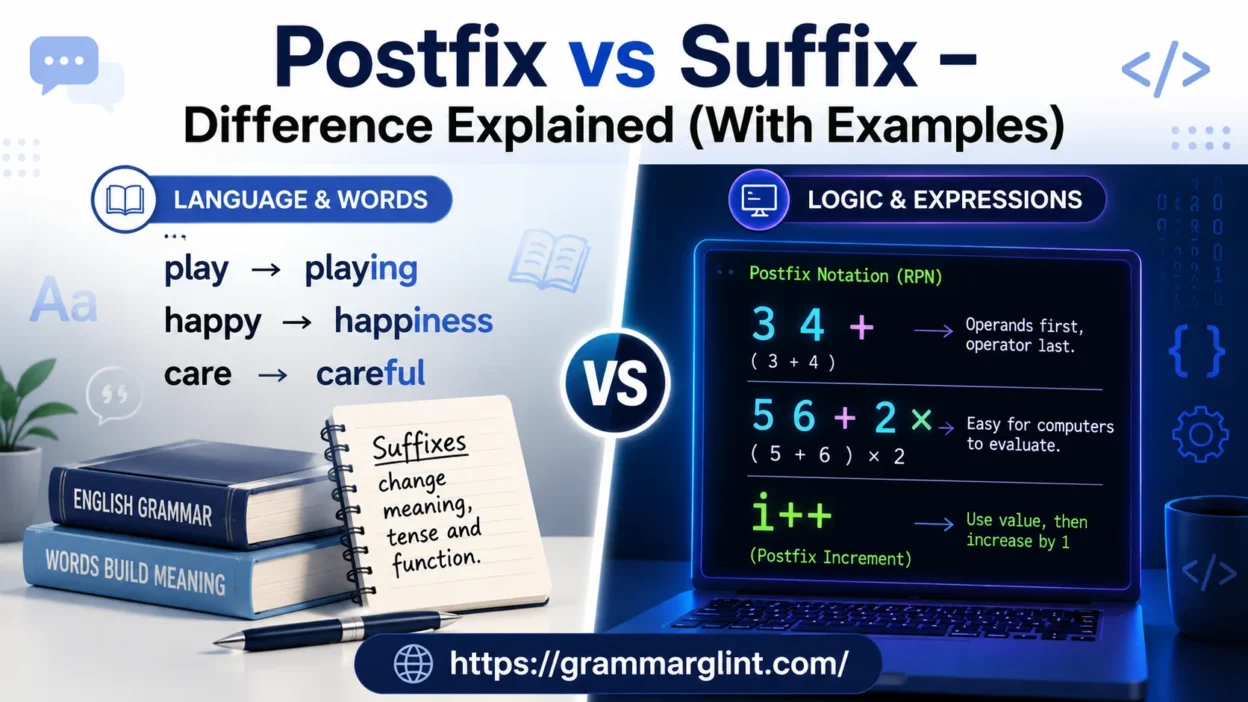
- play → playing
- teach → teacher
- kind → kindness
- hope → hopeless
- child → childhood
Each suffix shifts meaning in a meaningful way.
What suffixes actually do in language
Suffixes perform specific jobs in grammar:
Change tense
- walk → walked
- talk → talking
Change word class
- beauty (noun) → beautiful (adjective)
- modern → modernize (verb)
Show plurality
- cat → cats
- box → boxes
Express condition or quality
- child → childish
- help → helpful
Why suffixes matter in communication
Suffixes help language stay flexible. Without them, we’d need completely new words for every idea. Instead, we reuse roots and modify them.
As linguist Noam Chomsky once emphasized in simplified form:
“Language builds meaning through structure, not just vocabulary.”
Suffixes are a perfect example of that structure in action.
What Is a Postfix in Postfix vs Suffix
A postfix works in a completely different space. It doesn’t belong to grammar. It belongs to structured systems like:
- Mathematics
- Computer science
- Programming syntax
- Expression evaluation
Simple definition
A postfix is an element placed after another element in a structured expression or notation system.
Unlike suffixes, postfixes don’t change meaning in language. They define position and operation order.
Read More: Thus vs Therefore vs Hence vs So: Difference Explained
Postfix Notation in Mathematics and Computer Science
One of the most important uses of postfix appears in postfix notation, also called Reverse Polish Notation (RPN).
Traditional expression (infix)
- 3 + 4
Postfix expression
- 3 4 +
Both represent the same operation, but the structure differs.
Why postfix exists
Computers process expressions differently from humans. They don’t need parentheses when using postfix.
For example:
- (3 + 4) × 5 becomes:
- 3 4 + 5 ×
This eliminates ambiguity.
How computers evaluate postfix
Computers use a stack structure:
- Read numbers
- Push them onto a stack
- Apply operators in order
This makes evaluation faster and simpler.
Postfix in Programming Languages
Postfix also appears in programming, especially in increment operations.
Example
- i++
Here, the operator appears after the variable.
What it means
- Use the current value of i
- Then increase it by 1
This differs from prefix form:
- ++i increases first, then uses the value
Why developers care
Postfix and prefix behavior affects logic in loops, arrays, and performance-critical code.
Even a small misunderstanding can lead to bugs.
Core Difference Explained Clearly
Now let’s remove confusion completely.
Suffix belongs to language
- Works with words
- Changes meaning or grammar
- Used in linguistics
Postfix belongs to systems
- Works with expressions
- Controls evaluation order
- Used in math and programming
Side-by-Side Comparison
| Feature | Suffix | Postfix |
| Field | Linguistics | Mathematics, Programming |
| Function | Changes word meaning | Defines position in expressions |
| Unit type | Letters or morphemes | Operators or symbols |
| Example | -ing, -ness, -ful | 3 4 +, i++ |
| Purpose | Grammar modification | Expression structure |
| Human vs machine | Human language | Machine logic |
This table shows the divide clearly. They only share one thing: placement at the end.
Real-World Examples
Understanding improves when you see both in action.
Example 1: Suffix in everyday language
Take the word:
- “develop”
Add suffixes:
- develop → developer
- develop → development
- develop → developing
Each suffix changes meaning and grammatical role.
Now compare that with postfix systems.
Example 2: Postfix in computation
Consider this expression:
- 5 6 + 2 ×
Step-by-step evaluation:
- 5 6 + → 11
- 11 2 × → 22
A computer evaluates it without needing parentheses.
Example 3: Mixed confusion scenario
A beginner sees “postfix” and assumes:
“Oh, it’s just a fancy word for suffix.”
Then they try to apply grammar rules in programming logic.
That leads to mistakes like:
- Misreading i++ as a word rule instead of execution order
- Thinking postfix changes meaning instead of structure
Why People Confuse
This confusion happens for three main reasons.
Both appear at the end
Humans naturally group things by position. If something appears at the end, we assume similarity.
Language overlap in education
Some textbooks casually use both terms without context. That creates mental shortcuts that break later.
Programming introduces linguistic terms
Computer science borrows language-like terminology, which blurs boundaries.
A programming educator once put it simply:
“Students confuse postfix with suffix because both sit at the end, but only one actually speaks language.”
Common Mistakes
Let’s fix the most frequent errors.
Mistake: Thinking postfix equals suffix
Reality:
- Suffix modifies words
- Postfix defines order or structure
Mistake: Ignoring context
The word “postfix” changes meaning depending on field.
- In grammar discussions → incorrect term
- In programming → valid concept
- In math → standard notation
Mistake: Mixing evaluation rules
Beginners often treat postfix expressions like written sentences.
But computers don’t read—they compute step-by-step using rules.
Case Study: How Postfix Improves Computer Calculations
Let’s look at a practical computing scenario.
Problem: Expression ambiguity
Expression:
- (5 + 3) × (2 + 4)
Humans understand it easily. Computers must parse it carefully.
Postfix version
- 5 3 + 2 4 + ×
Why this matters
Using postfix:
- Removes parentheses
- Reduces parsing time
- Avoids ambiguity
- Simplifies compiler design
Real-world impact
Early calculators and compilers adopted postfix to reduce computational complexity. Some stack-based systems still rely on it today.
Case Study: Suffix Impact in English Language Learning
Now switch to linguistics.
Problem: Word flexibility
English relies heavily on root words.
Without suffixes:
- teach stays teach
- no teacher
- no teaching
- no teachable
With suffixes:
You get multiple meanings from one root:
- teach → teacher (person)
- teach → teaching (action)
- teach → teachable (quality)
Real-world benefit
Language becomes efficient. You express more ideas with fewer roots.
Memory Trick
Here’s a simple way to lock it in:
Suffix = language tool
- Think: “word builder”
- Example: happiness, playing, slowly
Postfix = system tool
- Think: “order builder”
- Example: 3 4 +, i++
Or even simpler:
- Words → suffix
- Systems → postfix
When to Use Suffix vs Postfix Correctly
You’ll rarely need both in the same context, but knowing when matters.
Use suffix when:
- Studying grammar
- Learning vocabulary
- Analyzing sentence structure
- Teaching language rules
Use postfix when:
- Writing or studying code
- Learning compiler design
- Working with mathematical notation
- Understanding expression evaluation
My Personal Experience as an English Language Specialist
Over the years, I’ve worked with students, ESL learners, writers, and professionals who often confuse Postfix and Suffix simply because both appear at the end of something. At first glance, the two terms seem closely related, but once I explain the context behind each one, the confusion usually disappears. I’ve found that learners who study both English grammar and programming are especially likely to mix them up, assuming they have the same meaning.
In my experience, the easiest way to remember the difference is to focus on the field rather than the position. A suffix belongs to language and helps create or modify words, while a postfix belongs to computing, mathematics, and programming, where it describes the placement of operators in an expression. This simple distinction has helped many of my students build confidence, avoid repeated mistakes, and use both terms accurately in academic, technical, and everyday communication.
FAQs
1. What is the main difference between Postfix and Suffix?
The main difference between Postfix and Suffix is their field of use. A Suffix is used in English grammar and linguistics to modify a word, while Postfix is mostly used in programming, computing, and mathematical expressions.
2. Is a Suffix always added at the end of a word?
Yes, a Suffix is attached to the end of a base word to change its meaning, tense, or grammatical function.
3. Are Postfix and Suffix interchangeable terms?
No, Postfix and Suffix are not completely interchangeable terms. They may look similar, but they belong to different concepts and have different usage.
4. What is an example of a Suffix?
An example of a Suffix is adding –s to create strengths or adding –ed to show a past verb form. These changes affect the structure of a sentence.
5. What does Postfix mean in programming?
In programming, Postfix refers to a notation where operators are placed after operands in an expression. It helps with correct syntax and efficient processing.
6. Why do learners confuse Postfix and Suffix?
Many learners get confused because both terms involve something being added after another element. Understanding their different roles makes the concept clearer.
7. How does learning Suffixes improve English skills?
Learning Suffixes helps people improve writing, speaking, and communication by creating more natural and accurate English sentences.
8. Where is Postfix notation used?
Postfix notation is used in areas like calculators, software tools, computer science, and technical tasks that involve expressions and data.
9. Can Postfix be related to linguistics?
Yes, Postfix can appear in linguistics, but its common modern use is connected with computing and symbolic notation.
10. How can someone remember the difference between Postfix and Suffix?
A simple way is to remember that Suffix changes words in language, while Postfix works with symbols, operators, and structures in technical fields.
Conclusion
The difference between Postfix vs Suffix is simple once you know the context. A suffix is part of English grammar and word formation, where letters are added to the end of a word to create a new meaning or grammatical function. A postfix, however, is mainly used in programming, mathematics, and computer science, where an operator appears after its operands in an expression.
Remember this easy rule: if you’re talking about words, think suffix. If you’re talking about expressions or code, think postfix. Understanding this distinction will help you choose the correct term, avoid common mistakes, and communicate more clearly in both everyday English and technical discussions.

Aria Jane is a senior language writer and grammar specialist at Grammar Glint. She focuses on English grammar, spelling variations, vocabulary, and writing clarity. Through detailed research and practical examples, Aria helps readers understand language rules and avoid common mistakes. Her articles are designed to make English learning accessible for students, professionals, and everyday writers seeking reliable language guidance.