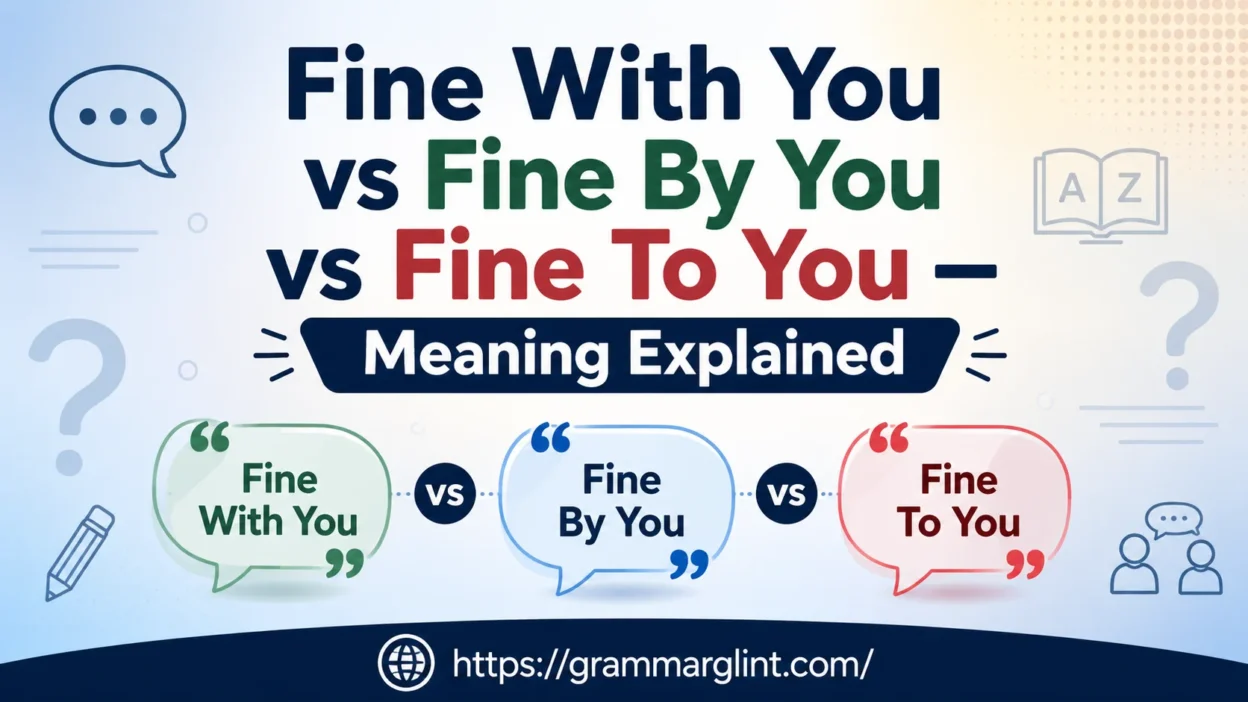
I explore Fine With You vs Fine By You vs Fine To You and how prepositions can change meaning in phrases based on their use today. From my experience, these finicky little things have the power to completely shift how a sentence feels because a small change in wording can affect the message. Certain phrases may look similar, but they work depending on how they are used. This article aims to explore these expressions and help readers understand the major differences between them in everyday communication.
The phrase fine to you is only correct in specific situations because to works differently from other prepositions. It is correct when to is modifying a verb that comes before fine, rather than directly showing agreement. A small word like with, by, or to can guide the direction of a sentence and influence how the listener understands the intended meaning.
In my writing practice, I notice that each expression has its own role and purpose. Choosing the right option makes communication clearer and helps avoid confusion in both spoken and written English. Learning these small distinctions improves accuracy and allows sentences to sound more natural. Even though the differences are subtle, using the correct form keeps the sentence fine and effective.
Why “Fine With You vs Fine By You vs Fine To You” Confuses So Many Learners
English learners often get stuck here because all three phrases look almost identical. The only difference is one tiny word: with, by, or to.
But here’s the catch:
- English doesn’t always follow literal logic
- Prepositions behave more like “feeling markers” than grammar rules
- Native speakers choose phrases based on rhythm and habit, not strict rules
So when you translate directly from your native language, you often land on something like “fine to you,” which sounds off.
The real goal is simple:
You want to sound natural, not translated.
Core Meaning Behind All Three Phrases
At the heart of Fine With You vs Fine By You vs Fine To You, all three try to do one thing:
Ask if something is acceptable or agreeable to someone.
But each version carries a slightly different tone and level of naturalness.
Think of it like this:
- You’re checking approval
- You’re testing comfort
- You’re confirming agreement
Now let’s break each one down clearly.
Fine With You: The Most Natural and Widely Used Form
Meaning
“Is this okay for you?”
How it feels
Neutral, balanced, and widely accepted in both spoken and written English.
Why it works
The preposition “with” suggests compatibility. Two things existing together without conflict.
So when you say:
- “Is this fine with you?”
You’re really asking:
Can you exist comfortably with this decision?
Common examples
- “We’ll meet at 6 PM. Is that fine with you?”
- “I changed the schedule. Hope it’s fine with you.”
- “We can go with your idea if it’s fine with you.”
Where you’ll hear it
- Workplace conversations
- Casual speech
- Emails and messages
- Customer service interactions
Natural tone analysis
- Polite ✔
- Neutral ✔
- Natural ✔
- Widely accepted ✔
If you only remember one version, remember this one.
Fine By You: Casual, Conversational, and Slightly More Direct
Meaning
“Do you approve of this?”
How it feels
More conversational and slightly quicker in tone.
Why it works
The preposition “by” here signals acceptance or permission coming from the listener.
It carries a sense of:
“Are you okay giving approval for this?”
Common examples
- “We’ll leave early. Fine by you?”
- “If we cancel the meeting, is that fine by you?”
- “I’ll book the tickets now, fine by you?”
Where you’ll hear it
- Spoken English
- Informal planning conversations
- Quick decisions between friends or colleagues
Tone analysis
- Casual ✔
- Slightly direct ✔
- Natural in speech ✔
- Less formal than “fine with you” ✔
Think of it like a shortcut version of the same idea.
Read More: Question About vs Question On vs Question Regarding: Explained
Fine To You: The One You Should Avoid
Meaning attempt
“Is this acceptable to you?”
Reality
It sounds unnatural in standard English.
Why it fails
The preposition “to” shows direction, movement, or destination.
For example:
- Give this to you
- Send this to you
But acceptance doesn’t involve direction. It involves agreement.
So “fine to you” creates a mismatch in logic.
Common reaction from native speakers
- It feels awkward
- It sounds “translated”
- It breaks natural rhythm
Example comparison
❌ “Is this fine to you?”
✔ “Is this fine with you?”
✔ “Is this okay for you?”
Deep Grammar Insight: Why Prepositions Change Everything
Let’s simplify the logic behind Fine With You vs Fine By You vs Fine To You.
| Phrase | Preposition Meaning | Real Interpretation | Natural Level |
| Fine with you | Compatibility | Can you accept this situation? | Very natural |
| Fine by you | Permission/approval | Do you agree or approve? | Natural in speech |
| Fine to you | Direction | ❌ Doesn’t match meaning | Unnatural |
Simple mental trick
- With = together
- By = approval
- To = direction (not agreement)
Once you remember this, you stop guessing.
How Native Speakers Actually Use These Phrases
Native speakers don’t think about grammar rules when they speak. They rely on patterns.
Here’s what actually happens in real life:
- In emails → “Does this work for you?”
- In meetings → “Is this fine with you?”
- In quick speech → “Fine by you?”
Notice something important:
They often skip all three and use even simpler alternatives.
Spoken vs Written Differences
Language changes depending on context. The phrase you choose should match the situation.
| Situation | Best Choice |
| Formal email | Is this fine with you? / Does this work for you? |
| Casual chat | Fine by you? |
| Professional discussion | Is this acceptable to you? |
| Friendly planning | Fine with you? |
Real-Life Case Studies
Case Study 1: Workplace scheduling
A team lead writes:
“We’re moving the meeting to 3 PM. Is that fine with you?”
Team members respond naturally without confusion.
Now compare:
“We’re moving the meeting to 3 PM. Is that fine to you?”
People pause. It feels off. It breaks flow.
Result: “with you” wins in professional clarity.
Case Study 2: Friends making plans
Two friends decide dinner time:
- A: “Let’s meet at 8. Fine by you?”
- B: “Yeah, that works.”
Here, “fine by you” feels fast and natural.
Now replace it:
- A: “Let’s meet at 8. Fine with you?”
Still correct, but slightly more formal.
Result: Both work, but tone changes.
Case Study 3: Customer service email
A support agent writes:
“We’ve updated your delivery address. Please confirm if this is fine with you.”
This sounds polite and professional.
Now compare:
“Please confirm if this is fine by you.”
It feels too casual for service tone.
Result: “with you” fits formal tone better.
Common Mistakes Learners Make
Many learners struggle not because English is hard, but because they overthink it.
Here are the biggest mistakes:
- Using “to you” because of literal translation
- Mixing formal and informal tone in the same sentence
- Trying to sound “advanced” instead of natural
- Copying phrases without understanding context
Quick reality check
If a phrase sounds like something you wouldn’t hear in daily speech, it probably needs adjustment.
Simple Decision Guide
When you’re unsure, follow this:
- Want safe and correct? → fine with you
- Want casual and quick? → fine by you
- Thinking of using “fine to you”? → stop and replace it
Better Alternatives You Should Actually Use
Sometimes, the best English avoids all three phrases completely.
Here are stronger natural options:
- “Does that work for you?”
- “Are you okay with that?”
- “Is that alright with you?”
- “Would that be okay?”
- “Can you go with this?”
These often sound smoother in real communication.
Why “Work for You” Is So Common
You might notice something interesting.
Native speakers often prefer:
“Does this work for you?”
Instead of:
“Is this fine with you?”
Why?
Because “work” is direct, simple, and emotionally neutral. It avoids ambiguity.
My Personal Experience as an English Language Specialist
As an English language specialist, I have reviewed thousands of grammar questions, editing projects, and learner mistakes over the years. One pattern I see repeatedly is that people focus on the main words in a sentence but overlook the importance of prepositions. Phrases like fine with you, fine by you, and fine to you may seem interchangeable at first glance, yet they create different meanings and levels of naturalness. I’ve found that understanding these subtle differences helps learners sound more fluent and confident instead of relying on literal translations from their native language.
In my experience, the fastest way to improve your English is to pay attention to how native speakers naturally use these expressions in conversations, emails, and everyday writing. Rather than memorizing isolated grammar rules, I encourage learners to study phrases in context and practice them regularly. Over time, this approach builds intuition, making it much easier to choose the right expression without hesitation. These small improvements may seem minor, but together they make your English clearer, more natural, and far more effective.
FAQs
1. What is the difference between fine with you and fine by you?
Fine with you and fine by you both ask whether someone accepts or agrees with something. However, fine with you is more common in everyday conversations, while fine by you is also correct and often used to ask for approval.
2. Is fine with you the most common expression?
Yes, fine with you is the most common and natural choice when asking if someone is comfortable with a plan, decision, or action. It shows that something is acceptable to another person.
3. Can I use fine by you in formal communication?
Yes, fine by you can be used in formal and informal situations. It politely checks whether an arrangement or decision is acceptable to someone.
4. Is fine to you grammatically correct?
Fine to you is only correct in specific sentence structures. The word to usually needs to connect with a verb that comes before fine, rather than directly replacing with or by.
5. Why do prepositions create confusion in English?
Prepositions are small words, but they can completely change the meaning of a sentence. Words like with, by, and to often affect how an expression is understood.
6. Can fine with you and fine by you be used interchangeably?
In many situations, yes. Both expressions can show agreement, but fine with you is generally the more common and natural phrase for most speakers.
7. How do I know which preposition to choose?
The choice depends on the meaning and structure of the sentence. Understanding the context helps determine whether with, by, or to is the correct option.
8. What does fine with you mean?
Fine with you means that something is acceptable, suitable, or not a problem for someone. It is often used when checking another person’s opinion.
9. What does fine by you mean?
Fine by you means that someone approves of or agrees with something. It is commonly used when asking for permission or confirmation.
10. Why is learning these differences important?
Learning the difference between fine with you, fine by you, and fine to you improves clarity and helps speakers and writers use English more naturally.
Conclusion
Understanding Fine With You vs Fine By You vs Fine To You is easier once you know what each expression is meant to do. Fine with you is the most common choice when asking for someone’s agreement, while fine by you expresses a similar idea with a slightly different tone. Fine to you, however, is used only in specific grammatical situations where to describes how something appears, feels, or is directed toward someone rather than asking for approval.
The best way to remember these differences is to focus on the context instead of the individual words. Reading, listening, and practicing these expressions in real conversations will help you recognize which one sounds natural. As you become more familiar with their usage, choosing between Fine With You vs Fine By You vs Fine To You will become automatic, making your spoken and written English clearer, more accurate, and more confident.

Aria Jane is a senior language writer and grammar specialist at Grammar Glint. She focuses on English grammar, spelling variations, vocabulary, and writing clarity. Through detailed research and practical examples, Aria helps readers understand language rules and avoid common mistakes. Her articles are designed to make English learning accessible for students, professionals, and everyday writers seeking reliable language guidance.