English language has many surprises, especially when small prepositions like on, in, and at create confusion. These little words may look straightforward, but they can create a puzzle when forming a simple sentence. On the Tree or In the Tree Which Is Correct? explains how these words affect meaning and why choosing the correct phrase depends on the context. Understanding these differences improves sentence structure, word choice, and overall grammar.
From my experience with learning and explaining grammar, I noticed that deciding between on the tree and in the tree depends on the situation and what you are referring to. Many learners find these phrases confusing because both seem natural, but they have different purposes. This article explores how these phrases are used correctly and how a small change in preposition can change the expression and usage of a sentence.
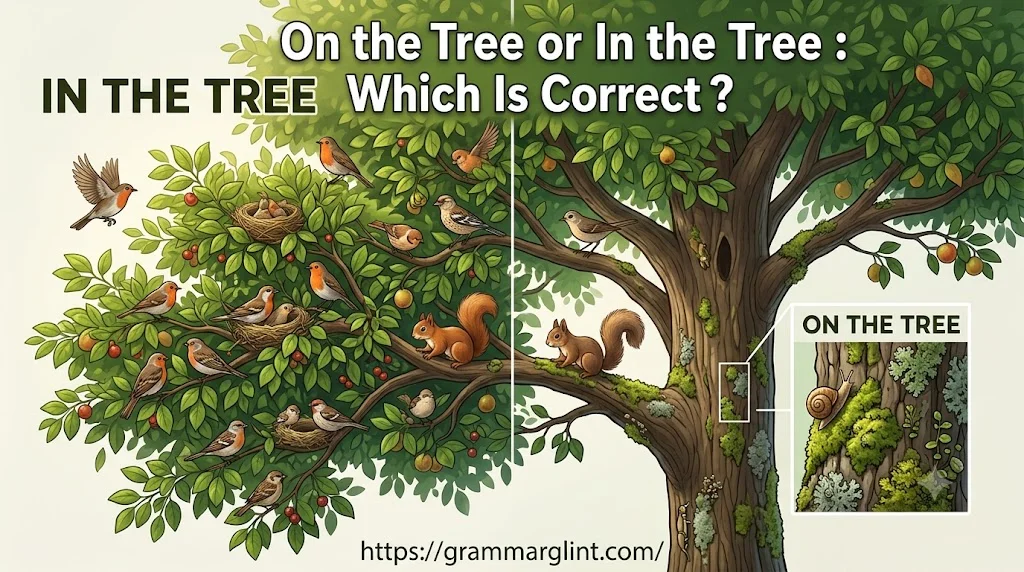
The phrase on the tree is used when talking about something attached to the surface of the tree or placed on the top of the tree. For example, apples, leaves, and fruit are growing on a plant because they are connected to its branches. The sentence “apples are on the tree” shows something that is on the outside part of the tree. This meaning focuses on the location, position, and attachment of an object.
On the other hand, in the tree describes something inside, surrounded by branches, or nestled within the tree area. A bird or treehouse can be described with this phrase because they are placed among the branches rather than on the outer surface. The sentence “bird is in the tree” explains its habitat and shows the difference between inside and outside placement.
Quick Answer You Can Trust
If you’re in a hurry, this is what you need:
- Use “in the tree” when something is inside branches or surrounded by leaves
- Avoid “on the tree” unless you’re talking about bark or a very specific surface context
- Native speakers overwhelmingly say “in the tree” for birds, animals, and objects
Simple mental shortcut:
If something can “hide” in it, use in the tree.
Why It Confuses So Many Learners
At first glance, “on the tree” feels logical.
Why? Because many languages treat trees like vertical objects with surfaces. So learners map the idea of “on” directly from their native grammar.
But English works differently.
In English thinking, a tree is not a flat object like a wall or table. Instead, it’s a 3D natural structure filled with space, depth, and layers.
So instead of thinking:
- ❌ Tree = surface
English thinks: - ✅ Tree = environment you can be inside
That small shift changes everything.
A simple analogy
Think of a tree like a multi-level jungle apartment.
- Branches = rooms
- Leaves = walls
- Hollow spaces = hallways
You don’t stand on the apartment. You exist in it.
That’s why “in the tree” dominates natural English.
The Real Rule Behind
Let’s make this practical and crystal clear.
Use “in the tree” when:
You are describing something located among branches or inside foliage.
Common examples:
- A bird in the tree
- A squirrel in the tree
- A fruit hidden in the tree
- A cat in the tree
In all of these, the object is not resting on a surface. It is inside a structure of branches.
Why It feels natural to native speakers
Native speakers mentally place themselves inside a spatial system. The tree becomes a container.
So instead of seeing:
bird + surface contact
They see:
bird + space within branches
That’s why “in the tree” feels automatic in conversation.
When “On the Tree” Is Actually Used (Rare but Real Cases)
Now here’s where things get interesting.
“On the tree” is not completely wrong, but it is extremely limited in usage.
Correct use
You can use “on the tree” when referring to:
- Bark surface contact
- Decorative or physical placement on the trunk
- Scientific or descriptive writing
Examples that are acceptable:
- Moss on the tree trunk
- Paint on the tree bark
- Carvings on the tree surface
Notice something important:
We are not talking about branches or leaves anymore. We are talking about a surface layer, usually the trunk.
Why it sounds unnatural in most cases
Try this:
- ❌ A bird is on the tree
- ✅ A bird is in the tree
The first one sounds wrong because birds don’t sit on the “surface” of a tree in English imagination. They occupy space inside it.
Comparison Table
| Phrase | Meaning Area | Natural Usage | Example |
| In the tree | Inside branches/leaves | Very common | A bird in the tree |
| On the tree | Bark or trunk surface | Rare | Moss on the tree trunk |
| On a tree (general) | Physical contact only | Uncommon | Ladder on a tree trunk |
Common Mistakes People Make
Let’s look at where learners usually go wrong.
Mistake 1: Treating trees like tables
Many learners think:
“If something is sitting there, I use ‘on’.”
So they say:
- ❌ The bird is on the tree
But trees are not flat surfaces. That rule doesn’t apply here.
Mistake 2: Direct translation from native language
Some languages don’t distinguish spatial depth the same way English does.
So learners translate word-for-word and end up with unnatural phrasing.
Mistake 3: Overusing “on” for everything
Because “on” feels safe and simple, learners default to it.
But English is more spatially precise than that.
Real-Life Usage Examples (What Native Speakers Actually Say)
Here’s how English is actually used in everyday speech.
Natural sentences:
- “There’s a parrot in the tree outside my window.”
- “The kids climbed up into the tree and stayed there for hours.”
- “I saw a squirrel in the tree this morning.”
- “The apples are still in the tree.”
Unnatural sentences:
- ❌ “There’s a parrot on the tree”
- ❌ “The cat is on the tree branch” (unless literally balanced on a surface edge, still rare)
Read More: Aunty or Auntie: Correct Spelling by Country, Explained
Case Study: Why Learners Keep Mixing It Up
Let’s look at a real learning scenario.
Case: Maria, an English learner from Spain
Maria often said:
“The bird is on the tree.”
Her teacher corrected her repeatedly, but she kept making the same mistake.
Why?
Because in Spanish, the equivalent structure doesn’t emphasize “inside vs surface” the same way.
Once she reframed the concept as:
“A tree is a space, not a surface.”
Everything clicked.
Within a week, she naturally switched to:
- “The bird is in the tree.”
This shift wasn’t memorization. It was reframing spatial logic.
Memory Trick That Actually Works
Here’s a simple trick you can use instantly.
Think of a tree as a house
- Branches = rooms
- Leaves = walls
- Inside = “in the tree”
So:
- Bird = living inside the house → in the tree
- Moss = stuck on outer wall → on the tree (trunk)
Another quick trick:
If it can hide inside, use “in.”
If it sticks outside, it’s probably “on the trunk.”
Related Preposition Confusion You Should Know
Once you understand trees, you start noticing other tricky English patterns.
In vs On (General Rule)
| Preposition | Meaning | Example |
| In | Inside enclosed space | in the room |
| On | Surface contact | on the table |
But trees break this pattern because they are treated as natural containers, not surfaces.
In vs Into
- “In the tree” = position
- “Into the tree” = movement
Examples:
- The cat is in the tree.
- The cat climbed into the tree.
On vs Onto
- “On the roof” = position
- “Onto the roof” = movement
Same idea applies, but again trees behave differently.
Linguistic Insight: Why English Treats Trees as “Containers”
Here’s something interesting.
English often uses cognitive framing—meaning we describe things based on how we mentally experience them.
A tree is:
- Tall
- Complex
- Filled with space
So the brain maps it as a container-like structure.
That’s why:
- We say “in the forest”
- We say “in the tree”
- We say “in the garden”
Even though none of these are closed spaces.
Real-World Usage Breakdown (Native Speech Pattern Analysis)
In everyday spoken English:
- “In the tree” appears extremely frequently
- “On the tree” appears mostly in technical or descriptive writing
Natural frequency pattern:
| Phrase | Everyday speech | Formal writing | Technical use |
| In the tree | Very high | High | Medium |
| On the tree | Very low | Low | Medium |
My Personal Experience as an English Language Specialist
Throughout my journey as an English language specialist, I have noticed that prepositions are among the most challenging parts of English grammar for learners of all levels. Questions like “on the tree” or “in the tree” come up frequently because the difference is not always obvious. Many students assume that if something is touching a tree, on must be the correct choice. However, English often follows patterns based on how native speakers naturally perceive space rather than strict physical contact.
While teaching grammar and reviewing thousands of learner sentences, I have seen this confusion repeatedly. Students often write sentences such as “The bird is on the tree” because they translate directly from their native language. Once I explain that English usually views a tree as a three-dimensional space filled with branches and leaves, rather than simply as a surface, the concept becomes much easier to understand. After practicing with real-life examples, most learners begin using “in the tree” naturally and with confidence.
This experience has reinforced an important lesson for me: mastering English is not just about memorizing grammar rules. It is about understanding how native speakers think about places, objects, and relationships. I encourage learners to focus on meaning and context instead of translating word for word. In my experience, this approach leads to faster improvement, greater confidence, and more natural communication in both speaking and writing.
FAQs
1. What does “on the tree” mean in English?
On the tree means something is attached to the surface or outer part of a tree, like leaves, fruits, or apples.
2. What does “in the tree” mean?
In the tree means something is inside or among the branches, such as a bird, nest, or treehouse.
3. Are both “on the tree” and “in the tree” correct?
Yes, both are correct phrases, but they are used in different situations based on context and meaning.
4. Can we say apples are in the tree?
No, we usually say “apples are on the tree” because apples are attached to the surface of the tree.
5. Why do prepositions like on and in cause confusion?
These prepositions are small little words, but they change sentence structure, meaning, and usage.
6. When should we use “in the tree”?
We use in the tree when something is inside, surrounded by branches, or located within the tree.
7. Is a bird on the tree or in the tree?
We usually say a bird is in the tree because it sits among the branches.
8. What is the difference between on and in in tree context?
On shows surface or attachment, while in shows inside position or surrounding.
9. Do both phrases depend on context?
Yes, both phrases depend on context, situation, and the location of the object.
10. Can prepositions change sentence meaning?
Yes, changing a preposition like on or in can completely change the meaning of a sentence.
Conclusion
Choosing between on the tree and in the tree is easier once you understand the relationship between the object and the tree. Use on the tree for things that are naturally attached to the tree, such as leaves, flowers, or fruit. Use in the tree for people, animals, or objects that are positioned among the branches or within the tree’s canopy.
Remember that the correct preposition is determined by context, not by a fixed rule that applies in every situation. By paying attention to where something is located and how it relates to the tree, you can select the appropriate phrase with confidence. Mastering this small grammar point will make your English more accurate, natural, and easier for others to understand.

Aria Jane is a senior language writer and grammar specialist at Grammar Glint. She focuses on English grammar, spelling variations, vocabulary, and writing clarity. Through detailed research and practical examples, Aria helps readers understand language rules and avoid common mistakes. Her articles are designed to make English learning accessible for students, professionals, and everyday writers seeking reliable language guidance.