All Of vs All explains how a small preposition can change the meaning and structure of a sentence. These phrases may look similar, but they can feel confusing because each form has its own role. Both options can be grammatically correct and appropriate depending on the situation, making it important to understand the difference before choosing the right expression.
The main phrase depends on the noun, determiner, and context. In the English language, proper usage helps create a correct sentence structure and improves overall communication. Following basic grammar rules allows learners to recognize when a sentence needs a specific form and how small changes can affect meaning.
A noun phrase can be preceded by words like my or the, which can affect whether all or all of is used. When working with pronouns and a pronoun, the structure often guides the choice. These small details in English grammar help explain the connection between words, terms, and sentence patterns.
Understanding these differences improves vocabulary and makes grammar easier to apply. The correct choice depends on contextually suitable usage, including singular, plural, and nouns. To explore and see the correction clearly, remember that use all, use all of, all of or all, correct usage, and appropriate usage all depend on the role of the word in the sentence.
Why It Confuses So Many Learners
At first glance, “all of” looks unnecessary. After all, why add “of” when “all” already works?
That’s where most learners get stuck.
English doesn’t always follow logic in a strict mathematical sense. It follows usage patterns shaped by rhythm, clarity, and meaning.
Here’s what makes this confusing:
- Both forms often mean the same thing
- Native speakers use them interchangeably in casual speech
- Grammar rules depend on noun type, not just meaning
- Some structures sound more natural than others
Think of it like seasoning in cooking. Salt and salt water both add saltiness, but they don’t behave the same in a recipe.
The same idea applies to All Of vs All.
“Grammar is not just correctness. It is clarity wrapped in habit.”
Once you understand the habit, the confusion disappears.
Quick Core Rule
Let’s make this extremely clear and practical.
The simple rule:
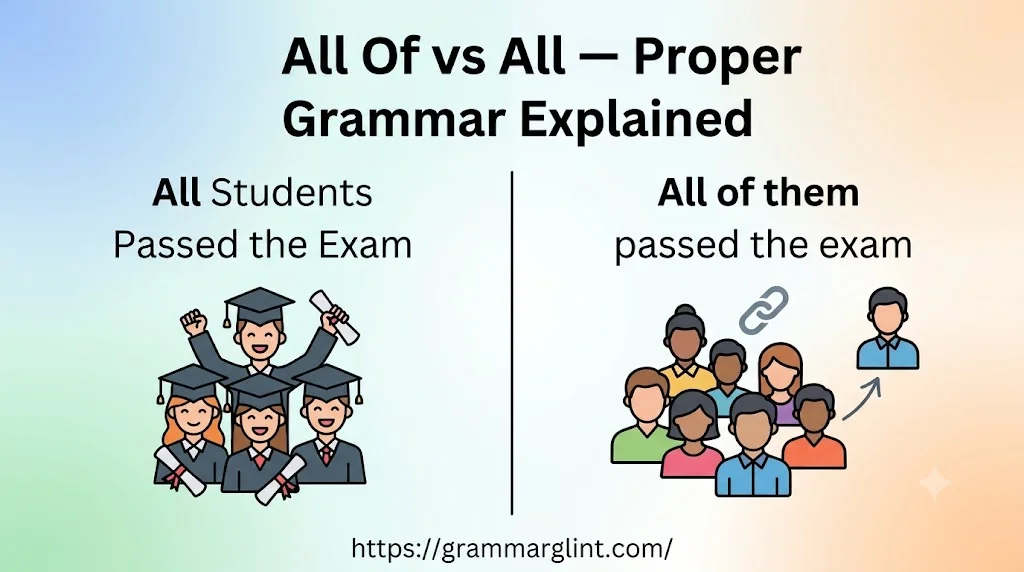
- Use “all” directly before plural nouns
- Use “all of” before pronouns or specific determiner phrases
That’s it.
But let’s break it down properly so you actually remember it.
Core structure table
| Situation | Correct Form | Example |
| General plural noun | All | All students arrived |
| Pronoun (us, them, it) | All of | All of them arrived |
| Possessive determiner (my, your, their) | Both possible | All my friends / All of my friends |
| Specific group | All of | All of the employees agreed |
The key idea here is specificity.
- “All” feels lighter and more general
- “All of” feels more connected and specific
When to Use “All” (No “Of” Needed)
You use “all” when the noun stands strong on its own. No extra connection is needed.
It works best with plural nouns and general statements.
Examples of correct usage
- All students passed the exam
- All phones need charging
- All buildings must follow safety rules
- All animals need water
Notice something?
These sentences feel clean and direct. There’s no extra weight. The meaning is already complete.
Why “all” works so well here
It’s because the noun already carries full meaning.
For example:
- “Students” already refers to a group
- “Phones” already implies multiple objects
- “Animals” already represents a category
So adding “of” would feel unnecessary and slightly clunky.
A simple analogy
Think of “all” like a shortcut on a road. You go straight to meaning without detours.
When to Use “All Of”
Now let’s look at the opposite structure.
You use “all of” when the object is more defined or specific, especially with pronouns.
Common situations
- Pronouns: us, them, it, you
- Specific groups introduced earlier
- Emphasized reference to a known set
Examples of “all of”
- All of us agreed on the decision
- I read all of it last night
- All of them left early
- All of you need to listen carefully
Why “of” matters here
The word “of” creates a link. It connects “all” to something already defined.
Without “of,” the sentence can sound incomplete or unnatural.
For example:
- ❌ All them left early
- ✅ All of them left early
Here, “of” acts like glue holding meaning together.
Read More: A Good News or Good News? Difference Explained
Another way to think about it
Imagine you’re pointing at a group.
- “All students” = talking about students in general
- “All of them” = pointing at a specific group you already know
That small difference changes structure and tone.
“All” vs “All Of” With Determiners
Now things get slightly more flexible.
Determiners include:
- my
- your
- his
- her
- their
- this
- that
- these
- those
With these, both “all” and “all of” can work.
But they don’t always feel the same.
Examples
- All my friends came to the party
- All of my friends came to the party
- All those people were waiting
- All of those people were waiting
Both are grammatically correct.
However, native speakers often prefer “all + determiner + noun” in writing.
Subtle difference in tone
| Form | Tone | Usage |
| All my friends | Smooth and natural | Formal and informal writing |
| All of my friends | Slightly heavier emphasis | Spoken English or emphasis |
Real-life insight
In emails, you’ll often see:
- All the documents are attached
Not: - All of the documents are attached
Why? Because professionals prefer clarity and brevity.
Common Mistakes
Even advanced learners make simple mistakes with this rule.
Let’s fix them clearly.
Mistake 1: Using “all of” with general nouns
- ❌ All of students passed
- ✅ All students passed
Why it’s wrong: “students” is a general plural noun.
Mistake 2: Dropping “of” with pronouns
- ❌ All them came early
- ✅ All of them came early
Why it’s wrong: pronouns need the connector “of.”
Mistake 3: Overusing “all of” unnecessarily
Many learners add “of” because it “sounds more correct.”
But English prefers simplicity.
- ❌ All of cars need fuel
- ✅ All cars need fuel
Quick mistake table
| Incorrect | Correct |
| All of people arrived | All people arrived |
| All them left | All of them left |
| All of dogs bark | All dogs bark |
Spoken English vs Written English Differences
Here’s where things get interesting.
English behaves differently in speech and writing.
Spoken English
- More flexible
- Often includes “all of” for rhythm
- Emphasizes clarity over structure
Example:
- All of us are going to the movie
Written English
- More concise
- Prefers “all + noun”
- Avoids unnecessary words
Example:
- All employees must sign the form
Real-world observation
In interviews, people often say:
- All of us worked together on the project
But in reports:
- All team members collaborated on the project
Same meaning. Different style.
Easy Decision Guide for All Of vs All
Let’s simplify everything into a quick mental checklist.
Ask yourself:
- Is it a pronoun? → use all of
- Is it a general plural noun? → use all
- Do I want emphasis? → consider all of
- Do I want brevity? → use all
Fast decision table
| Question | Use |
| Talking about “them/us/it”? | All of |
| Talking about general groups? | All |
| Want emphasis or spoken tone? | All of |
| Writing formally? | All |
Think of it like a traffic light:
- Green = “all” (go straight)
- Yellow = “all of” (slower, more careful phrasing)
Real-Life Usage Scenarios
Let’s bring this into real situations so it sticks.
Emails and professional writing
- All employees must complete training
- All documents are required for approval
This keeps communication tight and efficient.
Academic writing
- All research participants signed consent forms
- All data was analyzed using statistical software
Here, precision matters more than style.
Everyday conversation
- All of us are tired today
- All of them loved the movie
Here, rhythm and flow matter more.
Social media usage
- All my friends showed up 🎉
- All of us needed this vacation
Short, expressive, and natural.
Mini Case Study: Why Both Forms Exist
Linguists often explain this difference through language economy.
English tends to shorten phrases when possible.
So:
- “All of the students” becomes “All students”
- But pronouns resist simplification, so “all of them” stays
Why pronouns behave differently
Pronouns don’t stand alone like nouns.
You can’t say:
- ❌ All them
So English inserts “of” to stabilize structure.
This explains why both forms survive.
It’s not random. It’s structural balance.
My Personal Experience as an English Language Specialist
During my years as an English language specialist, I’ve noticed that “all” and “all of” are among the grammar points that learners often overthink. Students frequently ask whether adding “of” makes a sentence more correct or formal. The answer isn’t always straightforward because both expressions are grammatically correct in different contexts.
I’ve taught learners from various language backgrounds, and one pattern appears repeatedly. Many students instinctively insert “of” before every noun because they believe it sounds more natural. Others avoid it completely, even when it’s required before pronouns like them, us, or it. These small mistakes rarely change the intended meaning, but they can make writing sound less fluent to native English speakers.
In my experience, the fastest way to master this grammar rule is to stop memorizing isolated rules and instead focus on sentence patterns. Once learners recognize that “all” usually comes before general plural nouns, while “all of” naturally introduces pronouns or specific groups, the confusion quickly disappears. I’ve seen students gain confidence after practicing just a few real-life examples rather than trying to memorize long grammar explanations.
Throughout this guide, I’ll share the same practical approach I use when teaching English. My goal isn’t simply to explain a grammar rule but to help you understand why native speakers choose one form over the other. Once you understand the reasoning behind the structure, you’ll be able to use both expressions naturally in conversations, professional writing, academic work, and everyday communication.
FAQs
1. What is the difference between all of and all?
All and all of are both used to talk about the whole amount or group, but their usage depends on the noun structure, determiner, and context.
2. Is all of grammatically correct?
Yes, all of is grammatically correct and is commonly used before pronouns or nouns with determiners like the or my.
3. Is using all without of correct?
Yes, all is correct when a noun does not require a determiner or when it fits naturally in the sentence structure.
4. Can all of be used with pronouns?
Yes, all of is commonly used with pronouns such as us, them, or you to show the complete group.
5. Can all and all of have the same meaning?
In many situations, all and all of have a similar meaning, but grammar rules decide which one sounds more natural.
6. Why do learners find all of and all confusing?
Many learners find them confusing because a small preposition changes the sentence structure and affects correct usage.
7. Does the noun affect the use of all or all of?
Yes, the noun, determiner, and context influence whether all or all of should be used.
8. What role does a determiner play with all of?
A determiner like the or my can allow the use of all or all of depending on the sentence formation.
9. Are all and all of related to English grammar rules?
Yes, both forms are connected to English grammar, sentence structure, and proper language usage.
10. How can someone choose between all and all of?
Check the noun, pronoun, and context to decide whether all or all of provides the correct and appropriate expression.
Conclusion
Mastering the difference between “all” and “all of” ultimately comes down to the word that immediately follows it. While both forms are grammatically correct in the right context, “all of” is strictly required when followed by object pronouns like them, us, or it. Conversely, general plural or uncountable nouns require “all” alone. Recognizing these specific word patterns removes the guesswork, ensuring your sentences sound natural and clear.
When dealing with nouns that already have a determiner, such as the, my, or these, you have the flexibility to use either phrasing without changing the core meaning. Choosing “all” often keeps your writing direct and concise, while “all of” can add a touch of emphasis. By keeping these simple guidelines in mind, you can confidently craft grammatically precise sentences that elevate your overall communication.

Aria Jane is a senior language writer and grammar specialist at Grammar Glint. She focuses on English grammar, spelling variations, vocabulary, and writing clarity. Through detailed research and practical examples, Aria helps readers understand language rules and avoid common mistakes. Her articles are designed to make English learning accessible for students, professionals, and everyday writers seeking reliable language guidance.