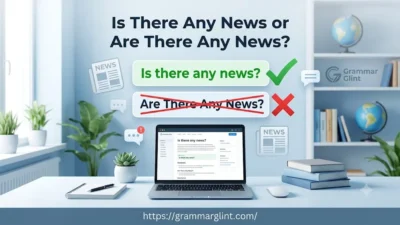
“A Good News” or “Good News”? creates confusion when learners study English grammar and face a common mistake with small grammar rules, especially when dealing with determiners like a. Many people wonder whether the article a can be used before news, but the answer depends on the nature of the word. The correct phrase, Good News, is used because news is a singular noun and an uncountable noun.
The word news may look like a regular noun, but it does not work like a countable noun. People cannot count it as one news or two news, and they cannot divide it into separate units. Instead, it represents information as a whole and works as a collective idea. This means news collectively refers to a complete piece of information rather than individual items that can be numbered.
The comparison and explanation provide clarity about the meaning, usage, and context of this phrase. Understanding these rules helps avoid confusion and improves sentence formation. The grammatically correct phrase is Good News, while a good news is incorrect because it does not follow proper noun rules, phrase structure, or grammatical rules of the English language.
Using the right expression improves communication and makes writing more accurate. The appropriate usage of Good News follows the natural pattern of English, while incorrect usage can create a common misunderstanding. Recognizing how words behave in different contexts helps develop stronger language skills and better grammar awareness.
Is “A Good News” Correct or Is “Good News” Correct?
The correct phrase is “good news.”
The phrase “a good news” is incorrect in standard English because the word news is uncountable.
When English speakers talk about news, they usually mean information, updates, or reports. Information is something you receive, share, or hear. It is not usually counted as one individual item.
For example:
✅ I heard good news today.
✅ They shared good news with their family.
✅ That is great news.
But:
❌ I heard a good news today.
❌ They shared a good news with their family.
The mistake happens because many learners translate directly from their first language. In many languages, the equivalent word for news can be counted. English does not follow that pattern.
Why Do We Say “Good News” Instead of “A Good News”?
The answer is grammar.
English nouns fall into two main categories:
| Type of noun | Meaning | Examples |
| Countable nouns | Things you can count | a book, a message, an idea |
| Uncountable nouns | Things viewed as a whole | information, advice, news |
You can say:
- a book
- a message
- an announcement
because these things have clear individual units.
However, you cannot normally say:
- a news
- an advice
- an information
because these words represent a collection or amount rather than a single object.
Think of it like water. You do not usually say:
❌ “I drank a water.”
You say:
✅ “I drank some water.”
✅ “I drank a glass of water.”
The same idea applies to news:
❌ “I have a news.”
✅ “I have some news.”
✅ “I have a piece of news.”
Understanding the Word “News” in English Grammar
The word news creates confusion because it looks plural.
Many English words ending in -s are plural:
- books
- cars
- ideas
- messages
So learners naturally assume:
“News ends in -s, so it must be plural.”
But that is not true.
News is usually treated as singular and uncountable.
For example:
✅ The news is surprising.
✅ The news was announced this morning.
Not:
❌ The news are surprising.
❌ The news were announced this morning.
The word behaves like a singular idea, even though its spelling looks different.
Meaning of It and Why It Is Uncountable
News means information about recent events or important developments.
It can include:
- world events
- personal updates
- business announcements
- weather reports
- discoveries
- changes in plans
When someone says:
“I have news.”
They do not mean one single object. They mean they have information to share.
For example:
A friend says:
“I have news!”
They could mean:
- They got a new job.
- They passed an exam.
- They are moving.
- Something important happened.
The word “news” covers the entire piece of information.
When to Use It Correctly
The phrase “good news” appears in everyday conversations, workplaces, media, and writing.
It usually refers to positive information.
Read More: Thanks, Thank’s, or Thanks’? Examples and Grammar Rules
Sharing positive information
Use good news when you want to announce something positive.
Examples:
- I have good news for you.
- We received good news from the university.
- She brought good news home.
Responding to positive information
People often use “good news” as a reaction.
Examples:
- That’s good news!
- This is wonderful news.
- What good news!
These expressions sound natural because native speakers use them frequently.
Talking about positive situations generally
You can also use good news when discussing positive events.
Examples:
- Good news travels fast.
- Everyone likes hearing good news.
- The report contained good news for investors.
“Good News” vs. “The Good News”
Many learners also wonder about the difference between “good news” and “the good news.”
Both are correct, but they have different meanings.
Good news
Use it when talking about positive information generally or when introducing new information.
Examples:
- I have good news.
- She shared good news yesterday.
The listener does not know the specific information yet.
The good news
Use it when referring to a specific positive fact.
Examples:
- The good news is that you passed.
- The “A Good News” or “Good News”? creates confusion when learners study English grammar and face a common mistake with small grammar rules, especially when dealing with determiners like a. Many people wonder whether the article a can be used before news, but the answer depends on the nature of the word. The correct phrase, Good News, is used because news is a singular noun and an uncountable noun.
- The word news may look like a regular noun, but it does not work like a countable noun. People cannot count it as one news or two news, and they cannot divide it into separate units. Instead, it represents information as a whole and works as a collective idea. This means news collectively refers to a complete piece of information rather than individual items that can be numbered.
Here, the speaker points to a particular situation.
A simple way to remember it:
Good news = any positive information
The good news = a specific positive fact
How to Say “A Piece of Good News” Correctly
Sometimes you really want to use “a” because you are talking about one specific item.
That is where “a piece of good news” comes in.
This phrase is correct.
Examples:
✅ I have a piece of good news to share.
✅ She told me a piece of good news.
✅ Here is a piece of good news for everyone.
Why does this work?
Because piece is countable.
You are not counting the news itself. You are counting a piece of information.
The structure is:
A + countable unit + of + uncountable noun
This pattern appears often in English.
Examples:
| Incorrect | Correct |
| a news | a piece of news |
| an advice | a piece of advice |
| an information | a piece of information |
Common Mistakes
Small grammar mistakes can change how natural your English sounds. Here are the most common errors.
Mistake: Adding “a” before It
Incorrect:
❌ I have a good news.
Correct:
✅ I have good news.
The word “good” does not change the grammar rule. “News” remains uncountable.
Mistake: Making It plural
Incorrect:
❌ The news are amazing.
Correct:
✅ The news is amazing.
Although “news” ends with “s,” it takes a singular verb.
Mistake: Saying “a news”
Incorrect:
❌ Can you give me a news?
Correct:
✅ Can you give me some news?
✅ Can you give me a piece of news?
English needs a counting word if you want to make it singular.
Real-Life Examples
The easiest way to learn this phrase is by seeing how people use it naturally.
Everyday conversations
- I have good news about your order.
- That’s good news. I’m happy for you.
- We finally got good news.
Workplace examples
- The manager shared good news with the employees.
- The company received good news about its latest project.
- Investors reacted positively to the good news.
Academic examples
- The student received good news after the exam.
- The research team reported good news.
- The professor shared good news with the class.
Why English Learners Often Say “A Good News”
The mistake with “a good news” is extremely common because the phrase seems to follow normal English patterns.
Most beginners learn that singular nouns usually need a or an:
- a car
- a house
- an idea
- an opportunity
So it feels natural to say:
❌ I have a good news.
The problem is that news does not work like these nouns.
English learners often memorize vocabulary first and grammar rules later. When they see “news” as a noun, they apply the same rule they learned for countable nouns. However, English has many exceptions where a word does not behave the way it looks.
A few other examples include:
- advice
- information
- furniture
- equipment
- research
You can say:
✅ some information
✅ a piece of information
but not:
❌ an information
You can say:
✅ some advice
✅ a piece of advice
but not:
❌ an advice
The same logic applies to news.
In Formal and Informal English
The phrase “good news” works well in both casual conversations and professional writing.
It appears in:
- emails
- business reports
- academic writing
- news articles
- everyday speech
The tone changes slightly depending on the situation.
Casual examples
- I have good news!
- Guess what? I got the job.
- That’s such good news.
Professional examples
- We are pleased to share good news regarding the project.
- The company received good news from its partners.
- The latest results provide good news for customers.
In formal writing, you may also see alternatives such as:
- positive development
- encouraging update
- favorable result
However, good news remains completely acceptable.
Can You Say “A Good Piece of News”?
Yes, but it sounds less common.
The more natural phrase is:
✅ a piece of good news
Examples:
- I want to share a piece of good news.
- She gave me a piece of good news yesterday.
You can technically rearrange the phrase:
- a good piece of news
But the meaning shifts slightly.
Compare:
A piece of good news
= one positive update
Example:
- I have a piece of good news about your application.
A good piece of news
= a news item that is good or valuable
Example:
- That was a good piece of news to hear before the meeting.
Both are grammatically possible, but the first one sounds more natural in everyday English.
“Good News” vs. “Great News” vs. “Wonderful News”
English speakers often replace “good” with stronger adjectives.
All of these are correct:
- good news
- great news
- excellent news
- wonderful news
- amazing news
- fantastic news
The noun stays the same.
Examples:
✅ I have great news for you.
✅ She received wonderful news.
✅ This is amazing news.
Not:
❌ I have a great news for you.
Changing the adjective does not make “news” countable.
A Simple Trick to Remember
Here is an easy memory trick:
You don’t count news. You receive it.
Think of news like:
- information
- advice
- knowledge
1. You can have some of it.
2. You can share it.
3. You can receive it.
But you do not normally count it directly.
A helpful comparison:
| Thing | Correct phrase |
| Water | a glass of water |
| Advice | a piece of advice |
| Information | a piece of information |
| News | a piece of news |
This small trick can prevent a common grammar mistake.
Examples: Correct and Incorrect Sentences
Seeing the difference makes the rule easier to remember.
| Incorrect sentence | Correct sentence |
| I have a good news. | I have good news. |
| She told me a news. | She told me some news. |
| The news are exciting. | The news is exciting. |
| He gave me a good news yesterday. | He gave me good news yesterday. |
| Can you share a news? | Can you share a piece of news? |
Mini Case Study: How a Small Grammar Error Changes Naturalness
Imagine two coworkers talking.
Person A says:
“I have a good news about the meeting.”
The meaning is clear. Everyone understands the message. However, the sentence sounds unnatural because native speakers do not use “news” with “a.”
Person B says:
“I have good news about the meeting.”
This sounds smooth and natural.
The difference is small, but these details separate basic English from polished English.
Grammar is not only about being understood. It also helps your communication sound confident and natural.
Quick Reference Table
| Question | Answer |
| Correct phrase? | Good news |
| Incorrect phrase? | A good news |
| Type of noun? | Uncountable noun |
| Verb form? | Singular |
| Singular option? | A piece of good news |
| Example | I have good news for you |
My Personal Experience as an English Language Specialist
As an English language specialist, I have noticed that “a good news” is one of the most common mistakes made by English learners. The confusion usually comes from the fact that news looks like a plural noun because it ends with -s, while the adjective good makes it seem like it should follow the same pattern as phrases like a good book or a good idea. In reality, news is an uncountable noun, so the correct expression is always good news. I often encourage learners to think of news in the same way they think of information or advice, which also cannot be used with the article a.
From my experience teaching and editing English content, the easiest way to master this rule is through regular exposure to natural examples. Reading newspapers, books, and professional articles helps learners see that native speakers consistently say good news, great news, or a piece of good news. Once you understand that news refers to information as a whole rather than individual countable items, choosing the correct phrase becomes automatic. This small grammar rule may seem minor, but applying it correctly makes your English sound more fluent, natural, and grammatically accurate.
FAQs
1. Is “A Good News” grammatically correct?
No, “A Good News” is not grammatically correct because news is an uncountable noun and does not take the article a.
2. What is the correct phrase: “A Good News” or “Good News”?
The correct phrase is “Good News” because news is used as a singular uncountable noun.
3. Why can’t we say “one news” or “two news”?
We cannot say one news or two news because news cannot be counted or divided into separate numbers.
4. Is “news” singular or plural?
The word news is treated as a singular noun even though it ends with the letter s.
5. Why is “news” considered an uncountable noun?
News refers to information as a whole, so it is not measured as individual countable items.
6. Can “a” be used before every singular noun?
No, a is only used with certain countable singular nouns, not with uncountable nouns like news.
7. What is the meaning of “Good News”?
Good News means positive information, pleasant information, or something beneficial that someone shares.
8. Are there other confusing words like “news”?
Yes, words like scissors and pants can also confuse learners because their grammar rules are different from common nouns.
9. What is the difference between correct and incorrect usage?
Correct usage follows English grammar rules, while incorrect usage creates mistakes in sentence structure and meaning.
10. How can learners avoid mistakes with words like “news”?
Learners can avoid mistakes by understanding noun types, including countable nouns and uncountable nouns, and their usage rules.
Conclusion
“A Good News” or “Good News” is an easy grammar mistake to avoid once you understand that news is an uncountable noun. Since it cannot be counted, you should never use the article a before it. The correct expression is always good news, while a good news is grammatically incorrect. If you need to refer to a single item, use phrases like a piece of news or an item of news instead.
Remembering this simple rule will make your English sound more natural and accurate. Whenever you talk about information, announcements, or updates, choose good news with confidence. Understanding how uncountable nouns work is a small step that can greatly improve your grammar, writing, and everyday communication.

Aria Jane is a senior language writer and grammar specialist at Grammar Glint. She focuses on English grammar, spelling variations, vocabulary, and writing clarity. Through detailed research and practical examples, Aria helps readers understand language rules and avoid common mistakes. Her articles are designed to make English learning accessible for students, professionals, and everyday writers seeking reliable language guidance.