When I started exploring English grammar, I noticed how small words and punctuation marks can influence the meaning of a sentence. Many people focus on large grammar concepts but often miss these small details that create clarity in daily communication. This article helps explain the basics of possessive forms and the difference between Thanks, Thank’s, or Thanks’? while focusing on the correct use of the word thanks.
The correct form is thanks because it works as an expression used to show that you are grateful to someone for something. In normal conversations and writing, people use this word to express appreciation, kindness, and respect. The use of apostrophes and placing them incorrectly can create a mistake if you do not understand the basic rules of punctuation.
This explanation improves learning and understanding of the English language, especially in spelling, clarity, and accuracy while writing. Understanding these small differences helps avoid common grammar problems and makes communication more effective. A simple approach is to observe how words function in a sentence before adding punctuation.
What Is the Correct Form?
Let’s settle this right away.
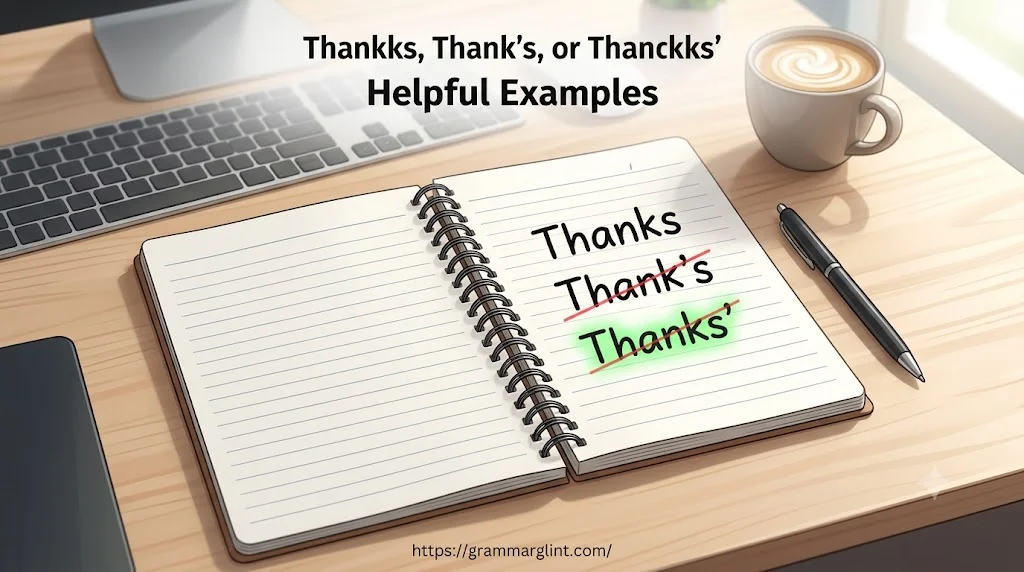
The correct form is:
Thanks
That’s it. No apostrophe. No extra punctuation. Just the word “thanks.”
It works as a plural noun used to express gratitude, and sometimes as an informal interjection.
Here are correct examples you already use every day:
- “Thanks for your help.”
- “Thanks, I really appreciate it.”
- “Big thanks to everyone who supported me.”
Simple, clean, and widely accepted.
Now let’s look at the confusion.
Why “Thanks” Works Without Any Apostrophe
The word “thanks” comes from the idea of expressing gratitude or acknowledgment. It behaves like a plural noun, even though you don’t usually count “thanks” like objects.
Think of it like this:
You don’t say “one thank” or “two thanks” in normal conversation. But English still treats it like a plural form of gratitude.
That’s why there’s no need for an apostrophe.
Apostrophes in English usually do two things:
- Show possession (John’s book)
- Show contraction (don’t = do not)
But “thanks” is neither of those.
So adding an apostrophe creates a grammatical mismatch.
Why “Thank’s” Is Incorrect and Always Distracting
Let’s talk about the most common mistake: thank’s.
At first glance, it feels harmless. You might think it looks more “correct” or formal. But it actually breaks grammar rules.
Here’s why it doesn’t work:
- It is not a contraction
- It is not possessive
- It has no missing letters
So what is it doing there?
Nothing.
Incorrect examples:
- “Thank’s for your message” ❌
- “Thank’s a lot for coming” ❌
- “Thank’s everyone” ❌
If you remove the apostrophe, everything instantly becomes correct.
Quick memory trick:
If you’re expressing gratitude, never add an apostrophe.
Simple rule. Easy win.
Why “Thanks’” Is Also Wrong in Almost Every Case
Now let’s move to the version that confuses advanced writers: thanks’.
This one tries to follow the possessive rule for plural nouns. In English, plural possessives usually end with an apostrophe after the “s.”
For example:
- The teachers’ lounge
- The dogs’ park
So people assume “thanks’” should work the same way.
But here’s the issue.
The word “thanks” is almost never used in a possessive sense.
You don’t usually say:
- “The thanks’ meaning was unclear” ❌
- “Thanks’ message arrived late” ❌
It sounds unnatural because English doesn’t treat gratitude as something that owns anything.
The reality:
“Thanks’” exists in theory, but almost never in real-life writing.
Most style guides avoid it completely.
Apostrophes Made Simple: The Rule You Actually Need
Apostrophes are not random decoration marks. They follow strict rules.
Here’s a simple breakdown:
| Usage Type | Correct Form | Example |
| Possession | John’s phone | The phone belongs to John |
| Contraction | don’t | do not becomes don’t |
| Plural gratitude | thanks | used for appreciation |
Now notice something important.
“Thanks” doesn’t fit into the first two categories.
That’s why it stands alone without punctuation.
How Native Speakers Actually Use “Thanks” in Real Life
If you want clarity, watch how people actually write in real communication.
1. In emails:
- “Thanks for your quick response.”
- “Thanks, I’ll review the document.”
2. In texting:
- “Thanks!”
- “Thx 👍” (informal shortcut)
3. In workplace chat tools:
- “Thanks team, great work today.”
- “Thanks for the update.”
4. On social media:
- “Big thanks to everyone who supported this project.”
- “Thanks for all the birthday wishes!”
Across all platforms, one pattern stands out.
No apostrophes appear in “thanks.” Ever.
Case Study: Why “Thank’s” Looks Unprofessional in Business Writing
Let’s imagine two job candidates emailing a recruiter.
Candidate A:
“Thank’s for your time and consideration.”
Candidate B:
“Thanks for your time and consideration.”
Now, both messages communicate the same idea. But perception matters.
Recruiters often associate grammar accuracy with attention to detail.
Candidate A’s message may subtly feel less polished due to the apostrophe error. Even if the content is strong, small mistakes can influence perception.
Read More: Surname vs Last Name vs Family Name: Difference Explained
Key insight:
Small grammar errors can affect credibility more than you think.
This is why “thanks” without apostrophe is the safe professional choice.
“Thanks” vs “Thank You”: Tone Matters More Than You Think
Now let’s step beyond grammar and talk about tone.
Both “thanks” and “thank you” are correct. But they don’t feel the same.
“Thanks” feels:
- Casual
- Friendly
- Quick
- Modern
Example:
- “Thanks for helping me out.”
“Thank you” feels:
- Formal
- Respectful
- Slightly distant
- Professional
Example:
- “Thank you for your assistance in this matter.”
Quick comparison table:
| Phrase | Tone | Best Use |
| Thanks | Casual | Friends, coworkers, texts |
| Thank you | Formal | Emails, business, authority |
Choosing the right one depends on your audience.
Common Mistakes People Make with “Thanks”
Even though the rule is simple, mistakes still happen.
Here are the most common ones:
Adding unnecessary apostrophes
- Thank’s ❌
- Thanks’ ❌
Overthinking grammar rules
Some people try to force possession where none exists.
Mixing tone and punctuation
- “Thanks.” (feels abrupt in casual chat)
- “Thanks!” (feels warm and natural)
Forgetting context
Tone mismatch can make “thanks” sound either too cold or too informal.
Simple Memory Tricks to Never Get It Wrong Again
If grammar rules feel overwhelming, use shortcuts.
Rule 1: No ownership, no apostrophe
If nothing belongs to anything, don’t use ’s.
Rule 2: “Thanks” is already complete
You don’t need to fix what isn’t broken.
Rule 3: If unsure, strip punctuation
Say the word out loud:
- “thank’s” → sounds wrong
- “thanks” → sounds natural
Rule 4: Think of it like currency
You wouldn’t write “doll’ar” or “eu’ro.” Same logic applies.
Quick Reference Table
| Form | Correct? | Usage | Example |
| Thanks | ✅ | Standard gratitude | Thanks for your help |
| Thank’s | ❌ | Grammar error | Thank’s for coming |
| Thanks’ | ❌ (rare misuse) | Incorrect possessive attempt | Thanks’ message |
Real-World Writing Scenarios You Can Learn From
Let’s look at how this plays out in different settings.
Scenario 1: Customer service email
Wrong:
“Thank’s for contacting support.”
Correct:
“Thanks for contacting support.”
Scenario 2: Friend texting you
Wrong:
“Thank’s bro!”
Correct:
“Thanks bro!”
Scenario 3: Academic submission
Wrong:
“Thank’s to my supervisor.”
Correct:
“Thanks to my supervisor.”
Even in formal writing, “thanks” stays consistent.
Why This Small Word Matters More Than You Think
It’s easy to dismiss grammar details like this. But small words carry weight.
They influence:
- Clarity
- Professionalism
- Readability
- First impressions
And because “thanks” appears so often in communication, even tiny mistakes get noticed.
Think of it like handwriting. One smudge won’t ruin a page, but repeated smudges change perception.
My Personal Experience as an English Language Specialist
From my experience as an English language specialist, I have learned that the most common writing mistakes often involve small punctuation marks rather than complex grammar rules. While reviewing articles, business emails, academic assignments, and online content, I frequently notice writers using Thank’s or Thanks’ instead of the correct form, thanks. These errors usually happen because many people believe every word ending in s needs an apostrophe. Through years of editing and teaching, I have found that understanding the purpose of a word is far more important than memorizing punctuation rules.
I always encourage learners to ask a simple question before adding an apostrophe: Does this word show possession or form a contraction? If the answer is no, an apostrophe is usually unnecessary. This practical approach has helped many students and writers improve their grammar, produce clearer sentences, and communicate with greater confidence. In my experience, mastering small details like the correct use of thanks not only strengthens writing accuracy but also creates a more professional and polished impression in every form of communication.
FAQs
1. What is the correct form between Thanks, Thank’s, or Thanks’?
The correct form is thanks. It is used as an expression to show gratitude, while Thank’s and thanks’ are incorrect forms.
2. Why is Thank’s incorrect in English?
Thank’s is incorrect because the apostrophe does not show possession or create the correct grammatical form of the word thanks.
3. Can thanks be used as a possessive word?
No, thanks is not normally used as a possessive word. It is an expression that shows appreciation or gratitude.
4. What does thanks mean?
Thanks means showing appreciation or being grateful to someone for something they have done or provided.
5. When should I use thanks in a sentence?
You can use thanks in daily communication, messages, conversations, and writing when you want to express gratitude.
6. Does the apostrophe change the meaning of thanks?
Yes, an apostrophe can change the purpose of a word, but adding it to thanks as Thank’s or thanks’ creates a mistake.
7. Is thanks singular or plural?
The word thanks has a plural-looking form, but it is commonly used as an expression rather than a normal plural noun.
8. Why do people confuse Thanks and Thank’s?
People often confuse these forms because they associate apostrophes with ownership, but not every word requires an apostrophe.
9. How can I avoid mistakes with thanks?
To avoid mistakes, check the context, meaning, and grammar rules before using punctuation in a word.
10. Why is learning this difference important?
Understanding the difference improves writing clarity, communication, and accuracy in the English language.
Conclusion
Understanding the difference between Thanks, Thank’s, or Thanks’? is easier once you know the basic rules of apostrophes. In everyday English, thanks is the only correct form when expressing gratitude. Since the word does not show possession or act as a contraction, adding an apostrophe creates a grammatical error. Remember that punctuation should support the meaning of a sentence, not change it unnecessarily.
The best way to avoid confusion is to think about how the word functions before writing it. If you are simply thanking someone, write thanks without an apostrophe. With regular practice and careful proofreading, you will naturally recognize the correct form and communicate more clearly and confidently in both casual and professional writing.

Aria Jane is a senior language writer and grammar specialist at Grammar Glint. She focuses on English grammar, spelling variations, vocabulary, and writing clarity. Through detailed research and practical examples, Aria helps readers understand language rules and avoid common mistakes. Her articles are designed to make English learning accessible for students, professionals, and everyday writers seeking reliable language guidance.