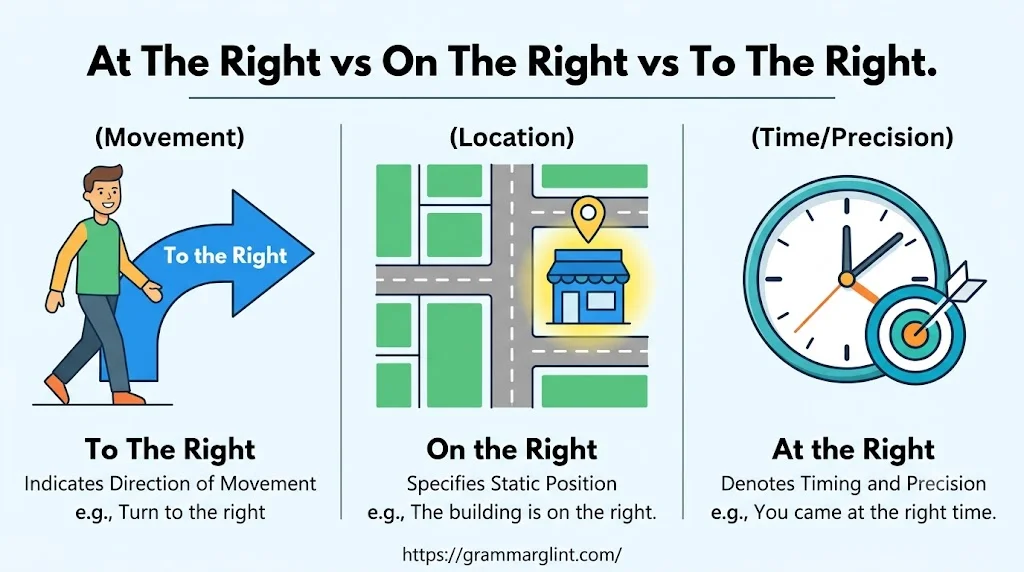
At The Right vs On The Right vs To The Right explains how small changes in prepositions change meaning in English. At right is used for an absolute value in time or places, where a fixed reference point is considered. This form works in contexts where positioning is not dependent on comparison but on a defined point.
On the right is used for physical positioning, describing something placed on the right side of an object or space. It is commonly used in directions, layouts, and real-world spatial descriptions where clear side-based location is required. This makes it a standard form for identifying visible placement.
To the right expresses relative positioning, where movement or direction is compared with another object. It shows that something is located in a direction toward the right side rather than fixed on it. This form is often used when explaining shifts, transitions, or directional changes between two points.
Overall, these forms show different layers of meaning in spatial and contextual grammar. At right focuses on fixed reference, on the right focuses on direct placement, and to the right focuses on directional relation, making each expression useful in distinct situations.
Why These Phrases Matter
English relies heavily on prepositions to describe space, direction, and position. That means one small word can completely change the meaning of a sentence.
For example:
- “Turn to the right” means movement.
- “The shop is on the right” means location.
- “Do it at the right time” means timing or precision.
See the difference? Same idea of “right side,” but three different grammatical jobs.
Most learners struggle here because their native language often uses one single word for all these meanings. English does not.
Quick Meaning Breakdown
Before diving deeper, here’s a simple snapshot you can always refer back to:
| Phrase | Core Meaning | Function | Example |
| To the right | Direction / movement | Shows motion toward right side | Turn to the right at the light |
| On the right | Position / location | Shows where something is | The bank is on the right |
| At the right | Fixed expression / timing | Refers to correctness or specific point | At the right moment |
This table alone solves most confusion. But let’s go deeper so you actually feel the difference.
The Grammar Logic Behind Directional Prepositions
To understand At The Right vs On The Right vs To The Right, you need to understand how English treats space.
English separates spatial ideas into three mental categories:
- Movement (where you go)
- Position (where something exists)
- Precision (when or how exactly something happens)
Each phrase maps into one of these categories.
Think of it like a GPS system:
- “To” is the route.
- “On” is the destination marker.
- “At” is the pinpoint coordinate or exact moment.
Once you see it this way, the confusion starts to fade.
“To the Right” Meaning and Usage (Movement in Action)
When you say “to the right,” you describe movement. Something or someone changes position toward the right side.
Definition
“To the right” means movement or direction toward the right side of space.
Real Examples You’ll Actually Hear
- Turn to the right after the traffic light.
- Slide the box to the right so it fits.
- Move your chair to the right a little.
Notice something important here: the action always involves motion.
When You Should Use It
Use “to the right” when:
- Giving directions
- Describing movement
- Explaining step-by-step instructions
Common Mistake
❌ The library is to the right of the station.
✔ The library is on the right of the station.
Why? Because the library does not move. It sits there.
Simple Memory Trick
Think: “to = travel”
If something travels right, you use “to the right.”
“On the Right” Meaning and Usage (Static Position)
Now let’s shift gears.
“On the right” describes location. Nothing moves. You are simply pointing out where something already exists.
Definition
“On the right” means a fixed position on the right side of something else.
Real-Life Examples
- The pharmacy is on the right.
- You’ll see a café on the right side of the road.
- My office is on the right after the elevator.
When You Should Use It
Use “on the right” when:
- Describing maps or layouts
- Giving driving directions
- Identifying objects in space
Common Mistake
❌ Turn on the right at the corner.
✔ Turn to the right at the corner.
Why? Because turning involves movement.
Simple Memory Trick
Think: “on = location pinned in place”
If you can point at it like a photo, use “on the right.”
“At the Right” Meaning and Why It Feels Tricky
Now comes the confusing one: “at the right.”
This phrase does NOT behave like the other two. It rarely works as a pure directional expression.
Instead, it appears inside fixed expressions or technical contexts.
Definition
“At the right” usually refers to:
- A precise moment
- A correct condition
- A specific point in a structure or system
Read More: Like I Said vs As I Said: Meaning, Difference, and Usage Explained
Real Examples That Make Sense
- At the right time, everything changes.
- You pressed the button at the right moment.
- The image appears at the right side of the screen (technical usage).
When You Should NOT Use It
Avoid using “at the right” for directions.
❌ Turn at the right.
❌ The store is at the right.
These sound unnatural in everyday English.
Why It Exists at All
English uses “at” for precision. Think:
- at 5 PM
- at the door
- at the center
So “at the right” survives mostly in structured phrases, not navigation.
Simple Memory Trick
Think: “at = exact point”
If you can replace it with “exactly,” it might fit.
Side-by-Side Comparison
Let’s simplify everything visually.
| Feature | To the Right | On the Right | At the Right |
| Type | Movement | Position | Precision |
| Action | Yes | No | Rare |
| Directional use | Strong | Moderate | Weak |
| Example | Turn to the right | House is on the right | At the right time |
This is the mental map you want to build.
Real-Life Scenarios
Let’s bring this into real life so it sticks.
Driving Scenario
Imagine you’re giving directions:
- Turn to the right at the gas station.
- The mosque is on the right after two blocks.
Simple. Natural. Native-like.
Classroom Scenario
A teacher might say:
- Move your desk to the right.
- The clock is on the right wall.
Cooking Scenario
- Add salt at the right moment.
- Keep the pan slightly to the right of the flame.
Notice how “at the right” only appears in timing or precision.
Case Study: Why Language Learners Mix These Up
Let’s look at a real pattern seen in ESL learning environments.
The Problem
Many learners translate directly from languages like Urdu, Spanish, or Arabic, where one word often covers all directional meanings.
So they say:
- “Turn on the right” ❌
- “The shop is to the right” (overgeneralized)
The Result
Communication becomes unclear or sounds unnatural.
The Fix
Once learners separate:
- Movement = to the right
- Location = on the right
- Precision = at the right
Accuracy improves dramatically.
Outcome Example
Before:
“Go on the right and find the station.”
After:
“Turn to the right and the station is on the right.”
That small shift changes clarity completely.
Memory System: How to Never Confuse These Again
Use this three-step mental shortcut:
1: Ask “Is there movement?”
- Yes → use to the right
2: Ask “Is it location?”
- Yes → use on the right
3: Ask “Is it timing or precision?”
- Yes → use at the right
It works like a decision tree.
Common Mistakes People Make (And How to Fix Them)
Mistake 1: Mixing movement and location
❌ “The café is to the right of the mall.”
✔ “The café is on the right of the mall.”
Mistake 2: Using “at the right” for directions
❌ “Turn at the right.”
✔ “Turn to the right.”
Mistake 3: Overusing “right” without context
❌ “Go right there.”
✔ “Turn to the right there.”
Expert Tip: Think in Camera Angles
Here’s a helpful analogy.
Imagine you’re filming a scene:
- To the right = camera moves right
- On the right = object appears on screen
- At the right = perfect timing of a scene
This mental picture makes the grammar stick faster than memorizing rules.
Why Context Always Wins Over Rules
Grammar rules help, but context decides everything.
For example:
- “On the right track” (idiom)
- “At the right time” (fixed phrase)
- “Turn to the right” (direction)
English doesn’t always behave logically. It behaves naturally. That’s why exposure matters as much as rules.
My Personal Experience as an English Language Specialist
As an English language specialist, I’ve found that prepositions are among the most challenging parts of English grammar for learners. Many students have a strong vocabulary and understand basic sentence structure, yet they still hesitate when choosing between phrases like at the right, on the right, and to the right. These small words may seem insignificant, but they can completely change the meaning of a sentence.
Throughout my teaching experience, I’ve noticed that most of these mistakes happen because learners translate directly from their native language. In many languages, a single expression can describe both location and direction, but English separates these ideas with different prepositions. Once students understand that to usually expresses movement, on describes a fixed position, and at often refers to a specific moment or precise point, their confidence improves significantly.
I’ve also learned that grammar becomes much easier when it is taught through real-life situations instead of memorizing rules. Giving examples such as following road directions, describing room layouts, or talking about timing helps learners recognize how native speakers naturally use these expressions. Practical context always makes the rules easier to remember.
That is why I created this guide. Rather than simply listing definitions, I want to explain the grammar in a clear, practical way that reflects how English is actually used every day. My goal is to help you understand not only which phrase is correct but also why it is correct, so you can speak and write with greater accuracy and confidence.
FAQs
1. What does “at the right” mean?
It refers to an absolute reference point in time or places, where something is described without comparing positions.
2. When should “on the right” be used?
It is used for physical positioning, showing something is located on the right side of an object, space, or layout.
3. What is the meaning of “to the right”?
It shows relative positioning, meaning movement or direction toward the right side compared to another object.
4. Is “at the right” commonly used?
It is less common in modern usage but still appears in formal or structured descriptions involving fixed reference points.
5. Can “on the right” and “to the right” be used interchangeably?
No, they are different. On the right shows location, while to the right shows direction or movement.
6. Which phrase is best for giving directions?
On the right is most commonly used for clear, direct physical directions.
7. Does “to the right” always mean movement?
It usually implies direction or shift toward the right, even if actual movement is not described.
8. Is “at the right” grammatically correct?
Yes, it is grammatically correct, but its usage is limited compared to the other two forms.
9. Why do these phrases cause confusion?
Because small prepositions like at, on, and to change the meaning of positioning and reference.
10. Can these phrases appear in everyday English?
Yes, all three are used, especially in spatial description, direction-giving, and contextual explanation.
Conclusion
Understanding the difference between at right, on the right, and to the right helps you describe location and direction more accurately. While on the right is the most common choice for everyday conversations and physical positioning, to the right is better when comparing locations or giving directions. At right is much less common and is mainly used in captions, diagrams, tables, and other formal or visual contexts. By recognizing when each expression fits the situation, you can communicate more clearly and sound more natural in both spoken and written English.

Aria Jane is a senior language writer and grammar specialist at Grammar Glint. She focuses on English grammar, spelling variations, vocabulary, and writing clarity. Through detailed research and practical examples, Aria helps readers understand language rules and avoid common mistakes. Her articles are designed to make English learning accessible for students, professionals, and everyday writers seeking reliable language guidance.