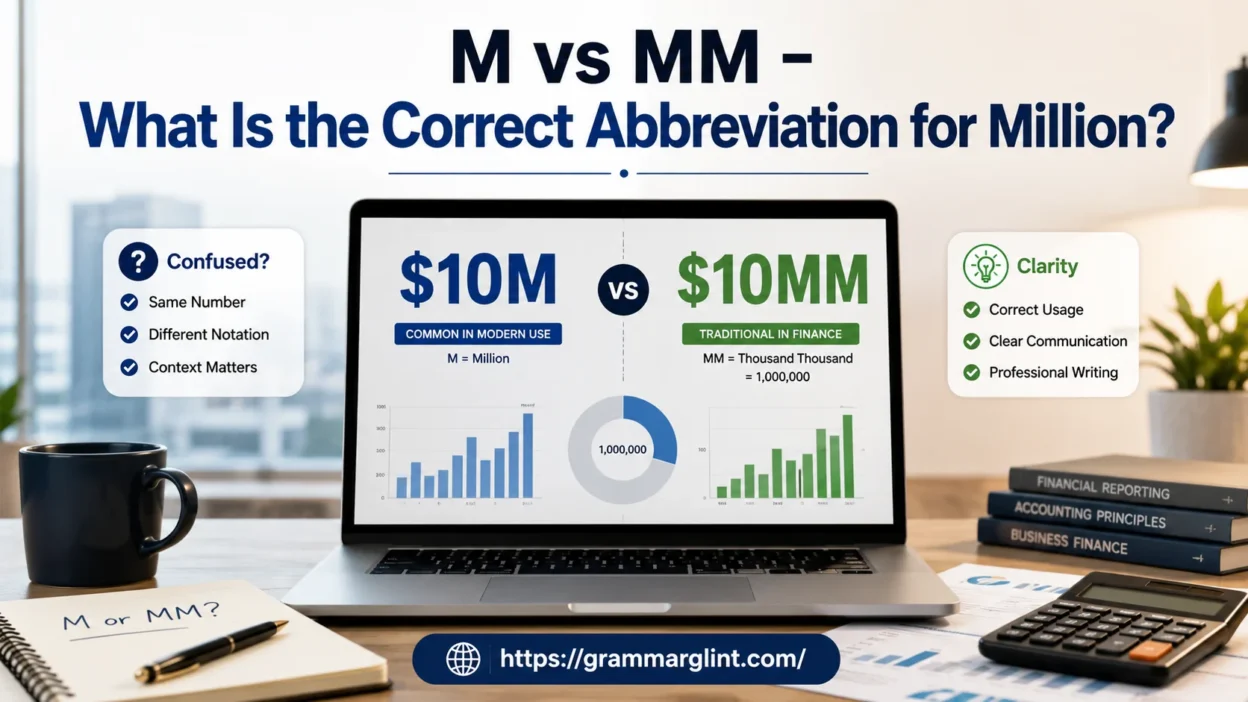
The guide M vs MM: What Is the Correct Abbreviation for Million? explains how abbreviations, numbers, and usage work with clear context for different readers. Many people come across these short forms while reading financial reports, checking measurements, or creating general writing. These official abbreviations are commonly used to represent large amounts, and understanding them improves clarity. This article helps explain the correct abbreviation for million while building useful knowledge about common terms found in the language of numbers.
The M abbreviation is considered a common form because the capital letter M is often used as a direct million symbol. In many situations, this numeric abbreviation makes information easier to read because it provides a shorter way to show a large numeric value. The usage of M depends on the context, the field where it appears, and the style of communication being followed. Readers can better understand the meaning behind the abbreviation when they know how it connects with quantities and measurements.
The MM abbreviation also carries a specific literal meaning because it represents thousand thousand. This idea shows that two values can multiply together to create a million through a simple mathematical expression. Although it may look different from M, it is another accepted way of presenting a large quantity. The explanation of MM helps readers recognize why different terms and symbols may appear in financial and numerical environments.
Selecting the right abbreviation depends on correct usage, the official term, and the purpose of the information. These letters, capitalization, and number system rules support accurate calculation and clear communication. The financial notation, measurement, and quantity details become easier to follow when the correct form is chosen. Both correct abbreviations show different forms while representing the same singular concept.
Why It Confuses So Many People
At first glance, this looks like a simple abbreviation issue. But it’s deeper than that.
You’re dealing with three competing influences at the same time:
- Roman numeral history
- Finance and accounting legacy systems
- Modern digital reporting standards
So when you see:
- $5M
- $5MM
You might assume they mean different things. In reality, they often mean the same thing—but not always in every context.
That’s where the trouble begins.
A marketing dashboard might use M = million, while an old banking report might use MM = million. And neither one is technically “wrong” in its own ecosystem.
As one financial analyst once put it:
“The problem isn’t the abbreviation. The problem is assuming everyone uses it the same way.”
What Does “M” Mean?
Let’s start with the more modern and widely used version: M.
M = Million (Modern Business Usage)
In most modern business, tech, and media contexts, M stands for million.
So:
- $1M = $1,000,000
- $25M = $25,000,000
- 10M users = 10 million users
Where “M” Comes From
This is where things get interesting.
“M” originally comes from the Roman numeral system, where:
- M = 1,000
But in modern finance and business shorthand, “M” has been reinterpreted to mean million, especially when paired with context like dollars or users.
So even though historically M meant thousand, modern usage evolved differently.
Where You’ll Commonly See “M” Today
You’ll see M used heavily in:
- SaaS dashboards (Monthly Recurring Revenue, users, churn metrics)
- Marketing analytics tools
- Startup pitch decks
- Journalism headlines
- Social media growth reports
For example:
- “The app reached 5M downloads in 6 months.”
- “Revenue crossed $12M ARR.”
Why Businesses Prefer “M”
It’s simple, clean, and widely understood.
No extra letters. No confusion. Just clarity.
And in fast-moving environments like tech, clarity wins.
What Does “MM” Mean?
Now let’s look at the older and more traditional version: MM.
MM = Million (Legacy Finance Usage)
In finance and accounting, MM stands for million, based on Roman numeral multiplication logic:
- M = 1,000
- MM = 1,000 × 1,000 = 1,000,000
So:
- $1MM = $1,000,000
- $50MM = $50,000,000
Where MM Is Still Used
Even today, MM appears in:
- Investment banking reports
- Private equity deal sheets
- Oil and gas industry reports
- Internal accounting spreadsheets (legacy systems)
For example:
- “The acquisition value was $120MM.”
- “CapEx budget: $8.5MM.”
Why MM Still Exists
Simple answer: legacy systems don’t die easily in finance.
Banks, investment firms, and energy companies often rely on:
- Older accounting software
- Established reporting templates
- Long-standing documentation standards
Changing all of that costs time and money, so MM sticks around.
Read More: On the Tree or In the Tree: Which Is Correct?
The Core Difference Explained Simply
Let’s clear this up in the simplest possible way:
| Abbreviation | Meaning | Common Usage | Modern Standard |
| M | Million (modern usage) | Tech, media, dashboards | Yes |
| MM | Million (legacy usage) | Banking, oil & gas | Partially |
| K | Thousand | All industries | Yes |
Key Insight
Both M and MM usually mean the same number:
👉 1,000,000
The difference is not mathematical. It’s cultural and historical.
Why Both M and MM Exist (A Simple History of the Confusion)
This isn’t random. It comes from how financial communication evolved.
Step 1: Roman Numeral Influence
Finance originally borrowed Roman numeral notation:
- I = 1
- V = 5
- X = 10
- L = 50
- C = 100
- D = 500
- M = 1,000
So accountants naturally extended this system:
- MM = 1,000 × 1,000 = 1,000,000
Step 2: Paper-Based Accounting Era
Before computers, accountants used shorthand heavily to save space.
- MM = million
- M = thousand
Everything had to fit neatly on paper ledgers.
Step 3: Digital Transition
As spreadsheets and dashboards took over:
- Simpler notation won (M = million)
- MM started to feel outdated outside finance
Step 4: Global Inconsistency
Different industries adopted different habits:
- Finance stuck with MM
- Tech adopted M
- Media simplified everything further
That’s why both still exist today.
The Real Problem With M vs MM in Business Communication
Here’s where things get serious.
Misinterpretation Risks
Confusion between M and MM can lead to:
- Incorrect financial interpretation
- Misread contracts
- Reporting inconsistencies
- Investor misunderstandings
Example of a Real-World Confusion Scenario
Imagine this:
A startup pitch says:
- “Revenue: $5M”
An investor assumes:
- $5,000,000
But a legacy finance system exports:
- $5MM interpreted as $5,000,000
Now imagine someone misreads:
- $5M as $5,000 (in rare thousand-based interpretation systems)
That’s a massive gap.
Case Study: When Abbreviation Confusion Impacts Decision Making
Scenario: Private Investment Deal
A mid-size investment firm reviewed two reports:
- Internal spreadsheet: “$18MM valuation”
- External summary: “$18M valuation”
What Went Wrong
One analyst assumed:
- MM = million (correct)
Another assumed:
- M = thousand (incorrect in context)
Result
The team initially underestimated the company’s valuation by a factor of 1,000.
Lesson Learned
They standardized reporting language afterward:
- All million values written as “$X million”
- Abbreviations removed from final investor summaries
Industry Standards: How It Is Used Today
Different industries handle this differently.
Finance and Banking
- MM still appears in internal documents
- External communication shifts toward clarity
- Many firms now prefer spelling out “million”
Technology and SaaS
- Strong preference for “M”
- Metrics like MAU, ARR, and revenue use M consistently
Example:
- “ARR: $42M”
Media and Journalism
- Prefer clarity over shorthand
- Often write “million” instead of abbreviations
Example:
- “The company raised $200 million in funding.”
Oil and Gas Industry
- Still uses MM frequently
- Legacy reporting systems dominate
M vs MM vs Other Financial Abbreviations
Understanding M and MM also requires knowing related abbreviations.
| Abbreviation | Meaning | Example |
| K | Thousand | $50K = $50,000 |
| M | Million | $10M = $10,000,000 |
| MM | Million (legacy) | $10MM = $10,000,000 |
| B | Billion | $1B = $1,000,000,000 |
Common Mistakes People Make
Let’s make this practical.
Mistake 1: Assuming M Always Means Thousand
In finance contexts, M rarely means thousand today. But confusion still exists.
Mistake 2: Thinking MM Is “More Correct”
It’s not more correct. It’s just older.
Mistake 3: Mixing Both in One Document
This creates instant confusion. Readers lose trust in the data.
Mistake 4: Ignoring Audience Context
A tech investor and a bank auditor interpret abbreviations differently.
Best Practice: How to Use It Correctly Today
If you want to avoid confusion, follow this simple rule set:
1. Use “M” When:
- Writing tech reports
- Creating dashboards
- Sharing marketing metrics
- Communicating with general audiences
2. Use “MM” When:
- Working inside legacy finance systems
- Following industry-specific accounting standards
- Reading older financial documents
3. Use “Million” When:
- Writing legal documents
- Preparing investor materials
- Ensuring maximum clarity
Quick Decision Guide
Here’s a fast mental shortcut:
- Need clarity? → Write “million”
- Need speed in dashboards? → Use “M”
- Working in legacy finance? → You may see “MM”
Simple. Clean. No confusion.
Real-World Examples
Let’s make this even clearer.
1 Example: SaaS Company Report
- “Monthly revenue reached $14.3M”
2 Example: Investment Banking Memo
- “Transaction valued at $75MM”
3 Example: News Article
- “The startup raised $200 million in Series C funding”
Key Takeaway: Clarity Wins Over Tradition
At the end of the day, M vs MM is not about right or wrong—it’s about context.
- M dominates modern usage
- MM survives in legacy finance
- “Million” is the safest universal option
When clarity matters, spell it out, when speed matters, use M and when legacy systems demand it, MM still shows up.
But never assume everyone reads it the same way.
That’s where mistakes happen.
My Personal Experience as an English Language Specialist
As an English language specialist, I’ve noticed that M vs MM is one of those topics that seems straightforward until you encounter it in real documents. While reviewing business reports, financial articles, and educational content, I’ve seen writers use both abbreviations interchangeably without explaining why. That often leaves readers wondering whether M and MM represent different values. Through years of analyzing English usage and technical writing, I’ve learned that the confusion isn’t caused by grammar but by differences in industry conventions. That’s why I always encourage writers to consider their audience before choosing an abbreviation.
In my experience, the clearest approach is to use M for modern business and general writing because it is instantly recognized by most readers. However, when editing financial or accounting documents, I respect the established style guides that still use MM in legacy reporting systems. I’ve found that spelling out “million” is often the best choice when absolute clarity matters, especially in legal, academic, or investor-focused content. My goal has always been to help readers understand not only which abbreviation is correct but also why different industries continue to use different forms.
FAQs
1. What does M mean in numbers?
M is a common abbreviation used to represent million. It is widely used in financial writing, reports, and numerical contexts.
2. What does MM stand for?
MM stands for thousand thousand, which creates the value of a million when the two quantities are multiplied.
3. Are M and MM both correct abbreviations for million?
Yes, M and MM are both accepted abbreviations for million, but their usage depends on the context and field.
4. Why is M more commonly used than MM?
M is more common because it is shorter, easier to understand, and directly connected with the first letter of million.
5. Is MM used in financial notation?
Yes, MM is often found in financial notation, accounting, and business documents where specific numerical formats are followed.
6. Does capitalization matter in M and MM?
Yes, capitalization can affect meaning. A capital M is usually used as a million symbol in numerical contexts.
7. Can M be used in general writing?
Yes, M can be used in general writing when the audience understands that it represents million.
8. What is the literal meaning of MM?
The literal meaning of MM is thousand thousand, showing a mathematical connection between numbers.
9. Which abbreviation should be used for clarity?
The best choice depends on the context, usage, and expected number system or formatting style.
10. Are M and MM different values?
No, both M and MM represent the same numeric value, which is one million, but they use different forms.
Conclusion
In conclusion, both M and MM are correct abbreviations for million, but their usage depends on the context and the audience. M is the modern and widely recognized choice in business writing, journalism, marketing, and everyday communication because it is simple and easy to understand. MM, on the other hand, remains common in accounting, banking, and certain financial reports due to its historical roots in Roman numerals.
Choosing the right abbreviation helps make your writing clear, professional, and consistent. If you are writing for a general audience, M is usually the best option. If you are following a company’s financial reporting standards or an industry-specific style guide, MM may be the preferred format. Understanding when to use each abbreviation ensures your numbers are presented accurately and your message is easy for readers to interpret

Aria Jane is a senior language writer and grammar specialist at Grammar Glint. She focuses on English grammar, spelling variations, vocabulary, and writing clarity. Through detailed research and practical examples, Aria helps readers understand language rules and avoid common mistakes. Her articles are designed to make English learning accessible for students, professionals, and everyday writers seeking reliable language guidance.