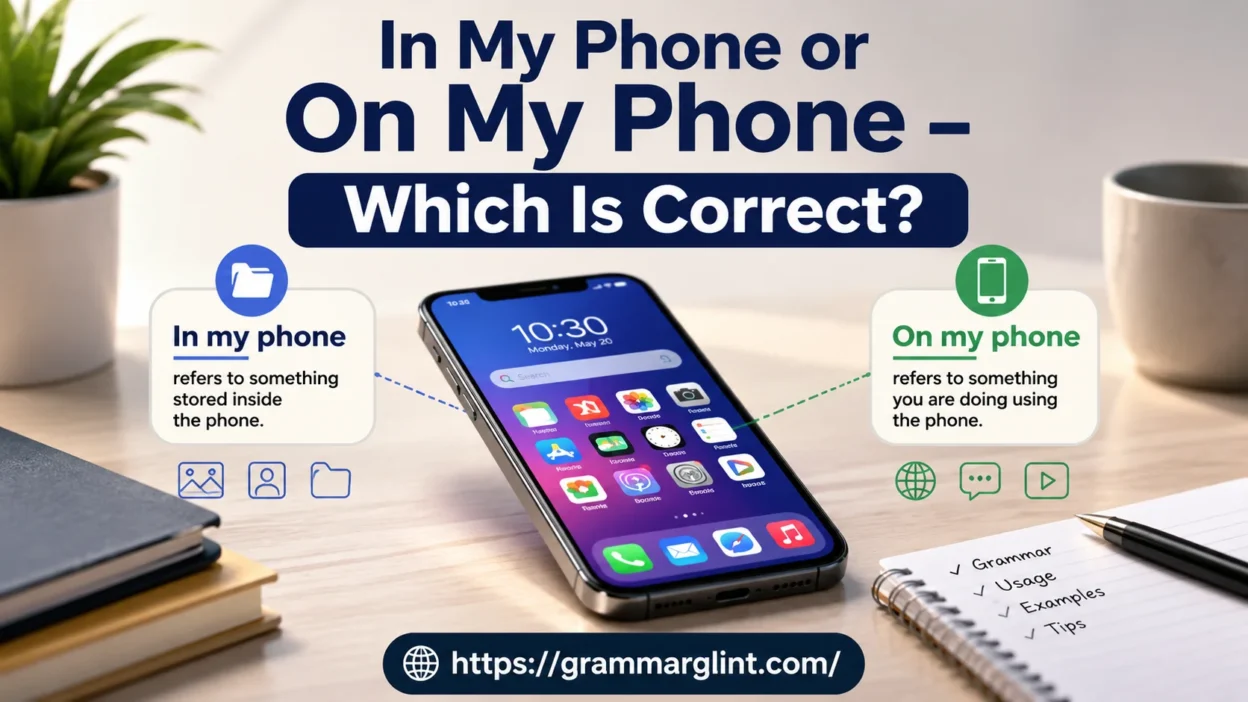
The correct phrase for In My Phone or On My Phone in most situations is on my phone, which is used to indicate something happening or being done using a phone as a tool or platform. In everyday context, this expression helps explain how a mobile phone works as a digital device for communication, technology, and application use.
The phrase typically refers to applications, content, activities, and things we access while using your phone, including browsing the internet and using an app. These phrases show the meaning, usage, and sentence structure of the English language through proper grammar, preposition, and language rules.
The phrase in my phone is not commonly used in the same context, but some people use it when referring to files, pictures, photos, contacts, or data that is stored inside a smartphone or smart phone. It suggests something integrated within the device itself and saved directly in the phone’s memory.
The use of a smartphone has increased tremendously over the last ten years and is not slowing down anytime soon. Both phrases are grammatically correct with logical sense, but they describe different things where on emphasizes interaction with external elements, while in focuses on internal storage, memory, hardware, software, SIM card, electronics, device features, phone functions, file storage, image storage, and location of information.
Quick Answer First
Let’s not waste your time.
The correct phrase in most situations is:
“On my phone”
The phrase:
“In my phone”
is usually incorrect in everyday English.
However, there’s a twist. “In my phone” is not completely wrong in every case. It works in specific technical or storage-related contexts.
So the real answer is:
- On my phone → correct for everyday use
- In my phone → correct only for internal storage or technical context
That’s the core rule. Everything else builds from it.
Understanding “On My Phone” in Real English Usage
When people say “on my phone,” they are talking about using the device as a platform.
Think of your phone as a surface where actions happen. You don’t physically enter it. You interact with it.
This is why English speakers naturally say:
- I saw it on my phone
- I read the message on my phone
- The app is on my phone
- I’ll check it on my phone
Why “on” works here
In English, “on” often means interaction or interface use, especially with technology:
- on a screen
- on a device
- on a website
- on an app
Your phone behaves like a digital workspace. You don’t go inside it. You use it.
Simple mental picture
Imagine your phone as a table.
You place things on the table, not inside it.
That’s how English treats phone usage too.
Why “In My Phone” Sounds Wrong in Everyday English
Now let’s talk about the phrase that causes confusion.
When someone says “in my phone,” it often feels slightly off to native speakers. Not because it’s grammatically impossible, but because it clashes with how English categorizes devices.
The main issue
“In” suggests:
- being inside a container
- physical enclosure
- internal space you can enter
For example:
- in a box
- in a room
- in a bag
But your phone, in everyday speech, is not treated like a container you step inside. It’s treated like a tool you operate.
Read More: Our Mind or Our Minds: What Is the Plural of “Mind”? Explained
Incorrect everyday examples
These sound unnatural:
- ❌ I saw the photo in my phone
- ❌ The app is in my phone
- ❌ I read it in my phone
Even though people sometimes say it, it doesn’t match standard usage.
When “In My Phone” Is Actually Correct
Here’s where things get interesting.
“In my phone” becomes correct when you talk about storage or internal system location.
Now your phone does behave like a container.
Correct examples
- The file is saved in my phone’s memory
- I found it in my phone storage
- There’s a backup in my phone system
In these cases, you are not talking about using the phone. You are talking about where data physically exists inside the device system.
Technical context matters
Developers, engineers, or technicians might say:
- Logs stored in the phone system
- Data cached in internal memory
- Files stored in device storage
Here, “in” works because we are referring to internal architecture, not user interaction.
Grammar Rule Behind It
Let’s simplify the logic.
English uses prepositions based on concept, not physical reality.
General rule:
| Preposition | Meaning |
| On | Interface, interaction, surface |
| In | Container, storage, internal system |
Apply it to devices:
- On my phone → using the device
- In my phone → inside storage system
Simple analogy
Think of your phone like this:
- On my phone = working at a desk
- In my phone = files inside a locked drawer
Same object. Different perspective.
Real-Life Usage Table for Clarity
Let’s break it down into everyday situations.
| Situation | Correct Phrase | Why |
| Checking messages | On my phone | User interaction |
| Watching a video | On my phone | Screen-based activity |
| Installing an app | On my phone | Device usage |
| Saving a photo | In my phone | Storage location |
| Retrieving a file from memory | In my phone | Internal system |
| Browsing social media | On my phone | Platform interaction |
This table shows a key truth: context decides everything.
Why People Confuse
This confusion doesn’t come from ignorance. It comes from logic.
Let’s break down the real reasons.
Influence of native language
Many languages treat devices as containers. So speakers naturally translate:
“It is inside my phone”
Directly into English.
But English doesn’t always follow that logic.
Digital vs physical thinking clash
People think:
- “Photos are inside the phone”
- “Messages are inside the phone”
That feels intuitive. But English separates storage from usage.
Casual speech habits
Even native speakers sometimes say:
- “It’s in my phone”
They usually mean “stored inside,” not general usage. But in formal English, “on my phone” remains standard.
How Native Speakers Actually Use These Phrases
Let’s look at natural speech patterns.
Common native usage:
- “I saw it on my phone.”
- “Let me check on my phone.”
- “It’s already on my phone.”
Rare usage:
- “It’s in my phone’s storage.”
- “I saved it in my phone.”
Notice the difference. Native speakers switch naturally depending on meaning.
Related Expressions You Should Know
Once you understand this rule, you’ll start noticing similar patterns everywhere.
On vs In digital language
- on my laptop
- on my computer
- on my screen
- on the internet
But:
- in my inbox
- in my folder
- in my storage
- in my app settings
Why apps are special
Interestingly, people sometimes say:
- “in the app”
because apps are seen as environments, not just tools.
So both can be correct:
- on the app (general usage)
- in the app (inside features or sections)
Quick Memory Trick That Actually Works
Here’s a simple way to never mix them up again.
If you interact with it → use “on”
If you store something inside it → use “in”
Example:
- You scroll Instagram → on your phone
- Your photo is saved → in your phone
Simple. Fast. Practical.
Case Study: Real Conversation Breakdown
Let’s look at a real-life style example.
Situation:
A student is talking about a lost document.
Incorrect version:
“I think I saw it in my phone yesterday.”
Correct version:
“I think I saw it on my phone yesterday.”
Why?
Because the student is talking about viewing, not storage.
Now consider another case.
Situation:
A technician checks device storage.
Correct version:
“The file is still in your phone memory.”
Now “in” is correct because we’re talking about system storage.
Common Mistakes Learners Make
Here are frequent errors you should avoid:
- Mixing “in” and “on” randomly
- Translating directly from native language
- Thinking “in” always means physically inside
- Overcorrecting simple sentences
Better approach:
Focus on meaning, not translation.
Why “On My Phone” Dominates Modern English
Modern English has shifted heavily toward digital usage patterns.
Phones are no longer seen as storage boxes. They are seen as:
- platforms
- interfaces
- tools
- access points
That’s why “on my phone” dominates everyday language.
My Personal Experience as an English Language Specialist
From my experience as an English language specialist, I’ve noticed that “in my phone” and “on my phone” are two expressions that English learners frequently confuse. The mistake usually happens because many languages describe a phone as a container, leading people to translate phrases directly into English. In reality, native speakers almost always say “on my phone” when referring to activities like texting, browsing the internet, using apps, or watching videos.
I’ve found that the simplest way to remember the difference is to focus on the meaning. If you’re talking about something you do using your phone, “on my phone” is the natural choice. If you’re referring to files, photos, contacts, or other data stored in the device’s memory, “in my phone” is appropriate. This small distinction helps learners sound more fluent and communicate more naturally in everyday English.
FAQs
1. What is the correct phrase: In My Phone or On My Phone?
The more common and correct phrase is on my phone when talking about using a phone for activities like apps, browsing, or communication. In my phone usually refers to things stored inside the device.
2. Why do people say on my phone?
People use on my phone because the phone acts as a platform or tool for accessing applications, websites, and digital activities.
3. Is in my phone grammatically correct?
Yes, in my phone can be grammatically correct when discussing internal items such as files, photos, contacts, or stored data.
4. What does on my phone mean?
On my phone means something is available, running, or being used through a mobile phone, such as an app, website, or digital service.
5. What does in my phone mean?
In my phone suggests something exists inside the device, especially in its memory or storage, like saved pictures or documents.
6. Can in my phone and on my phone be used interchangeably?
No, both phrases have different meanings. On my phone focuses on interaction and usage, while in my phone focuses on internal storage.
7. Which phrase is used for apps and software?
On my phone is used for applications, software, browsing, and online activities performed through the device.
8. Which phrase is used for photos and contacts?
In my phone is often used for things like photos, contacts, and files saved in the phone’s storage.
9. Does smartphone technology affect these phrases?
Yes, the growth of smartphones and digital devices has made these phrases more common in everyday English language usage.
10. How can these phrases improve English usage?
Understanding in my phone and on my phone helps improve grammar, sentence structure, and correct communication in digital contexts.
Conclusion
Choosing between in my phone and on my phone is easier once you understand the difference in meaning. In most everyday conversations, on my phone is the correct and more natural expression because it refers to activities you do using your phone, such as browsing the web, watching videos, texting, or using apps. In my phone, on the other hand, is best when you’re talking about something stored inside the device, like photos, contacts, files, or messages.
Remember that neither phrase is wrong. The right choice depends on what you want to express. If you’re discussing an activity, use on my phone. If you’re referring to data or items saved in the device’s memory, use in my phone.With this simple distinction in mind, you’ll sound more natural and communicate more clearly in both spoken and written English.

Aria Jane is a senior language writer and grammar specialist at Grammar Glint. She focuses on English grammar, spelling variations, vocabulary, and writing clarity. Through detailed research and practical examples, Aria helps readers understand language rules and avoid common mistakes. Her articles are designed to make English learning accessible for students, professionals, and everyday writers seeking reliable language guidance.