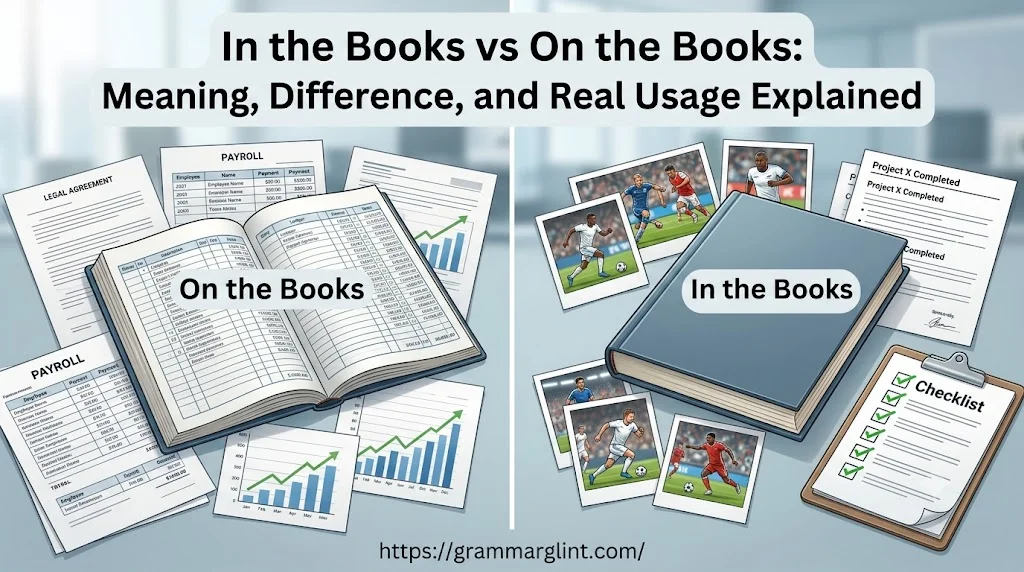
In everyday English Learning, understanding In the Books vs On the Books helps explain how small language choices can create major differences in meaning. These Two phrases may look almost identical, but they carry completely different meanings depending on the situation and context. Many learners notice that both expressions involve the word “books,” which can create confusion because books are often connected with records, information, and written details.
This article provides a clear explanation of how these phrases work and why a small change in a preposition can affect the entire meaning. At first glance, the phrases may seem interchangeable, but they are used in different situations. The difference often depends on whether something is being recorded, officially listed, remembered, or discussed as part of a plan or event.
Knowing when each phrase is correctly used can help improve fluency and make communication clearer. Both forms may appear right, but the way they are used in conversations and writing changes the meaning entirely. With proper examples and practical understanding, these differences become easier to remember and apply.
This guide clears confusion by breaking down the topic with simple explanations, useful examples, and memorable tips. By the end, the use of both phrases becomes more understandable, helping learners recognize the difference and use each expression with greater confidence.
Why It Confuses So Many People
Let’s be honest. English is full of phrases that look like twins but act like strangers.
The confusion between “in the books” and “on the books” happens for a few simple reasons:
- Both use the word “books”, which often means records or accounts
- Both appear in formal settings like law, business, and sports
- Both sound grammatically correct in casual speech
- Context changes their meaning completely
Here’s the tricky part. In older English usage, “books” referred to ledgers, written records, and official accounts. That’s why both phrases grew from bookkeeping language. But over time, they split into two different directions.
Think of them like two roads leaving the same town. Same origin. Different destinations.
A quick quote to anchor this idea:
“Words don’t confuse people. Context does.”
And that’s exactly what we’ll fix here.
What “On the Books” Actually Means
When you hear “on the books,” think official, active, and recorded.
It means something exists in a formal system. It hasn’t been erased, removed, or canceled. It’s part of the official record.
Simple Definition of “On the Books”
On the books = officially recorded in a system or register
That system could be:
- A legal code
- A company payroll
- A financial ledger
- A government registry
If it’s “on the books,” it’s recognized by authority.
Where “On the Books” Is Commonly Used
This phrase shows up a lot in serious, structured environments:
- Law and legislation
- Employment records
- Accounting and finance
- Government policies
Let’s break those down.
Legal Usage of “On the Books”
When a law is “on the books,” it means it officially exists.
Even if nobody enforces it anymore, it still remains part of written law.
Example:
- “The regulation is still on the books, even though it’s rarely applied.”
In legal terms, this matters a lot. A law doesn’t disappear just because it’s outdated. It stays active in record unless formally removed.
Business and Employment Usage
In workplaces, “on the books” means someone is officially recorded as part of payroll or staffing.
Example:
- “She’s on the books as a full-time employee.”
This matters for:
- Taxes
- Benefits
- Employment rights
If you’re not “on the books,” you’re not officially registered. That can mean informal or even illegal work in some cases.
Accounting Usage
In accounting, “on the books” refers to recorded financial entries.
Example:
- “The expense is on the books for this quarter.”
This means:
- It appears in financial statements
- It affects official balance sheets
- It has been logged properly
Key Idea for “On the Books”
If you remember just one thing:
On the books = officially recorded and still valid
Think of it like a file sitting neatly in a cabinet, actively recognized by the system.
Read More: On the Tree or In the Tree: Which Is Correct?
What “In the Books” Actually Means
Now let’s flip the coin.
“In the books” means something is finished, completed, or part of history.
It no longer describes something active. Instead, it marks closure.
Simple Definition of “In the Books”
In the books = completed and recorded as done
It often shows up in informal speech, especially when talking about results or events.
Where “In the Books” Is Commonly Used
This phrase is popular in:
- Sports commentary
- Project wrap-ups
- Business reporting
- Casual conversation
It feels lighter and more reflective than “on the books.”
Sports Usage of “In the Books”
This is where the phrase really shines.
Example:
- “That match is in the books.”
It means:
- The game is over
- The result is final
- It is now part of history
Sports broadcasters love this phrase because it signals closure with style.
You might hear:
- “Another win in the books for the team.”
- “A tough season is now in the books.”
Business and Work Usage
In workplaces, “in the books” often refers to completed cycles or projects.
Example:
- “The quarterly report is in the books.”
This means:
- The work is finished
- The data is finalized
- It’s officially closed
Everyday Usage
People also use it casually.
Example:
- “That road trip is in the books.”
It gives a sense of nostalgia. Something done. Something remembered.
Key Idea for “In the Books”
If you remember just one thing:
In the books = completed and filed away as history
Think of it like a photo album. The moment is gone, but the record remains.
The Core Difference
Now let’s make it crystal clear.
These two phrases differ in time, status, and function.
Simple Breakdown
- On the books = active record, officially recognized
- In the books = completed record, part of history
Easy Mental Shortcut
Here’s a simple way to lock it in:
- On = ongoing status
- In = finished outcome
Real-Life Analogy
Imagine a library system:
- A book being cataloged and available → on the books
- A book being read, finished, and summarized → in the books
Same system. Different stage.
Side-by-Side Comparison Table
| Phrase | Meaning | Status | Tone | Common Use |
| On the books | Officially recorded | Active | Formal | Law, payroll, accounting |
| In the books | Completed or finished | Closed | Informal | Sports, events, summaries |
Real-Life Scenarios That Make It Easy to Remember
Let’s connect these phrases to real situations so they stick.
Workplace Scenario
A company hires a new employee.
- Before hiring: not recorded anywhere
- After hiring: employee is on the books
Now the employee completes a major project.
- Project done: it is now in the books
Two stages. Two phrases.
Legal Scenario
A city has an old regulation:
- It is still on the books
- Even if rarely enforced
Later, a court case ends.
- The case result is now in the books
One stays active. One becomes history.
Sports Scenario
A football club signs a player:
- Contract is on the books
At the end of the season:
- The season record is in the books
That simple shift shows time moving forward.
Finance Scenario
A business logs an expense:
- Expense is on the books
At the end of the fiscal year:
- Financial results are in the books
One tracks reality. The other summarizes it.
Common Mistakes People Make
Even fluent speakers mix these up.
Here are the most common errors:
- Saying “in the books” for laws or regulations
- Using “on the books” for completed events
- Swapping them in financial summaries
- Treating them as interchangeable synonyms
Why does this happen?
Because both phrases sound official. But only one is about completion.
Memory Trick to Never Confuse Them Again
Let’s simplify it into something you can remember instantly.
- On the books = On record (active)
- In the books = In history (finished)
Or even shorter:
- On = Now
- In = Done
This tiny mental switch solves 90% of confusion.
Why Context Always Matters With These Phrases
English idioms don’t live in isolation. They depend on context.
The phrase “books” can mean:
- Financial records
- Legal documents
- Historical logs
- Sports statistics
So the meaning of “in the books vs on the books” shifts based on where you use it.
Here’s the real takeaway:
- Formal systems prefer “on the books”
- Informal storytelling prefers “in the books”
That’s why you’ll hear accountants and lawyers use one, while sports commentators prefer the other.
Case Study: How Context Changes Meaning
Let’s look at a simple scenario involving a company and a sports team.
Company Scenario
A tech company records a new policy:
- The policy is now on the books
Six months later, the policy is replaced.
- The old policy is still historically referenced but inactive
Sports Team Scenario
A basketball team finishes a season:
- Final game ends
- Season becomes in the books
Now analysts study it:
- Wins
- Losses
- Performance trends
Same idea of “record,” but different timing.
My Personal Experience as an English Language Specialist
As an English language specialist, I have found that In the Books vs On the Books is one of the most commonly misunderstood expression pairs among English learners. Since both phrases contain the word books, many people naturally assume they have the same meaning. In reality, a single change in the preposition completely changes the message. This confusion often appears in classroom discussions, writing exercises, and everyday conversations.
Through teaching and reviewing learners’ work, I have noticed that the easiest way to understand these expressions is by focusing on the context rather than translating them literally. On the books is commonly used when something is officially recorded, registered, or recognized, whereas in the books refers to something that has been completed and is now part of the record or history. Once learners connect each phrase with its purpose instead of the individual words, they begin using them much more naturally.
This guide follows the same practical approach by explaining both expressions with clear definitions, real-life examples, common mistakes, and simple memory tips. The goal is to help learners understand not only the meanings of these phrases but also the situations in which native English speakers use them confidently.
FAQs
1. What is the difference between “in the books” and “on the books”?
In the books usually refers to something recorded, remembered, or considered as part of a plan or history. On the books often means something is officially listed, documented, or registered.
2. Is “in the books” a correct phrase?
Yes, in the books is a correct phrase. It is commonly used when talking about something that has been recorded, completed, or placed into memory or consideration.
3. What does “on the books” mean?
On the books means something exists in an official record, document, system, or list. It is often connected with laws, rules, accounting, or official information.
4. Can “in the books” and “on the books” be used interchangeably?
No, they usually cannot be exchanged freely. The small difference between in and on changes the meaning and purpose of the phrase.
5. Why do learners confuse these phrases?
Learners often get confused because both phrases contain the word books and seem similar at first glance. The difference comes from the preposition and the context of use.
6. Does “on the books” relate to accounting?
Yes, on the books is often related to accounting and official documentation because it can describe something that is entered into records.
7. Does “in the books” refer to the future or past?
It depends on the context. In the books can refer to something recorded, completed, or remembered as part of a timeline or event.
8. How can these phrases improve English fluency?
Learning the difference between these phrases helps improve sentence accuracy, communication skills, and understanding of natural English usage.
9. Are both phrases common in conversations and writing?
Yes, both phrases appear in everyday conversations and writing, but each one fits different meanings and situations.
10. What is the easiest way to remember the difference?
Remember that on the books focuses on official records or listings, while in the books often focuses on something recorded, completed, or remembered.
Conclusion
Understanding In the Books vs On the Books becomes much easier once the difference in meaning is clear. On the books refers to something that is officially recorded, registered, or scheduled, while in the books describes something that has already been completed, finalized, or entered into the record. Although the phrases differ by only one preposition, they are not interchangeable.
Remembering the purpose of each expression helps avoid common mistakes in both speaking and writing. Regular exposure to real-world examples makes the distinction more natural over time. Using the correct phrase improves clarity, accuracy, and overall confidence in everyday English communication.

Aria Jane is a senior language writer and grammar specialist at Grammar Glint. She focuses on English grammar, spelling variations, vocabulary, and writing clarity. Through detailed research and practical examples, Aria helps readers understand language rules and avoid common mistakes. Her articles are designed to make English learning accessible for students, professionals, and everyday writers seeking reliable language guidance.