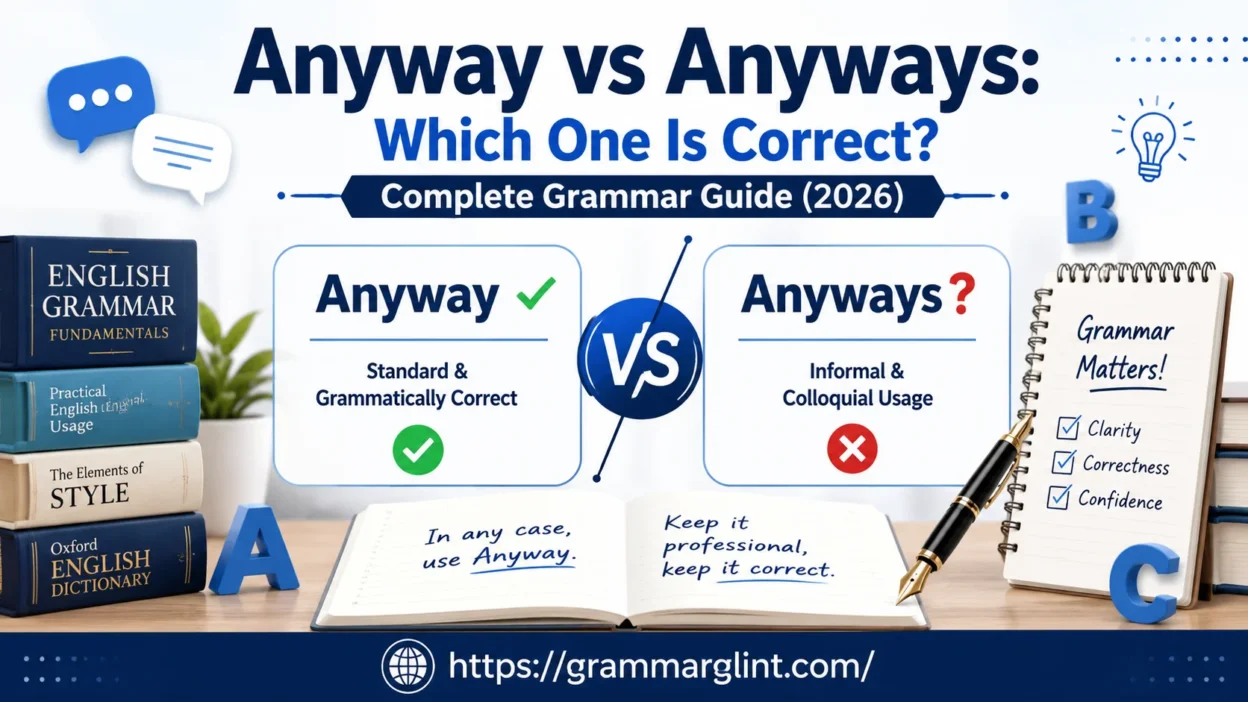
Anyway vs Anyways often confuses writers because both words look similar, yet their difference depends on formality, usage, and context.
Have you ever written anyway or anyways and wondered which one is correct? It is a common English grammar question because many people use them interchangeably in casual conversation. They essentially share the same meaning, but Anyway is the standard form, grammatically correct, widely accepted, and the preferred choice for written English, spoken English, formal English, professional writing, and formal writing. Anyways is an informal form, a colloquial colloquial variation that is commonly used in some dialects, especially American English, where it appears in conversation and speech with a relaxed tone. Although it has some acceptance, most style guides still consider it nonstandard or slang in formal situations.
From my editing experience, the best choice usually depends on the level of formality and contextual usage. Anyway can mean regardless or in any case, and it also works as a transition, transitional word, or discourse marker to dismiss a previous point and continue the discussion. This distinction may seem small, but the nuance and distinct nuances matter in language usage, word choice, and overall grammar.
A quick trick is to stick with anyway because it is the accepted option. It is also advisable to avoid or keep avoided anyways in formal work, although you may use it in relaxed settings if the context fits. To discover the right answer, think about when and how you want to convey your message correctly. Ultimately, the best choosing method is simple: if it is raining, you could still say, “we went out anyway.”
Quick Answer
If you only remember one rule, make it this one:
- Anyway is the standard and preferred form in both American and British English.
- Anyways is an informal variant that appears mainly in casual speech and relaxed writing.
- Both words usually have the same meaning, but they are not equally appropriate in every context.
- In academic, professional, or formal writing, always choose anyway.
- In text messages or friendly conversations, anyways is generally acceptable.
Example
✅ Anyway, let’s continue the meeting.
✅ Anyways, what are your weekend plans?
The first sentence fits every situation. The second sounds conversational and informal.
Anyway vs Anyways at a Glance
| Feature | Anyway | Anyways |
| Grammar status | Standard English | Informal variant |
| Meaning | Regardless, in any case, moving to another point | Same meaning |
| Formal writing | Recommended | Not recommended |
| Academic writing | Correct | Avoid |
| Business communication | Correct | Avoid |
| Casual conversation | Very common | Common |
| American English | Widely accepted | Informal but recognized |
| British English | Strongly preferred | Less common |
| Dictionary status | Standard entry | Listed as informal in major dictionaries |
| Best choice | Anytime you’re unsure | Only in relaxed situations |
What Does “Anyway” Mean?
Anyway is an adverb that helps connect ideas, shift conversations, or emphasize that something remains true despite previous information.
In simple words, it often means:
- Regardless
- In any case
- Nevertheless
- Moving on
- Returning to the main topic
You probably hear this word every day without realizing how flexible it is.
Definition
Anyway means despite what has been said, regardless of circumstances, or returning to the original subject after a brief interruption.
It serves as a transition word that keeps conversations flowing naturally.
Common Functions in English
The word performs several jobs depending on the sentence.
Showing that something doesn’t change
It was raining. We went hiking anyway.
The rain did not change the decision.
Changing the subject
Anyway, let’s discuss tomorrow’s presentation.
The speaker gently moves the conversation forward.
Ending a discussion
Anyway, that’s all I wanted to say.
This signals closure without sounding abrupt.
Adding emphasis
I didn’t want the job anyway.
Here, the speaker emphasizes that losing the opportunity doesn’t matter.
When Native Speakers Use “Anyway”
Native English speakers use anyway in countless situations.
For example:
- During conversations
- In presentations
- During interviews
- In business meetings
- In classroom discussions
- In articles and books
- In podcasts
- In news reports
One reason for its popularity is versatility. Instead of sounding repetitive, it naturally guides readers and listeners from one thought to another.
What Does “Anyways” Mean?
The word anyways carries almost the same meaning as anyway. The difference isn’t about definition. It’s about style.
Many people assume anyways is simply wrong. That isn’t entirely true.
Definition
Anyways is an informal variation of anyway that appears mostly in spoken English and casual writing.
It usually means:
- Regardless
- In any case
- Moving back to the main point
The meaning stays the same.
Is It a Real Word?
Yes.
Major dictionaries recognize anyways as an actual English word. However, they consistently label it as informal, nonstandard, or chiefly conversational.
That distinction matters.
A word can exist in English while still being unsuitable for formal writing.
Think of expressions like:
- Gonna
- Wanna
- Kinda
Native speakers use them constantly, but professional writers rarely include them in formal documents.
Anyways falls into a similar category.
Why It Exists Despite Being Informal
Languages naturally evolve.
People often add sounds or endings to words because they feel more comfortable during speech. Over generations, these habits become common enough that dictionaries record them.
That doesn’t mean grammar experts recommend them in every situation.
Instead, dictionaries document real language use while style guides explain when certain words fit best.
Anyway vs Anyways: What’s the Real Difference?
The biggest difference has nothing to do with meaning.
It comes down to formality, tone, and audience.
Grammar Difference
Grammatically, anyway is the accepted standard form.
Anyways functions the same way but belongs to informal English.
Neither word changes sentence structure.
For example:
✅ Anyway, we’ll leave at noon.
✅ Anyways, we’ll leave at noon.
Both are understandable.
Only the first sounds suitable for every audience.
Formality Difference
Imagine you’re sending two different messages.
One goes to your professor.
The other goes to your best friend.
The wording shouldn’t be identical.
For example:
Formal
Anyway, I appreciate your feedback and look forward to your response.
Informal
Anyways, see you later!
The second sentence feels relaxed because that’s exactly what anyways communicates.
Tone and Style
Words carry personality.
Anyway sounds polished, neutral, and professional.
Anyways sounds friendly, conversational, and spontaneous.
Neither is inherently better.
The best choice depends on who will read or hear your message.
Meaning Comparison
In nearly every sentence, the meaning remains identical.
Compare these examples.
Anyway
I wasn’t interested anyway.
Anyways
I wasn’t interested anyways.
Both communicate exactly the same idea.
Only the tone changes.
Acceptance in Standard English
Professional editors almost always replace anyways with anyway.
Schools, universities, newspapers, government agencies, and businesses also favor anyway because it follows standard written English.
That consistency helps maintain a professional style across different types of writing.
Is “Anyways” Grammatically Correct?
This question creates more debate than almost any other grammar topic.
The answer depends on what you mean by correct.
If you mean recognized as an English word, then yes.
If you mean recommended for formal writing, then no.
Both statements can be true at the same time.
What Major Dictionaries Say
Leading English dictionaries include anyways in their entries because people genuinely use it.
However, they usually describe it with labels such as:
- Informal
- Nonstandard
- Conversational
- Dialectal in some regions
These labels help readers understand the context in which the word naturally appears.
What Grammar Guides Recommend
Most grammar experts recommend a simple rule.
Use anyway whenever you’re writing something that others will evaluate professionally.
That includes:
- Essays
- Research papers
- Reports
- Business emails
- Job applications
- News articles
- Academic journals
- Website content
Save anyways for relaxed conversations where sounding natural matters more than following formal style conventions.
Why Teachers Prefer “Anyway”
Teachers focus on standard English because students need writing skills that work everywhere.
If you consistently use anyway, you’ll never lose marks because of word choice.
Using anyways may not always be marked wrong, but many instructors consider it too informal for academic work.
Choosing the standard form removes uncertainty.
It also helps your writing appear more polished and professional.
Why Do People Say “Anyways”?
If “anyway” is the standard form, why do millions of people still say “anyways”?
The answer lies in how language naturally develops. Spoken English doesn’t always follow the same rules as formal writing. Over time, people adopt words that feel comfortable, even if style guides recommend something different.
Think about everyday expressions such as “gonna,” “y’all,” or “ain’t.” They appear in casual speech because they’re familiar and easy to say. The same idea applies to “anyways.”
Regional Speech Habits
Language changes from one region to another.
In parts of the United States and Canada, “anyways” appears regularly in casual conversations. People often grow up hearing family members, friends, and coworkers use it, so it becomes part of their everyday vocabulary.
In contrast, British English strongly favors “anyway.” While you might occasionally hear “anyways,” it is far less common.
Regional differences don’t necessarily make one version right and the other wrong. They simply reflect how language evolves within different communities.
Influence of Spoken English
Speech moves quickly.
People don’t stop to analyze grammar before responding in a conversation. They naturally choose words that sound familiar.
Imagine two friends talking:
Friend A: I forgot my umbrella.
Friend B: Anyways, it stopped raining.
No one pauses to consider whether “anyways” follows a formal style guide. The conversation flows naturally because the focus is communication rather than perfect grammar.
Habit Rather Than Grammar
Many speakers use “anyways” simply because they’ve always heard it.
Language habits often develop during childhood. Once a phrase becomes part of someone’s speech, changing it requires conscious effort.
That’s why even experienced professionals might occasionally say “anyways” in conversation while writing “anyway” in emails and reports.
Does It Sound More Natural?
For some speakers, yes.
The extra -s creates a rhythm that feels more conversational. It doesn’t change the meaning, but it can change how relaxed the sentence sounds.
That said, if you’re unsure which version to choose, “anyway” remains the safest option because it works in every setting.
Read More: Take Affect vs Take Effect: The Correct Phrase Explained
When Should You Use “Anyway”?
If you want one word that fits almost every situation, choose “anyway.”
It is accepted in formal writing, professional communication, academic work, and everyday conversations. Few English words offer that kind of flexibility.
Academic Writing
Schools, colleges, and universities expect students to follow standard English.
For example:
✅ Anyway, the results support the original hypothesis.
❌ Anyways, the results support the original hypothesis.
The first sentence sounds polished and professional.
Business Emails
Professional communication should always prioritize clarity.
Imagine writing to a client.
Correct
Anyway, I’ll send the revised proposal before Friday.
Less Professional
Anyways, I’ll send the revised proposal before Friday.
Small details influence how readers perceive your writing.
Professional Documents
Whether you’re preparing a report, proposal, or presentation, “anyway” helps maintain a consistent tone.
Use it in:
- Business reports
- Company policies
- Legal documents
- Technical manuals
- Research papers
- Professional presentations
- Cover letters
- Official announcements
Everyday Conversation
Unlike many formal words, “anyway” doesn’t sound stiff.
You can comfortably use it while talking with family, friends, coworkers, or classmates.
Examples:
Anyway, how was your vacation?
Anyway, let’s grab some coffee.
Anyway, I’ll call you tonight.
Because it works everywhere, many language experts recommend making “anyway” your default choice.
When Is It Acceptable to Use “Anyways”?
Although “anyway” is the safer option, “anyways” isn’t forbidden.
The key is understanding your audience.
Casual Conversations
Friends rarely judge each other’s grammar.
That’s why sentences like these sound perfectly natural.
Anyways, let’s watch another movie.
Anyways, I’m heading home now.
The informal tone actually matches the relaxed setting.
Text Messages
People often shorten words and ignore strict grammar while texting.
Examples include:
- BTW
- LOL
- Gonna
- Yep
- Anyways
In personal messages, sounding natural usually matters more than sounding formal.
Social Media
Social platforms encourage conversational writing.
Many creators intentionally use “anyways” because it feels authentic.
For example:
Anyways, here’s what happened today.
That style fits platforms where people expect informal language.
Dialogue in Creative Writing
Authors frequently write dialogue that reflects how real people speak.
If a fictional character naturally says “anyways,” using it can make conversations feel more believable.
Notice the difference.
Narration
Anyway, the investigation continued.
Dialogue
“Anyways,” Jake said, “let’s get going.”
The narration remains formal, while the dialogue reflects natural speech.
Anyway vs Anyways in American and British English
English isn’t identical around the world.
Vocabulary, spelling, pronunciation, and grammar vary from country to country.
Fortunately, the difference between “anyway” and “anyways” follows a fairly predictable pattern.
American English Usage
American English accepts both forms.
However, they serve different purposes.
| Situation | Preferred Choice |
| Academic writing | Anyway |
| Newspapers | Anyway |
| Business communication | Anyway |
| Casual speech | Anyway or Anyways |
| Social media | Either, depending on tone |
Although “anyways” appears in everyday American speech, professional writers overwhelmingly choose “anyway.”
British English Usage
British English strongly favors “anyway.”
Most British publications, schools, and professional organizations discourage using “anyways” in writing.
If you’re writing for a UK audience, choose “anyway.”
Canadian English
Canadian English sits somewhere between American and British English.
You’ll occasionally hear “anyways” in conversation, but formal Canadian writing almost always prefers “anyway.”
Australian English
Australians generally follow the same pattern.
Casual speech sometimes includes “anyways,” yet newspapers, universities, and official documents consistently use “anyway.”
Which Version Is More Common Worldwide?
Looking across English-speaking countries, “anyway” is by far the more common choice.
It appears in:
- Books
- Newspapers
- Academic journals
- Government publications
- Business websites
- Professional blogs
- Educational materials
Because it enjoys worldwide acceptance, learning “anyway” first gives you the greatest flexibility.
Grammar Rules for Anyway
Understanding the grammar behind “anyway” helps you use it naturally instead of memorizing isolated examples.
Part of Speech
Anyway is primarily an adverb.
It modifies an entire sentence rather than a single noun or verb.
Examples:
Anyway, we should leave now.
She finished the project anyway.
In both cases, the word affects the overall meaning of the sentence.
Sentence Position
One advantage of “anyway” is its flexibility.
You can place it at the beginning, middle, or end of a sentence.
Beginning
Anyway, let’s continue.
Middle
We should, anyway, review the report one more time.
End
I didn’t need the extra help anyway.
Although all three positions are grammatically correct, beginning and ending positions are far more common in modern English.
Using It as a Transition
One of the most common uses of “anyway” is transitioning from one idea to another.
For example:
We spent twenty minutes discussing the budget. Anyway, let’s move on to next month’s goals.
The word signals a shift without sounding abrupt.
Using It for Emphasis
Sometimes “anyway” emphasizes that something remains true despite another fact.
Example:
I wasn’t planning to attend anyway.
Even if circumstances changed, the speaker’s decision stayed the same.
This subtle emphasis makes “anyway” one of the most useful transition words in everyday English.
Can “Anyways” Replace “Anyway”?
This is one of the most common questions English learners ask.
The short answer is sometimes, but not always.
In casual conversations, replacing “anyway” with “anyways” usually doesn’t change the meaning. Most native speakers will understand you immediately. However, once you move into formal or professional writing, the two words are no longer interchangeable.
A good rule is to match your language to your audience.
If you’re writing something that will be graded, published, or reviewed by professionals, choose “anyway.” If you’re chatting with friends, “anyways” is usually acceptable.
Situations Where It Works
You can safely use “anyways” in relaxed settings such as:
- Conversations with friends
- Family discussions
- Text messages
- Social media posts
- Informal online chats
- Creative dialogue
For example:
Anyways, I’ll see you tomorrow.
Anyways, that movie was better than I expected.
These sentences sound friendly and conversational.
Situations Where It Doesn’t
Avoid “anyways” in situations where your writing represents your professionalism.
Examples include:
- Academic essays
- Research papers
- Business emails
- Cover letters
- Resumes
- Reports
- News articles
- Official correspondence
Instead, write:
Anyway, I’ll submit the report by noon.
This version sounds polished and follows standard English conventions.
Examples of Correct and Incorrect Usage
| Situation | Correct Choice |
| College essay | Anyway |
| Office email | Anyway |
| Job application | Anyway |
| Friendly text | Anyway or Anyways |
| Instagram caption | Either |
| Novel dialogue | Either, depending on the character |
| Newspaper article | Anyway |
| Classroom presentation | Anyway |
The pattern is easy to remember.
The more formal the situation, the stronger the case for using “anyway.”
Anyway vs Anyways Examples
Reading real examples helps you understand the difference much faster than memorizing grammar rules.
Everyday Conversation Examples
These examples sound natural during daily conversations.
Using “Anyway”
- Anyway, what did you decide?
- Anyway, let’s head home before it gets dark.
- Anyway, I’ll call you later tonight.
- Anyway, we had a great time.
- Anyway, that’s all I wanted to mention.
Using “Anyways”
- Anyways, what’s everyone doing this weekend?
- Anyways, I should probably leave now.
- Anyways, thanks for stopping by.
- Anyways, let’s order some pizza.
- Anyways, I’ll text you when I arrive.
Both versions communicate the same idea, but “anyways” sounds noticeably more relaxed.
Workplace Examples
Professional communication almost always favors “anyway.”
Examples:
Anyway, I’ve attached the revised proposal.
Anyway, we’ll discuss the budget during tomorrow’s meeting.
Anyway, thank you for your valuable feedback.
Anyway, the project remains on schedule.
Notice how the word smoothly transitions between ideas without distracting the reader.
Academic Writing Examples
Students should consistently choose “anyway.”
Examples:
Anyway, the experiment produced consistent results.
Anyway, previous studies support this conclusion.
Anyway, the evidence suggests a different interpretation.
Anyway, further research is necessary.
Formal writing values consistency and precision.
Read More: Swifty or Swiftie: Which Spelling Is Correct? The Complete Guide
Email Examples
Professional emails benefit from neutral language.
Example 1
Anyway, I appreciate your time and look forward to hearing from you.
Example 2
Anyway, please let me know if you have any questions.
Example 3
Anyway, I’ve included the updated schedule for your review.
These sentences sound confident without becoming overly casual.
Social Media Examples
Social media allows more flexibility.
Examples:
Anyways, here’s my travel vlog.
Anyway, today’s workout was amazing.
Anyways, who’s watching the game tonight?
Anyway, thanks for all the support!
On social platforms, your personal style matters more than strict grammar.
Common Mistakes to Avoid
Many learners understand the basic difference between “anyway” and “anyways,” yet they still make small mistakes.
Avoiding these common errors will instantly improve your writing.
Using “Anyways” in Formal Writing
This is by far the most frequent mistake.
Consider this email opening:
❌ Anyways, I’m writing to request additional information.
A better version is:
✅ Anyway, I’m writing to request additional information.
The correction seems small, but it creates a stronger professional impression.
Confusing “Anyway” with “Any Way”
These expressions look similar, but they serve different grammatical purposes.
Anyway is one word.
Any way is two separate words.
Compare these sentences.
Anyway, we’ll find another solution.
Is there any way to solve this problem?
The first introduces a transition.
The second refers to any possible method.
A quick memory trick is this:
If you could replace the phrase with “regardless” or “in any case,” use “anyway.”
If you’re talking about a method or possibility, write “any way.”
Assuming “Anyways” Is Always Wrong
Another misconception is believing “anyways” is not an English word.
That isn’t true.
The word exists and appears in respected dictionaries.
The important distinction is that dictionaries describe it as informal rather than standard.
So instead of calling it wrong, it’s more accurate to call it context-dependent.
Mixing Formal and Informal Tone
Imagine reading this paragraph.
Dear Professor,
Anyways, I’ve completed the research paper and attached it below.
The greeting sounds formal, but “anyways” suddenly shifts the tone.
A better version keeps everything consistent.
Dear Professor,
Anyway, I’ve completed the research paper and attached it below.
Consistency helps readers focus on your message instead of your wording.
Don’t Confuse These
Many people accidentally write “any way” when they actually mean “anyway.”
Although the spellings differ by only one space, the meanings are completely different.
Difference in Meaning
| Word | Meaning |
| Anyway | Regardless, in any case, moving to another point |
| Any way | Any method, any possible manner |
Examples:
Anyway, let’s continue the lesson.
Is there any way to fix this computer?
Only one of these expressions can fit each sentence.
Grammar Rules
Think about the role each expression plays.
Anyway
- Functions as an adverb.
- Connects ideas.
- Adds emphasis.
- Changes the direction of a conversation.
Any way
- Refers to a noun phrase.
- Means any possible method or any possible route.
Examples:
We should leave anyway.
Can you think of any way to improve the design?
The meanings are completely different even though the words look alike.
Easy Memory Trick
Ask yourself one question.
Can I replace it with “regardless”?
If the answer is yes, use “anyway.”
If the answer is no, you’re probably looking for “any way.”
Examples:
We’ll finish anyway.
We’ll finish regardless.
That works.
Now try:
Is there regardless to solve this?
That doesn’t make sense.
Instead:
Is there any way to solve this?
Now the sentence sounds correct.
This simple test eliminates confusion almost every time.
Anyway vs Similar Transition Words
English offers several transition words that express similar ideas. While “anyway” often overlaps with words like “anyhow,” “regardless,” and “nonetheless,” each has its own tone and purpose.
Understanding these subtle differences helps you write more naturally and choose the most appropriate word for every situation.
Anyway vs Anyhow
Both “anyway” and “anyhow” can mean “in any case” or “regardless.” However, “anyway” appears far more often in modern English.
| Feature | Anyway | Anyhow |
| Formality | Neutral | Slightly informal |
| Frequency | Very common | Less common |
| Business writing | Yes | Rarely |
| Everyday speech | Very common | Common |
Examples:
Anyway, let’s begin the meeting.
Anyhow, we managed to finish the project.
Although both sentences are correct, “anyway” sounds more natural in most situations.
Anyway vs Regardless
Regardless emphasizes that something remains true despite obstacles or opposing circumstances.
Compare these examples.
We decided to travel anyway.
We decided to travel regardless of the weather.
The first sentence uses a transition.
The second highlights determination despite a challenge.
Choose “regardless” when you want stronger emphasis.
Anyway vs Nonetheless
Nonetheless is much more formal than “anyway.”
Examples:
The task was difficult. Nonetheless, the team completed it.
The task was difficult. Anyway, we finished it.
The first sentence sounds appropriate for reports or academic writing.
The second feels conversational.
Anyway vs Besides
People sometimes confuse these transition words because both introduce another idea.
However, they have different purposes.
Anyway moves the conversation forward or returns to the main point.
Besides introduces an additional reason or argument.
Compare these examples.
Anyway, let’s continue with today’s lesson.
Besides, we already have enough evidence.
One shifts the discussion.
The other strengthens an argument.
Which One Fits Your Sentence Best?
Use this quick guide.
| If You Want To… | Best Choice |
| Return to the main topic | Anyway |
| Express “despite that” | Regardless |
| Sound formal | Nonetheless |
| Add another reason | Besides |
| Sound conversational | Anyway |
| Use an older informal style | Anyhow |
Learning these small distinctions makes your writing smoother and more precise.
Pronunciation Guide
Although “anyway” and “anyways” differ by only one letter, learners sometimes hesitate when pronouncing them.
Fortunately, both words follow simple pronunciation patterns.
How to Pronounce “Anyway”
Pronunciation:
/ˈɛn.i.weɪ/
You can think of it as three natural parts.
- En
- Ee
- Way
Say them together.
En-ee-way
The stress falls on the first syllable.
Example:
Anyway, let’s continue.
How to Pronounce “Anyways”
Pronunciation:
/ˈɛn.i.weɪz/
The pronunciation stays almost identical to “anyway.”
The only difference is the z sound at the end.
Break it into parts.
- En
- Ee
- Wayz
Example:
Anyways, I’ll see you tomorrow.
Common Pronunciation Errors
Many English learners make these mistakes.
Adding an extra syllable
❌ En-ee-wa-yis
✅ En-ee-way
Overemphasizing the final “s”
The ending should sound soft rather than exaggerated.
Dropping the first syllable
Some speakers shorten the word too much during fast conversations.
Speaking slowly at first helps develop natural pronunciation.
Reading dialogues aloud is another excellent way to build confidence.
Word Origin and History
The history of “anyway” explains why “anyways” exists today.
Like many English words, its meaning developed gradually over centuries.
Etymology of “Anyway”
The word “anyway” comes from combining:
- Any
- Way
Originally, the phrase referred to any manner or any direction.
Over time, English speakers began using it as a sentence adverb meaning:
- In any case
- Regardless
- Nevertheless
Eventually, it became one of the most common transition words in English.
How “Anyways” Developed
The form “anyways” appeared later through everyday speech.
Native speakers often add sounds or endings to words during informal conversation. Similar developments can be seen in expressions such as:
- Towards
- Afterwards
- Besides
Although “anyways” followed a similar pattern, it never became the preferred form in formal English.
Instead, it remained associated with conversational speech.
Historical Usage Over Time
Historical writing shows a clear trend.
Older books, newspapers, and academic works overwhelmingly favored “anyway.”
As spoken English became more visible through television, movies, podcasts, and social media, “anyways” gained popularity in informal settings.
Despite that increase, publishers, editors, universities, and professional organizations continue to recommend “anyway” as the standard choice.
Expert Writing Tips
Choosing the right word isn’t just about grammar. It’s also about making your writing clear, natural, and appropriate for your audience.
These practical tips can help you avoid mistakes.
Which Word Editors Recommend
Professional editors almost always replace “anyways” with “anyway” unless they’re editing dialogue or preserving a speaker’s authentic voice.
That’s because “anyway” works in every context.
If your writing may be published, graded, or reviewed, “anyway” is the safer option.
Which Word Performs Better in Professional Writing
Professional communication values consistency.
Whether you’re writing:
- A report
- A proposal
- A business email
- A resume
- A research paper
- A website article
Anyway creates a more polished impression.
Readers rarely notice its use because it feels natural and expected.
By contrast, “anyways” may distract some readers who consider it too informal.
Best Practice for Students and English Learners
If English isn’t your first language, simplify your decision.
Follow this rule every time:
- Use “anyway” in writing.
- Use “anyways” only if you’re intentionally writing casual dialogue or chatting with friends.
This habit eliminates nearly every mistake related to these two words.
Over time, choosing the standard form becomes automatic.
Quick Memory Trick
Grammar becomes much easier when you connect it to a simple idea instead of memorizing long rules.
A Simple Rule You’ll Never Forget
Remember this sentence:
“Anyway works anywhere.”
That’s because “anyway” fits:
- School
- College
- Work
- Business
- Emails
- Blogs
- Presentations
- Conversations
Now remember this one:
“Anyways stays with friends.”
Think of “anyways” as the casual version you use in relaxed conversations.
One-Minute Decision Chart
| Ask Yourself | Choose |
| Am I writing an essay? | Anyway |
| Am I sending a work email? | Anyway |
| Am I writing a report? | Anyway |
| Am I texting a friend? | Anyway or Anyways |
| Am I posting on social media? | Either |
| Am I unsure? | Anyway |
Whenever you hesitate, choose “anyway.” It’s the standard form, it’s accepted everywhere, and you’ll never sound too informal by using it.
FAQs
1. Is anyway or anyways correct?
Both are used in English, but anyway is the standard and grammatically accepted form. Anyways is informal and is mostly heard in casual speech.
2. What is the difference between anyway and anyways?
The main difference is formality. Anyway is appropriate for both formal and informal situations, while anyways is generally limited to casual conversation.
3. Is anyways considered incorrect?
Not exactly. It is recognized as an informal or colloquial variation, but many style guides recommend avoiding it in formal writing.
4. Can I use anyways in professional writing?
It is better not to. In emails, reports, academic papers, and business documents, anyway is the preferred choice.
5. Is anyways common in American English?
Yes. Anyways is heard more often in American English than in many other English varieties, especially in everyday conversation.
6. Does anyway mean “regardless”?
Yes. Anyway can mean “regardless” or “in any case,” depending on the sentence.
7. Can anyway be used as a transition word?
Yes. Anyway is often used to change the topic, return to the main point, or move a conversation forward.
8. Why do people say anyways instead of anyway?
Many people use anyways because it sounds natural in casual speech or because of regional dialects and personal speaking habits.
9. Which form should English learners use?
English learners should use anyway because it is widely accepted, grammatically correct, and suitable for every type of writing.
10. How can I easily remember the correct form?
A simple rule is: if you’re writing anything formal or you’re unsure, always choose anyway. You can think of anyways as a casual spoken variation.
Conclusion
Although anyway and anyways share the same basic meaning, they are not equally appropriate in every situation. Anyway is the standard, widely accepted choice for formal and informal writing, professional communication, and everyday speech. Anyways remains an informal, conversational variation that is best reserved for relaxed settings. When accuracy and clarity matter, choosing anyway is the safest option. By understanding the difference in formality and usage, you can make the right choice with confidence and write more natural, polished English.

Aria Jane is a senior language writer and grammar specialist at Grammar Glint. She focuses on English grammar, spelling variations, vocabulary, and writing clarity. Through detailed research and practical examples, Aria helps readers understand language rules and avoid common mistakes. Her articles are designed to make English learning accessible for students, professionals, and everyday writers seeking reliable language guidance.