The phrase I’ve Been Thinking About You vs. I Was Thinking About You shows how the English language connects thoughts, feelings, and time in everyday speech. When people want to express a thought about someone or someone else, they often choose between these two phrases. Although both sentences talk about a similar idea, they create different impressions because of the time reference and the situation where they are used.
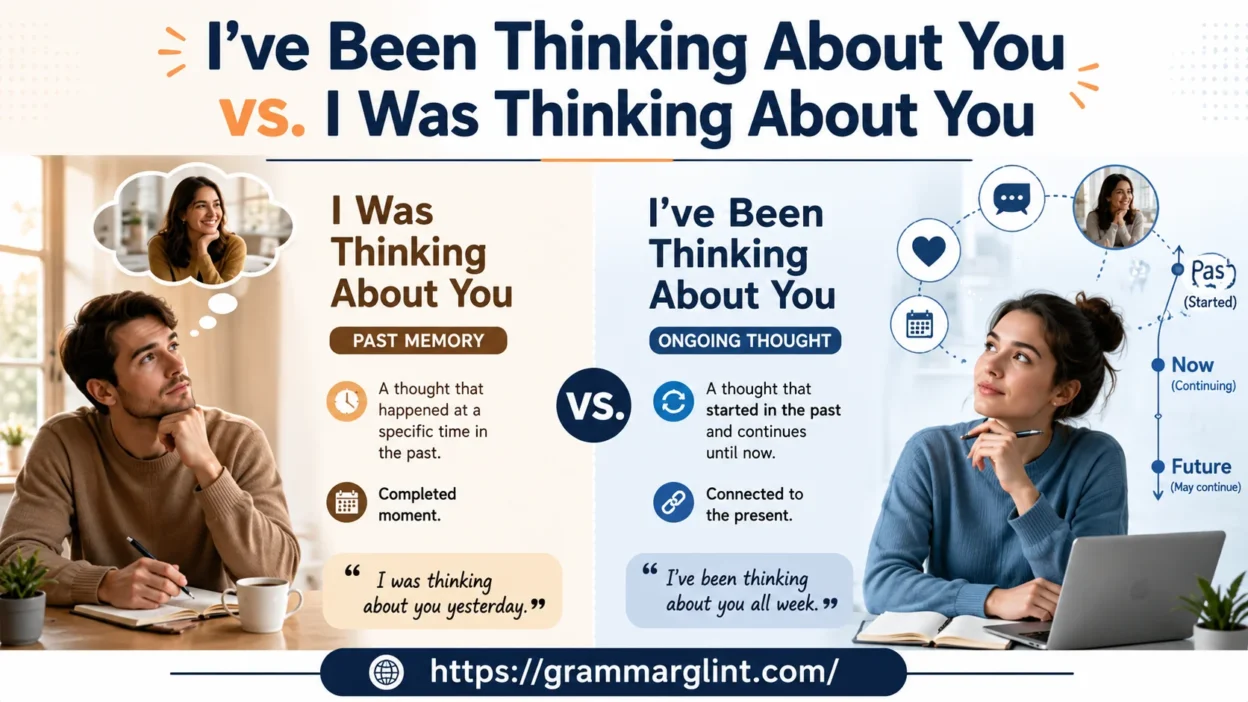
I Was Thinking About You uses the simple past verb tense, which means the point of thinking happened in the past. It usually refers to a completed moment when the person had that thought. For example, the speaker may be talking about a specific time when they remembered someone or considered something about them.
On the other hand, I’ve Been Thinking About You uses the present perfect continuous tense, showing that the thought started earlier and continued until now. This form creates a stronger connection between the past and present because it suggests an ongoing feeling or repeated action.
I Was Thinking About You: Meaning and Grammar Explained
The phrase “I was thinking about you” uses the past continuous tense.
The past continuous describes an action that was happening at a specific time in the past. The action may have continued for a short period but does not necessarily continue now.
The structure is:
Subject + was/were + verb (-ing)
Examples:
- I was thinking about you.
- She was thinking about her family.
- They were thinking about the problem.
The important part is the word “was.”
It places the action inside a finished past time.
What Does “I Was Thinking About You” Mean?
When someone says:
“I was thinking about you.”
They usually mean:
“At some point in the past, you came into my thoughts.”
The thought happened before now.
For example:
“I was thinking about you yesterday.”
The speaker tells you when the thought happened. Yesterday is complete. The thinking happened then.
Another example:
“I was thinking about you when I saw your old photo.”
The thought occurred during a specific past moment.
The phrase does not automatically mean the person is still thinking about you now.
Examples of “I Was Thinking About You” in Everyday Conversations
Example: Remembering Someone
A: I found our old messages today
B: I was thinking about you when I saw them.
Meaning:
The memory happened at that moment. The speaker describes a past reaction.
Example: Explaining Why You Contacted Someone
“I was thinking about you, so I decided to call.”
Here, the thought came first. Then the person called.
The phrase explains the reason behind an action.
Example: Talking About a Past Event
“I was thinking about you during the movie because one character reminded me of you.”
The thought happened during a specific event.
Emotional Feeling of “I Was Thinking About You”
Although the phrase is grammatically focused on the past, it can still feel warm and meaningful.
It often sounds:
- Friendly
- Casual
- Sweet
- Spontaneous
It can suggest a simple moment of remembering someone.
For example:
“I was thinking about you when I heard that song.”
This feels like a natural memory.
It does not necessarily suggest deep or ongoing feelings.
I’ve Been Thinking About You: Meaning and Grammar Explained
The phrase “I’ve been thinking about you” uses the present perfect continuous tense.
This tense connects the past with the present.
The structure is:
Subject + have/has been + verb (-ing)
Examples:
- I’ve been thinking about you.
- She’s been thinking about moving.
- They’ve been thinking about the future.
The key phrase is:
“have been.”
It shows that the action started earlier and continues until now or has a strong connection to now.
What Does “I’ve Been Thinking About You” Mean?
When someone says:
“I’ve been thinking about you.”
They usually mean:
“You have been in my thoughts for a period of time.”
The thought did not happen only once.
It continued.
For example:
“I’ve been thinking about you all week.”
This means the person thought about you repeatedly during the week.
Another example:
“I’ve been thinking about what you said.”
The person is still considering your words.
Read More: Of Great Help or A Great Help: Which Is Correct?
Examples of “I’ve Been Thinking About You” in Real Life
Example: Missing Someone
“I’ve been thinking about you lately.”
This suggests:
- The person has crossed your mind often.
- The feeling has continued.
- You may want to reconnect.
Example: Processing a Conversation
“I’ve been thinking about our conversation.”
This means the conversation stayed with you.
You have continued reflecting on it.
Example: Showing Care
“I’ve been thinking about you and wanted to check in.”
This sounds thoughtful.
It suggests that the person mattered enough to remain in your thoughts.
The Main Difference
The biggest difference is the relationship between past time and present time.
| Phrase | Grammar Tense | Time Focus | Main Meaning |
| I was thinking about you | Past continuous | Past moment | A thought happened before now |
| I’ve been thinking about you | Present perfect continuous | Past + present | Thoughts continued until now |
A simple way to remember:
“I was thinking” = a snapshot.
“I’ve been thinking” = a timeline.
Imagine your thoughts as a movie.
“I was thinking about you” shows one scene.
“I’ve been thinking about you” shows the whole story.
Time Words That Change the Meaning
Time expressions help determine which phrase sounds natural.
Using “I Was Thinking About You”
This phrase works well with finished past time.
Common examples:
- Yesterday
- Last night
- Earlier
- When I saw…
- At that moment
Examples:
“I was thinking about you yesterday.”
“I was thinking about you earlier.”
“I was thinking about you when your name appeared.”
These examples point to a completed time.
Using “I’ve Been Thinking About You”
This phrase works well with ongoing time periods.
Common examples:
- Recently
- Lately
- All day
- For a while
- Since…
Examples:
“I’ve been thinking about you lately.”
“I’ve been thinking about you for a few days.”
“I’ve been thinking about you since our last conversation.”
These phrases show continuation.
The Emotional Difference Between the Two Phrases
Grammar affects more than correctness. It affects tone.
The phrase you choose can change how your message feels.
“I Was Thinking About You” Feels Like a Memory
Example:
“I was thinking about you when I walked past your favorite café.”
This sounds like a moment of remembrance.
The person came to mind because something triggered the thought.
“I’ve Been Thinking About You” Feels Like Ongoing Attention
Example:
“I’ve been thinking about you since we talked.”
This feels more personal.
It suggests that the conversation or person has stayed important.
Using These Phrases in Friendships
Both phrases work naturally with friends.
The choice depends on the situation.
A Casual Check-In
“I was thinking about you yesterday.”
This feels relaxed.
You remembered your friend and wanted to reach out.
A Deeper Connection
“I’ve been thinking about you lately.”
This sounds more intentional.
It suggests your friend has been on your mind for some time.
Using These Phrases in Romantic Situations
These phrases often appear in romantic conversations because they express attention.
However, they create different impressions.
“I Was Thinking About You” in Romance
This can sound sweet and natural.
Example:
“I was thinking about you when I heard that song.”
It creates a connection between a memory and a person.
“I’ve Been Thinking About You” in Romance
This often feels stronger.
Example:
“I’ve been thinking about you a lot.”
This suggests:
- Continued interest
- Emotional focus
- Missing someone
The phrase carries more emotional weight because the thought has lasted.
Common Mistakes
Understanding the rules helps you avoid awkward sentences.
Mistake: Using “Was Thinking” With Long Periods
Incorrect:
“I was thinking about you for three months.”
This sounds unusual because “three months” connects the thought to the present.
Better:
“I’ve been thinking about you for three months.”
The present perfect continuous fits the ongoing period.
Mistake: Using “I’ve Been Thinking” With Finished Time
Incorrect:
“I’ve been thinking about you yesterday.”
Better:
“I was thinking about you yesterday.”
Why?
Because yesterday is finished.
The present perfect continuous usually does not work with completed past time.
Mistake: Assuming One Phrase Is Always More Romantic
Many people think:
“I’ve been thinking about you” always means deeper feelings.
Not necessarily.
Context matters.
A friend might say:
“I’ve been thinking about you. How are you doing?”
A romantic partner might say:
“I’ve been thinking about you all night.”
The situation changes the meaning.
Related Expressions and Their Meanings
English has several similar phrases.
| Expression | Meaning |
| I thought about you | A completed thought |
| I was thinking about you | A past moment of thinking |
| I’ve been thinking about you | A continuing thought |
| You’ve been on my mind | Strong focus on someone |
| I missed you | Feeling someone’s absence |
Each phrase carries a slightly different feeling.
Quick Guide: Which Phrase Should You Choose?
Use “I was thinking about you” when:
- You mean one specific moment.
- You are describing a past event.
- The thought already ended.
Examples:
“I was thinking about you during my walk.”
“I was thinking about you yesterday.”
Use “I’ve been thinking about you” when:
- The thought has continued.
- You mean recently.
- You want to show ongoing attention.
Examples:
“I’ve been thinking about you lately.”
“I’ve been thinking about what you said.”
Real Conversation Examples
Conversation One: Friends
Emma: I saw your favorite coffee shop today.
Jake: I was thinking about you when I passed there last week.
Meaning:
A specific memory.
Conversation Two: Reconnecting
Emma: It’s been a while. How have you been?
Jake: I’ve been thinking about you lately.
Meaning:
The person has stayed in Jake’s thoughts.
Conversation Three: After a Serious Talk
Emma: Did you think about what we discussed?
Jake: Yes, I’ve been thinking about it.
Meaning:
Jake is still processing the conversation.
My Personal Experience as an English Language Specialist
From my experience as an English language specialist, I have found that learners often understand grammar rules more easily when they see how native speakers use them in everyday conversations rather than simply memorizing definitions. One of the most common challenges I notice is that students recognize the grammar but struggle to understand the subtle difference in meaning that context creates. That is why I always explain language through real-life examples, showing not only what is grammatically correct but also why one expression sounds more natural than another. This practical approach helps learners build confidence and use English more accurately in both speaking and writing.
FAQs
1. What is the difference between I’ve Been Thinking About You and I Was Thinking About You?
I Was Thinking About You refers to a thought that happened at a specific time in the past, while I’ve Been Thinking About You suggests the thought started in the past and may continue until now.
2. Is I Was Thinking About You grammatically correct?
Yes, I Was Thinking About You is correct. It uses the past continuous tense to describe an action or thought that was happening at a certain moment in the past.
3. When should I use I’ve Been Thinking About You?
Use I’ve Been Thinking About You when you want to show an ongoing thought, feeling, or connection that began earlier and is still relevant in the present.
4. Does I Was Thinking About You mean the thought stopped?
Not always. It usually focuses on a past moment, but it does not always mean the feeling completely ended.
5. Is I’ve Been Thinking About You more emotional?
It can sound more personal because it connects the past with the present and often suggests continued attention or care.
6. What tense is used in I’ve Been Thinking About You?
It uses the present perfect continuous tense, which describes an action or feeling that started in the past and continues or has a connection to now.
7. What tense is used in I Was Thinking About You?
It uses the past continuous tense, which describes something happening at a particular time in the past.
8. Can both phrases be used in the same situation?
Sometimes yes, but the meaning changes. The choice depends on whether the speaker wants to highlight a past moment or an ongoing thought.
9. Which phrase sounds more natural in conversation?
Both are natural. I’ve Been Thinking About You often sounds like a current feeling, while I Was Thinking About You sounds connected to a previous moment.
10. Why do learners confuse these two phrases?
Many learners confuse them because both phrases describe thinking about a person, but the difference comes from time, context, and the type of verb tense used.
Conclusion
Choosing between I’ve Been Thinking About You and I Was Thinking About You is not just about grammar, it is about expressing the right meaning. The first phrase highlights an ongoing thought or feeling that continues into the present, while the second points to a specific moment in the past. Once you understand how each tense shapes the message, selecting the correct expression becomes much easier.
As you continue learning English, pay attention to the time and context behind what you want to say. With regular practice, you’ll naturally recognize when to use each phrase, making your conversations and writing sound more accurate, confident, and natural.

Aria Jane is a senior language writer and grammar specialist at Grammar Glint. She focuses on English grammar, spelling variations, vocabulary, and writing clarity. Through detailed research and practical examples, Aria helps readers understand language rules and avoid common mistakes. Her articles are designed to make English learning accessible for students, professionals, and everyday writers seeking reliable language guidance.