Learning the difference between wish and wishes becomes easier when we look at how each word works in a sentence. In my experience, many learners mix these forms because the meaning changes with the subject, pronoun, and person. The phrase Wish or Wishes Which Is Correct? helps explain why the correct use depends on context, structure, and rules of English grammar.
The word wish can work as a verb or a noun, and the same idea applies in different ways. There is a variety of examples where this expression appears in everyday conversations and formal sentences. When we study the usage of these words, we learn that each form has a specific role.
As a noun, wish is the singular form, while wishes is the plural form. This simple explanation might help you know when you can use each option correctly. Paying attention to the subject, pronoun, and person creates stronger sentences and helps you follow proper grammar rules with confidence. These examples show how small changes in word forms can affect the overall structure and clarity of English.
Which Is Correct in English Grammar?
Let’s begin with the basic idea.
The difference between wish and wishes depends on:
- The subject of the sentence
- The tense being used
- Whether the word is acting as a verb or noun
Think of it as a grammar pattern. The subject controls which form you need.
Basic Difference Between Wish and Wishes
Before going deeper, you need a strong foundation.
Wish (Base Form of Verb)
We use wish when the subject is:
- I
- You
- We
- They
It is commonly used to express:
- Unreal situations
- Desires
- Regrets
- Things that are different from reality
Examples:
I wish I had more confidence.
We wish we could visit that place.
They wish they knew the answer.
The important point is that wish often talks about something that is not true or not happening.
Wishes (Third Person Singular or Noun Form)
We use wishes mainly in two situations.
1. With He, She, It
When the subject is third-person singular, the verb changes.
Examples:
She wishes she had more time.
He wishes he could sing better.
It wishes things were easier.
The extra -es appears because English verbs change with he, she, and it.
2. Wishes as a Noun
“Wishes” can also be a noun used for greetings and good thoughts.
Examples:
Best wishes for your success.
Birthday wishes from everyone.
Sending warm wishes to you.
Here, wishes does not describe an action. It describes kind thoughts or messages.
Grammar Rules Explained
Now let’s look deeper into how these words work in different situations.
Wish for Present Situations
When you want something to be different in the present, use:
wish + past simple
Even though you are talking about now, English uses the past form to show that the situation is unreal.
Examples:
I wish I knew the truth.
She wishes she lived closer.
We wish we had more opportunities.
The meaning is:
“This is not my current reality, but I want it to be different.”
Read More: Neither Nor Comma Rules Explained (With Examples)
Wish for Past Regrets
When talking about something that already happened, use:
wish + past perfect
This shows regret about the past.
Examples:
I wish I had worked harder.
She wishes she had accepted the offer.
They wish they had arrived earlier.
You cannot change the past, so “wish” expresses a different imagined result.
Wish for Future Changes
Sometimes wish is used for future situations.
The structure is:
wish + would + verb
Examples:
I wish you would listen carefully.
He wishes the weather would improve.
They wish the problem would disappear.
This usually shows a desire for something to change.
Wishes in Daily Communication
The word wishes appears frequently in everyday communication.
It is common in:
- Messages
- Cards
- Emails
- Celebrations
- Formal writing
Examples:
Best wishes on your new journey.
My wishes are with you.
Warm wishes for your family.
This usage makes “wishes” an important word beyond grammar rules.
Common Mistakes
Let’s look at common errors learners make.
Mistake 1: Wrong Subject Agreement
❌ I wishes I was there.
❌ She wish she had money.
Correct:
✔ I wish I was there.
✔ She wishes she had money.
The subject decides whether you add -es.
Mistake 2: Using the Wrong Tense
❌ I wish I have more time.
❌ He wishes he knows the answer.
Correct:
✔ I wish I had more time.
✔ He wishes he knew the answer.
Wish usually connects with a past form when talking about unreal situations.
Mistake 3: Confusing Wish as a Noun
❌ Best wish for your future.
Correct:
✔ Best wishes for your future.
When giving greetings, the plural form is normally used.
Quick Comparison Table
| Form | Usage | Example |
| Wish | I/You/We/They | I wish I were taller |
| Wishes | He/She/It | She wishes she was taller |
| Wishes | Noun (greeting) | Best wishes |
Wish vs Hope: Important Difference
Many learners confuse wish and hope, but they are different.
Wish = something unreal or unlikely
Example:
I wish I could fly.
Hope = something possible or expected
Example:
I hope I pass my test.
Simple trick:
Wish = imagination or regret
Hope = possibility
Real-Life Examples
Let’s make this practical.
Student Situation
I wish I had studied earlier.
She wishes she had more time.
Workplace Situation
We wish the meeting would end soon.
He wishes his manager understood.
Social Messages
Best wishes for your birthday.
Sending you wishes for success.
These examples show how often this grammar appears in real conversations.
Simple Rule to Remember Forever
Here is an easy shortcut:
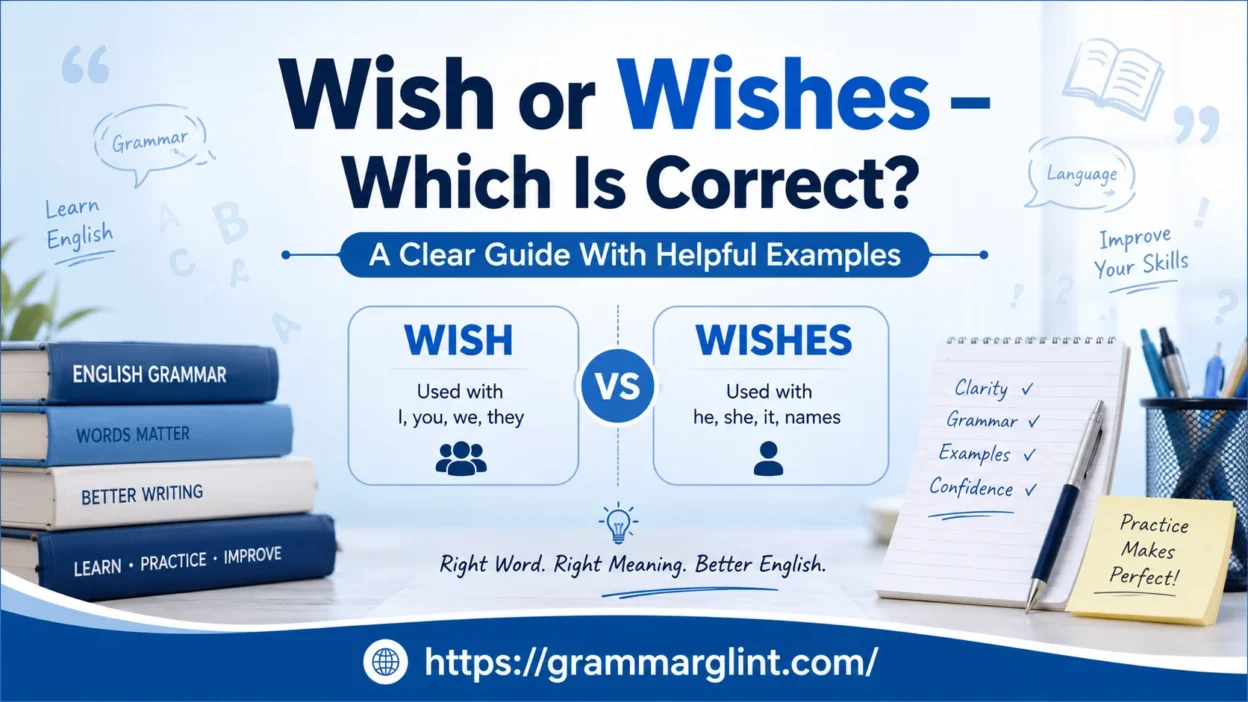
Use wish with:
- I
- You
- We
- They
Use wishes with:
- He
- She
- It
Use wishes for greetings and blessings.
Once you understand this pattern, you will stop mixing them.
My Personal Experience as an English Language Specialist
As an English language specialist, I have noticed that wish and wishes are among the most commonly confused words for English learners. Many students know the basic grammar rules, yet they hesitate when writing emails, greeting cards, or everyday messages because they are unsure which form sounds natural. In my teaching experience, the confusion usually disappears once learners focus on the subject of the sentence instead of trying to memorize isolated rules. I always encourage students to read authentic English examples, practice writing short sentences, and pay attention to how native speakers use these expressions. Over time, this simple habit builds confidence and makes choosing between wish and wishes feel automatic. Grammar becomes much easier when it is learned through meaningful context rather than memorization alone.
FAQs
1. What is the main difference between wish and wishes?
Wish is used for I, we, you, they, while wishes is used for he, she, and it in the present tense.
2. Is wish a verb or a noun?
Wish can be both a verb and a noun, depending on how it is used in a sentence.
3. When do we use wishes in English grammar?
We use wishes with third-person singular subjects like he, she, or it in verb form, or as a plural noun.
4. Can we say “I wishes”?
No, “I wishes” is incorrect. The correct form is I wish.
5. What is the plural form of wish?
The plural noun form of wish is wishes.
6. Is “we wish you” correct?
Yes, we wish you is correct because first-person plural uses the verb wish.
7. Why do learners confuse wish and wishes?
Learners confuse them because the form changes based on subject, person, and tense.
8. Can wishes be used in past tense?
Yes, but in past tense we usually use “wished” instead of wishes.
9. Is wish used in formal writing?
Yes, wish is commonly used in both formal and informal writing.
10. How can I remember when to use wish or wishes?
Remember: wish = I/we/you/they, and wishes = he/she/it.
Conclusion
Choosing between wish and wishes is simple once you understand how each form fits into a sentence. The key is to identify whether the word is being used as a verb or a noun and to check the subject. Use wish with I, you, we, and they, and use wishes with he, she, and it. As a noun, wish refers to one desire, while wishes refers to more than one.
The more you read, write, and practice these forms in real-life situations, the more natural they become. Instead of memorizing rules, focus on how native speakers use them in everyday conversations, emails, greeting cards, and professional writing. With consistent practice, you’ll choose the correct form confidently and communicate more clearly in every situation.

Aria Jane is a senior language writer and grammar specialist at Grammar Glint. She focuses on English grammar, spelling variations, vocabulary, and writing clarity. Through detailed research and practical examples, Aria helps readers understand language rules and avoid common mistakes. Her articles are designed to make English learning accessible for students, professionals, and everyday writers seeking reliable language guidance.