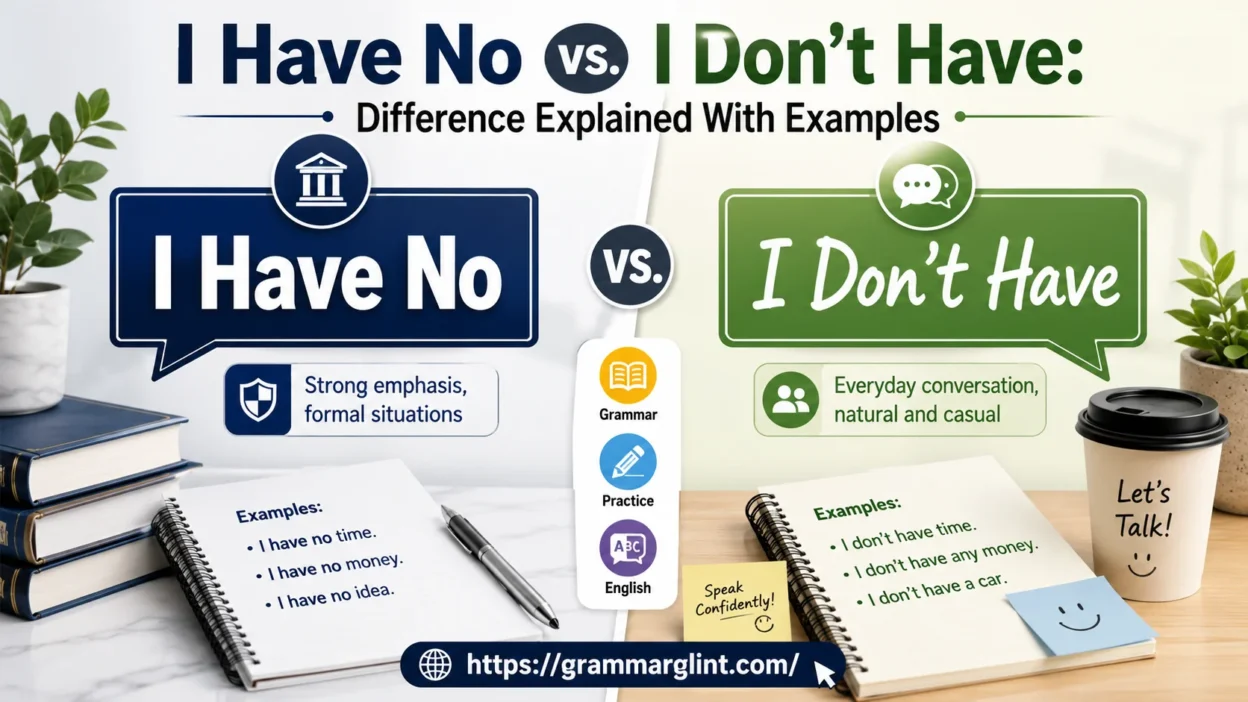
I Have No vs. I Don’t Have Difference shows how English expresses absence in different ways, where usage often shifts the tone between formal stronger and casual lighter use. In real learning practice, English can be a bit of puzzle especially when it comes to expressing absence or lack something, and this is where learners usually pause and rethink structure.
I have no and don’t mean same thing right Well not exactly These phrases are close cousins but they’re used in different contexts convey slightly shades meaning. There are many language interchangeable patterns, and at the same time interchangeably when they aren’t supposed, which creates confusion in real speaking situations. This is why learners often hesitate while choosing the correct form in daily conversation.
In the end, both forms still express absence or lack something, but the real difference is in tone and impact. One feels more formal stronger, while the other stays casual lighter use, helping speakers adjust their English depending on situation and audience.
The Main Difference Explained
The simplest way to understand the difference is this:
| Phrase | Main Meaning | Common Use |
| I have no + noun | I have zero of something | Strong emphasis, formal situations |
| I don’t have + noun | Something is unavailable or missing | Everyday conversation |
Both expressions can replace each other in many situations, but they do not always create the same impression.
Consider these examples:
I have no time.
This sounds like the speaker has absolutely zero time available. It creates a stronger feeling.
I don’t have time.
This sounds more natural in daily conversation. It simply explains the situation.
Imagine someone asking:
“Can you help me move this weekend?”
You might naturally answer:
“Sorry, I don’t have time.”
You probably would not say:
“Sorry, I have no time.”
The second sentence is correct but sounds more dramatic.
What Does “I Have No” Mean?
Understanding “I Have No” in English
The phrase “I have no” means “I do not have any.”
The word “no” works as a determiner. It comes before a noun and shows complete absence.
The structure is:
Subject + have/has + no + noun
Examples:
- I have no questions.
- She has no experience.
- They have no money.
- We have no choice.
Each sentence means the same thing as:
- I don’t have any questions.
- She doesn’t have any experience.
- They don’t have any money.
- We don’t have any choice.
However, “no” gives the sentence more force.
Examples of “I Have No” in Real Situations
At Work
Someone asks:
“Do you need more information?”
You answer:
“No, I have no questions.”
This sounds professional and complete.
A coworker might also say:
“I have no concerns about this project.”
The speaker is emphasizing that there are zero concerns.
In Daily Life
A person says:
“Why didn’t you buy anything?”
You reply:
“I have no money with me.”
This highlights that your wallet is empty or you have nothing available.
In Writing
“I have no doubt” is a very common expression.
Examples:
- I have no doubt that she will succeed.
- I have no reason to complain.
- I have no interest in that topic.
These phrases appear frequently in articles, emails, books, and formal communication.
What Does “I Don’t Have” Mean?
Understanding “I Don’t Have” in English
The phrase “I don’t have” is the negative form of “I have.”
English uses the helping verb do to create negative sentences in the simple present tense.
The structure is:
Subject + do/does + not + have + noun
Examples:
- I don’t have a car.
- You don’t have enough time.
- He doesn’t have a ticket.
- They don’t have permission.
This form is extremely common because it sounds natural and conversational.
Why Do We Use “Do” in Negative Sentences?
Many English learners ask why we say:
✅ I don’t have a phone.
instead of:
❌ I have not a phone.
The reason is that English uses auxiliary verbs for simple present negatives.
Examples:
Positive:
I have a phone.
Negative:
I don’t have a phone.
The word “do” carries the negative form:
- do + not = don’t
For third-person singular subjects:
- He doesn’t have
- She doesn’t have
- It doesn’t have
Grammar Rules
The grammar difference is small but important.
“I Have No” Structure
Formula:
Subject + have/has + no + noun
Examples:
- I have no idea.
- She has no patience.
- He has no experience.
The noun comes directly after “no.”
You do not add “a” or “any” after “no.”
Incorrect:
❌ I have no a car.
Correct:
✅ I have no car.
“I Don’t Have” Structure
Formula:
Subject + don’t/doesn’t + have + noun
Examples:
- I don’t have a car.
- She doesn’t have patience.
- He doesn’t have experience.
You can also use “any”:
- I don’t have any money.
- I don’t have any questions.
- I don’t have any ideas.
Examples
Example: Money
Both sentences work:
I have no money.
Meaning:
- I have zero money.
- Strong emphasis.
I don’t have any money.
Meaning:
- I currently do not have money.
In normal conversation, most people choose the second option.
Example: Time
Compare:
I have no time.
This can sound urgent.
Example:
“The deadline is tomorrow and I have no time left.”
It emphasizes pressure.
I don’t have time.
This sounds casual:
“Sorry, I don’t have time today.”
Both are correct.
Example: Experience
Professional situations often use both.
Example:
Job interview:
“I don’t have experience with this software.”
This sounds natural.
A formal statement:
“I have no experience with this software.”
This sounds more official.
Read More: Any Problem or Any Problems : Which Is Correct?
The Difference Between “No” and “Not Any”
A major reason learners confuse these phrases is because “no” and “not any” often have the same meaning.
Compare:
- I have no books.
- I don’t have any books.
Both mean:
I have zero books.
The difference is style.
No is shorter and stronger.
Not any is more conversational.
Avoid Double Negatives
A common mistake is using both negative forms together.
Incorrect:
❌ I don’t have no money.
This creates a double negative.
Correct:
✅ I don’t have any money.
or:
✅ I have no money.
Remember:
- Use no by itself.
- Use don’t + any together.
Formal vs. Informal English: Which One Should You Choose?
Choosing between “I have no” and “I don’t have” depends on your audience.
Use “I Have No” When:
- You want stronger emphasis.
- You are writing formally.
- You want to sound more serious.
Examples:
- I have no further questions.
- I have no explanation for this.
- I have no knowledge of that matter.
Use “I Don’t Have” When:
- Talking with friends.
- Having normal conversations.
- Explaining everyday situations.
Examples:
- I don’t have my keys.
- I don’t have enough cash.
- I don’t have time right now.
Common Mistakes
Even advanced learners slip up here. The mistake usually comes from translating directly from another language or mixing grammar rules that don’t belong together.
Let’s break down the most common errors so you can avoid them completely.
Using “Have Not” in the Wrong Way
Many learners try to form negatives like this:
❌ I have not money.
❌ She has not car.
This sounds incorrect because English doesn’t build simple present negatives this way.
Instead, English requires an auxiliary verb:
✅ I don’t have money.
✅ She doesn’t have a car.
✅ I have no money.
A quick rule to remember:
If you’re talking about habits or general facts, use don’t have or have no, not “have not.”
Double Negatives That Break the Sentence
This is one of the biggest problems learners face.
❌ I don’t have no idea.
❌ I don’t have no money.
In English, two negatives cancel each other out or create confusion.
Correct forms:
✅ I have no idea.
✅ I don’t have any idea.
✅ I don’t have any money.
Think of it like math:
- “don’t” = negative
- “no” = negative
- two negatives = confusion or wrong meaning
Forgetting “Any” in Negative Sentences
This one is subtle but very common.
❌ I don’t have books.
❌ I don’t have money.
While native speakers might understand you, it sounds incomplete.
Correct forms:
✅ I don’t have any books.
✅ I don’t have any money.
However, you can drop “any” when using “no”:
✅ I have no books.
✅ I have no money.
Real-Life Conversation Examples
Grammar becomes useful only when you see it in real situations. Let’s look at how people actually use these expressions.
At a Café or Restaurant
Situation: The waiter asks if you need anything else.
- “Do you want dessert?”
You respond:
- “No, I don’t have any room left.”
or more emphatic:
- “No, I have no space left.”
The second version sounds stronger and slightly more dramatic.
At Work or Office
Manager: “Do you have any updates?”
You reply:
- “I don’t have any updates yet.”
or in a more formal report:
- “I have no updates at this time.”
Both are correct, but tone changes the impression.
With Friends
Friend: “Are you coming tonight?”
You answer:
- “Sorry, I don’t have time.”
or stronger:
- “I have no time at all.”
The first feels natural. The second feels like you’re really busy or even stressed.
During Exams or Interviews
Interviewer: “Do you have experience in data analysis?”
You reply:
- “I don’t have experience in that field.”
or more formal:
- “I have no experience in that field.”
Both are acceptable, but the second feels more structured and polished.
Quick Comparison Table: Tone and Usage
| Situation | “I Have No” | “I Don’t Have” |
| Casual speech | Sounds slightly strong | Sounds natural |
| Formal writing | Very appropriate | Also acceptable |
| Emotional emphasis | Strong and direct | Mild and neutral |
| Job interviews | Professional tone | Safe and natural |
| Everyday conversation | Less common | Very common |
Why Native Speakers Prefer “I Don’t Have”
Here’s something interesting.
Native speakers often choose “I don’t have” in spoken English because it feels smoother and less absolute.
Think about everyday speech:
- I don’t have time.
- I don’t have money.
- I don’t have a clue.
It flows easily in conversation.
On the other hand, “I have no” often appears in:
- Written English
- Formal statements
- Strong emotional expressions
Example:
“I have no doubt that this will succeed.”
This sounds confident and polished.
The Emotional Difference Between the Two Phrases
This part is often ignored, but it matters a lot.
Let’s compare emotional tone:
“I have no…”
This feels:
- Strong
- Final
- Sometimes dramatic
- More absolute
Example:
“I have no patience for this.”
It sounds like frustration or firmness.
“I don’t have…”
This feels:
- Neutral
- Natural
- Flexible
- Conversational
Example:
“I don’t have patience today.”
It simply describes a situation.
Case Study: Same Meaning, Different Tone
Let’s imagine two people responding to the same question.
Question: “Can you help me today?”
Person A:
“I have no time today.”
- Sounds strict
- May feel a bit harsh
- Implies full unavailability
Person B:
“I don’t have time today.”
- Sounds polite
- Feels conversational
- Still communicates the same meaning
👉 Result: Person B sounds easier to approach.
This small difference can shape how people perceive your tone.
Useful Expressions You Can Use Right Away
Instead of only learning rules, here are real phrases you can use immediately.
With “I have no”
- I have no idea.
- I have no problem with that.
- I have no interest in it.
- I have no choice.
- I have no doubts.
With “I don’t have”
- I don’t have time right now.
- I don’t have enough money.
- I don’t have any plans.
- I don’t have experience in this.
- I don’t have access to it.
Mini Practice Section
Try choosing the correct form.
- I ___ any information about this.
- I ___ no idea what happened.
- She ___ enough time today.
- We ___ any questions left.
Answers:
- don’t have
- have
- doesn’t have / has no
- don’t have
My Personal Experience as an English Language Specialist
As an English language specialist, I’ve noticed that one of the most common challenges learners face isn’t understanding grammar rulesit’s knowing which expression sounds the most natural in real conversations. Over the years, I’ve seen many students use “I have no” and “I don’t have” interchangeably without realizing that each carries a slightly different tone. While both are grammatically correct, choosing the right one can make your English sound either more formal or more conversational.
From my experience teaching and writing about English grammar, I’ve found that the best way to master these expressions is through real-life examples instead of memorizing rules. Native speakers usually prefer “I don’t have” in everyday speech because it feels relaxed and natural, while “I have no” appears more often in formal writing or when stronger emphasis is needed. Once learners understand this subtle difference, they become more confident in speaking and writing, and their English begins to sound much more fluent and authentic.
FAQs
1. What is the main difference between “I have no” and “I don’t have”?
“I have no” sounds more formal and stronger, while “I don’t have” is more casual and commonly used in spoken English.
2. Are both “I have no” and “I don’t have” grammatically correct?
Yes, both expressions are grammatically correct and widely used in English.
3. When should I use “I have no”?
Use “I have no” when you want to emphasize a stronger or more formal sense of absence.
4. When is “I don’t have” more suitable?
“I don’t have” is best for everyday conversation and informal communication.
5. Do both phrases mean the same thing?
Yes, both express lack or absence of something, but the tone is different.
6. Which one is more common in spoken English?
“I don’t have” is more common in spoken and casual English.
7. Does “I have no” sound more emotional or strong?
Yes, it often gives a stronger and more direct impact.
8. Can I use both in writing?
Yes, but “I have no” is preferred in formal writing, while “I don’t have” fits informal writing.
9. Why do learners get confused between these phrases?
Because both express absence, but their tone and usage context are different.
10. How can I choose the correct phrase easily?
Think about tone use “I have no” for emphasis and “I don’t have” for natural, everyday speech.
Conclusion
Choosing between “I have no” and “I don’t have” isn’t about right or wrong—it’s about using the expression that best matches the situation. “I have no” adds stronger emphasis and often sounds more formal, while “I don’t have” is the phrase you’ll hear most often in everyday conversations. Knowing this difference helps you communicate more naturally and confidently.
As you continue learning English, pay attention to how native speakers use these expressions in different contexts. With a little practice, selecting the right form will become automatic, making both your spoken and written English clearer, more fluent, and more effective.

Aria Jane is a senior language writer and grammar specialist at Grammar Glint. She focuses on English grammar, spelling variations, vocabulary, and writing clarity. Through detailed research and practical examples, Aria helps readers understand language rules and avoid common mistakes. Her articles are designed to make English learning accessible for students, professionals, and everyday writers seeking reliable language guidance.