When learners of English try to understand the difference between Question About vs Question On vs Question Regarding, they often face confusing challenges while learning the right preposition. These prepositions may look simple, but their usage and meaning can change depending on the context. The choice between these expressions can influence communication and clarity in both written and spoken English. Many native speakers use these phrases naturally without thinking deeply about the structure, but language learners and experienced writers often need to notice the subtle nuances behind each phrase.
This Complete Guide explains the core grammar logic behind each question form and helps you choose the best option by looking at sentence structure, tone, and intention. A Question On is commonly used when referring to a field of study or a specific topic, while a Question About or Question Regarding is often more directly connected to the subject matter, actual subject matter, or a wider connection with the topic. The difference is not only about grammar but also about how the speaker wants to present the idea.
Ultimately, deciding between these phrases is not always about being completely right or wrong; it is a matter of context. The best choice depends on the subject, the relationship between ideas, and the way you want your question to be understood. With practice, learners can recognize these differences and use English language expressions with greater confidence, precision, and clarity.
Why These Small Words Matter More Than You Think
Prepositions may look like small words, but they carry tone, context, and intention. That’s where most learners slip up.
When you say:
- I have a question about your schedule
it feels friendly and natural.
But if you switch it to:
- I have a question regarding your schedule
it suddenly feels formal, like a corporate email.
Same meaning. Different personality.
That’s the real key here. These phrases don’t change what you’re asking. They change how it sounds to the listener.
And in communication, tone often matters as much as grammar.
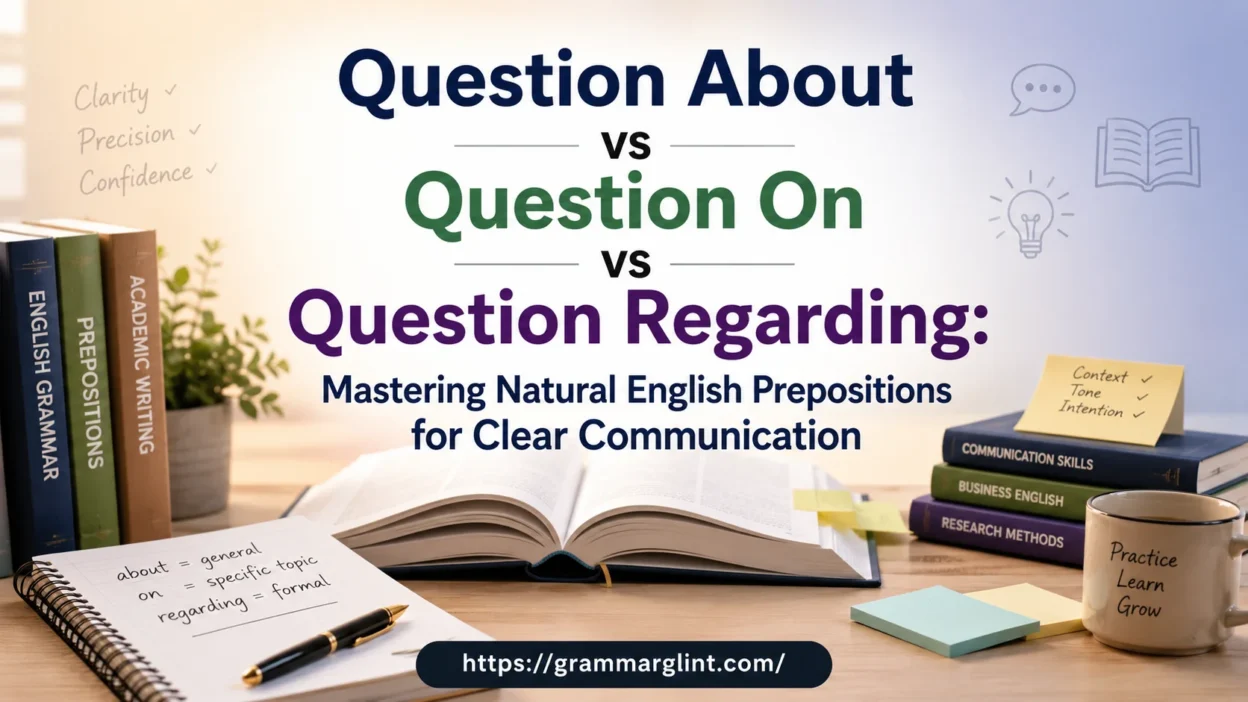
Quick Mental Map
Before going deeper, here’s a simple way to organize your thinking:
- Question about → everyday English, flexible, natural
- Question on → focused, academic, topic-specific
- Question regarding → formal, official, business-style
Think of it like clothing:
- “About” is casual wear
- “On” is smart casual
- “Regarding” is formal suit and tie
You wouldn’t wear the same outfit everywhere. English works the same way.
Deep Dive into “Question About”
Why “Question About” Feels the Most Natural
“Question about” is the phrase native speakers use most often in daily life. It works in almost any situation because it expresses a simple relationship between your question and the topic.
It doesn’t try too hard. It just connects ideas clearly.
That’s why it dominates spoken English, emails, and casual writing.
How “Question About” Actually Works in Meaning
The preposition “about” creates a broad connection. It doesn’t limit or narrow the topic.
So when you say:
- I have a question about the assignment
you’re simply pointing toward the assignment as the subject.
No technical framing. No formality. Just clarity.
Real-Life Examples
Here’s how it shows up naturally:
- I have a question about your pricing.
- She asked a question about the meeting time.
- We got a question about shipping delays.
- Do you have any questions about this policy?
- I called support with a question about my account.
You’ll notice something important here: it works in both spoken and written English without sounding strange.
When You Should Always Choose “Question About”
Use it when:
- Talking to friends or colleagues
- Writing emails that are not strictly formal
- Speaking with customer support
- You’re unsure which phrase fits
If you’re ever stuck, this is your safest choice.
Read More: Any Problem or Any Problems : Which Is Correct?
Why ESL Learners Prefer It (And Should Keep Using It)
English learners often overthink prepositions. “About” solves that problem because it doesn’t require precision.
It behaves like a universal connector. That’s why teachers often recommend it as the default.
Understanding “Question On”
What “Question On” Really Means
“Question on” feels more structured. It shows up when the topic is specific, narrow, or technical.
Instead of a broad subject, it zooms in on a defined area.
For example:
- A question on calculus derivatives
- A question on cybersecurity protocols
This is not casual conversation territory anymore.
How “Question On” Changes the Focus
Compare these two:
- Question about math homework (general)
- Question on quadratic equations (specific topic)
The second version feels more precise. You’re not talking about math in general. You’re targeting one concept inside it.
That’s the shift “on” creates.
Examples in Real Usage
- The professor answered a question on quantum theory.
- I have a question on your research method.
- She asked a question on financial forecasting.
- The exam included a question on grammar rules.
It often appears in academic or technical environments where precision matters.
Where You Should Avoid “Question On”
Don’t use it in casual conversations.
For example:
- ❌ I have a question on your lunch plans
- ✔ I have a question about your lunch plans
The first one feels unnatural because lunch plans aren’t a structured topic.
The Subtle Rule Behind “On”
Here’s the simple logic:
- “On” = focused subject inside a bigger system
Think of it like zooming into a map. You’re not looking at the country anymore. You’re looking at a specific street.
Breaking Down “Question Regarding”
What “Question Regarding” Really Means
“Regarding” is more formal than both “about” and “on.” It signals professionalism and distance.
It often appears in business communication, legal writing, or official documents.
It doesn’t feel conversational. It feels structured and polished.
How “Regarding” Shapes Tone
When you say:
- I have a question regarding your invoice
it immediately sounds like a business interaction.
Now compare:
- I have a question about your invoice
The second version feels friendlier and more human.
Same meaning. Different tone.
Real Examples
- I’m writing regarding my job application.
- We received a question regarding policy changes.
- She contacted support regarding her account issue.
- This email is regarding your subscription renewal.
It creates distance on purpose. That’s why companies use it.
Where “Regarding” Works Best
Use it when:
- Writing formal emails
- Communicating with institutions
- Handling legal or financial topics
- Drafting professional documents
Why It Can Feel Stiff in Daily Life
“Regarding” carries institutional weight. It doesn’t sound conversational.
If you use it casually, it may feel like you’re over-formalizing simple situations.
For example:
- ❌ I have a question regarding dinner plans
- ✔ I have a question about dinner plans
One sounds like a corporate memo. The other sounds like a human.
Clear Comparison Table
| Phrase | Tone | Common Use | Naturalness | Best Setting |
| Question about | Neutral, friendly | General topics | Very high | Everyday speech, emails |
| Question on | Focused, academic | Technical subjects | Medium | Education, research |
| Question regarding | Formal, official | Business/legal writing | Low in casual use | Corporate communication |
Real Case Studies
Case Study: Student Asking a Teacher
A student writes:
- I have a question about homework instructions.
The teacher responds naturally. The tone feels normal and approachable.
Now compare:
- I have a question regarding homework instructions.
It still works, but it feels more formal than necessary.
Case Study: University Exam Context
A student says:
- I have a question on organic chemistry reactions.
This fits perfectly because the subject is technical and structured.
Switching it to “about” would still be correct, but slightly less precise.
Case Study: Corporate Email Scenario
A customer writes:
- I am writing regarding a billing discrepancy.
This is standard business English. It sets a professional tone immediately.
If they used “about,” it would still be understandable, but less formal.
Common Mistakes You Should Avoid
Mistake: Overusing “On” in Daily English
Many learners try to sound advanced and overuse “on.”
- ❌ Question on your availability
- ✔ Question about your availability
This is one of the most common errors.
Mistake: Using “Regarding” in Casual Talk
It creates unnecessary stiffness.
- ❌ I have a question regarding your weekend plans
- ✔ I have a question about your weekend plans
Keep “regarding” for formal situations.
Mistake: Mixing Tone Levels
Don’t mix casual and formal styles in the same sentence:
- ❌ I have a question regarding your lunch break timing
It feels off because the context is casual but the phrasing is formal.
Simple Memory Tricks
You don’t need to memorize rules. Just remember this:
- About = everyday speech
- On = narrow academic focus
- Regarding = official communication
Here’s another trick:
Imagine three rooms:
- “About” = living room (comfortable, casual)
- “On” = classroom (structured, focused)
- “Regarding” = office boardroom (formal, professional)
Once you picture that, choosing becomes automatic.
Advanced Usage Insight
Register Matters More Than Grammar
Native speakers don’t choose these phrases based on rules. They choose based on register—the level of formality.
That’s why:
- Emails to friends use “about”
- Research papers use “on”
- Legal letters use “regarding”
It’s not about correctness alone. It’s about social context.
Collocation Patterns You’ll Notice in Real English
- question about + anything (very flexible)
- question on + subject/topic areas
- regarding + official matters, documents, policies
These patterns repeat constantly in real communication.
Email Templates for Practical Use
Casual:
- I have a question about your message.
Semi-formal:
- I have a question on the project timeline.
Formal:
- I am writing regarding your recent update.
Each one fits a different communication environment.
My Personal Experience as an English Language Specialist
As an English language specialist, I’ve noticed that learners rarely struggle with the meaning of these expressions, they struggle with choosing the one that sounds most natural. Over the years, I’ve reviewed thousands of sentences from students, professionals, and content writers, and one pattern appears repeatedly: people often use question on or question regarding because they believe those phrases sound more advanced. In reality, question about is usually the expression native speakers choose in everyday communication.
I’ve also learned that effective English isn’t about using the most formal words. It’s about matching your language to the situation. In classrooms and research discussions, question on fits naturally because it points to a specific subject. In business emails or official documents, question regarding creates the professional tone readers expect. But for most daily conversations, emails, and online messages, question about is the clearest and most natural choice. Once learners understand this difference in tone and context, they become much more confident in their writing and speaking.
FAQs
1. What is the main difference between Question About, Question On, and Question Regarding?
The main difference is based on context, usage, and the relationship between the question and the topic. Question About is usually broader, Question On often connects to a specific subject or field, and Question Regarding sounds more formal and direct.
2. Is Question About the most common phrase in English?
Yes, Question About is commonly used in everyday English. It works well in casual conversation, general discussions, and situations where someone wants information about a particular matter.
3. When should I use Question On?
You can use Question On when talking about a specific topic, field of study, or area of knowledge. It is often found in academic, educational, or professional contexts.
4. Is Question Regarding more formal than the other options?
Yes, Question Regarding is generally more formal and is often used in formal email, business communication, official writing, or professional discussions where a serious tone is needed.
5. Can native speakers use these phrases interchangeably?
Sometimes native speakers may use them similarly, but there are small subtle nuances in meaning and intention. The best choice depends on the context and the message you want to communicate.
6. Do these phrases follow strict grammatical rules?
Not always. Grammar helps guide usage, but the choice often depends on natural expression, sentence structure, and how the speaker wants the question to sound.
7. Is a Question On connected only to academic topics?
No, but it is commonly associated with a specific topic or subject matter. It can appear in different settings depending on the speaker’s purpose and communication style.
8. Why do language learners find these prepositions confusing?
Many language learners struggle because small words like prepositions can change the meaning and clarity of a sentence. Understanding patterns and examples helps improve accuracy.
9. Does choosing the wrong phrase make a sentence incorrect?
Not always. It may simply make the sentence sound less natural. The difference is often about professional, natural, and effective communication rather than a simple right or wrong choice.
10. How can I choose the correct phrase quickly?
Look at the situation, topic, and purpose of the question. Decide whether you are asking generally (Question About), focusing on a subject (Question On), or making a formal reference (Question Regarding).
Conclusion
Choosing between Question About, Question On, and Question Regarding becomes much easier once you understand the context behind each expression. Question about is the most natural and widely used choice for everyday conversations, question on is commonly preferred for academic subjects and specific topics, and question regarding works best in formal or professional communication. Selecting the right preposition helps your writing sound more accurate and appropriate for your audience.
Instead of memorizing fixed rules, pay attention to how these phrases are used in real situations. Reading, listening, and practicing with authentic examples will help you develop a natural sense of which expression fits best. As your familiarity with English grows, choosing the correct phrase will become automatic, making your communication clearer, more confident, and more effective.

Aria Jane is a senior language writer and grammar specialist at Grammar Glint. She focuses on English grammar, spelling variations, vocabulary, and writing clarity. Through detailed research and practical examples, Aria helps readers understand language rules and avoid common mistakes. Her articles are designed to make English learning accessible for students, professionals, and everyday writers seeking reliable language guidance.