The choice between These Data and This Data depends on how we treat the word data in a sentence. Traditionally, data is considered the plural form of datum, which comes from a Latin term meaning something given. In this traditional sense, the correct usage follows older English grammar rules where these data are is treated as a plural noun. This approach is commonly seen in formal and academic writing where accuracy and traditional language structures are important.
These Data or This Data Which Is Correct? explains why both forms can be considered grammatically acceptable depending on the situation, meaning, and personal preference. In my experience with writing and communication, this question often arises because many learners find these terms confusing, especially when similar pronouns like these and this appear in a sentence. Small differences in word choice can affect clarity and make a sentence sound more nat
Some spell-checkers may fault the use of these data, but this does not always mean the expression is wrong. Writers should consider the context before deciding which version is most suitable. Understanding both traditional and modern approaches helps improve grammar skills and allows people to choose the form that best fits their intended message.
Why This Confusion Exists in the First Place
The confusion starts with history.
The word data comes from Latin. In Latin, datum means “a piece of information,” and data is simply the plural form, meaning “pieces of information.”
So originally:
- datum = one fact
- data = multiple facts
That’s why older grammar rules treated “data” as plural.
But English didn’t stop there. It evolved. Fast.
Today, most people treat “data” as a single uncountable mass, like:
- water
- information
- furniture
That shift created the modern debate:
Should we treat “data” as plural or singular?
Both camps still exist, and that’s where the confusion comes from.
What “Data” Really Means in Modern English
In modern usage, data means information collected for analysis or reference.
But here’s the tricky part: English speakers don’t always agree on how to treat it grammatically.
There are two main interpretations:
Traditional view (plural)
- Data = multiple individual pieces of information
- Verb agreement uses plural forms
Modern view (singular)
- Data = a single collective mass of information
- Verb agreement uses singular forms
Most everyday English now follows the singular approach, but academic and scientific writing often keeps the traditional form alive.
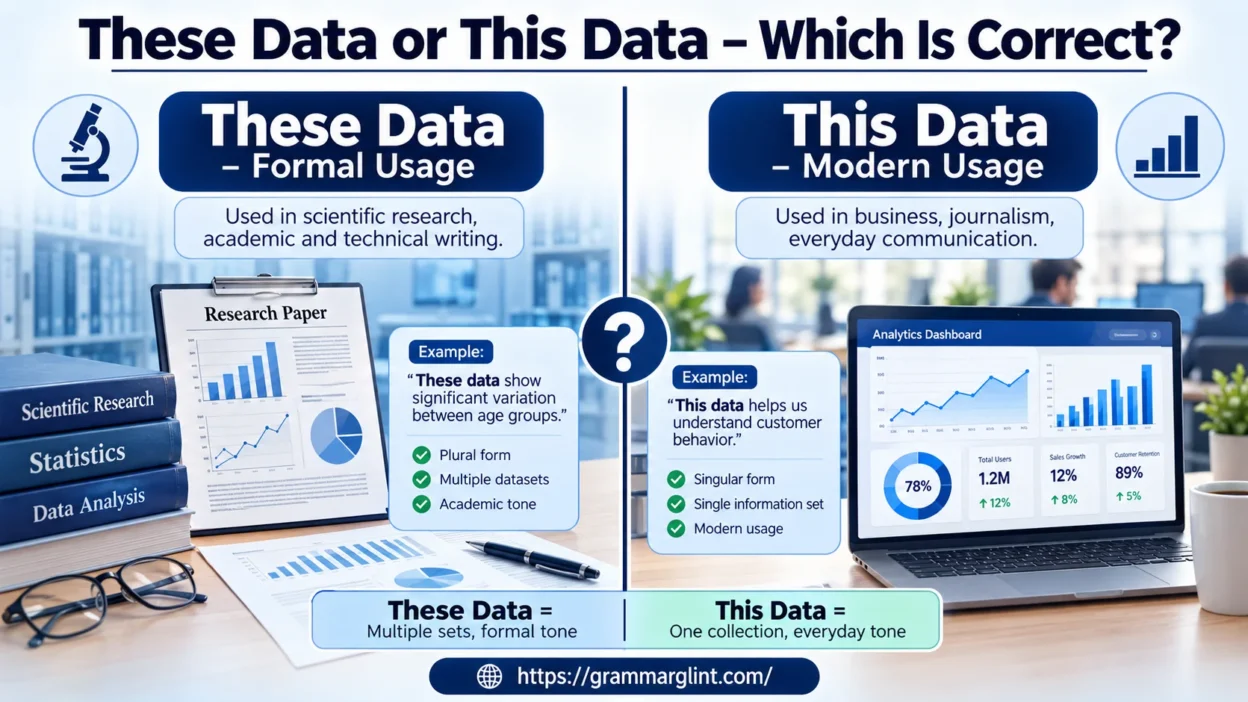
When “These Data” Is Correct (And Why Scientists Still Use It)
Let’s start with the older, more formal usage.
You use “these data” when you treat data as individual, countable pieces.
This appears mostly in:
- Scientific research
- Academic papers
- Statistical reports
- Technical analysis
Example usage:
- “These data show significant variation between age groups.”
- “These data were collected over five years.”
Notice something important:
- The verb is plural: show, were
That’s intentional. It matches the plural interpretation.
Why researchers still prefer it
In science, precision matters. Researchers often deal with multiple datasets, not a single blob of information.
So they say:
- “these data sets”
- “these data points”
- “these data are inconsistent”
It helps maintain clarity in technical discussions.
Read More: “On the Road” or “In the Road”: Which Is Correct?
When “This Data” Is Correct (And Why Most People Use It Now)
Now let’s move into modern English usage.
You use “this data” when you treat data as a single collection of information.
This is the most common form today, especially in:
- Business writing
- Journalism
- Marketing reports
- Everyday conversation
Example usage:
- “This data is very useful for decision-making.”
- “This data helps us understand customer behavior.”
Why this form dominates today
Language evolves toward simplicity. And in real life, people don’t usually think in “pieces of data.” They think in information as a whole.
So English naturally shifted toward singular usage.
Even major style authorities accept it.
The Real Difference Explained Simply
Let’s strip away complexity.
Here’s the clean breakdown:
- These data = multiple sets, formal tone, scientific context
- This data = one collection, modern usage, everyday tone
That’s it.
No need to overthink it.
Quick comparison table
| Phrase | Grammar View | Meaning Style | Best Used In |
| These data | Plural | Multiple datasets | Science, research |
| This data | Singular | Single information set | Business, general use |
What Style Guides Actually Say (Real Rules, Not Opinions)
Let’s move beyond opinions and look at real-world authorities.
APA Style (American Psychological Association)
- Accepts “data is” in modern writing
- Still acknowledges plural usage in technical contexts
Oxford English Dictionary
- Recognizes both singular and plural usage
- Notes that singular usage is now widespread
Chicago Manual of Style
- Prefers singular in most modern writing
- Allows plural in scientific contexts
Nature and scientific journals
- Still lean toward plural usage
- Especially in formal research papers
Real takeaway:
There is no single universal rule anymore.
Common Mistakes People Make
Even confident writers mess this up. Here are the biggest mistakes.
Mistake 1: Mixing grammar styles
❌ “These data is very important”
✔ “These data are very important”
Mistake 2: Overusing plural in casual writing
❌ “These data show the sales are increasing” (in a business email)
✔ “This data shows sales are increasing”
Mistake 3: Forcing singular in academic writing
❌ “This data were collected from experiments”
✔ “These data were collected from experiments”
How to Decide (Simple Logic System)
Here’s a practical decision method you can use instantly.
Ask yourself:
Are you writing formally or scientifically?
→ Use these data
Are you writing casually or in business context?
→ Use this data
Are you emphasizing multiple datasets?
→ Use these data
Are you referring to information as a whole?
→ Use this data
Real-World Examples That Show the Difference Clearly
Let’s bring this to life with real scenarios.
Academic research example
A university study on climate change:
“These data were collected from Arctic ice samples over ten years.”
Why it works:
- Multiple datasets
- Formal scientific tone
Business report example
A company analyzing customer behavior:
“This data shows that customer retention improved by 12%.”
Why it works:
- Single dataset view
- Business-friendly tone
News article example
A journalist writing about elections:
“This data highlights shifting voter trends.”
Why it works:
- General audience
- Simplified structure
Everyday conversation example
A manager talking to a team:
“This data helps us understand what went wrong.”
Why it works:
- Natural speech
- No need for plural form
Case Study: How Tech Companies Handle “Data”
Let’s look at how real companies treat this grammar issue.
Google’s internal documentation generally uses:
- “data is”
- Treats data as singular in most UI and product writing
Example:
“This data is stored securely in your account.”
Microsoft
Microsoft follows a similar approach:
- Singular in product messaging
- Plural reserved for technical documentation
Academic publishers (Nature, Elsevier)
- Stick with plural usage in research articles
- Especially in experimental sciences
Key insight:
Different industries don’t agree — and that’s normal.
Why Language Evolved Toward “This Data”
English tends to simplify over time.
We’ve seen this before:
- “You are” replaced older plural/singular distinctions in informal speech
- “Information” never became plural in modern use
- “Furniture” is always singular now
“Data” is going through the same shift.
People prefer:
- faster communication
- simpler grammar
- less overthinking
So “this data” became the default in everyday writing.
Memory Shortcut You Can Actually Use
Here’s a simple way to remember it:
If you can count it, say “these data.”
If you can’t, say “this data.”
But in real life:
- You’ll use “this data” 80–90% of the time
My Personal Experience as an English Language Specialist
As an English language specialist, I’ve noticed that “These Data” vs. “This Data” is one of the grammar questions that surprises many learners. Students often expect a single correct answer, but English doesn’t always work that way. Over the years, while editing articles, reviewing academic papers, and helping writers improve their grammar, I’ve learned that context matters more than memorizing a rigid rule. In formal research and scientific writing, I usually keep “these data” because many academic disciplines still treat data as a plural noun. However, when I’m writing blog posts, business content, or web copy for a general audience, I naturally use “this data” because that’s how modern English is commonly used and understood.
My advice is simple: don’t focus only on what is technically possible—think about your readers. Clear communication should always come first. If your audience is made up of researchers or academics, following the traditional plural usage can make your writing feel more precise and professional. If you’re writing for everyday readers, customers, or online audiences, “this data” will usually sound more natural and approachable. In my experience, good writing isn’t about proving how many grammar rules you know; it’s about choosing the form that fits your audience, your purpose, and the style of your writing.
FAQs
1. Is These Data grammatically correct?
Yes, These Data can be grammatically correct when data is treated as a plural noun. This follows the traditional rule that data is the plural form of datum.
2. Is This Data also correct?
Yes, This Data is widely used in modern English. Many speakers treat data as a mass noun or uncountable concept, especially in everyday communication.
3. Why do people confuse These Data and This Data?
The confusion happens because data has two different usages. Traditional grammar considers it plural, while modern usage often treats it as singular.
4. Should I use These Data in academic writing?
In many academic and scientific texts, These Data may be preferred because it follows the traditional plural form. However, style guides and fields may differ.
5. Should I use This Data in daily conversations?
Yes, This Data is commonly used in spoken English and everyday situations because many native speakers naturally treat data as singular.
6. What is the original meaning of data?
The word data comes from the Latin word datum, meaning something given. Originally, it was understood as a plural form.
7. Are both These Data and This Data acceptable?
Yes, both forms can be acceptable depending on context, meaning, and the type of writing or communication being used.
8. Why do some spell-checkers mark These Data as wrong?
Some modern grammar tools follow common usage patterns and may consider This Data more natural, even though These Data has traditional support.
9. How can I decide between These Data and This Data?
Consider your audience, field, and purpose. Formal research may use These Data, while general communication often uses This Data.
10. Does the choice affect the meaning?
Usually, the meaning stays the same. The difference is mainly about grammar, style, and whether data is viewed as plural or singular.
Conclusion
The difference between These Data and This Data shows how language changes over time. Traditionally, data was treated as a plural noun connected to datum, so These Data followed older grammar rules. However, modern English increasingly treats data as a singular mass noun, making This Data common in everyday use.
Both forms have their place, and the best choice depends on context, audience, and writing style. Understanding both traditional and modern usage helps writers make clearer decisions and communicate more effectively.

Aria Jane is a senior language writer and grammar specialist at Grammar Glint. She focuses on English grammar, spelling variations, vocabulary, and writing clarity. Through detailed research and practical examples, Aria helps readers understand language rules and avoid common mistakes. Her articles are designed to make English learning accessible for students, professionals, and everyday writers seeking reliable language guidance.