Send You or Send to You? English maze of phrasal verbs and prepositions confuses learners in sentence structure and meaning context now. In real English usage, the maze of phrasal verbs and prepositions creates a confusing learning experience in language learning, where learners often rely on approach and walking through rules while Figuring the right way becomes a common dilemma shaped by devil in context.
The sentence structure shows how send you and send to you shift destination and receiver, making a sentence look almost identical at first glance, but details reveal a world of difference and a correct choice that depends on depending use of small words, prepositions, and big punch meaning.
I have seen learners hit a dead end while tackling a clear path, especially with package example like tomorrow delivery, where directly mentioned or directly sent changes emphasis of action in structure.
This explores differences between these forms where one is over the other and the whole different direction appears when a case is studied closely, because everything is not always what it seems.
Learners must remembering the difference which helps to serve and communicate correctly in every phrase, and forever in real usage. The deciding of both forms shows how they are used in real phrases, making it easier to understand how sentence doesn’t directly follow what meets the eye, even when we look at it from first glance.
Why It Feels So Confusing
At first glance, both phrases look interchangeable. That’s where most learners get stuck.
You might hear:
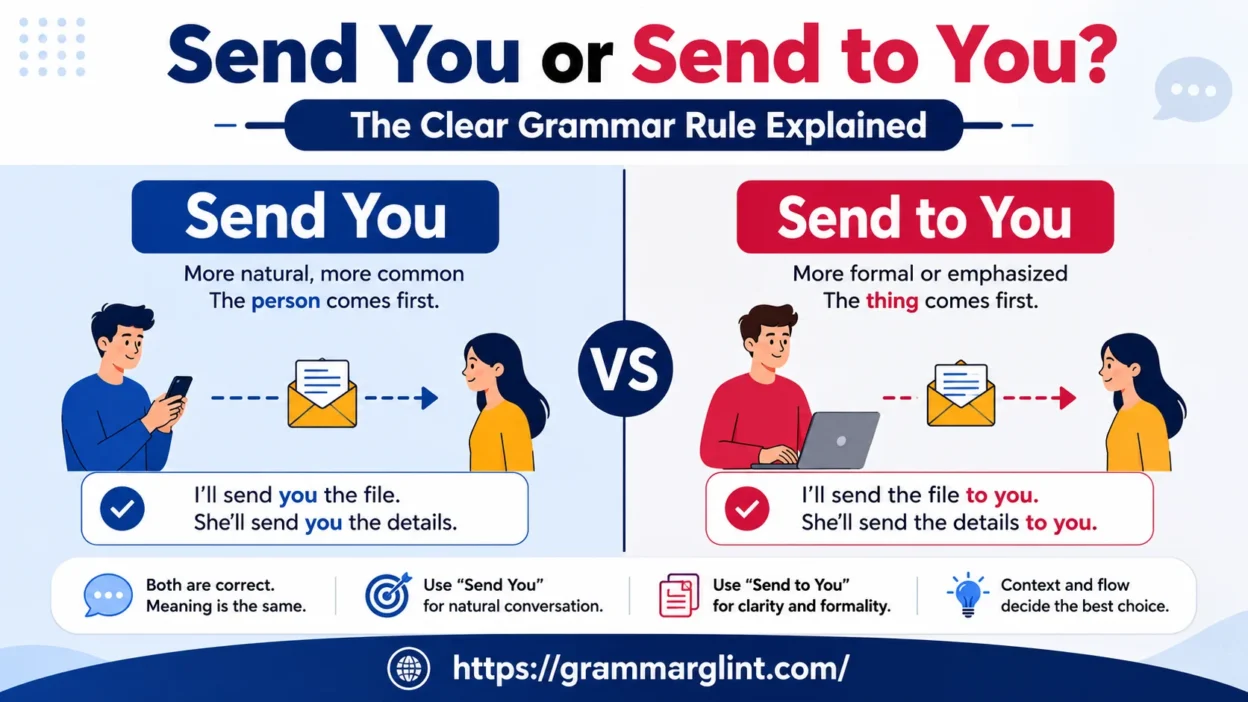
- “I’ll send you the file.”
- “I’ll send the file to you.”
Both are correct. So what’s the difference?
The confusion comes from how English allows two different structures for the same idea. Native speakers switch between them without thinking. But learners often try to find a strict rule where none fully exists.
Here’s the simple truth:
English allows two valid sentence patterns for the verb “send,” and both are correct depending on emphasis and flow.
Once you see that, everything starts making sense.
The Core Rule
Let’s simplify it immediately:
- Send you = more natural, more common, conversational
- Send to you = slightly more formal or emphasized structure
But both are grammatically correct.
The difference isn’t meaning. It’s sentence rhythm and focus.
Think of it like this:
- One version flows like speech
- The other sounds slightly more structured or deliberate
English often prefers smoother, shorter patterns in daily communication. That’s why “send you” dominates spoken English.
How the Verb “Send” Actually Works in English
To really understand send you vs send to you, you need to understand how the verb “send” behaves.
“Send” is called a ditransitive verb, meaning it can take:
- A recipient (you)
- An object (message, file, letter)
It can appear in two main sentence patterns:
Pattern 1: Direct object first
Subject + send + person + thing
- I sent you the report.
- She will send you the details.
- They sent me the invitation.
This is the “send you” structure.
Pattern 2: Object first with “to”
Subject + send + thing + to + person
- I sent the report to you.
- She will send the details to you.
- They sent the invitation to me.
This is the “send to you” structure.
Both patterns are correct because English allows object movement. The meaning stays the same. Only emphasis changes.
When You Should Use “Send You”
Now let’s focus on the most natural form: send you.
This is what people use in everyday conversation, texting, emails, and casual writing.
Why it feels natural
English prefers shorter, smoother phrasing. “Send you” removes extra words and flows quickly.
When it works best
Use send you when:
- You want to sound natural and conversational
- The sentence is short and direct
- You’re speaking or texting
Real examples
- “I’ll send you the link.”
- “Can you send me the address?”
- “She sent you a message last night.”
- “I’ll send you the details later.”
Notice how clean and fast these sound. That’s the key.
A simple way to think about it
If you’re talking like a normal conversation, send you is almost always the better choice.
When “Send to You” Works Better
Now let’s look at the second structure: send to you.
This version isn’t wrong or awkward. It just has a different purpose.
Read More: Is “Any” Singular or Plural? Correct Grammar (+Examples)
Why it exists
English sometimes uses “to” to:
- Add clarity
- Emphasize the object
- Separate long phrases
When to use it
Use send to you when:
- The object is long or detailed
- You want extra clarity
- You’re writing formal or structured content
Real examples
- “I will send the full documentation to you.”
- “They sent the complete report to you and your team.”
- “We will send the revised contract to you tomorrow.”
Why it sounds more formal
Adding “to you” slightly slows the sentence. That makes it feel more deliberate. That’s why business emails often use it.
The Subtle Meaning Difference Between the Two
Even though both mean the same thing, tone matters.
Let’s break it down clearly:
“Send you”
- Focus: the person receiving
- Tone: quick, natural, friendly
- Use: daily speech, texting, informal writing
“Send to you”
- Focus: the object being sent
- Tone: structured, formal, careful
- Use: business, legal, detailed communication
Think of it like this:
- “Send you” feels like handing something directly to someone
- “Send to you” feels like mailing something through a system
Same result. Different feel.
Side-by-Side Comparison Table
| Structure | Example | Tone | Best Use |
| send you | I’ll send you the file | Natural | Everyday speech |
| send to you | I’ll send the file to you | Formal | Emails, reports |
| send you + long object | I’ll send you the full details | Slightly heavy | Acceptable |
| send to you + long object | I’ll send the full details to you | Clear and clean | Best for writing |
This table shows the real-world pattern: both are valid, but context decides the winner.
Common Mistakes People Make
Even advanced learners slip up with this phrase. Here are the most common issues.
Overusing “send to you” in casual speech
Many learners think “send to you” sounds more correct. So they use it everywhere. That makes their English sound stiff.
Instead:
- Say “I’ll send you the file,” not “I’ll send the file to you” in casual talk.
Awkward word order
Some learners mix structures incorrectly:
❌ “I send to you this file”
✔️ “I send you this file”
✔️ “I send this file to you”
English doesn’t allow random placement. The structure must stay clean.
Overthinking every sentence
Learners often pause too long deciding between the two forms. Native speakers don’t do that.
They choose based on rhythm, not rules.
Formal vs Informal Usage in Real Life
Let’s look at how real communication changes the structure.
Informal English
You’ll almost always hear:
- “I’ll send you the link.”
- “Send me your number.”
- “I sent you a message.”
This dominates:
- Text messages
- Spoken English
- Social media
Formal English
You’ll often see:
- “We will send the updated contract to you.”
- “Please send the completed form to us.”
- “The report was sent to you yesterday.”
This is common in:
- Business emails
- Academic writing
- Legal documents
Better Alternatives
Sometimes English gives you even better options.
Natural alternatives
- Forward
- “I’ll forward it to you.”
- Share
- “I’ll share the document with you.”
- Get to you
- “I’ll get it to you by tomorrow.”
- Send your way
- “I’ll send it your way shortly.”
Why these matter
These alternatives:
- Sound more natural in specific contexts
- Avoid repetition
- Add tone variety
For example:
Instead of saying “send you” five times in an email, you can mix in “share” or “forward.”
Easy Memory Trick You Can Use
Here’s a simple shortcut:
- If you’re speaking fast → use send you
- If you’re writing formally or adding detail → use send to you
Or think of it like this:
- Short sentence = send you
- Long sentence = send to you
That’s it. No stress.
Real-World Case Study: Email vs Text Message
Let’s see how this works in real life.
Case 1: Text message
You text a friend:
“I’ll send you the pics later.”
This feels natural, fast, and casual.
Case 2: Business email
You write to a client:
“We will send the finalized proposal to you by Friday.”
Here, clarity matters more than speed. So “send to you” fits better.
Case 3: Mixed usage
A manager might write:
“I’ll send you the summary and send the full report to you.”
Why mix both?
Because:
- The summary is quick → send you
- The report is long → send to you
This shows how flexible English really is.
Why Native Speakers Switch Without Thinking
Native speakers don’t memorize rules for this.
Instead, they rely on:
- Rhythm
- Sentence length
- Natural flow
They instinctively say:
- “send you” when speaking fast
- “send to you” when emphasizing clarity
It’s like choosing between walking and jogging. Same destination. Different pace.
My Personal Experience as an English Language Specialist
As an English language specialist, I have worked with learners from different backgrounds, and one challenge appears again and again: understanding the small grammar details that make a big difference in communication. Over the years, I have found that many students are not held back by complex vocabulary but by everyday expressions such as “send you” and “send to you.” These phrases seem almost identical, yet choosing the right one often causes hesitation and uncertainty.
In my teaching and editing experience, I have learned that the best way to explain grammar is through real-life examples instead of long lists of rules. When students see how native speakers use these expressions in emails, conversations, and professional writing, the patterns become much easier to recognize. I encourage learners to focus on context, sentence flow, and natural usage rather than trying to memorize every grammar rule.
From my experience, mastering English is not about avoiding mistakes, it is about learning from them. Every grammar question, no matter how small it seems, is an opportunity to build stronger communication skills. That is why I enjoy breaking down confusing topics into simple, practical explanations that help learners write and speak English with greater clarity and confidence.
FAQs
1. What is the difference between “send you” and “send to you”?
“Send you” is used when the object comes directly after “you,” while “send to you” is used when the object is mentioned earlier or implied.
2. Are both “send you” and “send to you” grammatically correct?
Yes, both are grammatically correct and commonly used in English depending on sentence structure.
3. When should I use “send you”?
Use “send you” when the thing being sent directly follows the phrase, for example: I will send you the file.
4. When should I use “send to you”?
Use “send to you” when the object is already mentioned or when you want to emphasize the receiver.
5. Do both phrases mean the same thing?
Yes, both express the action of sending something to someone, but their structure and emphasis differ.
6. Is “send you” more common in spoken English?
Yes, “send you” is generally more natural and frequently used in everyday conversation.
7. Why do learners get confused between these phrases?
Because both forms look similar and depend heavily on sentence structure and context.
8. Can “send to you” sound more formal?
Yes, in some cases “send to you” can sound slightly more formal or structured.
9. Does word order matter in these phrases?
Yes, word order changes whether the focus is on the object or the receiver.
10. How can I choose the correct form easily?
Focus on sentence structure: if the object comes first, use “send to you”; if not, use “send you.”
Conclusion
Understanding the difference between “send you” and “send to you” is less about memorizing rules and more about recognizing how English naturally expresses ideas. In most everyday conversations, “send you” sounds smoother because English commonly places the indirect object before the direct object. Meanwhile, “send to you” remains perfectly correct when the object comes first or when you want to emphasize the recipient. Once you notice this pattern, choosing between the two becomes much more intuitive.
The good news is that both expressions are grammatically correct, they simply serve slightly different purposes. Instead of worrying about which one is always right, pay attention to the sentence structure and the emphasis you want to create. Reading authentic English, listening to native speakers, and practicing with real-life examples will quickly make this distinction feel natural, helping you communicate with greater confidence and accuracy.

Aria Jane is a senior language writer and grammar specialist at Grammar Glint. She focuses on English grammar, spelling variations, vocabulary, and writing clarity. Through detailed research and practical examples, Aria helps readers understand language rules and avoid common mistakes. Her articles are designed to make English learning accessible for students, professionals, and everyday writers seeking reliable language guidance.