In real learning situations, I often notice how learners compare Of Great Help or A Great Help while trying to understand natural English usage. At first glance, the two expressions seem different, but in everyday communication and writing, both follow accepted grammar patterns and convey nearly the same meaning. The choice usually depends on the sentence structure, context, and the writer’s preferred style rather than a strict grammatical rule. By exploring real examples, learners become more confident in using these phrases naturally, which improves both their writing clarity and overall communication skills.
A preposition is used to describe a person, thing, or even someone in a natural manner, depending heavily on context. The phrases and phrase forms rely on a correct structure, whether it is adjective or noun based, and from my experience, I see learners carefully check every sentence, words, and ensure correct meaning with proper comparison, which ultimately helps improve writing clarity and overall communication skills in daily use.
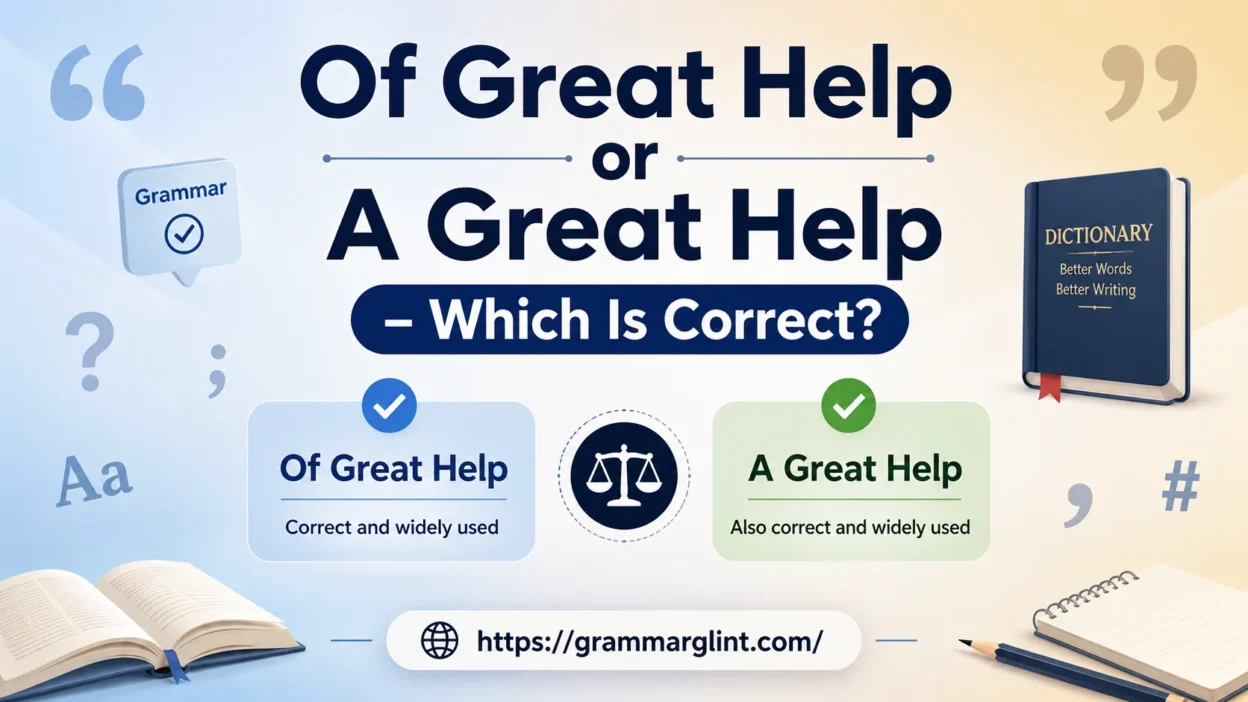
To give clarification and simple explanation, both 2 forms are considered acceptable because both can be right in actual use. It becomes clear through many examples that of great help, a great help, and even of/a great help carry the same intended meaning. These forms are widely accepted in different writing situations, depending on how naturally they fit into the sentence flow and tone.
In real practice, this flexibility allows writers and speakers to focus more on clarity and communication rather than worrying too much about minor variations. Over time, learners begin to trust their instinct and improve their writing and speaking naturally, making their expression smoother and more effective in both formal and informal contexts.
Quick Answer
Let’s make this simple.
- “Of great help” → more formal, polished, writing-friendly
- “A great help” → more casual, natural, conversation-friendly
- Both mean the same thing in meaning, but not in tone
Simple examples:
- “Your advice was of great help.” (formal)
- “Your advice was a great help.” (casual)
No hidden grammar rule makes one wrong. The difference is style, not correctness.
What “Of Great Help” Actually Means
When you say “of great help,” you’re using a structure that connects something to a quality rather than describing it directly.
Think of it like this: instead of saying something is helpful, you describe the value of the help.
In simple terms:
It means something provided strong or meaningful assistance.
Real examples:
- “Your explanation was of great help during the exam.”
- “The report was of great help to the research team.”
- “His guidance proved of great help in solving the issue.”
Where you’ll see it most:
- Academic writing
- Business communication
- Formal emails
- Reports and documentation
Why it sounds formal:
Because it avoids direct phrasing. It feels structured, almost like legal or academic English. It creates a bit of distance, which suits professional settings.
What “A Great Help” Actually Means
Now let’s switch gears.
“A great help” feels direct and human. It treats “help” like a normal noun you can describe, just like “a friend” or “a tool.”
In simple terms:
It means someone or something was very helpful in a clear, friendly way.
Real examples:
- “You’ve been a great help.”
- “She was a great help when I moved apartments.”
- “That tutorial was a great help for beginners.”
Where it fits best:
- Conversations
- Text messages
- Casual writing
- Friendly workplace communication
Why it feels natural:
It mirrors how people actually speak. No extra structure. No formality layer. Just clean communication.
Key Differences Explained
Even though both phrases share meaning, they behave differently in tone and usage.
| Feature | Of Great Help | A Great Help |
| Tone | Formal | Casual |
| Structure | Prepositional phrase | Noun phrase |
| Usage | Writing-heavy contexts | Speaking-heavy contexts |
| Emotional feel | Neutral, distant | Warm, personal |
| Common settings | Reports, essays, emails | Conversations, messages |
The real takeaway
This isn’t a grammar battle. It’s a tone choice. One fits polished writing. The other fits everyday talk.
Grammar Breakdown: Why Both Forms Work
Let’s break it down without overcomplicating things.
“Of great help”
This uses a prepositional structure where “of” links something to a quality.
- “of” shows relationship
- “great help” describes value
So instead of saying:
“This helped a lot”
You say:
“This was of great help”
It shifts focus from action to value.
“A great help”
This uses a straightforward noun phrase.
- “a” turns “great help” into a single idea
- It behaves like a normal description
So:
“You are a great help”
It feels personal and direct.
Why both exist in English
English developed from multiple language influences. That’s why it often gives two valid ways to say the same thing:
- One formal
- One conversational
Both survived because both serve different communication needs.
Read More: Input or Inputs? Correct Plural Form (Helpful Examples)
When to Use “Of Great Help”
Use “of great help” when you want a more polished tone.
Best situations:
- Business emails
- Academic writing
- Reports
- Formal letters
- Professional communication
Example:
“Your detailed feedback was of great help in completing the proposal.”
Why it works:
It keeps the tone respectful and structured without sounding emotional.
When to Use “A Great Help”
Use “a great help” when you want to sound natural and friendly.
Best situations:
- Conversations
- Informal messages
- Workplace chats
- Social media comments
- Everyday speech
Example:
“You were a great help today, thanks!”
Why it works:
It feels warm, simple, and human. It matches how people naturally talk.
Common Mistakes People Make
Let’s fix the real errors learners run into.
Mixing both structures
- ❌ “You were of a great help”
- ✔ “You were a great help” / “You were of great help”
Using formal tone in casual speech
- ❌ “You are of great help, my friend”
- ✔ “You’re a great help, my friend”
Over-intensifying the phrase
- ❌ “very of great help”
- ❌ “a very great help” (often unnecessary)
Thinking one version is wrong
Many learners assume “of great help” is outdated. It’s not. It’s still widely used in formal English.
Better Alternatives You Can Use
Sometimes you don’t want to repeat the same phrase. English gives you options.
Useful alternatives:
- Very helpful
- Extremely helpful
- A big help
- A huge help
- Really helped me
- Much appreciated support (formal tone)
Example:
- “Your advice was extremely helpful.”
- “You were a huge help during the project.”
These variations keep your writing fresh and natural.
Real-Life Case Study: Same Meaning, Different Tone
Let’s imagine a simple situation.
You ask a coworker for help on a report.
Formal version:
“Your input was of great help in completing the report.”
- Sounds professional
- Works in emails to managers
- Keeps emotional distance
Casual version:
“You were a great help with the report.”
- Sounds friendly
- Works in daily office talk
- Builds connection
What changed?
Not meaning. Just tone. One feels official. The other feels human.
Quick Memory Trick
Here’s an easy way to remember everything:
- Writing = of great help
- Speaking = a great help
Or even simpler:
Formal = of great help
Friendly = a great help
That’s all you need.
My Personal Experience as an English Language Specialist
Over the years, I’ve noticed that one of the biggest challenges English learners face isn’t complex grammar, it’s choosing between expressions that seem almost identical. “Of great help” and “a great help” are perfect examples. Many students assume one must be correct and the other wrong, but through teaching and reviewing countless pieces of writing, I’ve found that both are perfectly acceptable. The real difference lies in tone, context, and how naturally the phrase fits the sentence. Once learners understand this, their confidence grows, and they stop second-guessing every word they write.
As an English language specialist, I always encourage learners to focus on clear communication rather than chasing rigid grammar rules. English is a flexible language, and knowing when to use a formal expression like “of great help” or a more conversational one like “a great help” comes with practice and exposure. From my experience, students make the fastest progress when they read authentic English, write regularly, and pay attention to how native speakers express the same idea in different situations. That’s what turns grammar knowledge into real communication skills.
FAQs
1. What does “Of Great Help” mean?
It means someone or something is very helpful or useful in a situation.
2. Is “A Great Help” correct in English?
Yes, a great help is also grammatically correct and commonly used.
3. What is the difference between “Of Great Help” and “A Great Help”?
There is no real difference in meaning; both express strong help or support.
4. Can “Of Great Help” and “A Great Help” be used interchangeably?
Yes, both forms can be used interchangeably depending on sentence style.
5. Which form is more formal?
“Of great help” often sounds slightly more formal in writing.
6. Why are both forms correct?
Because English allows flexible usage with prepositions and noun phrases.
7. Do both phrases have the same meaning?
Yes, both express the idea of being very helpful or supportive.
8. Can I use these phrases in academic writing?
Yes, both are acceptable in academic and professional contexts.
9. Which is more commonly used in speaking?
Both are common, but “a great help” is often more natural in speech.
10. Is this confusion common among learners?
Yes, many learners struggle with such similar phrases in English language.
Conclusion
Understanding small grammar differences becomes much easier when you focus on how English is actually used. Instead of memorizing every rule, pay attention to context, sentence structure, and natural usage. Many expressions that seem different at first can communicate the same idea, with the best choice depending on the tone and flow of your sentence. Reading, writing, and noticing examples in real-life communication will gradually strengthen your confidence.
The key is to aim for clarity rather than perfection. As you practice, you’ll develop a better sense of word choice, grammar, and meaning, making your writing and speaking sound more natural in both formal and informal situations. With consistent exposure and practice, these small grammar decisions become instinctive, helping you communicate clearly and effectively.

Aria Jane is a senior language writer and grammar specialist at Grammar Glint. She focuses on English grammar, spelling variations, vocabulary, and writing clarity. Through detailed research and practical examples, Aria helps readers understand language rules and avoid common mistakes. Her articles are designed to make English learning accessible for students, professionals, and everyday writers seeking reliable language guidance.