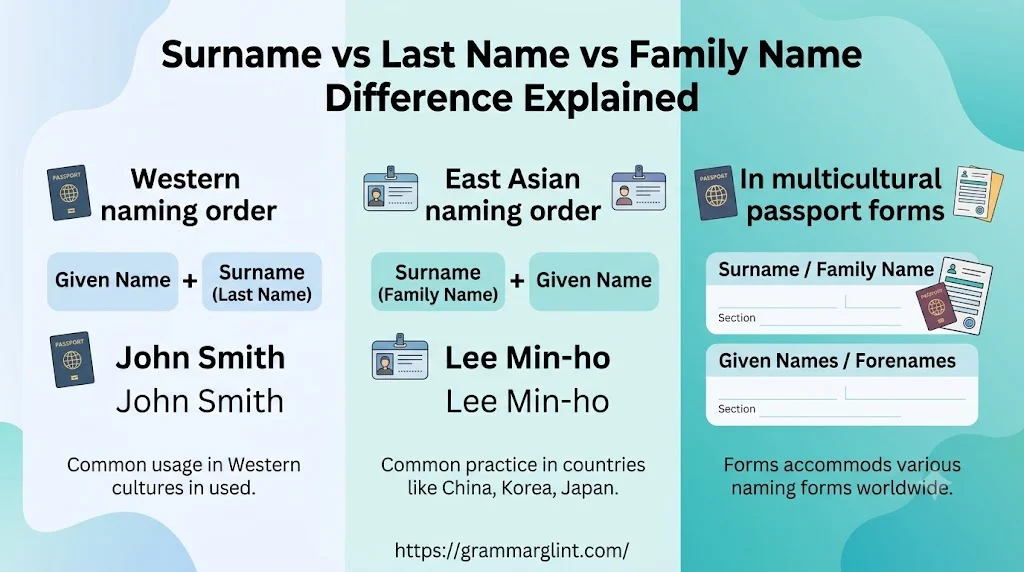
When you fill out a form, sign up for an event, or introduce yourself, you may be asked about your name, especially your surname, last name, or family name. Surname vs Last Name vs Family Name explains how these terms appear in conversations and documents across the globe and may seem interchangeable at a glance, but they have distinct stories, meanings, and links with culture, history, and personal identity.
This article helps explore the layers behind names because knowing your own name from backward and forward does not always show the origins or usage in different cultures. A rose with another name can still carry a new meaning depending on the world and the people who use it.
The slight differences between these three terms become clearer when names are shared by family members and passed down from generation to generation. A surname reflects ancestry and lineage, while the last name on the other hand refers to the final part of a person’s full name that appears at the end. Family name is essentially the same thing as a common name that connects individuals and shows their background and heritage.
These names are widely used and globally recognized, but their usage can vary because of cultural preferences and regional preferences. In English-speaking countries, last name is commonly used, while surname may be considered more formal. Some cultures have multiple names where the family name is written first, showing how naming systems are different.
What Is a Surname
A surname is the inherited part of a person’s name that connects them to their family lineage.
It usually passes from parents to children, although naming traditions vary across cultures.
The word itself comes from the Old French term surnom, meaning “additional name.” Over time, it became the marker of family identity.
Core meaning of surname
- A shared family identifier
- Passed through generations
- Used to distinguish people with the same first name
- Not tied to name order
Simple example
- John Smith → Smith is the surname
- Aisha Khan → Khan is the surname
But here’s where it gets interesting. In many cultures, the surname does NOT appear at the end. So the idea of “last” becomes misleading.
Key insight
A surname is about family connection, not position in a name.
That single difference shapes everything else.
What Is a Last Name
The term last name comes from Western naming order, where a person’s family name usually appears at the end.
So instead of focusing on meaning, it focuses on position.
Definition of last name
The last name is the final part of a full name in Western-style naming systems.
Example in Western format
- Emma Johnson
- Emma = first name
- Johnson = last name
Why the term exists
The term became popular in English-speaking administrative systems, especially in:
- Government forms
- School records
- Banking systems
- Immigration paperwork
But there’s a catch.
Not all cultures place the family name at the end. So “last name” only works when the name follows a Western order.
Key limitation
The phrase assumes:
“First name always comes first, and family name always comes last.”
That assumption fails in many real-world naming systems.
Key insight
A last name is about position in a name sequence, not cultural meaning.
What Is a Family Name
A family name is the most neutral and globally accepted term for inherited surnames.
It refers directly to the family unit rather than position or Western structure.
Definition of family name
The name shared by members of a family that identifies lineage.
Where it appears
- Passports
- International forms
- Legal documents
- Academic records
Example
- Li Wei
- Li = family name
- Wei = given name
In this case, the family name appears first, which shows why “last name” can become confusing.
Why it matters
The term “family name” avoids assumptions about:
- Name order
- Cultural structure
- Western formatting rules
Key insight
Family name is the most culturally flexible and internationally safe term.
Difference Explained Clearly
Now that each term is clear, let’s put them side by side.
Core differences
| Term | Meaning Focus | Depends on Position? | Cultural Neutral? |
| Surname | Family lineage | No | Moderate |
| Last Name | Name order | Yes | No |
| Family Name | Family identity | No | Yes |
Simple breakdown
- Surname = family identity marker
- Last name = position in full name
- Family name = global neutral version of surname
Important truth
In many cases, all three refer to the same name.
But they don’t always behave the same way.
And that difference matters more than most people realize.
How Different Cultures Shape the Surname vs Last Name vs Family Name Difference
Names don’t follow a universal rule. They follow culture, history, and language patterns.
Let’s explore how naming systems actually work around the world.
Western naming structure
In countries like the United States and the United Kingdom, names usually follow this pattern:
Given name → Middle name → Surname
Example
- Michael Robert Brown
- Michael = given name
- Robert = middle name
- Brown = surname
Here, surname and last name match neatly.
But that simplicity doesn’t exist everywhere.
East Asian naming structure
In countries like China, Japan, and Korea, the family name comes first.
Example
- Zhang Wei
- Zhang = family name
- Wei = given name
So if a form asks for “last name,” confusion happens instantly.
Is “last” referring to position or family identity?
That’s the problem.
South Asian naming diversity
South Asia doesn’t follow one fixed system.
Names may include:
- Given name + father’s name
- Caste or clan identifiers
- Regional or religious naming traditions
Example
- Muhammad Ali Khan
- Muhammad = given name
- Ali = middle name
- Khan = family/surname
But in another case:
- Ravi Kumar
- Kumar may function as surname or part of given identity
Key point
The structure changes based on region, religion, and family tradition.
There is no single fixed pattern.
Spanish and Latin American naming system
This system often uses two family names.
Example
- Carlos García López
- García = paternal surname
- López = maternal surname
Both are legally important.
So asking for “last name” becomes tricky. Which one counts as last?
Read More: Cheers To vs Here’s To: The Difference Explained With Examples
Arabic naming system
Arabic names often carry deep lineage information.
Example
- Omar ibn Hassan Al-Fulan
- Omar = given name
- ibn Hassan = “son of Hassan”
- Al-Fulan = family/clan name
Here, identity is layered rather than linear.
Icelandic naming system
Iceland uses patronymics instead of fixed surnames.
Example
- Eriksson = son of Erik
- Eriksdóttir = daughter of Erik
So the “family name” changes every generation.
That completely breaks the idea of a permanent surname.
Why Surname vs Last Name vs Family Name Difference Confuses Forms
Most confusion comes from one thing: forms assume one naming system for everyone.
That assumption creates real problems.
Common issues
- Name order reversed on documents
- Missing surname fields
- Misinterpreted last names
- Visa or passport mismatches
Real-world example
A Chinese traveler named Li Wei fills out a Western form:
- First name: Wei
- Last name: Li
Correct culturally, but confusing for systems that expect “last name” to match position.
Another person might do the opposite and face verification issues.
Case Study: Airline Ticket Name Mismatch Problem
Airlines often require exact name matching with passports.
Scenario
A passenger named:
- Zhang Wei (Chinese naming order)
Enters:
- First name: Zhang
- Last name: Wei
Now the airline system expects:
- First name: Wei
- Last name: Zhang
The mismatch creates check-in delays.
What went wrong
- System assumed Western order
- Passenger followed cultural order
Lesson
Small naming misunderstandings can cause real travel problems.
Technology and Database Problems in Name Systems
Modern systems still struggle with global naming diversity.
Common database design flaw
Most systems include only:
- First Name
- Last Name
That structure ignores:
- Multiple surnames
- No surname cultures
- Patronymic systems
Resulting issues
- Incorrect identity matching
- Duplicate records
- Banking verification failures
- Immigration processing delays
Why this happens
Early computer systems were designed using Western naming logic. That logic still shapes modern software today.
Common Mistakes People Make
Let’s clear up frequent errors.
Mistake 1: Assuming last name always comes last
Not true in many cultures.
Mistake 2: Dropping part of a compound surname
Example:
- “García López” becomes just “García”
That can cause legal inconsistencies.
Mistake 3: Treating all systems the same
Forms differ by country, not by universal rule.
Mistake 4: Confusing middle names with surnames
Middle names are not always part of family identity.
Quick Comparison Table with Real Examples
| Name Example | Surname | Last Name (Western form) | Family Name |
| John Smith | Smith | Smith | Smith |
| Li Wei | Li | Wei (in Western misinterpretation) | Li |
| Carlos García López | García + López | López (varies) | García + López |
| Erik Eriksson | Eriksson | Eriksson | Eriksson |
My Personal Experience as an English Language Specialist
As an English language specialist, I have noticed that many learners and writers often struggle to understand the difference between surname, last name, and family name. Throughout my experience helping people improve their English skills, I have seen how these terms can create confusion, especially when they appear on official forms, academic documents, and international applications. Many people assume that these words always mean exactly the same thing, but their usage can change depending on cultural traditions and naming systems.
In my work with language learners, I have explained that names are not just simple words; they represent identity, history, and family connections. I often guide people to understand that a surname highlights family lineage, a last name usually refers to the final part of a name in Western naming structures, and a family name is a more culturally neutral term used around the world.
From my experience, misunderstandings about names can lead to mistakes in professional communication, travel documents, and online forms. I have helped learners recognize that different cultures follow different naming patterns, and there is no single rule that applies everywhere. Understanding these differences not only improves English accuracy but also develops respect for the cultural stories and traditions behind every name.
FAQs
1. What is the difference between a surname, last name, and family name?
A surname, last name, and family name usually refer to the same part of a person’s identity that connects them with their family or ancestry. The difference mainly depends on culture and usage.
2. Is a surname always the same as a family name?
Yes, in most cases a surname and family name mean the same thing. Both describe a shared name passed through a family line.
3. Why do people use the term last name?
The term last name is commonly used in English-speaking countries because it usually appears at the end of a person’s full name.
4. Can a family name appear before the first name?
Yes, some cultures write the family name first followed by the given name. Naming systems vary across different regions.
5. Does a surname show ancestry or heritage?
A surname can often reflect ancestry, lineage, and family heritage, showing a connection between generations.
6. Are surname and last name interchangeable?
In many situations, surname and last name are interchangeable, but some cultures have different naming structures.
7. Why are there different terms for family names?
Different terms developed because of language, history, cultural preferences, and regional naming traditions around the world.
8. What should I write in a form asking for a last name?
When a form asks for a last name, you usually enter your surname or family name as used on official documents.
9. Can a person have multiple names before the family name?
Yes, many cultures use multiple names before the family name, which changes how a full name is arranged.
10. Is surname more formal than last name?
In some contexts, surname is considered more formal, especially in official writing and documents.
Conclusion
Understanding the difference between surname, last name, and family name helps you communicate more clearly and avoid confusion when completing forms, handling documents, or discussing names from different cultures. Although these terms often refer to the same part of a person’s name, their meanings and usage can change depending on language, tradition, and location. A surname highlights family connections and ancestry, while last name focuses more on its position in a full name.
Names are more than simple labels because they carry stories, history, and a sense of belonging. Whether a culture places the family name first or last, each naming system reflects the values and traditions of its people. By understanding these differences, you can appreciate the importance of names and use these terms correctly in both personal and professional situations.

Aria Jane is a senior language writer and grammar specialist at Grammar Glint. She focuses on English grammar, spelling variations, vocabulary, and writing clarity. Through detailed research and practical examples, Aria helps readers understand language rules and avoid common mistakes. Her articles are designed to make English learning accessible for students, professionals, and everyday writers seeking reliable language guidance.