Many people easily confuse inflection and intonation because both words can mean a similar thing when we discuss speaking, voice, and sound. Inflection vs Intonation explains the difference between these two important terms by looking at linguistics, where language, speech, and pronunciation work together. In daily communication, these concepts may seem like the same idea, but their usage depends on the context and the role they play in expressing meaning.
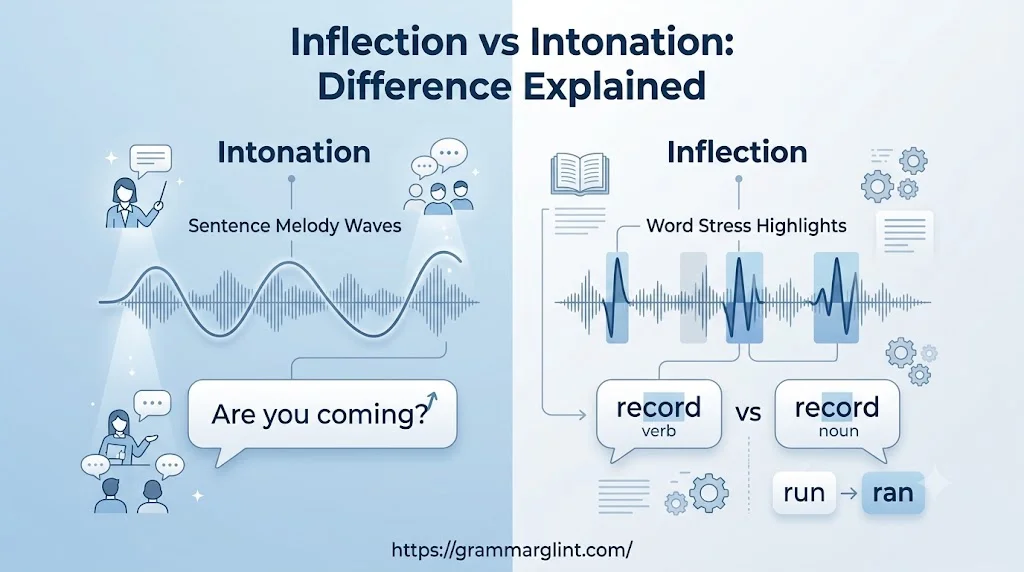
The simplest way to understand intonation is to see it as the melody of your voice while speaking. It shows your attitude across a whole sentence and helps listeners understand emotions, questions, or emphasis. For example, your pitch naturally rises when you ask a question, creating a different tone compared with a normal statement. This small change in sound can affect how the listener receives the message.
Inflection has a different purpose because it focuses on a word’s form and grammatical structure. It signals the role or job of a word by changing its form. A simple example is adding -ed to talk about the past, where the change shows when an action happened. Unlike intonation, inflection is more connected to written and spoken grammar rules.
From my experience learning and studying language, I have noticed that understanding these differences creates less confusion. Both concepts are connected because they influence how people understand speech, but they operate in separate ways. Both terms have their own place, and recognizing when each is fitting makes communication clearer and more accurate. The right understanding of context, meaning, and usage helps learners avoid mistakes while improving their overall communication skills.
Why People Confuse
Here’s a simple situation.
You say:
“You’re coming.”
Now imagine saying it three different ways:
- As a question
- As a statement
- With excitement
Same words. Different meaning.
That’s where confusion starts. English doesn’t rely only on words. It relies heavily on voice movement and emphasis.
People mix up the two terms because:
- Both involve voice changes
- Both affect meaning
- Both happen at the same time in real speech
But they work on different levels.
One shapes the sentence flow.
The other shapes word importance.
What Is Intonation?
Intonation is the rise and fall of your voice across a full sentence.
Think of it like a melody. Every sentence has a tune.
Simple meaning
Intonation = the overall pitch pattern of a sentence.
How Intonation Works in Real Life
Your voice naturally changes depending on:
- Emotion
- Questions
- Statements
- Surprise or doubt
Rising Intonation
- “You’re coming?”
- “Really?”
- “She did that?”
👉 Used for questions or uncertainty
Falling Intonation
- “You’re coming.”
- “That’s correct.”
- “I agree.”
👉 Used for certainty or completion
Flat Intonation
- “Okay.”
- “I see.”
- “Fine.”
👉 Often sounds neutral or uninterested
Real-Life Example
Say this sentence:
“That’s fine.”
It can mean:
- Genuine acceptance
- Frustration
- Passive aggression
Same words. Tone changes everything.
That’s intonation doing the heavy lifting.
Read More: In Which vs Where Difference Explained: A Guide With Examples
What Is Inflection?
Now let’s move to the second part.
Inflection is the change in pitch or stress on specific words inside a sentence.
Simple meaning
Inflection = emphasizing certain words to change meaning.
How Inflection Works
Look at this sentence:
“I didn’t say he stole the money.”
Now stress different words:
- I didn’t say he stole the money (someone else did)
- I didn’t say he stole the money (denial of saying it)
- I didn’t say he stole the money (someone else did it)
- I didn’t say he stole the money (something else was stolen)
Same sentence. Different meanings.
That’s inflection in action.
Where You Hear Inflection
- Arguments (correcting someone)
- Storytelling (adding drama)
- Public speaking (emphasizing key ideas)
- Daily conversations (clarifying meaning)
Key Differences
| Feature | Intonation | Inflection |
| Focus | Whole sentence | Specific words |
| Role | Shows emotion or intent | Shows emphasis |
| Scope | Sentence-level | Word-level |
| Function | Creates tone | Changes meaning |
| Example | Rising question tone | Stress on “didn’t” |
Easy Memory Trick
- Intonation = sentence melody
- Inflection = word spotlight
Why Inflection vs Intonation Matters in Real Life
This is not just grammar theory. It affects daily communication.
Avoid Misunderstandings
You say:
“I’m fine.”
But tone might suggest:
- Anger
- Sadness
- Disinterest
People react to how you say it more than what you say.
Boost Confidence
When you control your voice:
- You sound more natural
- You feel more confident
- People listen longer
Improve Persuasion
Strong speakers use:
- Intonation for emotion
- Inflection for emphasis
That’s why good speakers sound engaging instead of boring.
Common Mistakes Learners Make
Flat speaking style
No rise or fall in voice → sounds robotic
Over-exaggeration
Too much pitch change → sounds unnatural
Wrong word stress
Changes meaning unintentionally
Ignoring context
Same tone in every situation → causes confusion
How to Improve Inflection and Intonation
Listen actively
Watch:
- Podcasts
- Interviews
- Movies
Notice:
- Voice rise and fall
- Word stress patterns
Shadow native speakers
Repeat exactly what you hear:
- Same rhythm
- Same stress
- Same tone
Record yourself
Say the same sentence in:
- different tones
- different stress patterns
Then compare.
Practice daily variation
Try this sentence:
“I love that idea.”
Say it as:
- excitement
- sarcasm
- doubt
Quick Practice Section
Say these out loud:
- “You really said that.”
- “She is coming tomorrow.”
- “I can’t believe it.”
Now change:
- emotion
- stressed word
- tone
Notice how meaning shifts instantly.
Case Study: Real Communication Breakdown
A student says:
“I didn’t do it.”
Flat tone
Sounds neutral
Strong stress on “didn’t”
Sounds defensive
Rising tone
Sounds uncertain
Same sentence. Three interpretations.
That’s why mastering inflection vs intonation matters.
My Personal Experience as an English Language Specialist
From my experience as an English language specialist, I have noticed that many learners struggle to understand the difference between inflection and intonation because they often focus only on vocabulary and grammar rules. However, effective communication depends not just on the words we use but also on how we deliver them. I have observed that a small change in voice pitch, stress, or emphasis can completely change the meaning and feeling of a sentence.
While working with English learners, I have found that practical speaking activities help people understand these concepts more clearly. When learners practice different tones, stress patterns, and sentence rhythms, they become more confident and natural speakers. Understanding inflection and intonation does more than improve pronunciation; it helps speakers express emotions, intentions, and ideas with greater accuracy in real-life conversations.
FAQs
1. What is the main difference between inflection and intonation?
Inflection refers to changes in a word’s form, while intonation refers to changes in voice pitch and melody during speaking.
2. Can inflection and intonation mean the same thing?
Sometimes they seem similar because both relate to speech and voice, but they have different meanings in linguistics.
3. What is intonation in simple words?
Intonation is the rise and fall of your voice that shows attitude, emotion, or meaning in a sentence.
4. What is an example of intonation?
When your pitch rises while asking a question, it is an example of intonation.
5. What is inflection in grammar?
Inflection is a change in a word’s form that shows grammatical information, such as tense or number.
6. How does adding -ed relate to inflection?
Adding -ed to a verb like talk changes the form to show the past, which is an example of inflection.
7. Why do people confuse inflection and intonation?
People often confuse them because both involve changes connected to language, speaking, and expression.
8. Does intonation change the meaning of a sentence?
Yes, intonation can change how a sentence is understood by showing emotion, questions, or emphasis.
9. Is inflection only used in spoken language?
No, inflection can appear in both written and spoken language because it affects word structure.
10. Why is understanding inflection vs intonation important?
Understanding the difference helps improve pronunciation, communication, and correct usage in different contexts.
Conclusion
Understanding the difference between inflection and intonation helps you see how language works beyond just words and grammar rules. While intonation adds emotion, attitude, and expression to spoken sentences, inflection changes the form of words to show grammatical meaning. Both play an important role in communication, but they serve different purposes in speech and language structure.
Once you recognize how these two concepts work, it becomes easier to improve pronunciation, writing, and overall communication skills. Whether you are learning a new language or refining your speaking abilities, knowing when a change comes from intonation or inflection allows you to express ideas more clearly and avoid common misunderstandings.

Aria Jane is a senior language writer and grammar specialist at Grammar Glint. She focuses on English grammar, spelling variations, vocabulary, and writing clarity. Through detailed research and practical examples, Aria helps readers understand language rules and avoid common mistakes. Her articles are designed to make English learning accessible for students, professionals, and everyday writers seeking reliable language guidance.