When learning English, many people face confusion about whether to use in, which, or where, and understanding this subtle difference is essential because context can completely change how natural your writing sounds. Where usually refers to a place, spot, or area, while in, which is used for clear communication. Both phrases fit sentences, but their choice depends on the situation.
In my experience, paying attention prevents minor mistakes that might alarm teachers, editors, or anyone who flags errors, ensuring English flows clearly and professionally, as it often appears in written form to describe a condition, a more abstract idea, or even a simple place.
Knowing this difference helps sentences read smoothly and provide tools to guide proper usage. For instance, in, which works best when linking ideas in essays, emails, or formal communication, while using these correctly can make your writing express ideas more naturally and sound familiar to native speakers you know.
With practice, skills like this not only boost confidence but also improve mastering of In, Which, vs, Where so it feels intuitive and manageable. Always pick the right word that links ideas together, covers all conditions, and elevates the total number of correct usages in English, as this article will clearly break down, explain, show, real, life, examples, highlight, common, mistakes, and provide, practical, tips so by the end you will confidently know each form in writing, speaking, emails, essays, and professional communication.
Difference Explained in Simple Terms
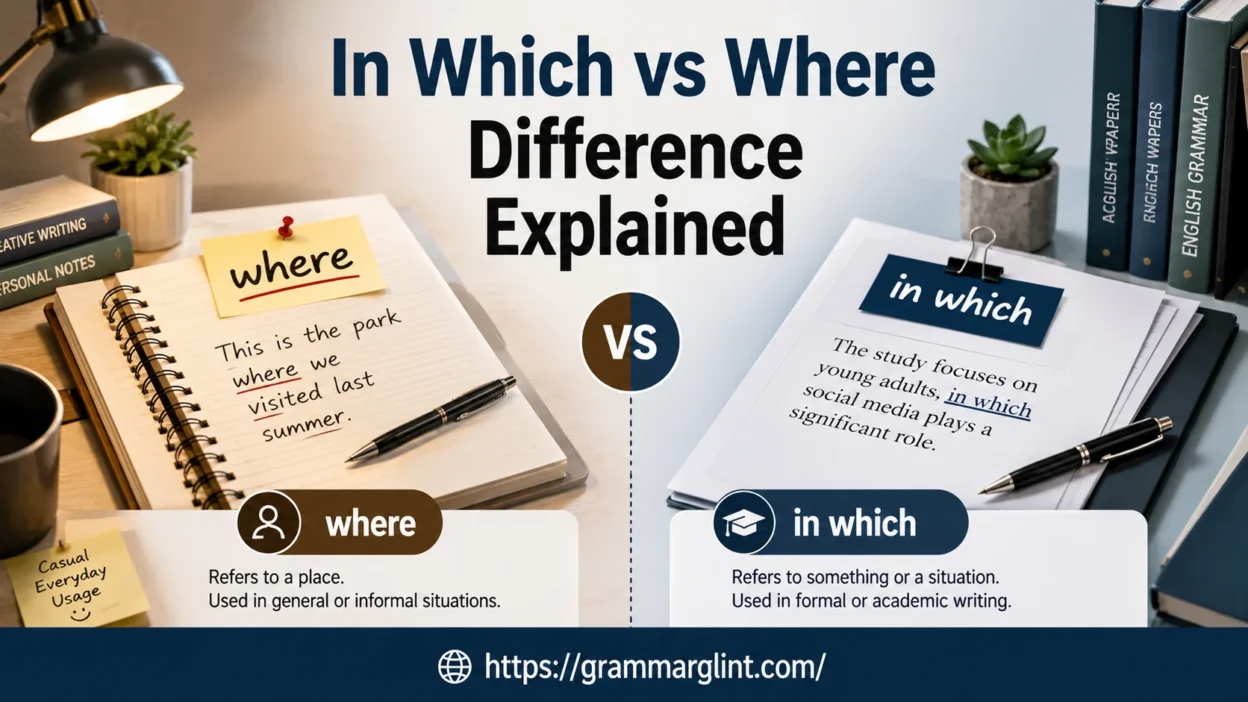
At the core, both “where” and “in which” point to a place or situation. But they build sentences in different ways.
- “Where” works as a relative adverb
- “In which” works as a preposition + relative pronoun structure
That sounds technical, but don’t worry. It’s simpler than it looks.
Think of it like this:
- “Where” = smooth shortcut
- “In which” = formal, structured version
Both lead you to the same destination. They just take different roads.
Why “In Which vs Where” Confuses So Many People
Here’s the real issue: English doesn’t always stay consistent.
Sometimes we say:
- The house where I live
- The house in which I live
Other times we say:
- A moment where everything changed
- A moment in which everything changed
Both work. That overlap creates confusion.
Now add style differences:
- Spoken English favors “where”
- Academic English leans toward “in which”
- Legal writing almost always prefers “in which”
So learners end up stuck between grammar rules and natural flow.
The Simple Rule for “In Which vs Where Difference Explained”
Let’s make this easy. No jargon.
Use “where” when:
- You are talking about a place (literal or figurative)
- You want natural, conversational English
- You don’t need formal precision
Use “in which” when:
- You want a formal tone
- You are writing academic, legal, or technical content
- You want to avoid ambiguity in complex sentences
That’s it. No overthinking needed.
Real-Life Examples
Let’s see how both forms work in real sentences.
Everyday English (Natural Flow)
- The café where we met feels special.
- The street where I grew up has changed a lot.
- A situation where patience matters most.
These feel smooth. You’d hear them in conversation.
Formal English (Structured Flow)
- The café in which we met feels special.
- The street in which I grew up has changed a lot.
- A situation in which patience matters most.
These sound more formal. They also feel slightly heavier.
Key Insight: Same Meaning, Different Tone
Here’s the important part:
“Where” and “in which” almost always carry the same meaning, but they shape tone differently.
Think of them like clothing:
- “Where” = casual outfit (jeans and a T-shirt)
- “In which” = formal outfit (suit and tie)
You wouldn’t wear a suit to the beach. And you wouldn’t wear flip-flops to court.
Context decides everything.
When “Where” Goes Beyond Physical Places
This is where English gets interesting.
“Where” doesn’t only refer to physical locations anymore. Modern English uses it in abstract situations too.
Examples:
- A case where evidence is missing
- A time where everything went wrong
- A scenario where mistakes happen easily
Notice something? These aren’t physical places.
Yet “where” still works because it acts like a mental or situational space.
This flexibility makes “where” extremely powerful in everyday writing.
When “In Which” Becomes the Better Choice
Now let’s switch gears.
“In which” shines when clarity matters more than style.
Use it in:
- Academic writing
- Legal documents
- Scientific explanations
- Technical descriptions
Example:
- The experiment in which temperature remained constant produced reliable results.
Why not use “where”?
Because “where” can feel too loose in technical writing. “In which” removes ambiguity.
Read More: X Times As Many As” vs. X Times More Than: Explained
Grammar Breakdown: What’s Actually Happening
Let’s simplify the structure.
Sentence 1:
- The house where I live
Sentence 2:
- The house in which I live
Now rewrite both into basic form:
- I live in the house
Now you see the transformation:
With “where”
- “where” replaces in the house
With “in which”
- “in which” directly preserves the preposition
So:
- “where” = compact replacement
- “in which” = explicit structure
That’s the key difference.
Preposition Placement: The Hidden Grammar Trick
English allows two ways to handle prepositions in relative clauses.
1. Preposition at the end (informal style)
- The place where I went to
- The chair where I sat on
2. Preposition in front (formal style)
- The place to which I went
- The chair on which I sat
Notice something important:
“In which” belongs to the second group:
- The place in which I lived
- The situation in which he failed
It keeps grammar tight and structured.
Common Mistakes With “Where” and “In Which”
Let’s fix some errors people make all the time.
❌ Incorrect:
- The reason where I left early
✔ Correct:
- The reason why I left early
- The reason for which I left early
❌ Incorrect:
- The place in where I studied
✔ Correct:
- The place where I studied
- The place in which I studied
❌ Incorrect hybrid:
- The city in where I live
This mixes two systems. It doesn’t work.
Naturalness Test: What Sounds Right?
Here’s a simple trick.
Read the sentence out loud.
Ask yourself:
Would I say this in a normal conversation?
Example:
- The park where we played as kids
Yes. Natural.
- The park in which we played as kids
Correct, but formal.
Now compare:
- The moment where everything changed (natural)
- The moment in which everything changed (formal)
Both work. But they feel different in tone.
Style Guide: Choosing Between “Where” and “In Which”
Let’s make it practical.
Casual Writing
Use “where”:
- Emails
- Blogs
- Social posts
Neutral Writing
Mix both depending on flow:
- Journalism
- General articles
Formal Writing
Prefer “in which”:
- Research papers
- Contracts
- Reports
Quick Reference Table
| Context | Preferred Form | Example |
| Daily conversation | where | The house where I live |
| Academic writing | in which | The study in which data was collected |
| Figurative situations | where | A moment where everything changed |
| Legal/technical writing | in which | The clause in which terms are defined |
| Spoken storytelling | where | A day where nothing went right |
Case Study: How Writing Tone Changes Meaning
Let’s look at a real-world style shift.
Scenario: A student writing an essay
Version 1 (Casual tone)
“The experiment where we changed the temperature showed different results.”
Version 2 (Formal tone)
“The experiment in which we changed the temperature showed different results.”
What changed?
Not the meaning. Only tone.
Version 2 feels more precise. Professors often prefer it.
Version 1 feels more natural and readable.
This is why understanding “In Which vs Where difference explained” matters. It helps you match tone to audience.
Mini Practice Section: Try This Yourself
Rewrite these sentences both ways:
1
- The room where I study
✔ The room in which I study
2
- The situation where he succeeded
✔ The situation in which he succeeded
3
- The country where she was born
✔ The country in which she was born
Notice something? You didn’t change meaning. You only changed tone and structure.
My Personal Experience as an English Language Specialist
As an English language specialist, I’ve found that one of the most common questions learners ask is whether they should use where or in which. At first glance, the two expressions seem interchangeable, so it’s easy to see why they cause confusion. However, after reviewing hundreds of essays, articles, emails, and other written materials, I’ve noticed that choosing the right one can significantly improve both clarity and tone.
In my editing work, I often see writers overuse in which because they believe it always sounds more intelligent or grammatically correct. In reality, where is usually the better choice in everyday writing because it feels natural and keeps sentences easy to read. On the other hand, in which has its place in academic papers, legal documents, technical reports, and other formal contexts where precision matters.
One technique I recommend is reading your sentence aloud. If in which makes the sentence sound unnecessarily stiff or complicated, where is probably the better option. If you’re writing for a professor, a client, or a professional audience, in which may provide the level of formality you’re aiming for. Thinking about your audience before choosing between the two has helped many of the writers I’ve worked with produce clearer, more effective English.
Over the years, I’ve learned that mastering grammar isn’t about memorizing every rule, it’s about understanding how language works in real situations. Once you recognize the difference in tone and purpose between where and in which, making the right choice becomes much more natural. That’s exactly why I created this guide: to simplify a grammar topic that often seems more complicated than it really is.
FAQs
1. What is the main difference between in which and where?
In which is more formal and precise, while where is simpler and usually used for places or locations in everyday English.
2. Can in which and where be used interchangeably?
Sometimes yes, but not always. In formal writing, in which is preferred when you need clarity or precision.
3. Is where only used for physical places?
Mostly yes, but it can also refer to situations or conditions, depending on context.
4. When should I use in which in writing?
Use in which in formal writing like essays, reports, or professional emails where accuracy matters.
5. Is where correct in academic writing?
Yes, but in which is often more preferred in academic or formal contexts.
6. Which one sounds more natural in speaking?
Where sounds more natural in daily conversation and spoken English.
7. Can I say “the place in which I live” or “the place where I live”?
Both are correct, but where I live is more common in everyday speech.
8. Why do learners get confused between in which and where?
Because both can refer to location, but they differ in formality and detail level.
9. Is in which always more formal than where?
Yes, generally in which is considered more formal and structured.
10. How can I improve usage of in which and where?
Practice reading and writing sentences, and focus on context to choose the correct form naturally.
Conclusion
Understanding In, Which, vs, Where is easier once you recognize the role each expression plays in a sentence. Where is the natural choice when referring to a place in everyday English, while in which is more formal and often appears in academic, legal, and professional writing. Choosing the right expression improves clarity, strengthens your writing, and helps your ideas flow naturally. The more you read and practice, the more instinctive this choice will become, allowing you to write with greater confidence in any situation.

Emma Brooke is an editor and language researcher at Grammar Glint. Her work centers on grammar rules, punctuation, word usage, and style consistency. Emma is passionate about transforming complex language concepts into clear, reader-friendly explanations. She contributes in-depth articles that help readers communicate more effectively and confidently in both academic and professional settings.