When people first come across “until”, they often wonder whether it includes the final date or not, especially when setting a clear time frame in real situations. This confusion usually appears when someone says “Is “Until [Date]” Inclusive or Exclusive?” while planning tasks, deadlines, or instructions. In everyday communication, this small detail matters a lot because even a single word can change how an entire message is understood.
Many learners ask whether “until” should include the date or exclude it, and this is exactly where the phrase becomes tricky. The expression “Until, [date]” is often used as a guide in explanations, showing how the idea of time works in language. It refers to “up time something happening”, meaning an action continues for a period and is still active as it approaches the given endpoint.
In simple terms, when I first tried to set a clear time frame, I also felt unsure about how “until” works in real use. I would read and recheck sentences again and again, trying to understand whether the meaning was inclusive or exclusive depending on the situation. This is where context becomes important, because the same phrase can feel slightly different based on how it is read and applied in daily communication.
The meaning becomes clearer when we see that “Until, [date]” often implies the action continues even on the arrival of the given date, rather than stopping before it. So the event usually keeps happening and only ends after reaching that date. This shows how usage changes understanding, and why people often refer to it as both inclusive and exclusive depending on interpretation.
In practice, once you understand this rule, setting instructions or deadlines becomes much easier. The action continues up to a certain point in time, and then finally stops at the end of the defined date. This simple clarity helps avoid confusion in communication, especially when giving directions or explaining schedules using “until” in real life.
What “Until [Date]” Means in Email Writing
At its core, the phrase “until [date]” describes a time boundary. It suggests continuity up to a certain point, but it does not clearly define whether that boundary is included or excluded.
In everyday language:
- “Until Friday” = something continues up to Friday
- But it does not clearly say if Friday is part of the allowed time window
That missing clarity is the root of the confusion.
Simple reality check
If someone writes:
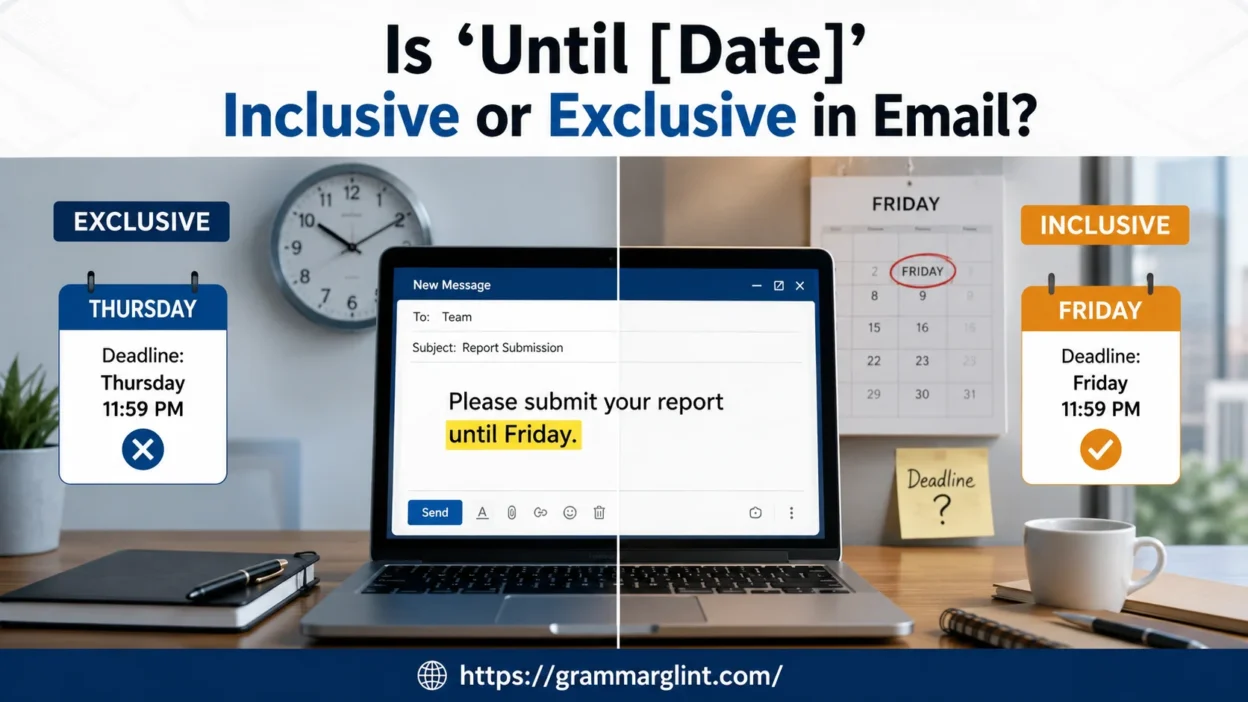
“Send your report until Friday.”
You are left guessing:
- Do I send it on Friday morning?
- Is Friday already too late?
- Does it stop at Thursday night?
There is no single correct answer without context.
Inclusive vs Exclusive Meaning of “Until [Date]”
To understand the confusion properly, you need to see both interpretations.
Exclusive meaning (common in formal settings)
In many professional, legal, and structured environments, “until [date]” is treated as exclusive.
That means:
- The deadline ends before the stated date begins
- “Until Friday” = last acceptable moment is Thursday 11:59 PM or business close
Where this interpretation is common
- Legal contracts
- Government notices
- Corporate policy documents
- Technical instructions
Why professionals prefer this
It reduces risk. In formal systems, ambiguity is expensive. So people prefer the stricter interpretation.
A compliance officer once summed it up neatly:
“If it can be misunderstood in legal communication, assume the stricter version.”
Inclusive meaning (common in casual communication)
In informal emails and conversations, “until [date]” often includes the date itself.
So:
- “Until Friday” = Friday is still valid
- Submissions on Friday morning or even end of day may be accepted
Where this interpretation appears
- Workplace chat messages
- Casual manager-to-team emails
- Everyday scheduling conversations
- Small team projects
Why this happens
People speak loosely in daily communication. They assume shared understanding that doesn’t always exist.
Why “Until [Date]” Is So Ambiguous in Emails
The problem is not the phrase itself. The problem is missing structure.
Let’s break down why confusion happens.
No built-in time definition
“Until Friday” does not include:
- Start time
- End time
- Time zone
- Business hours vs full day
Without those details, interpretation becomes guesswork.
Different workplace cultures
A global team makes this even worse.
For example:
- In one company, deadlines mean business hours only
- In another, deadlines mean 11:59 PM local time
- In remote teams, time zones clash constantly
So the same phrase produces different expectations.
Human assumption bias
People naturally fill in missing information.
If someone is used to flexible deadlines, they assume inclusion.
If someone works in structured environments, they assume exclusion.
That’s why two smart people can read the same sentence and disagree completely.
Read More: Matter or Matters: Which Is Correct?
Inclusive vs Exclusive Interpretation in Real Life
Let’s see how this plays out in actual email scenarios.
Example scenario
Manager writes:
“Please submit your weekly updates until Monday.”
Now observe two interpretations:
- Employee A: submits Sunday night
- Employee B: submits Monday afternoon
Now the conflict:
- Manager expected Sunday cutoff
- Employee expected full Monday availability
Result: confusion and frustration
How Industries Interpret “Until [Date]”
The meaning of “until” shifts depending on context. Here’s how it typically works.
Corporate business communication
In structured companies:
- “Until [date]” usually means exclusive
- Deadlines often end at 5:00 PM or business close
Example:
“Submit until Friday” = submit before Friday starts or by business close Thursday
Legal and contractual language
Legal systems remove ambiguity as much as possible.
- “Until” is interpreted strictly
- Dates are enforced precisely
- Often replaced with “on or before”
Example:
“Payment due until 10 June” is avoided entirely in legal writing
Instead:
- “Payment due on or before 10 June”
Education and academic systems
Universities vary widely:
- Online systems often use automatic timestamps
- Some professors accept submissions until midnight
- Others close submissions at class time
So “until Friday” depends heavily on instructor clarity.
Customer service communication
Customer-facing emails tend to be more flexible:
- “Offer valid until Friday” often includes Friday
- But cut-off times still apply behind the scenes
Example:
- “until Friday” may still end at 11:59 PM system time
The Real Problem: “Until” Lacks Time Precision
Let’s be honest. The biggest issue is not the word “until.”
It’s the missing details.
Compare these:
Weak version
“Apply until Friday”
Strong version
“Apply by Friday at 5:00 PM (PST)”
The difference is massive.
One creates confusion. The other removes it completely.
Better Alternatives to “Until [Date]” in Emails
If you want to avoid misunderstandings, you need better phrasing.
Use “By [Date]”
This is the most reliable option.
- Means: before or at the deadline
- Works well in business communication
Example:
“Submit the report by Friday.”
Use exact date and time
This removes nearly all confusion.
Example:
“Submit by Friday, June 20 at 11:59 PM PST.”
This works especially well for:
- Remote teams
- International communication
- Automated systems
Use “On or before”
This is slightly more formal but still clear.
Example:
“Complete registration on or before Friday.”
Avoid “until” for deadlines
A simple rule:
- Use “until” for duration
- Use “by” for deadlines
Example:
- Duration: “We work until Friday”
- Deadline: “Submit by Friday”
How to Interpret “Until [Date]” When You Receive It
If you receive a vague deadline, don’t guess. Follow a simple method.
Step-by-step approach
- Check the sender’s past emails
- Look for time patterns (5 PM, midnight, etc.)
- Check industry norms
- Look for hidden hints in the message
When unsure, ask directly
This is the safest move.
Example email:
“Just confirming, does ‘until Friday’ include Friday or is Thursday the deadline?”
This avoids misunderstandings and protects your work.
Common Mistakes People Make with “Until [Date]”
Let’s look at where people usually go wrong.
Assuming inclusion automatically
This is the most common mistake.
People assume Friday is included without confirmation.
Ignoring time zones
Remote work makes this critical.
- 11:59 PM in one country is daytime in another
- Deadlines shift without notice
Missing business hour restrictions
Many companies don’t run deadlines at midnight.
They close submissions at:
- 5:00 PM
- 6:00 PM
- End of shift
Real-World Scenarios Where Confusion Causes Problems
Let’s make this practical.
Project management delays
A team misreads “until Friday” and submits late.
Result: delayed release cycle and extra work for QA teams.
Job application rejection
An applicant submits on Friday afternoon.
System closed at Friday morning cutoff.
Application rejected automatically.
Payroll errors
HR sets “until Monday” for submission.
Employees submit at different times.
Payroll processing gets delayed.
Client disputes
Client expects delivery before Friday.
Agency delivers Friday evening.
Client rejects work.
Best Practices for Writing Clear Email Deadlines
If you write emails, this is where you can fix everything.
Always include three things
- Exact date
- Exact time
- Time zone
Example:
“Deadline: Friday, 20 June 2026 at 5:00 PM PST”
Avoid vague phrasing
Don’t use:
- “until next week”
- “until Friday evening”
- “soon”
These create interpretation gaps.
Use structured formats
Good format:
| Element | Example |
| Deadline | Friday, 20 June |
| Time | 5:00 PM |
| Zone | PST |
Quick Comparison Table: “Until” vs Better Alternatives
| Phrase | Clarity | Risk of Misunderstanding | Recommended |
| Until Friday | Low | High | No |
| By Friday | High | Low | Yes |
| On or before Friday | High | Low | Yes |
| Until end of Friday | Medium | Medium | Sometimes |
My Personal Experience as an English Language Specialist
Over the years, I’ve worked with English grammar, vocabulary, and real-world writing examples, and I’ve learned that many mistakes happen because words and rules can look very similar. Even experienced writers sometimes need a moment to choose the right spelling or expression.
As an English language specialist, I focus on making grammar explanations clear, accurate, and easy to understand. I use trusted references and practical examples to help readers see not just the correct answer, but also why it is correct and how to use it confidently in everyday writing.
FAQs
1. What does “Until [Date]” mean in simple English?
It means an action continues up to a specific date before it stops or changes.
2. Is “Until [Date]” Inclusive or Exclusive?
It is often considered inclusive, meaning the action continues on the date itself before stopping after it.
3. Why do people get confused about “until”?
Because the word “until” can be interpreted differently depending on context and sentence structure.
4. Does “until” always include the end date?
Not always. In most natural usage, it includes the date, but sometimes context can make it feel exclusive.
5. What does “up to the time something happens” mean?
It means the action continues until the exact moment or time the event or date arrives.
6. Can “until” be used for deadlines?
Yes, it is commonly used to set time frames, deadlines, and instructions.
7. What happens after the given date in an “until” sentence?
The action usually stops or changes after the given date.
8. Is “Until, [date]” grammatically correct?
Yes, it is used in explanations to show the idea of continuity up to a date.
9. Why is usage important in understanding “until”?
Because meaning depends on how the phrase is used in real-life context.
10. How can I avoid confusion with “until”?
Always check whether the action is meant to continue through the date or stop before it.
Conclusion
Understanding “Until [Date]” becomes easier once you focus on how the time frame is described in context. The phrase generally suggests that an action continues up to and includes the date, making it more inclusive in most real-life usage. However, the exact meaning can shift slightly depending on how the sentence is written and interpreted.
In everyday communication, clarity matters more than strict rules. When you use “until”, always make sure the intended meaning is clear so there is no confusion about whether something continues through the date or ends before it.

Aria Jane is a senior language writer and grammar specialist at Grammar Glint. She focuses on English grammar, spelling variations, vocabulary, and writing clarity. Through detailed research and practical examples, Aria helps readers understand language rules and avoid common mistakes. Her articles are designed to make English learning accessible for students, professionals, and everyday writers seeking reliable language guidance.