Many people have paused while writing an email and wondered about the correct choice between Onward and Onwards, as both terms appear frequently in daily English language usage. This confusion is common because both words look almost the same and are often used in similar situations. This article explores the nuanced differences between these adverbs by explaining their meaning, context, and style. Understanding these small differences helps improve writing accuracy and makes communication clearer in different situations.
Both forms indicate movement, direction, continuation, and progression with a forward sense. The main difference is not about meaning but about preference, region, and tone. The comparison between Onward or Onwards creates a better understanding of their role in grammar and expression. People often search “onward or onwards which is correct” because this small spelling choice can create confusion, even though both forms are accepted and correct.
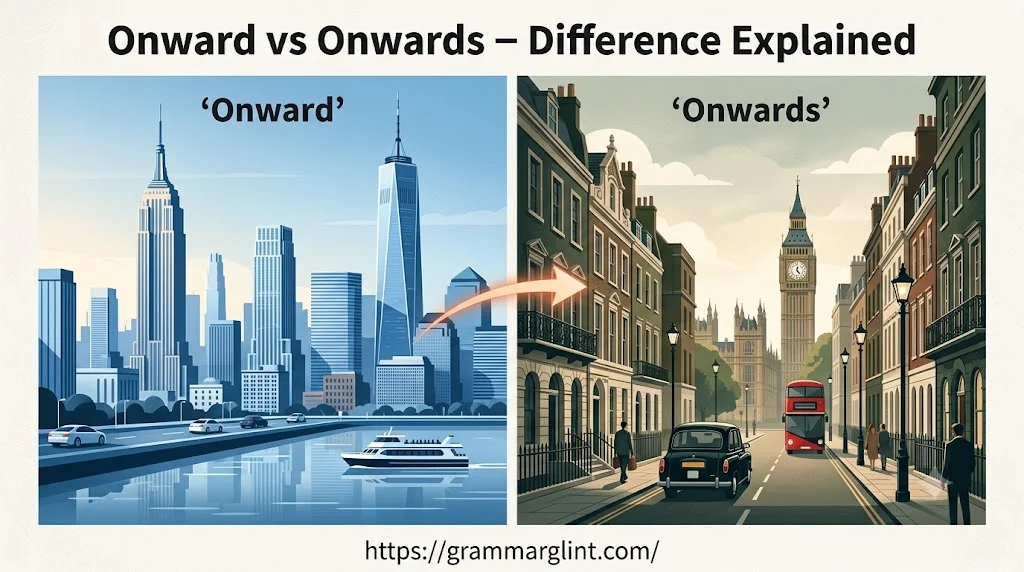
The choice between these words depends on the audience, tone, and region where the language is being used. American English commonly uses Onward as a preferred form, and it is more frequently used in situations where the writer wants to create a formal and determined connotation. It often gives a sense of progress, achievement, and moving ahead with purpose. In contrast, British English often prefers Onwards, which may sound slightly more relaxed and suggests a less formal or longer-duration type of progression.
In everyday communication, contextual preferences matter because language changes according to formal writing, casual conversation, informal writing, and speaking styles. Both words can support clear expression, but choosing the more suitable form can improve communication clarity and overall clarity. With practice, the difference becomes easier to recognize, allowing writers and speakers to use Onward and Onwards naturally.
Difference Explained in Simple Terms
Let’s start with the quick answer because that’s what most people need.
Both onward and onwards mean the same thing:
👉 moving forward in time, direction, or progress.
The difference is not meaning. It’s mainly about usage style and region.
- Onward → more common in American English and formal writing
- Onwards → more common in British English and informal speech
Think of it like two doors leading to the same room. The path is the same. The style of walking through it is slightly different.
What “Onward” and “Onwards” Actually Mean
Before we compare them, it helps to understand what they really express.
At their core, both words describe movement forward. That movement can be:
- Time moving ahead
- Physical direction forward
- Progress in a plan or situation
Simple meaning breakdown:
- Onward = forward, ahead, continuing
- Onwards = forward, ahead, continuing (same meaning, different style)
Real-world examples:
- “From today onward, things will change.”
- “From today onwards, things will change.”
Both sentences are correct. Both sound natural. The difference is subtle and mostly regional.
Why This Confusion Exists in the First Place
English is a mixed language shaped by centuries of regional evolution. American English and British English often develop slightly different preferences for the same word.
This is why you’ll notice:
- British English often adds “-s” in casual adverbs (towards, backwards, onwards)
- American English often prefers the shorter form (toward, backward, onward)
It’s not a grammar rule that breaks anything. It’s more like a style habit that stuck over time.
Core Difference Between Onward and Onwards
Let’s break it into clear categories so you can actually remember it.
Regional usage difference
- Onward → American English preference
- Onwards → British English preference
This is the biggest difference in real usage.
Formality level
- Onward → slightly more formal, clean, direct
- Onwards → more conversational and fluid
Style consistency
Writers usually stick to one form depending on:
- Their audience
- Their publication style
- Their region
Mixing both in one article is not wrong, but it looks inconsistent.
Read More: Is “Until [Date]” Inclusive or Exclusive? (Email Deadline Meaning)
When to Use “Onward”
Use onward when you want a clean, professional, or American-style tone.
Best situations for “onward”:
- Business communication in the US
- Academic writing
- Formal reports
- Instructions or policies
- Military or structured communication
Examples:
- “From Monday onward, new rules will apply.”
- “The team moved onward with the project.”
- “We continue onward despite challenges.”
You’ll notice it feels a bit sharper and more direct. That’s why it fits formal writing better.
When to Use “Onwards”
Use onwards when your tone is more relaxed or you’re writing in British English.
Best situations for “onwards”:
- UK English writing
- Casual speech
- Storytelling or narrative writing
- Friendly emails or conversations
Examples:
- “We walked onwards through the quiet streets.”
- “From here onwards, things get more interesting.”
- “Life moves onwards whether we’re ready or not.”
It has a slightly softer rhythm, which makes it feel more natural in storytelling.
Side-by-Side Comparison Table
Sometimes seeing things visually makes everything click faster.
| Situation | Preferred Form | Example Sentence |
| US business email | Onward | From next week onward, the policy changes |
| UK casual speech | Onwards | From next week onwards, things change |
| Formal report | Onward | Progress continues onward |
| Storytelling | Onwards | The journey continues onwards |
| Academic essay (US) | Onward | Research moves onward in this field |
| Narrative writing (UK) | Onwards | The hero travels onwards into the unknown |
Subtle Grammar Insight Most People Miss
Here’s something interesting.
Both onward and onwards function as adverbs, but they also behave slightly like directional markers in phrases such as:
- from here onward/onwards
- move onward/onwards
- continue onward/onwards
There is no strict grammar rule forcing one over the other. Instead, it comes down to language tradition.
That’s why even professional writers sometimes choose based on rhythm rather than rules.
Common Mistakes People Make
Let’s fix a few misunderstandings that show up often.
❌ Thinking one is correct and the other is wrong
Both are correct. Neither is incorrect.
❌ Mixing styles randomly
Switching between onward and onwards in the same document can confuse readers.
❌ Overthinking the difference
Most native speakers don’t consciously think about it. They just follow regional habit.
❌ Using it in overly rigid grammar thinking
English is flexible here. Context matters more than strict rules.
Easy Memory Trick to Remember the Difference
Here’s a simple way to lock it in your mind:
- Onward = American = clean and direct
- Onwards = British = softer and flowing
Or think of it like this:
👉 “The extra -s adds a little softness in British English.”
This small mental shortcut works surprisingly well when you’re writing quickly.
Real-Life Usage Examples
Let’s see how these words show up in everyday situations.
Workplace communication
- “We move onward with the next phase of development.”
- “We proceed onwards with the next phase.”
Travel writing
- “The train moved onward toward the city.”
- “The train moved onwards through the countryside.”
Academic writing
- “Research continues onward in artificial intelligence.”
Storytelling
- “The traveler journeyed onwards into the desert night.”
Each example shows how tone shifts slightly depending on the word choice.
Case Study: Same Sentence, Two Styles
Let’s take a single idea and rewrite it both ways.
Sentence idea:
A company is moving forward after restructuring.
American English style:
“The company will move onward with its new strategy following restructuring.”
British English style:
“The company will move onwards with its new strategy following restructuring.”
What changes?
- Nothing in meaning
- Slight shift in rhythm
- Different regional feel
This shows how small language choices shape tone without changing facts.
Why Consistency Matters More Than Perfection
Here’s a truth many writers overlook.
Readers don’t care which form you choose. They care about consistency.
If you start with onward, stick with it.
If you choose onwards, stay consistent throughout.
Consistency builds:
- clarity
- professionalism
- readability
In contrast, mixing forms can make writing feel careless even if everything is technically correct.
Simple Rules You Can Follow Every Time
If you want a no-stress approach, just follow this:
- Writing for US audience? → Use onward
- Writing for UK audience? → Use onwards
- Not sure? → Pick one and stay consistent
- Writing formally? → Lean toward onward
- Writing casually or narratively? → onwards feels natural
That’s it. No extra complexity needed.
My Personal Experience as an English Language Specialist
From my experience as an English language specialist, I have noticed that many writers hesitate when choosing between Onward and Onwards because they believe one form must be more correct than the other. In reality, both words are accepted in English, and the choice usually depends on writing style, regional preference, and the feeling a writer wants to create.
While reviewing articles, emails, and professional documents, I often see people focus too much on finding a “right” answer instead of understanding how language works in different contexts. I usually explain that Onward often feels more direct and formal, which makes it a common choice in American English, especially in professional communication. Onwards, on the other hand, has a softer and more conversational flow that many British English speakers naturally prefer.
Over time, I have learned that effective communication is not only about following grammar rules. It is also about understanding tone, audience, and purpose. A skilled writer knows when a word sounds natural and how small choices can influence the overall impression of a message.
My advice to learners and writers is simple: do not worry about choosing between Onward and Onwards as if one is correct and the other is wrong. Focus on consistency and context. Once you understand the subtle difference in style, you can use both forms confidently and make your writing sound more natural and professional.
FAQs
1. Is Onward or Onwards correct?
Both Onward and Onwards are correct words. The difference is mainly based on region, style, and context rather than meaning.
2. What is the main difference between Onward and Onwards?
The main difference is usage preference. Onward is more common in American English, while Onwards is often preferred in British English.
3. Can Onward and Onwards be used with time?
Yes, both can be used with time expressions. Examples include From today onward, 7pm onward or onwards, and similar phrases showing continuation.
4. Does Onwards mean something different from Onward?
No, both words have an identical meaning. They describe moving in a forward direction or continuing something.
5. Which form is better for formal writing?
Onward is often considered more suitable for formal writing, especially in American English contexts.
6. Why do people get confused between Onward and Onwards?
People often get confused because the words look almost identical and both are used for movement, progression, and continuation.
7. Is Onwards only used in British English?
No, Onwards can also appear in other varieties of English, but it is more commonly associated with British English.
8. Can I use Onward in daily conversation?
Yes, Onward can be used in daily life, conversation, and writing. The choice depends on your preferred style.
9. Does the audience affect the choice between Onward and Onwards?
Yes, the audience, tone, and situation can influence which word sounds more natural.
10. How can I remember the difference between Onward and Onwards?
Remember that Onward is often linked with American English and a more formal tone, while Onwards is commonly linked with British English and a more relaxed style.
Conclusion
Understanding the difference between Onward and Onwards becomes simple once you recognize that both words carry the same basic meaning: moving forward, continuing, or progressing. The main distinction lies in regional preference and writing style rather than correctness. Onward is more common in American English and often appears in formal or motivational contexts, while Onwards is frequently preferred in British English and can sound more conversational.
Both forms are correct, so the best choice depends on your audience, location, and the tone you want to create. Whether you write “from this point onward” or “from this point onwards,” your meaning remains clear. By understanding these small differences, you can make more confident language choices and communicate more naturally in both professional and everyday writing.

Aria Jane is a senior language writer and grammar specialist at Grammar Glint. She focuses on English grammar, spelling variations, vocabulary, and writing clarity. Through detailed research and practical examples, Aria helps readers understand language rules and avoid common mistakes. Her articles are designed to make English learning accessible for students, professionals, and everyday writers seeking reliable language guidance.