When I explored the word aunty and auntie, I noticed that the English language contains many words that are spelled differently across different regions and countries. These small variations often appear because of changes in language, local dialects, and everyday communication. Both terms are correct and recognized by dictionaries, which shows that each spelling has an accepted place in English usage and grammar.
The words aunty and auntie are commonly used informally to refer to an aunt. This usually means a sister of either parent or the spouse of an uncle. In many family contexts, the reference can also describe an older woman who may be related to you or may simply be someone close and respected. The meaning depends on the social relationship, personal connection, and the way people use these expressions.
The spelling choice also reflects regional differences in English-speaking communities. Auntie is generally more common in British English and many Commonwealth countries, while aunty is often found in casual writing, family conversations, and certain regional expressions. These forms continue to exist because people use language naturally based on their surroundings, habits, and cultural background.
These endearing forms provide useful insights into vocabulary, terminology, and the significance of simple family phrases. The use of aunty or auntie can show warmth, respect, and affection. A person’s mother or father may have a sibling, but the same friendly reference can also be used for a close female friend or a respected woman in social settings.
Understanding these small spelling choices helps explain how English develops across places and communities. The context, meaning, and usage behind these words are often more important than choosing only one form. Both spellings represent a familiar relationship and remain part of everyday communication.
What Is the Difference?
At first glance, “aunty” and “auntie” look different. However, their meaning is almost identical.
Both words are informal versions of the word “aunt.”
An aunt traditionally means:
- Your mother’s sister.
- Your father’s sister.
- The wife of your uncle.
However, language often grows beyond dictionary definitions. In many cultures, “aunty” or “auntie” becomes a warm and respectful title for women who are not biologically related.
You might call a close family friend “auntie” because she helped raise you, cared for you, or played an important role in your life.
Example:
“My auntie always supported me when I was younger.”
This sentence could mean a biological aunt or a loved older woman depending on the situation.
The spelling changes, but the emotional meaning stays the same.
Are Aunty and Auntie Different Words?
Not really.
The difference is mainly spelling preference rather than meaning.
Think of it like other English variations:
| Word Variation | Example |
| Color / Colour | American vs British spelling |
| Favorite / Favourite | American vs British spelling |
| Aunty / Auntie | Regional and cultural spelling |
English has many words with different spellings depending on location. “Aunty” and “Auntie” follow the same pattern.
The important thing is consistency.
If you choose one spelling for an article, story, or document, stick with it throughout.
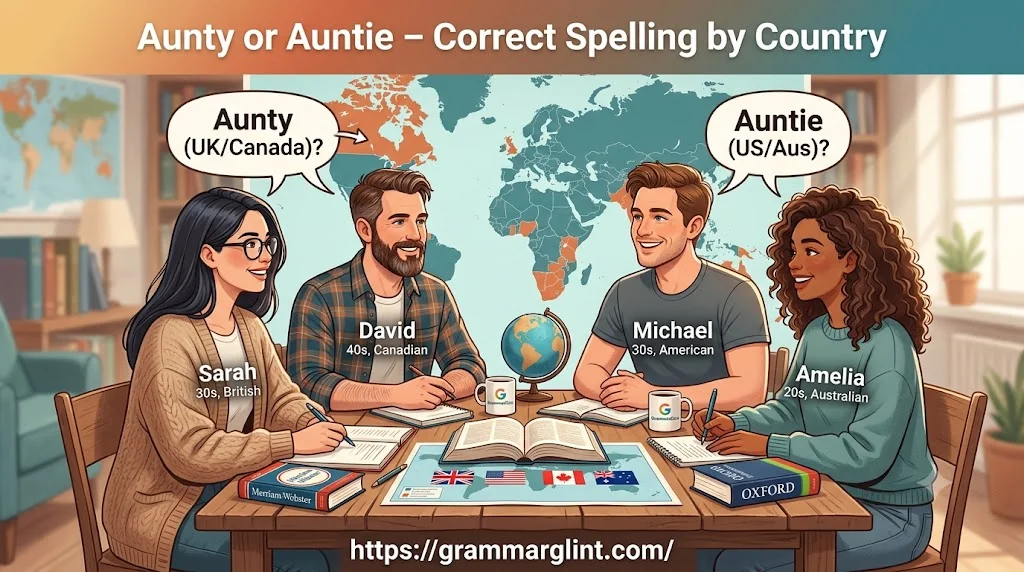
Aunty or Auntie Correct Spelling by Country
The “correct” spelling changes depending on the English style being used.
There is no single worldwide rule that makes one version right and the other wrong.
United States: Auntie Is More Common
In American English, “auntie” is the more common spelling.
Many Americans use it when speaking about a close relative or an affectionate family figure.
Examples:
- “My auntie lives in California.”
- “I visited Auntie Mary last weekend.”
The spelling with “-ie” often feels softer and more affectionate in American writing.
However, “aunty” is still understandable. It may appear because of cultural influence, personal preference, or international communication.
United Kingdom: Auntie Is Traditionally Preferred
British English also commonly uses “auntie.”
The word often appears in family conversations and children’s speech.
Examples:
- “Auntie Sarah gave me this book.”
- “I’m going to my auntie’s house.”
The UK has a long tradition of using “-ie” endings for affectionate words.
Other examples include:
- Mummy
- Daddy
- Granny
- Doggy
These endings often create a warmer or more personal feeling.
Australia: Aunty Is Widely Used
Australian English often prefers “aunty.”
This spelling appears frequently in casual writing and everyday conversation.
Australia also uses “aunty” in broader cultural contexts. In some communities, especially among Aboriginal and Torres Strait Islander peoples, “Aunty” can be a respectful title for an older woman or respected community member.
In these cases, the word carries more meaning than a simple family connection.
It can represent:
- Respect
- Wisdom
- Experience
- Community status
New Zealand: Aunty and Auntie Both Appear
New Zealand English uses both spellings.
However, “aunty” is common in everyday informal use.
Cultural influences, including Māori community practices, also shape how respectful titles are used.
The meaning often depends on the relationship between the speaker and the person being addressed.
Canada: Both Spellings Are Accepted
Canada sits between British and American language influences.
Because of this, Canadians may use either spelling.
You might see:
- “Auntie” in families influenced by American English.
- “Aunty” in families influenced by British, Australian, or South Asian English.
Neither choice looks unusual.
South Asia: Aunty Is Extremely Common
In countries such as India, Pakistan, and Bangladesh, “aunty” is one of the most common forms.
The word often extends beyond family relationships.
For example, someone may say:
“Aunty, could you please help me?”
The person may not be related at all. Instead, the term shows politeness and respect.
This usage reflects cultural values around relationships and community.
In many South Asian societies, older adults often receive respectful titles instead of being called only by their names.
Country Comparison Table
| Country | Common Spelling | Usage Style |
| United States | Auntie | Family and affectionate use |
| United Kingdom | Auntie | Traditional British English |
| Australia | Aunty | Common everyday spelling |
| New Zealand | Aunty/Auntie | Both accepted |
| Canada | Both | Mixed influence |
| India | Aunty | Family and respectful title |
| Pakistan | Aunty | Common social term |
| Bangladesh | Aunty | Respectful everyday address |
Why Do Two Spellings Exist?
The English language is full of small variations. Words change because people use language differently across regions and generations.
The difference between aunty and auntie comes from informal speech becoming written language.
Many family words develop multiple spellings because people write them the way they hear them.
For example:
- Mommy and Mummy
- Granny and Grannie
- Doggy and Doggie
These words often use endings like:
- -y
- -ie
Both endings create a friendly or familiar tone.
The Role of Informal English
English does not stay frozen. People shape it every day through conversations.
Children often hear affectionate versions of words before learning formal spelling rules.
A child may hear:
“Go ask Auntie.”
Later, they may write:
“Go ask Aunty.”
Both versions can become accepted depending on the community.
Language grows naturally. It is not always controlled by strict rules.
Is “Aunty” Grammatically Correct?
A common question people ask is:
“Is aunty a real word, or is auntie the only correct spelling?”
The answer is simple: yes, “aunty” is a correct and accepted spelling.
Many people assume one version must be wrong because English often has strict spelling rules. However, English also has many accepted variations that developed through history, culture, and everyday speech.
“Aunty” appears in dictionaries and is widely used in different English-speaking regions.
The key difference is not correctness. It is usage and preference.
For example:
- A writer in Australia may naturally choose aunty.
- A writer in the United States may prefer auntie.
- A South Asian speaker may use aunty in everyday conversations.
All of these choices can be correct.
Read More: People Who vs People That: Correct Usage Explained
In Formal and Informal Writing
Choosing between “aunty” and “auntie” often depends on where you use the word.
Informal Writing
In personal messages, stories, social media posts, or family conversations, both forms work well.
Examples:
- “I’m visiting my auntie tomorrow.”
- “My aunty made the best cake.”
These sentences sound natural because the words are usually connected with personal relationships.
Formal Writing
Formal writing usually uses the standard word:
Aunt
Examples:
- “My aunt attended the ceremony.”
- “I spoke with my aunt yesterday.”
Why?
Because “aunt” is the neutral dictionary form. It works well in:
- Business writing
- Academic assignments
- Official documents
- Professional communication
However, if you are writing a personal story or memoir, “auntie” or “aunty” may create a warmer tone.
How to Choose Between Aunty and Auntie
There is no complicated rule. Consider three things:
Your Audience
Who will read your writing?
If your audience mainly uses American English, “auntie” may feel more natural.
If your audience uses Australian or South Asian English, “aunty” may fit better.
Your Location
Regional habits matter.
Using the common spelling of your region makes your writing feel more natural.
A sentence can be grammatically correct but still sound unusual if it does not match local language patterns.
Your Tone
The spelling can slightly change the feeling.
| Spelling | Common Feeling |
| Aunt | Neutral and formal |
| Auntie | Warm and affectionate |
| Aunty | Friendly and familiar |
These differences are subtle, but they influence how readers perceive the word.
Cultural Meaning of Aunty Around the World
The word “aunty” carries more than a family meaning in many cultures.
It can represent connection, respect, and belonging.
Family Meaning
The original meaning is straightforward.
An aunty or auntie is a family member who is connected through your parents or relatives.
Many people have special relationships with their aunts because they often play important roles in childhood.
An aunt may be:
- A trusted advisor
- A caregiver
- A supporter
- A mentor
For many people, an aunt is not just another relative. She is someone who creates lasting memories.
Social Meaning
In some societies, “aunty” becomes a respectful title.
For example, in parts of South Asia, children and adults may use “aunty” when speaking to an older woman.
The person may not be related by blood.
This practice shows:
- Respect for age
- Politeness
- Community connection
A similar idea appears in different cultures with words like:
- Uncle
- Sister
- Brother
- Grandma
These terms often move beyond literal family relationships.
Examples in Sentences
Understanding real examples makes the difference easier to remember.
Family Examples
Auntie:
My auntie bought me a birthday gift.
Aunty:
My aunty lives near our house.
Both sentences have the same meaning.
Respectful Address Examples
South Asian style:
Aunty, would you like some tea?
The speaker may be talking to a neighbor, family friend, or older woman.
Storytelling Examples
A writer might choose:
“Auntie Rose always told the funniest stories.”
The spelling creates a warm, personal feeling.
Capitalization Rules
Capitalization depends on how you use the word.
Use Lowercase When It Is General
Example:
My auntie lives in London.
Here, “auntie” is simply a family relationship.
Use Capital Letters When It Acts Like a Name
Example:
Auntie Sarah visited us yesterday.
Here, “Auntie Sarah” works like a title before a name.
The same rule applies to:
- Uncle John
- Grandma Mary
- Doctor Smith
Common Mistakes People Make
Even though these words are simple, people often make small mistakes.
Mistake 1: Thinking One Spelling Is Always Wrong
Many people believe:
“Only auntie is correct.”
or:
“Only aunty is correct.”
Reality:
Both spellings are accepted.
Mistake 2: Mixing Styles in the Same Article
Consistency matters.
For example:
Incorrect style:
My auntie lives nearby. My aunty visits every week.
This is not technically wrong, but it can look inconsistent.
Better:
My auntie lives nearby. My auntie visits every week.
Choose one style and keep it.
Mistake 3: Using Informal Forms in Professional Writing
A business email usually sounds better with:
My aunt will attend the event.
Instead of:
My auntie will attend the event.
The formal version fits the situation better.
Case Study: How Regional English Changes Word Choice
Imagine three people writing the same sentence.
The sentence:
“I visited my aunt yesterday.”
Person A from the United States writes:
“I visited my auntie yesterday.”
Person B from Australia writes:
“I visited my aunty yesterday.”
Person C from the United Kingdom writes:
“I visited my auntie yesterday.”
The meaning stays exactly the same.
Only the regional preference changes.
This shows an important point:
Language is shaped by communities, not just grammar books.
Why Language Variations Matter
Small spelling differences tell stories about history and culture.
The word “aunty” shows how English changes as people use it in different places.
A language is like a living tree. Different branches grow in different directions, but they still belong to the same tree.
English has spread worldwide, and every region has added its own style.
That is why words like:
- Aunty
- Auntie
- Mum
- Mom
- Colour
- Color
all exist.
My Personal Experience as an English Language Specialist
As an English language specialist, I’ve often seen learners become confused by words that have more than one accepted spelling. One question that comes up repeatedly is whether Aunty or Auntie is the correct form. At first, many people assume one must be wrong, but after examining dictionaries, style guides, and real-world usage, it becomes clear that both spellings are correct. The real difference lies in regional English and cultural preference rather than grammar.
Over the years, I’ve learned that understanding these subtle spelling variations helps writers communicate more naturally with their audience. Whether I’m editing content, teaching grammar, or answering language questions, I always emphasize that context matters more than memorizing a single “correct” spelling. Exploring differences like Aunty vs. Auntie not only improves writing accuracy but also provides a deeper understanding of how English evolves across countries, cultures, and everyday communication.
FAQs
1. Are Aunty and Auntie both correct spellings?
Yes, both aunty and auntie are accepted spellings used in English. They are informal terms for an aunt and are recognized in many dictionaries.
2. What is the difference between Aunty and Auntie?
The main difference is spelling and regional usage. Auntie is often more common in British English and Commonwealth countries, while aunty is also widely used in casual communication.
3. Which spelling is more common in British English?
Auntie is generally more common in British English. However, aunty is still understood and used in informal contexts.
4. Does aunty only refer to a family member?
No, aunty can refer to an actual aunt, such as a parent’s sibling, or an older woman who is respected and treated with affection.
5. Can auntie be used for someone who is not related?
Yes, auntie can be used for a close female friend or respected woman even without a direct family relationship.
6. Why do English words have different spellings in different countries?
English changes across regions because of cultural influences, local dialects, and differences in everyday language usage.
7. Is one spelling more grammatically correct than the other?
No, both spellings are considered correct. The choice depends on personal preference, location, and writing style.
8. Are aunty and auntie formal words?
Both are mostly informal and are commonly used in family conversations, friendly expressions, and everyday communication.
9. What does the word aunt usually mean?
An aunt usually means the sister of your mother or father, or the spouse of an uncle.
10. How should I choose between Aunty and Auntie?
Choose based on your audience and region. Both forms share the same meaning, connection, and affectionate reference.
Conclusion
The difference between Aunty and Auntie is simply a matter of regional spelling, not meaning. Both words refer to an aunt or a respected older woman and are widely accepted in everyday English. Auntie is more common in British English, while Aunty is often seen in informal writing and certain regional varieties. Choosing the version that matches your audience will make your writing feel more natural.
Language evolves through culture, geography, and daily use, which is why both spellings continue to exist. Instead of focusing on which one is “right,” pay attention to consistency and context. Whether you write Aunty or Auntie, your readers will understand the same warm, affectionate meaning.

Aria Jane is a senior language writer and grammar specialist at Grammar Glint. She focuses on English grammar, spelling variations, vocabulary, and writing clarity. Through detailed research and practical examples, Aria helps readers understand language rules and avoid common mistakes. Her articles are designed to make English learning accessible for students, professionals, and everyday writers seeking reliable language guidance.