When learning the English language, many learners find grammar confusing because some irregular nouns can look and act differently from standard nouns. These differences often create doubts, especially when people try to understand how words behave in different situations. The topic “Is There Any News or Are There Any News?” creates a common question about plurality and the correct use of the word news in everyday communication.
Many people think that because news sounds like it refers to multiple pieces of information, it should have a plural form. However, news is an uncountable noun and works as a singular noun in English. To see and find out the right answer, we need to follow the basic rules of grammar. The correct and appropriate phrase is “is there any news,” while “are there any news” is considered incorrect.
The word news does not take a plural form because it is treated as a single idea rather than separate countable items. This is why the sentence structure follows a singular pattern. In my experience with English writing, I have noticed that this question often appears when learners forget the subject verb agreement rule and focus only on the meaning instead of the grammatical form.
This explanation shows why the noun does not change and why the correct form is always preferred. Once the relationship between uncountable nouns and verb agreement becomes clear, choosing the right phrase becomes easier. The phrase “is there any news” naturally fits English grammar and remains the standard way to ask about information or updates.
The Correct Answer
Here’s the straight truth:
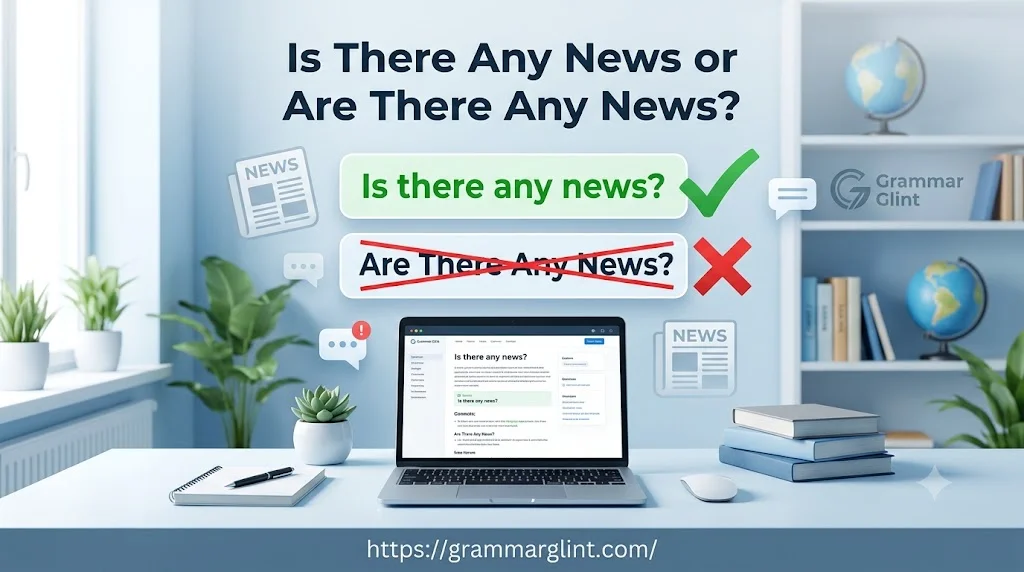
👉 The correct form is: “Is there any news?”
❌ “Are there any news?” is incorrect in standard English.
Why? Because “news” is an uncountable noun, even though it ends in “-s.”
Think of it like water or information. You don’t say “waters” or “informations.” You treat it as a single mass.
So even though “news” looks plural, grammar treats it as singular.
Understanding “News” in English Grammar
The confusion starts with appearance. “News” looks plural. That final “s” tricks your brain.
But here’s the truth:
- News = uncountable noun
- It refers to information in general
- Not individual items you can count
Similar uncountable nouns include:
- Information
- Advice
- Furniture
- Luggage
- Equipment
You wouldn’t say:
- ❌ “These informations are helpful”
- ✔️ “This information is helpful”
Same logic applies to “news.”
Why We Say “Is There Any News?”
Let’s break it down simply.
The sentence has two parts:
- “Is there” → singular verb form
- “any news” → uncountable noun phrase
So the structure stays singular.
Example breakdown:
| Sentence Part | Role | Explanation |
| Is there | Verb phrase (singular) | Refers to existence of something |
| any news | Uncountable noun | Treated as one whole concept |
So together, it becomes:
👉 “Is there any news?”
It works the same way as:
- Is there any water?
- Is there any information?
- Is there any progress?
Why “Are There Any News” Sounds Wrong
Now let’s talk about why the incorrect version feels off to native speakers.
When someone says:
❌ “Are there any news?”
A native speaker immediately notices a mismatch.
Here’s why it fails:
- “Are there” expects a plural noun
- But “news” is not plural
- So the sentence breaks grammatical agreement
It’s like trying to match puzzle pieces that don’t fit.
Even if the meaning is understandable, it still sounds unnatural.
Real-Life Usage Examples You Can Actually Use
Let’s make this practical. Here’s how native speakers naturally use it.
Everyday conversations
- “Is there any news about your interview?”
- “Is there any news from the doctor?”
- “Is there any news on the package delivery?”
Workplace communication
- “Is there any news on the project deadline?”
- “Is there any news from the client?”
- “Is there any news regarding the report?”
Casual texting
- “Hey, is there any news?”
- “Any news yet?”
- “Let me know if there’s any news.”
Correct vs Incorrect Usage Table
| Incorrect ❌ | Correct ✔️ | Why |
| Are there any news? | Is there any news? | “News” is uncountable |
| These news are good | This news is good | No plural form |
| A news is coming | A piece of news is coming | “News” cannot take “a” |
Common Grammar Traps
“News” creates a few sneaky traps that confuse learners.
“Good news” vs “Bad news”
- ✔️ The good news is that you passed.
- ✔️ The bad news is the delay continues.
Even when describing multiple items, we still treat “news” as singular.
Making “news” countable (yes, it’s possible)
If you really want to count it, you must change the structure:
- ✔️ A piece of news
- ✔️ Two pieces of news
- ✔️ Several news items (formal contexts only)
Example:
- “I have two pieces of news for you.”
Read More: People Who vs People That: Correct Usage Explained
“Latest news are…” (common mistake)
Wrong:
- ❌ The latest news are shocking
Correct:
- ✔️ The latest news is shocking
Why? Because “news” stays uncountable even when modified.
Regional Differences: US vs UK English
Good news here, both American and British English agree on this rule.
Both use:
- ✔️ “Is there any news?”
No major regional variation exists in formal grammar.
However, in casual speech:
- British English sometimes shortens it to “Any news?”
- American English does the same in informal contexts
But the verb agreement rule never changes.
Easy Memory Tricks to Avoid Mistakes
Here’s how to lock this into your memory fast.
Trick 1: Replace “news” with “information”
If the sentence works with “information,” it works with “news.”
- Is there any information? ✔️
- Is there any news? ✔️
Trick 2: Think of “news” as a liquid
Imagine it like water flowing.
You don’t count drops unless necessary. You just say “water.”
Same idea:
- You don’t count “news”
- You just refer to it as a whole
Trick 3: One golden sentence
Memorize this:
👉 “Is there any news?”
Say it often enough, and it becomes automatic.
Case Study: Real-World Usage in Communication
Let’s look at how this plays out in real communication.
Scenario: Office update email
Incorrect version:
Are there any news about the project deadline?
This looks unprofessional and grammatically weak.
Correct version:
Is there any news about the project deadline?
Impact:
- The correct form sounds polished
- It improves clarity and professionalism
- It avoids distracting grammar errors
Even small mistakes like this can affect tone in formal writing.
Why This Mistake Is So Common
This confusion usually comes from three things:
1. The “s” ending
People assume every word ending in “s” is plural.
2. Translation from other languages
Many languages treat “news” differently.
3. Spoken English shortcuts
In fast speech, grammar rules feel less obvious.
But once you understand the structure, it becomes easy.
My Personal Experience as an English Language Specialist
As an English language specialist, I have noticed that “Is there any news?” versus “Are there any news?” is one of the grammar questions learners ask surprisingly often. Most people assume that because news ends with the letter -s, it must be plural. During my experience teaching English and reviewing written content, I have found that this mistake usually comes from relying on the appearance of a word instead of understanding its grammatical function.
I always encourage learners to focus on how a noun behaves in a sentence rather than how it looks. Once they understand that news is an uncountable singular noun, just like information, advice, or furniture, the confusion disappears. I have seen students gain confidence in their speaking and writing simply by mastering this small grammar rule. In my experience, remembering the logic behind subject-verb agreement is much more effective than memorizing isolated phrases, and it helps learners avoid similar mistakes in many other areas of English grammar.
FAQs
1. Is “Is there any news?” grammatically correct?
Yes, “Is there any news?” is grammatically correct because news is an uncountable noun and takes a singular verb.
2. Why is “Are there any news?” incorrect?
“Are there any news?” is incorrect because news does not have a plural form in English. It always works as a singular noun.
3. Is news a singular or plural word?
News is a singular word in grammar. Although it refers to information or updates, it is treated as one uncountable idea.
4. Can we say “a news” or “two news”?
No, we cannot use news with numbers because it is an uncountable noun. We can say “a piece of news” or “two pieces of news.”
5. What type of noun is news?
News is an uncountable noun. It follows singular grammar rules and does not change into a plural form.
6. Which phrase should I use in daily English?
The correct phrase is “Is there any news?” This is the commonly used construction in normal communication.
7. Does news always take “is” instead of “are”?
Yes, news takes “is” because it follows a subject verb agreement rule where the subject is singular.
8. Why do people confuse is there any news and are there any news?
People often get confused because the meaning of news suggests multiple updates, but its grammatical form remains singular.
9. Is “news” an irregular noun?
Yes, news can be considered confusing because it behaves differently from many regular nouns and does not follow normal plurality patterns.
10. How can I remember the correct usage?
Remember that news is treated as one idea, so use “is there any news” instead of “are there any news.”
Conclusion
Understanding the difference between “Is there any news?” and “Are there any news?” is easier once you know that news is an uncountable singular noun. Even though the word ends with -s, it always takes a singular verb. That is why “Is there any news?” is the correct form, while “Are there any news?” is not grammatically correct. Learning this rule will help you speak and write English with greater accuracy.
Whenever you ask about updates, reports, or information, remember that news is treated as one whole idea rather than several separate items. By keeping subject-verb agreement in mind and recognizing common uncountable nouns, you can avoid this mistake with confidence. With regular practice, using the correct phrase will soon become natural in everyday conversations and writing.

Aria Jane is a senior language writer and grammar specialist at Grammar Glint. She focuses on English grammar, spelling variations, vocabulary, and writing clarity. Through detailed research and practical examples, Aria helps readers understand language rules and avoid common mistakes. Her articles are designed to make English learning accessible for students, professionals, and everyday writers seeking reliable language guidance.