When talking about things that exist inside an app itself, the correct expression is usually “In the App or On the App.” Many learners have questions about which phrase sounds natural in everyday language. The correct choice depends on grammar, usage, and the meaning a speaker wants to share. The phrase “in the app” is commonly used because it refers to something that is located within the app environment.
The preposition in helps show location and explains where something exists. When a user discusses features, content, tools, or functions available inside an application, this context makes the meaning clear. The digital technology experience of a mobile app includes different parts that work together, such as an interface, system, and other elements that are found within the application.
The choice between in and on creates a common comparison in online software, platforms, and website discussions. The phrase “on the app” may sound awkward or strange in many situations because on is more often connected with websites, online services, and external platforms. Understanding this difference improves language skills and helps users choose the right phrase in a sentence.
Some people may think these expressions are interchangeable, but there is a clear distinction in position, location, and meaning. The rules of prepositions help explain why in the app is the preferred expression when describing accounts, features that were recently added, or information that was discovered within a system. Proper word choice creates better communication and makes the explanation easier to understand.
Quick Answer First
Let’s cut straight to it.
In most cases, “in the app” is correct.
You use it when you’re talking about something inside a digital application—menus, features, settings, messages, or content.
“On the app” is less standard.
You’ll still hear it in casual speech, but it usually sounds informal or slightly off in formal writing.
Here’s the simple rule:
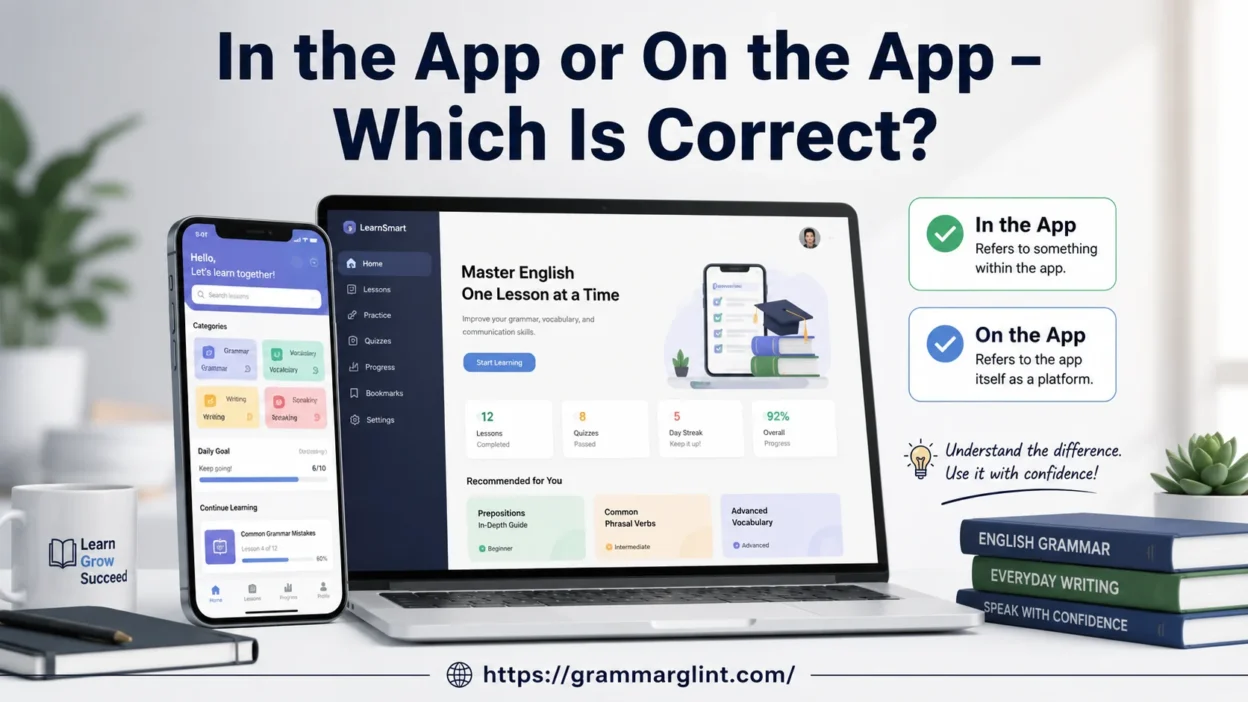
- In the app = inside the app (correct for most situations)
- On the app = using or being active on the platform (casual usage only)
That’s the core difference. Everything else builds from this idea.
What “In the App” Actually Means
When someone says “in the app,” they treat the app like a container.
Think of it like a room. You go inside it, You move around inside it, You interact with things inside it.
So when you say:
- “You’ll find that feature in the app.”
- “The update is available in the app settings.”
- “I saw your message in the app.”
You’re describing something located inside the digital environment.
Why this feels natural in English
English speakers often describe digital spaces as containers:
- in a folder
- in a document
- in a game
- in an app
It’s a mental model thing. You imagine yourself stepping inside the interface.
That’s why “in the app” dominates written English, especially in:
- UX writing
- technical documentation
- help guides
- product instructions
It just sounds clean and precise.
What “On the App” Really Means
Now let’s talk about the tricky one.
“On the app” is not completely wrong, but it behaves differently.
People usually use it when they mean:
- “I am using the app”
- “I am active on the platform”
So someone might say:
- “I’m on the app right now.”
- “She’s always on the app.”
This usage treats the app like a platform or surface, not a container.
Why it sounds different
“On” suggests a surface, like:
- on a website
- on Instagram
- on YouTube
That’s why social media platforms often sound natural with “on.”
But with apps, especially functional ones like banking or maps, “in the app” sounds more precise.
So “on the app” works more like spoken slang than formal grammar.
The Real Grammar Logic
Let’s simplify the logic behind both phrases.
English doesn’t follow strict rules for digital spaces. Instead, it uses metaphor-based thinking.
We mentally categorize digital things as:
- Containers → use “in”
- Platforms or surfaces → use “on”
Quick breakdown:
| Phrase | Mental Model | Meaning |
| in the app | container | inside features, menus, content |
| on the app | platform | using or being active |
This is why grammar guides don’t always agree. Language evolves based on how people think, not just rules.
Why “In the App” Feels More Professional
If you look at real-world usage in product writing, you’ll notice something consistent.
Tech companies almost always prefer:
- “in the app settings”
- “find it in the app”
- “available in the app”
They avoid “on the app” in formal documentation.
Why?
Because clarity matters.
“In the app” removes confusion. It tells users exactly where to look.
Compare these:
- ❌ “Change your password on the app settings”
- ✅ “Change your password in the app settings”
One feels vague. The other feels precise.
Read More: M vs MM: What Is the Correct Abbreviation for Million? Explained
When “On the App” Still Works Naturally
Even though “in the app” wins most of the time, “on the app” still shows up in real life.
Here are the main situations:
Casual conversation
People often say:
- “I was on the app all night.”
- “She’s on the app again.”
This simply means someone is spending time using the app.
Social media habits
You’ll hear “on the app” more with platforms like:
- TikTok
- Snapchat
Because users think of them as places they visit, not systems they navigate.
Spoken English vs written English
Spoken language is looser. People don’t pause to choose perfect grammar.
Written language is more structured. That’s why “in the app” dominates formal contexts.
The Core Grammar Rule Behind It All
Let’s break it into a simple rule you can actually remember:
Think of “in” when:
- You’re describing location inside the app
- You’re talking about features
- You’re giving instructions
Think of “on” when:
- You’re describing usage or activity
- You’re speaking casually
- You’re referring to social presence
Simple memory trick:
- In = inside the system
- On = using the system
That one idea solves 90% of confusion.
Real-World Examples
Let’s make this even clearer with practical examples.
Messaging apps
- “Your message is in the app.”
- “I’m on the app chatting right now.”
Navigation apps
- “Find directions in the app.”
- “I’m on the app trying to locate it.”
Streaming apps
- “Watch it in the app.”
- “We’re on the app watching a movie.”
Banking apps
- “Check your balance in the app.”
- ❌ “Check your balance on the app” (sounds unnatural here)
Key takeaway
Functional apps strongly prefer in the app.
Social or conversational contexts tolerate on the app.
Common Mistakes People Make
Even fluent English speakers slip up here. Let’s fix the most common mistakes.
Mixing both prepositions randomly
- ❌ “I saw it on the app settings”
- ❌ “It’s in the app right now I’m on it”
Copying spoken language into formal writing
People often write how they speak. That creates inconsistency.
Overusing “on the app” in instructions
This makes writing feel less precise.
Ignoring context
The biggest mistake is using one rule for everything. Context always matters.
Case Study: How UX Writing Teams Handle This
Let’s look at how real product teams think.
UX writers at major tech companies follow one principle:
“Users should never stop to interpret grammar.”
So they choose clarity over variation.
What they typically do:
- Use “in the app” for instructions
- Avoid ambiguity in onboarding flows
- Keep terminology consistent across screens
Example from UX style thinking:
Instead of writing:
- “Go on the app and update your profile”
They write:
- “Open the app and update your profile”
Even better:
- “Update your profile in the app”
This removes confusion completely.
Why this matters
Small wording choices affect user experience. One unclear phrase can slow someone down or create frustration.
Quick Comparison Table
| Factor | In the App | On the App |
| Formal writing | Strongly preferred | Not preferred |
| Casual speech | Acceptable | Very common |
| UX writing | Standard choice | Rare |
| Clarity | High | Medium |
| Naturalness in instructions | High | Low |
Memory Trick That Actually Works
Here’s a simple way to lock it in your mind:
Imagine your app is a house.
- You don’t stand on the house to find your keys.
- You go in the house.
Same idea.
- You find features in the app
- You spend time on the app
That mental picture sticks better than any grammar rule.
My Personal Experience as an English Language Specialist
As an English language specialist, I’ve noticed that “in the app” versus “on the app” is one of those questions that seems simple but often confuses learners. Students frequently assume both expressions mean exactly the same thing because they hear native speakers use both in everyday conversations. However, after analyzing real-world English usage across grammar references, product documentation, and everyday communication, I’ve found that the choice depends on the context rather than a fixed rule.
I’ve also observed that many technology companies consistently write phrases such as “Find it in the app,” “Update your settings in the app,” or “The feature is available in the app.” This consistent usage reinforces that “in the app” is the preferred choice in professional writing, user guides, and software documentation because it clearly describes something located within the application.
At the same time, I remind learners not to assume that “on the app” is always incorrect. In casual conversations, native speakers often say things like “I’m on the app right now” or “She’s been on the app all day.” In these situations, the focus isn’t on something inside the application but rather on the activity of using the platform. Understanding this distinction helps learners sound more natural while still using grammatically appropriate English.
My advice is simple: whenever you’re referring to features, settings, content, messages, or anything located within an application, choose “in the app.” If you’re talking about someone’s activity or presence while using an app, “on the app” may sound natural in informal speech. Keeping this distinction in mind will make your English clearer, more accurate, and more natural.
FAQs
1. What is the correct phrase, “in the app” or “on the app”?
The correct phrase is “in the app” because it describes something located inside the application environment.
2. Why do we use “in” instead of “on” for apps?
We use “in” because it shows internal location, meaning something exists within the app itself.
3. Is “on the app” ever correct?
In most cases, “on the app” is considered less correct and sounds unnatural when referring to app content or features.
4. Can “in the app” and “on the app” be interchangeable?
No, they are not fully interchangeable because they follow different preposition rules and meanings.
5. Why does “on the app” sound awkward?
It sounds awkward because “on” is mainly used for websites or external platforms, not internal app content.
6. What does “in the app” refer to?
It refers to features, tools, content, and functions that exist inside a mobile app or application.
7. Is this rule part of English grammar?
Yes, it is related to grammar, especially the correct use of prepositions in different contexts.
8. Does this rule apply to all digital platforms?
Mostly yes, but usage may vary depending on whether you are talking about internal or external systems.
9. Why is understanding this difference important?
It improves language usage and helps choose the correct phrase in a sentence.
10. What is the main idea behind this topic?
The main idea is understanding the correct expression for describing location inside digital apps.
Conclusion
The difference between “in the app” and “on the app” comes down to correct preposition usage and clear meaning in grammar. Since an app is an internal system filled with features, content, tools, and functions, the phrase “in the app” correctly shows internal location and usage. This makes communication clearer in modern digital technology contexts.
Understanding this simple language rule helps avoid confusion in everyday usage, especially when discussing mobile apps, software, and online platforms. Choosing the correct expression improves clarity, strengthens writing, and ensures proper sentence structure in both casual and professional communication.

Aria Jane is a senior language writer and grammar specialist at Grammar Glint. She focuses on English grammar, spelling variations, vocabulary, and writing clarity. Through detailed research and practical examples, Aria helps readers understand language rules and avoid common mistakes. Her articles are designed to make English learning accessible for students, professionals, and everyday writers seeking reliable language guidance.