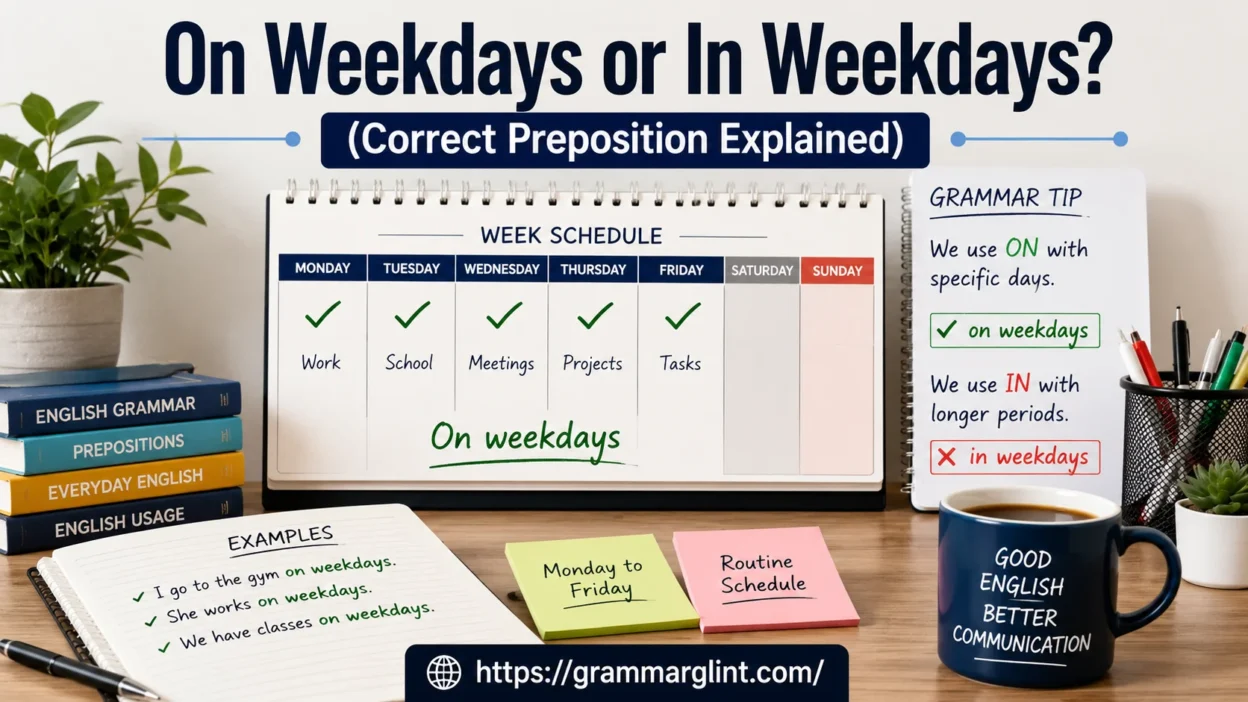
When talking about a Monday-to-Friday routine, many people become unsure whether to use in weekdays or on weekdays when referring to these days. This is a common question in English because small changes in prepositions can affect the meaning of a sentence. The correct phrase is on weekdays because it describes things that happen regularly during the week.
On Weekdays or In Weekdays? explains why this standard English usage matters in everyday communication. When people discuss a regular schedule, such as going to work or school, they usually refer to activities that happen from Monday to Friday. Using the correct phrase makes the sentence clearer and helps avoid an incorrect construction.
Prepositions can be confusing because different prepositions have different uses depending on the unit of time itself. Some expressions use specific forms based on whether someone is talking about a date, a day, or a longer time period. In this context, on is the suitable choice for specific days like weekdays.
This article will answer questions like Is It on weekdays or in weekdays and explain the grammar, expression, usage, context, and meaning behind these phrases. Saying in weekdays sounds odd because this phrase is not normally used in English.
Keep in mind that any task or activity that happens from Monday to Friday usually takes on weekdays. A precise date or given day follows the same pattern, making on the correct and natural option for everyday English.
The Correct Phrase
The phrase “on weekdays” is the standard and natural expression used in English.
It means during the days from Monday to Friday, usually referring to a routine, habit, schedule, or repeated activity.
When someone says:
“I go to work on weekdays.”
They mean they go to work regularly from Monday through Friday.
The phrase does not point to one specific day. Instead, it describes a repeated pattern.
Examples of “On Weekdays” in Daily English
Here are common examples:
- I wake up early on weekdays.
- She takes the bus on weekdays.
- The library is quieter on weekdays.
- Many people work from home on weekdays.
- Restaurants are usually less crowded on weekdays.
Notice how each sentence talks about a regular activity.
The phrase works because weekdays are treated as individual days in a schedule.
Why Do We Use “On” With Weekdays?
The reason comes from a basic English preposition rule:
Use “on” for days and dates.
English uses on when talking about specific points on a calendar.
Examples:
| Correct Expression | Meaning |
| on Monday | a specific day |
| on Friday | a specific day |
| on my birthday | a specific occasion |
| on weekdays | repeated days in a schedule |
| on weekends | repeated weekend days |
Think of a calendar. Days appear as separate boxes. English connects those boxes with on.
You are not inside a day. You are referring to a day on the calendar.
That is why:
- ✅ on Tuesday
- ✅ on weekdays
- ❌ in Tuesday
- ❌ in weekdays
Why “In Weekdays” Sounds Wrong
The phrase “in weekdays” is a common mistake because learners often translate directly from their first language.
However, English does not usually use in for days.
The word in normally describes longer periods.
Examples:
- in January
- in 2026
- in summer
- in the morning
- in the future
These are larger time frames.
A weekday, however, is a day-based idea.
Compare:
| Preposition | Used For | Examples |
| on | Days and dates | on Monday, on weekdays |
| in | Months, years, longer periods | in July, in 2026 |
| at | Exact times | at 5 PM |
So this sentence:
I exercise in weekdays.
sounds unnatural.
The better version:
I exercise on weekdays.
What Is the Difference?
Another common source of confusion is choosing between weekday and weekdays.
The difference is simple.
Weekday (Singular)
A weekday means one working day.
Usually, it refers to one day from Monday through Friday.
Examples:
- Monday is a weekday.
- Tuesday is my busiest weekday.
- I have a weekday schedule.
Here, you are talking about one day.
Read More: In the Books vs On the Books: Meaning, Difference Explained
Weekdays (Plural)
Weekdays means multiple working days or the general Monday-to-Friday period.
Examples:
- I work on weekdays.
- Weekdays are usually busy.
- Traffic is heavier on weekdays.
Here, you are talking about a group of days.
Quick Comparison
| Word | Meaning | Example |
| weekday | One working day | Friday is a weekday |
| weekdays | Monday through Friday generally | I work on weekdays |
A useful trick:
If you can replace the word with “Monday through Friday,” use weekdays.
Example:
“I work on Monday through Friday.”
That becomes:
“I work on weekdays.”
“On Weekdays” vs. “During the Week”
These expressions are similar, but they are not exactly the same.
On Weekdays
This specifically means Monday through Friday.
Example:
I exercise on weekdays.
This means:
I exercise Monday, Tuesday, Wednesday, Thursday, and Friday.
During the Week
This means sometime within the week.
It may include weekdays but focuses on the whole week as a period.
Examples:
- I usually finish my projects during the week.
- I answer emails during the week.
The difference is small but important.
Look at this comparison:
| Phrase | Meaning | Example |
| on weekdays | Monday–Friday routine | I work on weekdays |
| during the week | anytime within the week | I shop during the week |
If you are talking about a normal work or school schedule, on weekdays is usually the better choice.
“On Weekdays” vs. “On the Weekdays”
Many learners also ask whether they should say:
- on weekdays
- on the weekdays
Both can appear in English, but they have different uses.
“On Weekdays”
This is the normal choice for habits.
Example:
I drink coffee on weekdays.
It means this happens regularly.
“On the Weekdays”
This sounds more specific.
Example:
The meetings happen on the weekdays when everyone is available.
Here, the speaker refers to particular weekdays already understood from context.
In everyday English, most people simply say “on weekdays.”
Common Mistakes With Weekday Prepositions
Small preposition errors can make otherwise good English sound unnatural.
Here are the mistakes learners make most often.
Using “In Weekdays”
Incorrect:
I study in weekdays.
Correct:
I study on weekdays.
The problem is the preposition.
Using “At Weekdays”
Incorrect:
The office opens at weekdays.
Correct:
The office opens on weekdays.
“At” is usually used for exact times.
Examples:
- at 8 AM
- at noon
- at midnight
Not for days.
Forgetting “On” Before Days
Incorrect:
I visit my friend Monday.
Correct:
I visit my friend on Monday.
In informal speech, native speakers sometimes drop words in casual situations, but standard writing uses on.
Useful Time Prepositions in English
Understanding weekday phrases becomes easier when you learn the bigger pattern.
Use “On” for Days
Examples:
- on Monday
- on Friday
- on weekdays
- on weekends
- on New Year’s Day
Use “In” for Longer Periods
Examples:
- in March
- in 2026
- in winter
- in the morning
Use “At” for Exact Times
Examples:
- at 7 PM
- at noon
- at midnight
A simple memory trick:
Days → On
Long periods → In
Exact times → At
American English and British English Usage
Both American and British English speakers use:
on weekdays
The rule stays the same across both varieties.
Examples:
American English:
I work on weekdays.
British English:
I work on weekdays.
There may be small differences in vocabulary between regions, but this preposition does not change.
Real-Life Examples of “On Weekdays”
The phrase appears everywhere because people often talk about routines.
Work Examples
- The office is open on weekdays.
- Employees attend meetings on weekdays.
- Customer support operates on weekdays.
School Examples
- Students have classes on weekdays.
- Teachers prepare lessons on weekdays.
- Libraries are busy on weekdays.
Travel Examples
- Flights are often cheaper on weekdays.
- Roads are less crowded on weekdays.
- Hotels may have better rates on weekdays.
Personal Routine Examples
- I exercise on weekdays.
- She cooks on weekdays.
- They watch movies on weekends.
Practice: Choose the Correct Option
Test yourself.
Question One
I go running ___ weekdays.
- a) in
- b) on
Correct answer: on
I go running on weekdays.
Question Two
The meeting is ___ Monday.
- a) on
- b) in
Correct answer: on
The meeting is on Monday.
Question Three
My vacation starts ___ July.
- a) on
- b) in
Correct answer: in
My vacation starts in July.
A Simple Way to Remember the Rule
English time expressions follow patterns.
You do not need to memorize every sentence separately.
Remember:
If it is a day, use “on.”
Examples:
- on Monday
- on Tuesday
- on weekdays
- on weekends
If it is a month, year, or season, use “in.”
Examples:
- in June
- in 2026
- in summer
If it is a specific time, use “at.”
Examples:
- at 6 PM
- at midnight
Once this pattern becomes familiar, weekday mistakes become much easier to avoid.
My Personal Experience as an English Language Specialist
As an English language specialist, I have often noticed that learners struggle with small grammar differences, especially when choosing the correct prepositions for time expressions. During my teaching experience, many students have asked whether they should say “on weekdays” or “in weekdays.” I explain that “on weekdays” is the correct and natural expression because English uses “on” with days and dates. By connecting grammar rules with everyday examples like “I work on weekdays” or “I study on weekdays,” I help learners understand how native speakers use these expressions naturally.
Throughout my language teaching journey, I have learned that simple explanations and practical examples make grammar easier to remember. I have seen students improve their confidence when they understand the reason behind a rule instead of only memorizing it. The difference between “on weekdays” and “in weekdays” may seem small, but using the correct preposition helps learners communicate more clearly and sound more fluent in English.
FAQs
1. What is the correct phrase, on weekdays or in weekdays?
The correct phrase is on weekdays. It is used when referring to activities, routines, or events that happen during the days from Monday to Friday.
2. Is in weekdays grammatically correct?
No, in weekdays is not a common or standard English expression. Native speakers usually use on weekdays for regular weekday activities.
3. Why do we use on with weekdays?
The preposition on is used for specific days and dates. Since weekdays refer to particular days of the week, on weekdays is the natural choice.
4. Can on weekdays be used for work and school schedules?
Yes, on weekdays is commonly used for regular schedules such as going to work, attending school, or completing daily activities.
5. What does on weekdays mean?
On weekdays means something happens regularly during the working days of the week, usually from Monday through Friday.
6. Is weekdays a singular or plural word?
Weekdays is the plural form and refers to multiple days, usually the five working days of the week.
7. What is the difference between on weekdays and on a weekday?
On weekdays refers to repeated activities across multiple days, while on a weekday refers to one specific day.
8. Can we say in the weekdays?
No, in the weekdays is also not commonly used. The correct expression is on weekdays.
9. How can I remember the correct phrase?
Remember that on is used with days, so phrases like on Monday, on Friday, and on weekdays follow the same grammar rule.
10. Is on weekdays used in formal English?
Yes, on weekdays is acceptable in both everyday communication and formal writing when describing regular events or schedules.
Conclusion
Choosing between “on weekdays” and “in weekdays” is simple once you understand how English prepositions work. On weekdays is the correct and widely accepted expression because on is used with specific days and recurring days of the week. In contrast, in weekdays is not natural English and should be avoided in both speaking and writing.
Whenever you describe a routine that happens from Monday to Friday, remember to use on weekdays. Using the correct preposition makes your sentences sound more fluent, accurate, and natural. With regular practice and exposure to everyday English, you’ll find it much easier to choose the right preposition in different time expressions.

Aria Jane is a senior language writer and grammar specialist at Grammar Glint. She focuses on English grammar, spelling variations, vocabulary, and writing clarity. Through detailed research and practical examples, Aria helps readers understand language rules and avoid common mistakes. Her articles are designed to make English learning accessible for students, professionals, and everyday writers seeking reliable language guidance.