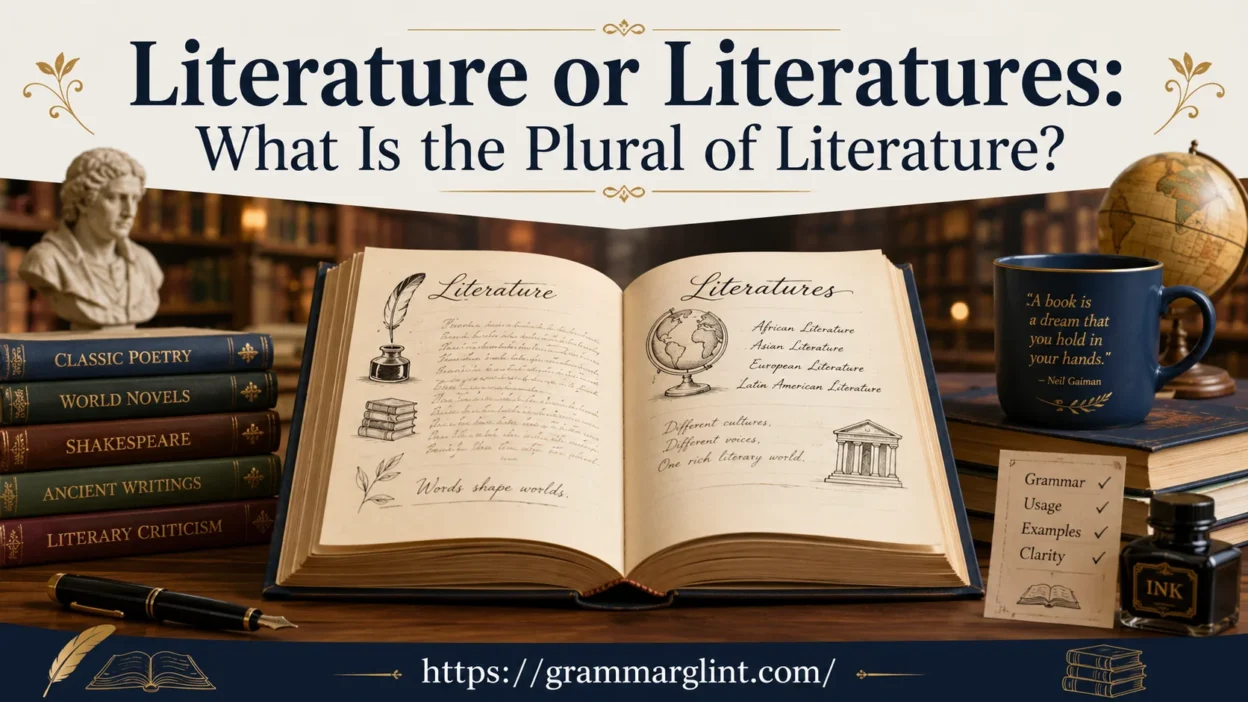
The article Literature or Literatures: What Is the Plural of Literature? explains the plural form and common usage of this important English word with clear examples. Many learners and writers often wonder about the difference between literature and literatures because both forms may appear in different situations. Understanding the correct usage helps improve writing, communication, and the overall understanding of language.
When discussing Literature, many people wonder about the correct form to use in different contexts. In general and commonly used situations, the word usually keeps its original spelling and remains “literature.” The term is often used as an uncountable noun because it describes a broad field of written works, ideas, and creative expression. The literature field is connected with knowledge acquired through reading, studying, books, letters, and other forms of written work.
In many cases, the singular form is the more natural choice because it refers to literature as a whole subject or collection of written material. From my experience with English learning and writing, I have noticed that people frequently use “literature” when they talk about academic studies, historical works, or creative texts. Although both correct options may exist, the meaning depends on the situation and how the speaker wants to present the ide
This article provides a simple review of the distinction through easy examples, showing how each sentence can change depending on the intended meaning. The term is also useful when discussing separate literary traditions as individual groups rather than a single broad field. Knowing when to use each form makes English expression clearer and more accurate.
What Does Literature Mean?
Before understanding whether literatures is the plural of literature, it helps to understand what the word actually means.
Literature generally refers to written or spoken works that have artistic, cultural, intellectual, or imaginative value. It includes many forms of expression created to communicate ideas, emotions, stories, and human experiences.
Common examples of literature include:
- Novels
- Poetry
- Short stories
- Drama and plays
- Essays
- Folktales
- Epic stories
- Biographies
- Creative nonfiction
For example:
“Shakespeare’s plays are an important part of English literature.”
This sentence does not mean one single book or one specific work. It refers to a larger tradition of writing.
Literature can also refer to written information about a particular subject. This meaning appears often in academic and scientific contexts.
Examples:
- “Scientists reviewed the existing medical literature.”
- “The research literature discusses climate change.”
- “The literature on artificial intelligence has expanded rapidly.”
Here, literature means a collection of published information.
The Different Meanings of Literature
The word literature changes slightly depending on context. Understanding these meanings makes the plural question much easier.
| Meaning | Explanation | Example |
| Creative writing | Artistic written works | “Classic literature shapes modern storytelling.” |
| Field of study | The academic study of writing | “She studies English literature.” |
| Research information | Published studies and documents | “The scientific literature supports this theory.” |
| A body of works | A collection of writings | “The literature of the Renaissance influenced Europe.” |
Because the word has several meanings, writers sometimes become unsure about whether it should have a plural form.
Is It Singular or Plural?
The word literature is grammatically singular.
Even though literature includes many books, poems, and stories, English usually treats it as one overall concept.
You can think of it like words such as:
- Music
- Art
- Knowledge
- Information
- Education
These words describe broad ideas rather than separate countable objects.
For example:
✅ “Literature is important for understanding history.”
❌ “Literature are important for understanding history.”
The first sentence is correct because literature takes a singular verb.
The confusion happens because people think:
“Books are many, so literature must be plural.”
But English does not always work that way. A category containing many things can still use a singular form.
A forest contains thousands of trees, but you still say:
“The forest is beautiful.”
You do not say:
“The forest are beautiful.”
The same idea applies to literature.
Why Does It Feel Like It Should Have a Plural Form?
The confusion comes from the fact that literature represents many individual works.
A library contains:
- novels
- poems
- plays
- essays
Yet we group all these works under one larger idea: literature.
Think of literature as a large umbrella. Under that umbrella, many different forms of writing exist.
For example:
Literature
- Poetry
- Fiction
- Drama
- Essays
- Oral traditions
The umbrella itself is singular, even though everything underneath it is diverse.
This is why native speakers usually say:
- “I enjoy literature.”
- “She studies literature.”
- “Literature influences society.”
They usually do not say:
- “I enjoy literatures.”
Is “Literatures” a Real Word?
Yes, literatures is a real word.
However, it does not work as a simple plural meaning “many books.”
This is where many writers make mistakes.
Adding -s changes the meaning. It usually refers to multiple literary traditions, systems, or bodies of writing.
For example:
“The course explores African and Asian literatures.”
Here, literatures refers to separate literary traditions from different regions.
African literature has its own history, themes, languages, and cultural influences. Asian literature includes many different traditions from countries and communities across Asia.
The writer is not talking about individual books. They are comparing different literary worlds.
When Should You Use It?
Use literatures when discussing distinct categories of writing.
Common situations include:
Comparing Cultural Traditions
Example:
“Students compare European and American literatures.”
This means students study different literary traditions.
Discussing National Literature
Example:
“World literatures reveal different perspectives on human experience.”
The plural highlights diversity.
Talking About Multiple Academic Fields
Example:
“The research examines medical and social science literatures.”
Here, each field has its own collection of published works.
Read More: Throughout The Years vs. Over The Years: A complete Guide
When Should You Avoid It?
In normal conversation, literatures often sounds unnatural.
For example:
❌ “I read many literatures.”
A native speaker would usually say:
✅ “I read many books.”
or:
✅ “I read many works of literature.”
The problem is that literatures does not simply mean “multiple pieces of literature.”
It refers to separate bodies of writing.
A person who reads ten novels is not necessarily reading “ten literatures.”
They are reading ten literary works.
The Main Difference
The easiest way to understand the difference is this:
Literature = the overall concept or one body of writing
Literatures = multiple distinct literary traditions or collections
| Word | Meaning | Example |
| Literature | Writing as an art form or general field | “Literature reflects human experiences.” |
| Literature | A specific tradition or collection | “American literature developed unique themes.” |
| Literatures | Different literary traditions | “African and European literatures have different histories.” |
The difference is not only grammar. It is also meaning.
Common Mistakes
Many learners make predictable mistakes when using these words.
Understanding them helps you write more naturally.
Mistake: Using Literature as a Countable Noun
A common error is saying:
❌ “I bought a literature.”
This sounds incorrect because literature is not usually a countable object.
Better options:
1. ✅ “I bought a book.”
2. ✅ “I bought a work of literature.”
3. ✅ “I bought a literary text.”
The word literature describes the category, not usually one individual item.
Mistake: Using Literatures to Mean Many Books
Another mistake:
❌ “The author wrote many literatures.”
A writer produces:
- books
- novels
- poems
- plays
- essays
They create works of literature, not “literatures.”
Better:
✅ “The author wrote many works of literature.”
Mistake: Confusing Literature With All Writing
Not every written document is literature.
For example:
A novel may be literature.
A poem may be literature.
A legal contract usually is not.
A product instruction manual usually is not.
Literature often involves creativity, expression, cultural importance, or artistic purpose.
Examples of Literature Used Correctly
Here are examples showing how native speakers commonly use the word.
General Meaning
“Literature allows people to explore different perspectives.”
Academic Meaning
“The professor assigned readings from modern literature.”
Research Meaning
“The literature shows several possible explanations.”
Historical Meaning
“Ancient literature provides insight into early civilizations.”
Examples of Literatures Used Correctly
Although literatures is less common than literature, it has a clear purpose in specific contexts.
The plural form usually appears when writers want to highlight differences between separate traditions or collections.
Comparing Regions and Cultures
Example:
“The study explores African and European literatures.”
This sentence compares two broad groups of writing.
African literatures may include works written in many languages and shaped by different historical experiences. European literatures include many traditions from countries with different cultures, histories, and literary movements.
The writer uses literatures because the focus is not on literature as one global category. The focus is on separate traditions.
Discussing World Literature
Example:
“World literatures introduce readers to stories from different societies.”
The phrase world literatures recognizes that literature exists in many forms across the globe.
It avoids the idea that one literary tradition represents everyone.
Academic Courses
Universities sometimes use terms like:
- Comparative literatures
- World literatures
- National literatures
These fields examine relationships between different literary traditions.
For example:
A comparative literature class may analyze how themes like love, war, identity, or migration appear in different cultures.
A Simple Rule for Choosing
When deciding between literature and literatures, ask yourself one question:
Am I talking about writing in general or comparing separate traditions?
If you mean writing as a whole:
Use literature.
Example:
“Literature can influence how people understand the world.”
If you mean different groups of writing:
Use literatures.
Example:
“The course compares Asian and African literatures.”
This small check prevents most mistakes.
Is Literature Countable or Uncountable?
The answer depends on meaning.
Most of the time, literature is uncountable.
That means you do not usually count it directly.
You do not say:
❌ “three literatures”
when you mean three books.
Instead, say:
1. ✅ “three books”
2. ✅ “three works of literature”
3. ✅ “three literary texts”
However, in specialized academic contexts, literatures becomes countable because it refers to separate bodies of writing.
For example:
“The researcher compares two national literatures.”
Here, the writer counts two traditions, not two books.
The Difference Between Literature and a Work of Literature
This distinction creates a lot of confusion.
Literature is the larger category.
A work of literature is one individual piece.
Think about animals.
“Animal” is the category.
“A dog” is one example.
The same idea applies:
Literature
- A novel
- A poem
- A play
- An essay
A person can read many works of literature.
They do not usually read many literatures.
In Academic Writing
The word literature appears frequently in academic writing.
Researchers use it to describe existing knowledge about a topic.
You may see phrases like:
- Literature review
- Existing literature
- Academic literature
- Research literature
- Scientific literature
For example:
“The literature review summarizes previous studies.”
This does not mean a review of novels or poetry. It means a review of published research.
The meaning changes depending on the field.
In science, literature may include:
- Research papers
- Studies
- Reports
- Academic articles
In English studies, literature may include:
- Novels
- Poems
- Plays
- Literary criticism
The Role of Literature in Different Fields
The word appears across many disciplines.
| Field | Meaning of Literature |
| English studies | Creative and artistic writing |
| History | Written records and historical texts |
| Science | Published research |
| Law | Legal writings and documents |
| Medicine | Scientific studies and evidence |
This wide use explains why the word can feel confusing.
It does not always mean novels and poems.
Why Scholars Use “Literatures”
The plural form has become more common in academic discussions because scholars recognize that writing traditions are diverse.
For centuries, many discussions focused heavily on famous European literary traditions.
Modern literary studies often examine a wider range of voices.
The term literatures helps emphasize:
- Cultural differences
- Language differences
- Historical contexts
- Regional traditions
For example:
“Literature” suggests one broad field.
“Literatures” suggests many connected but distinct fields.
Case Study: English Literature vs. English Literatures
Consider these two phrases:
English Literature
This usually refers to literature written in English or connected to English literary traditions.
Example:
“She studies English literature.”
This is a common academic subject.
English Literatures
This phrase is less common but may appear when comparing different traditions within English-language writing.
For example:
“The course examines English literatures from different regions.”
This could include writing from:
- Britain
- The United States
- Canada
- Australia
- Other English-speaking communities
The plural highlights variety.
FAQs
1. What is the plural form of literature?
The plural form of literature is usually literature because it is commonly used as an uncountable noun. However, literatures can be used in specific contexts.
2. Is literature a countable or uncountable noun?
Literature can be both a countable and uncountable noun depending on the meaning and context in which it is used.
3. Is the word literatures grammatically correct?
Yes, literatures is grammatically correct when referring to different types, collections, or traditions of literary works.
4. Why is literature usually not changed into a plural form?
Literature often describes a broad subject or field of study, so it commonly stays in its original form without adding “s.”
5. When should I use literatures instead of literature?
Use literatures when talking about separate categories, cultures, languages, or collections of literary works.
6. Are literature and literatures both correct?
Yes, literature and literatures are both correct, but they have different meanings based on the context.
7. Can literature refer to different books and written works?
Yes, literature can refer to books, writings, and creative works as a general collection of knowledge and expression.
8. What does the phrase types of literatures mean?
Types of literatures refers to different literary traditions, categories, or bodies of work from various backgrounds.
9. How can I identify the correct usage of literature?
Look at the meaning of the sentence. If it describes a general field, use literature; if it describes separate groups, literatures may fit.
10. Does the meaning change when using literatures?
Yes, using literatures often emphasizes different literary systems, traditions, or collections rather than literature as one broad concept.
Conclusion
Understanding the difference between literature and literatures is easier once you know the context. In most cases, literature is the correct choice because it refers to writing as a whole or to the field of literary study. The plural form, literatures, is much less common and is mainly used in academic or comparative discussions about separate literary traditions, cultures, or languages.
When you’re unsure which form to use, think about whether you’re referring to one broad body of written work or to multiple distinct literary traditions. Keeping this simple distinction in mind will help you choose the right word, write more naturally, and communicate your ideas with greater accuracy.

Aria Jane is a senior language writer and grammar specialist at Grammar Glint. She focuses on English grammar, spelling variations, vocabulary, and writing clarity. Through detailed research and practical examples, Aria helps readers understand language rules and avoid common mistakes. Her articles are designed to make English learning accessible for students, professionals, and everyday writers seeking reliable language guidance.